
Why Your Immigration Case Needs a Brain Scan Metaphorically
What a Cancellation of Removal Psych Eval Is — and Why It Can Save Your Case

A cancellation of removal psych eval is a clinical assessment conducted by a licensed psychologist to document the emotional, psychological, and developmental harm that deportation would cause to your U.S. citizen or lawful permanent resident (LPR) family members — such as your children, spouse, or parents.
Here is what you need to know at a glance:
| Question | Quick Answer |
|---|---|
| Who is it for? | Your qualifying U.S. citizen or LPR relatives (spouse, child, parent) |
| What does it prove? | "Exceptional and extremely unusual hardship" to those relatives |
| Who conducts it? | A licensed psychologist with immigration forensics experience |
| How long does it take? | 60–90 minute session; report delivered within 14 days (expedited options available) |
| Is telehealth available? | Yes, across most U.S. states in 2026 |
| Is it required by law? | Not always, but strongly recommended by immigration attorneys |
Facing removal from the United States is one of the most stressful experiences a person can go through. For many non-permanent residents in Texas, the fear is not just about themselves — it is about what happens to their children, their spouse, and their family when they are gone.
The legal bar for Cancellation of Removal is high. You must show that your removal would cause exceptional and extremely unusual hardship to a qualifying relative. That is a stricter standard than most other immigration relief options. A well-documented psychological evaluation is often the most powerful tool to meet that standard — and without it, many strong cases fall short.
I'm Francisco Ortiz, Lead Forensic Mental Health Evaluator at District Counseling PLLC, a Certified Forensic Mental Health Evaluator (CFMHE) with advanced training in cancellation of removal psych eval cases, hardship waivers, and immigration forensics, licensed across Texas, California, Florida, Virginia, Utah, and Idaho. In this guide, I'll walk you through everything you need to know to understand the process and build the strongest possible case for your family.
Eligibility and the Hardship Standard (EOIR-42A vs. EOIR-42B)

When we talk about stopping a deportation in immigration court, we are usually looking at two different paths. These are known by their form numbers: EOIR-42A and EOIR-42B. While they sound like robots from a sci-fi movie, they represent the difference between staying with your family or being forced to leave the country you call home.
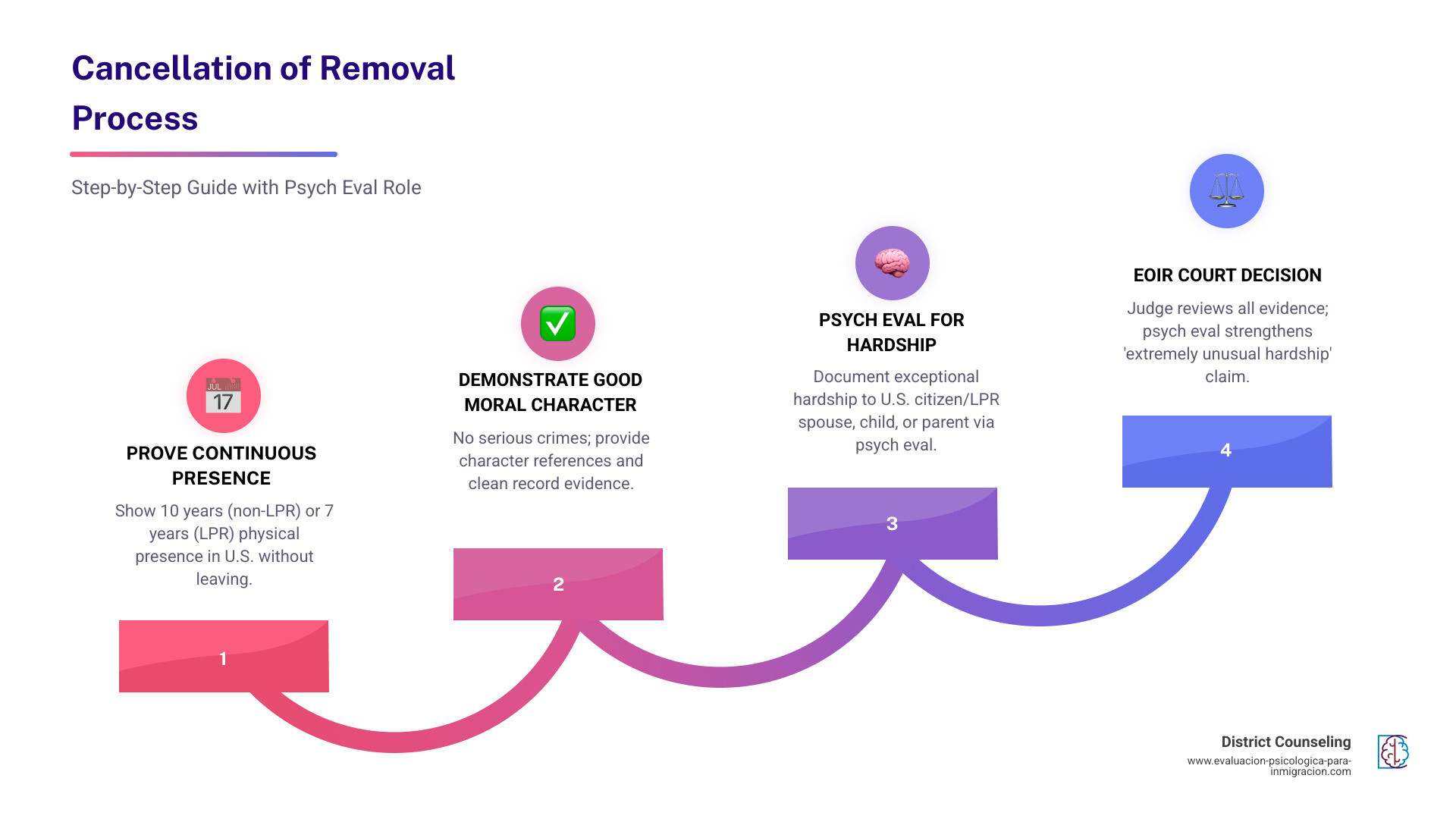
EOIR-42A (For Lawful Permanent Residents): This is for people who already have a "Green Card" but are facing deportation, often due to a criminal conviction. To be eligible in 2026, you generally need to have been an LPR for at least five years and have resided in the U.S. continuously for seven years after being admitted in any status. You also cannot have been convicted of an "aggravated felony."
EOIR-42B (For Non-Lawful Permanent Residents): This is the "10-year rule" case. It is for people who do not have legal status but have built a life here. The requirements are much steeper:
- Continuous Physical Presence: You must have been physically in the U.S. for at least 10 years.
- Good Moral Character: You must prove you have been a person of good moral character during that time.
- No Disqualifying Convictions: Certain crimes will automatically end your eligibility.
- The Hardship Standard: You must prove that your removal would result in "exceptional and extremely unusual hardship" to a qualifying relative.
| Feature | EOIR-42A (LPRs) | EOIR-42B (Non-LPRs) |
|---|---|---|
| U.S. Presence Required | 7 years | 10 years |
| Legal Status Required? | Yes (LPR for 5 years) | No |
| Hardship Target | Not strictly required by statute, but helpful | Qualifying U.S. Citizen/LPR Relative |
| Hardship Standard | Discretionary | Exceptional and Extremely Unusual |
Defining 'Exceptional and Extremely Unusual Hardship'
In immigration law, "hardship" isn't just one thing. If you were applying for a standard waiver (like an I-601), the law asks for "extreme hardship." But for a cancellation of removal psych eval, the law demands something much higher: exceptional and extremely unusual hardship.
What does that actually mean? It means the hardship must be "substantially beyond" what would ordinarily be expected from deportation. Every deportation causes sadness, financial loss, and family separation. To win a Cancellation of Removal case, we have to prove that your family’s situation is unique. Perhaps your child has a developmental disability that would go untreated in your home country, or your spouse has a chronic mental health condition that would spiral into a crisis if you were removed.
We look at this through a "cumulative analysis." This means the judge doesn't just look at one problem; they look at the pile of problems. Financial loss + medical issues + psychological trauma + educational barriers = a case that meets the standard. For a deeper look at how we translate these feelings into a legal format, you can read more about the Evaluacion Psicologica Para Caso De Una Cancelacion De Deportacion.
The Critical Role of a Cancellation of Removal Psych Eval

If an immigration case were a house, the legal arguments are the frame, but the psychological evaluation is the foundation. We often tell our clients at District Counseling that a cancellation of removal psych eval is like a metaphorical "brain scan." It allows the judge to see the invisible wounds and the internal resilience of your family.
In a courtroom, your testimony is important, but it is considered "subjective." A forensic psychological evaluation provides "objective" evidence. We use standardized clinical tools and deep interviewing techniques to map out exactly how a family's mental health will collapse without the applicant. We aren't just saying "they will be sad"; we are documenting clinical diagnoses like Major Depressive Disorder, Generalized Anxiety Disorder, or PTSD.
This evidence is so critical that even the USCIS Policy Manual acknowledges the weight of mental health in various waivers. For instance, when dealing with complex mental health histories, the standards set in Chapter 4 - Waiver of Physical or Mental Disorder Accompanied by Harmful Behavior | USCIS highlight how seriously the government views psychological documentation.
Who Should Receive the Cancellation of Removal Psych Eval?
One of the most common questions we get in Houston and Dallas is: "Do I need the evaluation, or does my wife?"
In an EOIR-42B case, the law focuses on the qualifying relative (the beneficiary), not the applicant (the petitioner). The judge wants to know how they will suffer. Therefore, the evaluation should primarily focus on:
- The Children: How will separation affect their brain development? If they have ADHD or Autism, how will the loss of their primary caregiver affect their progress?
- The Spouse: Does your spouse rely on you for emotional stability? If they have a history of trauma, will your deportation trigger a relapse?
- The Parents: Are you the primary caregiver for an elderly U.S. citizen parent? What happens to their health if you are gone?
While we often interview the applicant to get a full picture of the family history, the "star" of the report is the relative who holds the legal status.
How a Cancellation of Removal Psych Eval Proves Hardship
We use the DSM-5 (the "bible" of psychology) to provide a clear diagnosis. But a diagnosis is only half the battle. We also have to show "functional impact."
For example, if we diagnose a child with Separation Anxiety Disorder, we don't just stop there. We explain to the court that this child will likely stop performing in school, may experience physical illness from stress, and could suffer long-term attachment trauma that affects their ability to function as an adult. We document:
- PTSD and Trauma: Especially if the family has already survived violence or previous separations.
- Developmental Disabilities: Documenting how U.S.-based special education services are irreplaceable.
- Caregiver Dependency: Showing that the qualifying relative is physically or emotionally unable to survive without the applicant's daily presence.
The Evaluation Process: What to Expect in 2026
In 2026, the process is smoother than ever, thanks to technology. At District Counseling, we offer telehealth evaluations across Texas, Florida, California, and several other states. Here is the typical journey:
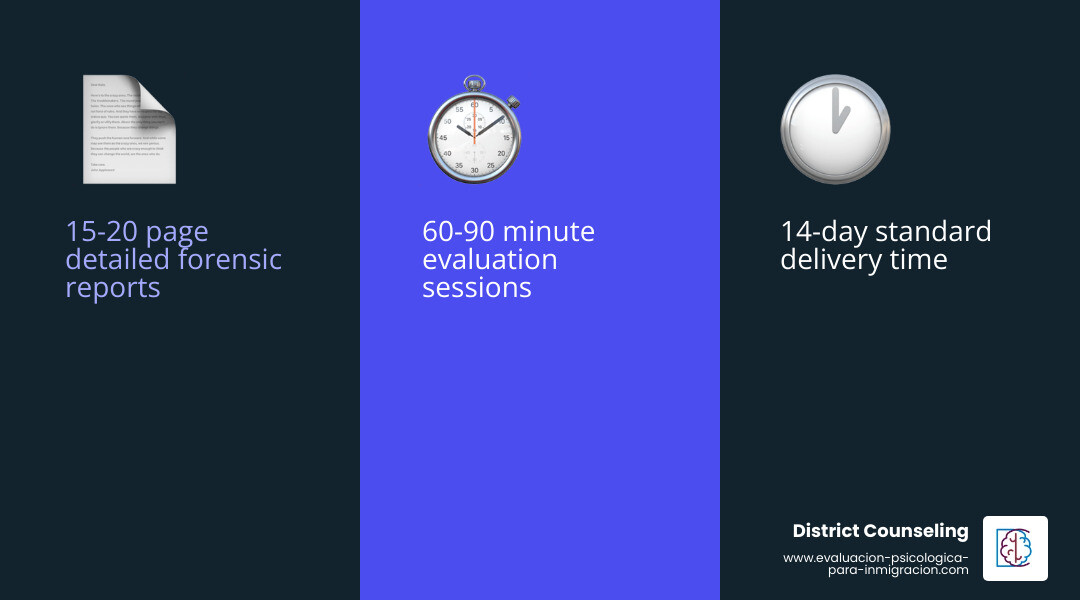
- The Clinical Interview: This usually takes 60 to 90 minutes. We talk about your family history, your life in the U.S., and your fears about the future.
- Standardized Assessments: We use tools like the GAD-7 (for anxiety) and PHQ-9 (for depression) to get measurable data.
- Collateral Review: We look at school records, medical files, and letters from teachers to corroborate what you tell us.
- The Report: We produce a 15–20 page forensic report. This isn't a simple "doctor's note." It is a detailed, evidence-based document designed specifically for an immigration judge.
Navigating Legal Precedents and Medical Documentation
The legal landscape changed significantly with the Board of Immigration Appeals (BIA) decision in Matter of J-J-G- (2020). This case set a very high bar for medical hardship. The BIA ruled that if you are claiming medical hardship, you must prove:
- The relative has a serious medical condition.
- Adequate care for that condition is not reasonably available in the country of removal.
This is where a cancellation of removal psych eval becomes vital. If we are documenting a psychological condition, we must also research the "country conditions." For example, if we are evaluating a family from a region where mental health care is stigmatized or non-existent, we document that. We use data from the World Health Organization (WHO) and the U.S. State Department to show the judge that "going back" isn't just a move — it's a death sentence for the relative’s mental health.
Documenting Psychological Factors for EOIR Standards
To meet EOIR (Executive Office for Immigration Review) standards, your evidence must be "corroborated." This means the judge doesn't have to just take your word for it. Our reports serve as expert testimony. We include:
- Evidence of Ongoing Treatment: If a relative is already in therapy, we document their progress and the risk of regression.
- Rebutting DHS Arguments: Government attorneys often argue that "there are doctors in every country." We provide the counter-argument, showing that "a doctor" is not the same as "the specific, culturally competent care this person needs."
- Cumulative Impact: We tie the psychological suffering to the economic and social losses, creating a complete picture of "exceptional" hardship.
Frequently Asked Questions about Cancellation of Removal
How long does a cancellation of removal psych eval take?
The actual face-to-face (or screen-to-screen) assessment usually takes between 60 and 90 minutes. However, the "behind the scenes" work — analyzing the data, reviewing records, and writing the 15-20 page report — takes much longer. Standard delivery is usually within 14 days, though we offer expedited options for those with urgent court dates.
Can I do my psychological evaluation via telehealth?
Absolutely. In 2026, telehealth is a standard and respected method for forensic evaluations. At District Counseling, we use HIPAA-compliant, secure video platforms. This is especially helpful for families in rural parts of Texas or for those who find traveling to a clinic in Houston or Dallas stressful. As long as your psychologist is licensed in your state (which we are in TX, FL, CA, NY, UT, VA, and ID), a remote evaluation is perfectly valid for immigration court.
How do I choose a qualified psychologist for my case?
Don't just go to any therapist. You need someone with immigration specialization. A forensic evaluator knows how to write for a judge, not just a medical file. Look for:
- Bilingual Services: At District Counseling, we offer Spanish evaluations that are translated into English for the court.
- Forensic Experience: They should understand terms like "exceptional and extremely unusual hardship."
- Attorney Collaboration: Your psychologist should be willing to speak with your lawyer to ensure the report addresses the specific legal theories of your case.
Conclusion: Strengthening Your Family’s Future
A cancellation of removal psych eval is more than just a piece of paper; it is the voice of your family in a system that often feels voiceless. It bridges the gap between a cold legal statute and the warm, breathing reality of your family’s life.
At District Counseling, we understand the stakes. We serve families across the great state of Texas — from the bustling streets of Houston and Sugar Land to Austin, Dallas, and San Antonio. We also support families in Florida, California, and beyond.
We take pride in our cultural sensitivity. We don't just provide a report; we provide support. That is why we offer Spanish-to-English translations and six free therapy sessions after your report is completed. We want to make sure that while you fight your legal battle, your mental health is being cared for.
If you are facing removal proceedings, don't leave your hardship claim to chance. A clinical "brain scan" of your family’s needs could be the evidence that keeps your family together.
Schedule your evaluation today and let us help you build a foundation for your future in the United States.