
The Ultimate USCIS U Visa Roadmap for Crime Victims
What the USCIS U Visa Is and Who It Protects

The uscis u visa is a temporary immigration status created by Congress in 2000 to protect crime victims who help law enforcement investigate or prosecute serious criminal activity.
Here is a quick overview of what you need to know:
| Key Detail | What It Means for You |
|---|---|
| Who it's for | Victims of qualifying crimes (domestic violence, assault, trafficking, and more) |
| Immigration status required | None — any immigration status can apply |
| Main benefit | Legal status + work authorization for up to 4 years |
| Family members | Spouse, children, parents, and siblings may qualify |
| Path to Green Card | Eligible after 3 years of continuous physical presence |
| Cost to apply | Free — no filing fees |
| Annual limit | 10,000 per year for principal applicants |
If you are a crime victim living in the U.S. without legal status, the U visa may be one of the most important protections available to you — even if you are currently in deportation proceedings.
Congress designed this program with two goals in mind: protect vulnerable victims and strengthen law enforcement's ability to solve crimes. Victims who cooperate with police or prosecutors can access legal status, work authorization, and eventually a path to a Green Card — regardless of how they entered the country.
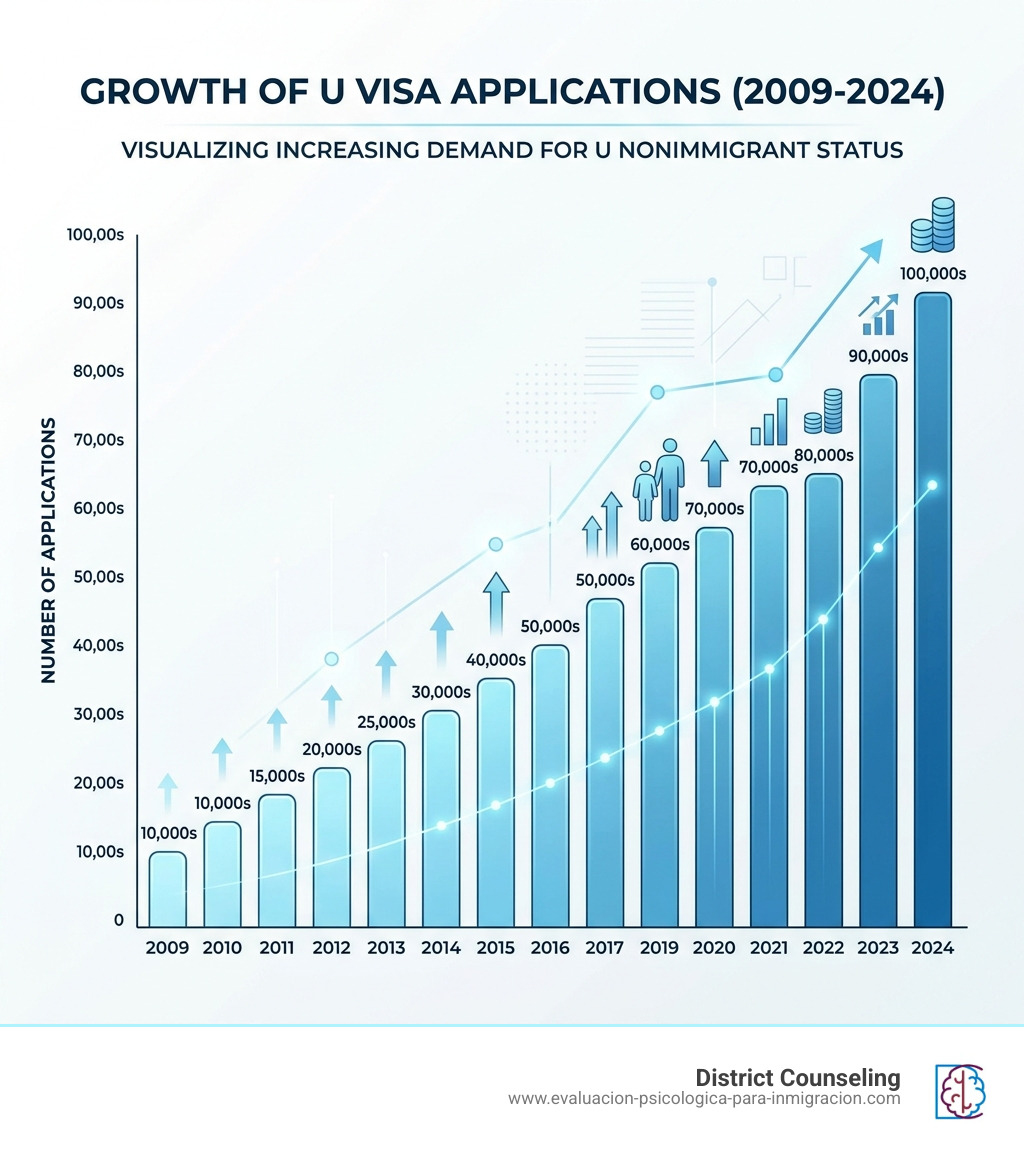
The demand for this program has grown dramatically. In FY 2009, about 6,850 applications were filed. By 2024, that number had grown to over 41,000 — a six-fold increase. As of June 2025, more than 416,000 petitions are pending, meaning most applicants wait years before receiving a final decision. That wait, however, does not have to mean uncertainty — there are interim protections available while you wait.
I'm Francisco Ortiz, Lead Forensic Mental Health Evaluator at District Counseling PLLC and a Certified Forensic Mental Health Evaluator, and I've conducted specialized psychological evaluations for uscis u visa petitions, asylum cases, and hardship waivers across six states. In this guide, I'll walk you through every stage of the U visa process — from eligibility and law enforcement certification to the bona fide determination process and your path to a Green Card.
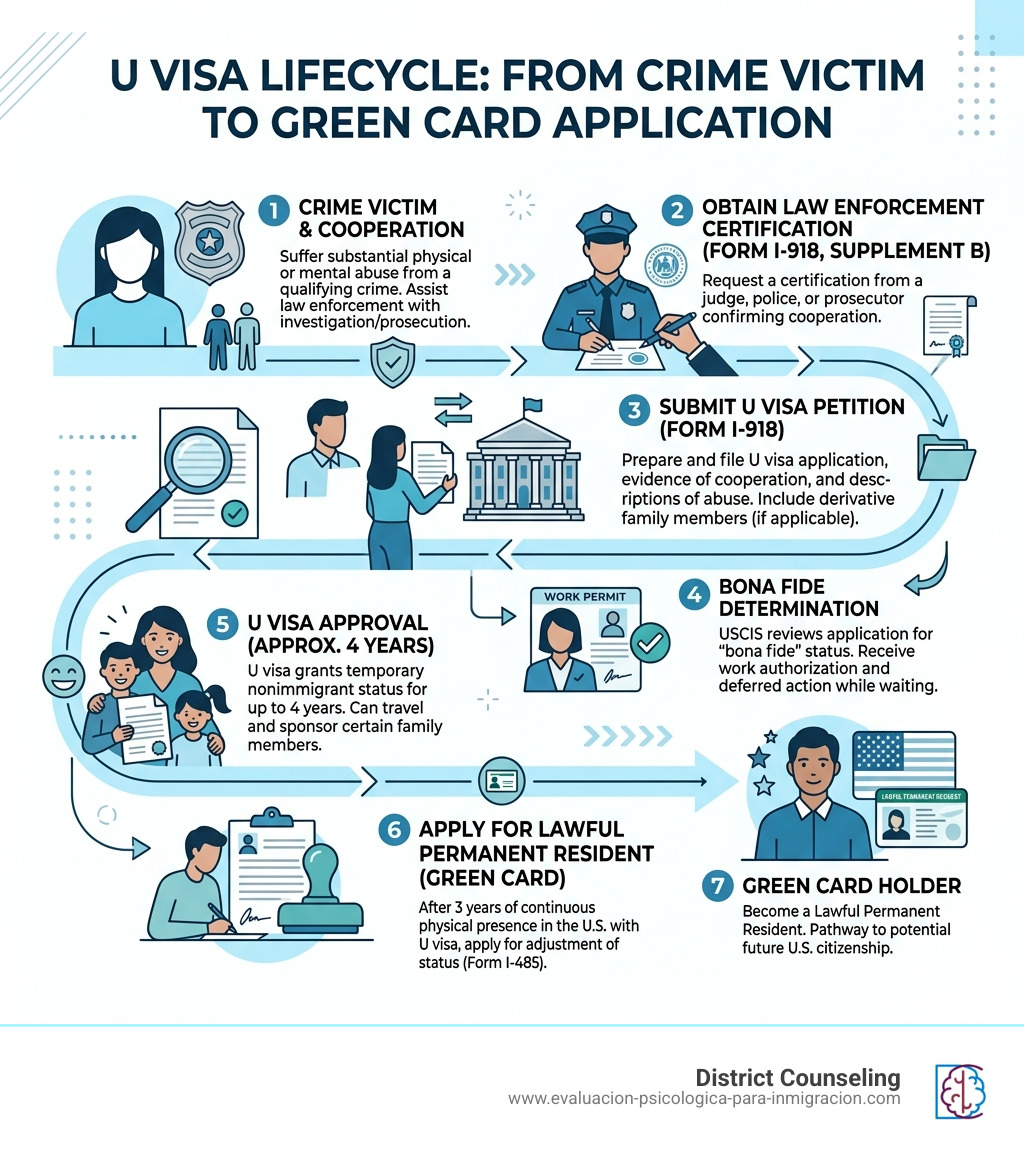
Understanding the Purpose and Eligibility Requirements for the USCIS U Visa
The primary mission of the uscis u visa is to bridge the gap between immigrant communities and law enforcement. Many victims of crime fear that reporting an incident will lead to deportation. By offering a safe pathway to legal status, the government encourages victims to come forward, which ultimately makes our communities in cities like Houston, Austin, and Dallas safer for everyone.
To qualify, you must demonstrate that you have suffered "substantial physical or mental abuse" as a result of being a victim of a qualifying criminal activity. This is where a professional Evaluacion Psicologica Para Caso De Uvisa becomes a cornerstone of your application. We help document the long-term psychological impact of the trauma, providing the clinical evidence USCIS needs to see the "substantial" nature of the suffering.

Qualifying Criminal Activities
Not every crime qualifies for a U visa. The law specifies a list of over 28 categories of crimes that are considered "qualifying criminal activities." These include:
- Violent Crimes: Murder, manslaughter, felonious assault, and kidnapping.
- Sexual & Domestic Crimes: Domestic violence, rape, sexual assault, incest, and female genital mutilation.
- Exploitation: Blackmail, extortion, involuntary servitude, and human trafficking.
- Obstruction of Justice: Perjury, witness tampering, and obstruction of justice.
It is important to note that "similar activity" to these crimes may also qualify if it violates federal, state, or local laws. You can find the full list on the official Victims of Criminal Activity: U Nonimmigrant Status page.
Core Eligibility Criteria
Beyond the type of crime, there are four mandatory pillars for uscis u visa eligibility:
- Victim Status: You must have been the direct or indirect victim of the crime.
- Possession of Information: You must have knowledge regarding the details of the criminal activity.
- Helpfulness: You must have been helpful, be currently helpful, or be likely to be helpful to law enforcement in the investigation or prosecution of the crime.
- Jurisdiction: The crime must have occurred in the United States or violated U.S. laws.
Additionally, you must be "admissible" to the U.S. If you have past immigration violations or certain criminal records, you may need to file a waiver (Form I-192) to overcome these issues. Understanding the emotional weight of these requirements is vital, and you can find more info about psychological evaluations to see how we support this narrative.
The Critical Role of Law Enforcement Certification
You cannot simply tell USCIS that you were helpful; you need a government official to vouch for you. This is done through Form I-918 Supplement B, also known as the U visa certification.

This form must be signed by a "certifying official." This includes heads of law enforcement agencies, prosecutors, judges, or other investigative authorities like Child Protective Services. According to Chapter 1 - Purpose and Background | USCIS, the certification acts as a prerequisite. Without a signed Supplement B, USCIS will automatically deny the petition.
The Certification Process and State Mandates
While the federal government sets the rules for the visa, state laws often dictate how local police handle certifications. In states like California, there are specific mandates requiring agencies to respond to certification requests within a certain timeframe (usually 30 to 90 days).
When a detective or prosecutor signs your form, they must use original wet signatures (no photocopies) and it is highly recommended they use blue ink to prove the document is an original. The certification is valid for only six months from the date of the signature, so we must ensure the rest of the application is ready to go once that signature is secured.
Withdrawal of Certification
It is a common misconception that once a certificate is signed, it is permanent. Law enforcement has the discretionary power to withdraw a certification at any time if a victim stops cooperating. If you "unreasonably refuse" to provide assistance—such as failing to show up for a court hearing or refusing to identify a suspect—the agency can notify USCIS, which may lead to the denial or revocation of your status. However, if a case is closed because the police cannot find the suspect, your certification remains valid as long as you were helpful while the case was active.
Navigating the USCIS U Visa Application Process
Applying for the uscis u visa is a marathon, not a sprint. The paperwork is extensive and requires meticulous attention to detail.
The primary forms involved are:
- Form I-918: The main petition for the victim.
- Form I-918 Supplement B: The law enforcement certification mentioned above.
- Personal Statement: A written narrative describing the crime and the suffering endured.
- Form I-192: An inadmissibility waiver if you entered the country without inspection or have other legal "red flags."
We often assist clients by providing an Evaluacion Forense De Inmigracion that complements the personal statement. While the statement tells what happened, our evaluation explains how it affected your mental health, which is a key component for USCIS when determining if the abuse was "substantial." For more details on the forms, visit the Petition for U Nonimmigrant Status | USCIS page.
The USCIS U Visa Bona Fide Determination Process
Because the backlog has grown so large (over 416,000 cases), USCIS implemented a "Bona Fide Determination" (BFD) process in June 2021. This was a game-changer for our clients in Houston and San Antonio.
Under this policy, USCIS performs an initial review of your case. If they determine your application is complete and filed in good faith (meaning you passed background checks and submitted the required certification), they can grant you deferred action and a work permit (EAD) valid for four years. This allows you to live and work legally while you wait for your "actual" U visa to become available under the annual cap.
Background Checks and Vetting
USCIS takes program integrity very seriously. Every applicant must undergo biometrics (fingerprinting and photos). Statistics show that USCIS is looking for more than just "helpfulness." Nearly 35% of U visa petitioners filed between 2012-2018 had a previous arrest for a criminal or immigration-related offense.
Furthermore, about 1.5% of approved recipients in that same period had documented ties to criminal gangs. USCIS uses this vetting process to ensure that the program isn't being used by "bad actors." They check for national security risks and public safety threats before granting even the interim BFD benefits. You can read more about these protections on the Victims of Human Trafficking and Other Crimes | USCIS resource page.
Managing the Annual Cap and Growing Backlogs
The biggest hurdle in the uscis u visa program is the statutory limit. Congress only allows 10,000 U-1 visas to be issued to principal petitioners each fiscal year.
As of June 2025, the numbers are staggering:
- Total Pending Cases: 416,000+
- Principal Petitioners: 250,000
- Family Members: 166,000
- FY 2025 Cap: Met on September 9, 2025.
Because the cap is met every year, a massive "waiting list" has formed. USCIS is currently resuming final approvals for petitions filed as far back as April 30, 2017. This means the wait for a final U visa can be 15 years or longer. This is why the BFD process is so critical; it provides a "bridge" of legal work authorization during this decade-long wait.
Trends in Application Growth
The program has seen a six-fold increase in applications since 2009. In 2024 alone, over 41,000 petitions were filed. This growth is partly due to increased awareness and partly due to new policies that provide work permits to those with pending cases. However, this has also led to "skeletal filings"—applications submitted without all the required evidence just to get a spot in line—which USCIS is now cracking down on to restore program integrity.
Program Integrity and Fraud Prevention
With such a valuable benefit on the line, fraud is a concern. A DHS Office of Inspector General (OIG) audit found that 8% of law enforcement certification forms reviewed were forged or altered. There have also been reports of "staged crimes" where individuals pay to be "robbed" just to get a police report.
In a survey, 61% of law enforcement agencies stated the program did not significantly improve their ability to investigate crimes, often because the applications were based on cases that were already closed (66% of cases reviewed in 2020). USCIS has responded by increasing vetting and clarifying that they can use information from "prohibited sources" to root out fraud.
Benefits, Family Derivatives, and the Path to Permanent Residency
Despite the long wait, the benefits of the uscis u visa are life-changing. Once approved, you receive U nonimmigrant status for four years.
Family Derivatives
The U visa isn't just for the victim; it’s for the family too. You can include:
- U-2: Spouse
- U-3: Unmarried children under 21
- U-4: Parents (if the victim is under 21)
- U-5: Unmarried siblings under 18 (if the victim is under 21)
These family members also receive work authorization and protection from deportation.
Adjusting to Lawful Permanent Resident Status
The "holy grail" of the U visa process is the Green Card. To adjust your status to a Lawful Permanent Resident (LPR), you must meet these requirements:
- Physical Presence: You must have been physically present in the U.S. for a continuous period of at least 3 years while in U status.
- Ongoing Cooperation: You must not have "unreasonably refused" to provide assistance to law enforcement since receiving your U visa.
- Humanitarian Justification: You must show that your continued presence is justified on humanitarian grounds, to ensure family unity, or is in the public interest.
You will file Form I-485 to make this transition. It is a discretionary grant, meaning USCIS will weigh your positive factors against any negative factors in your history.
Frequently Asked Questions about the USCIS U Visa
How long does it take to get a work permit after filing?
Under the current Bona Fide Determination policy, it typically takes several months to a year to receive an initial work permit. This is much faster than the 15+ year wait for the actual visa, but it still depends on USCIS processing speeds and how quickly you complete your biometrics.
Can I include my family members if they are outside the U.S.?
Yes. You file Form I-918 Supplement A for them. If they are outside the U.S., they will go through "consular processing" at a U.S. Embassy or Consulate once the petition is approved. There are also "age-out" protections that lock in a child's age on the date you file your petition, ensuring they don't lose eligibility just because the wait is long.
What happens if the law enforcement agency refuses to sign my certification?
Certification is entirely discretionary. No agency is required by federal law to sign it. If one agency refuses, we recommend checking if another agency (like a prosecutor or a judge) might be willing to sign. In states like California, laws require agencies to at least provide a written reason for a denial, but a signature is never guaranteed.
Conclusion
The journey to a uscis u visa is complex, emotional, and requires a great deal of patience. From the initial trauma of the crime to the years spent on the waiting list, victims need more than just legal help—they need emotional support and professional documentation of their experiences.
At District Counseling, we are proud to serve the immigrant communities of Houston, Katy, Austin, Dallas, and San Antonio. We provide specialized psychological evaluations in both Spanish and English, ensuring your story is told accurately and with the clinical depth USCIS requires. Our goal is to make you feel comfortable and supported throughout this process, which is why we offer 6 free therapy sessions after your evaluation report is completed.
If you are a victim of a crime and are working with an attorney on your uscis u visa case, we are here to help provide the clinical evidence you need. Evaluacion Psicologica Para Caso De Uvisa is more than just a requirement; it is a way to validate your experience and strengthen your roadmap to a safer future in the United States.