
Lost in Translation? The Importance of an Asylum Bilingual Psychological Report
When Words Aren't Enough: Why an Asylum Cancellation Psych Evaluation Can Change Everything

An asylum cancellation psych evaluation is a formal clinical assessment conducted by a licensed mental health professional to document trauma, psychological symptoms, and the emotional impact of deportation — submitted as legal evidence in immigration proceedings.
Here's what you need to know quickly:
- What it is: A written forensic report (typically 8–20 pages) used to support asylum or cancellation of removal cases
- Who needs it: Non-permanent residents in removal proceedings, asylum seekers, and qualifying U.S. citizen relatives (like children or spouses)
- What it proves: Extreme psychological hardship, trauma history, and the human cost of family separation
- How much it costs: Typically $1,200–$2,000, with some providers offering reduced fees
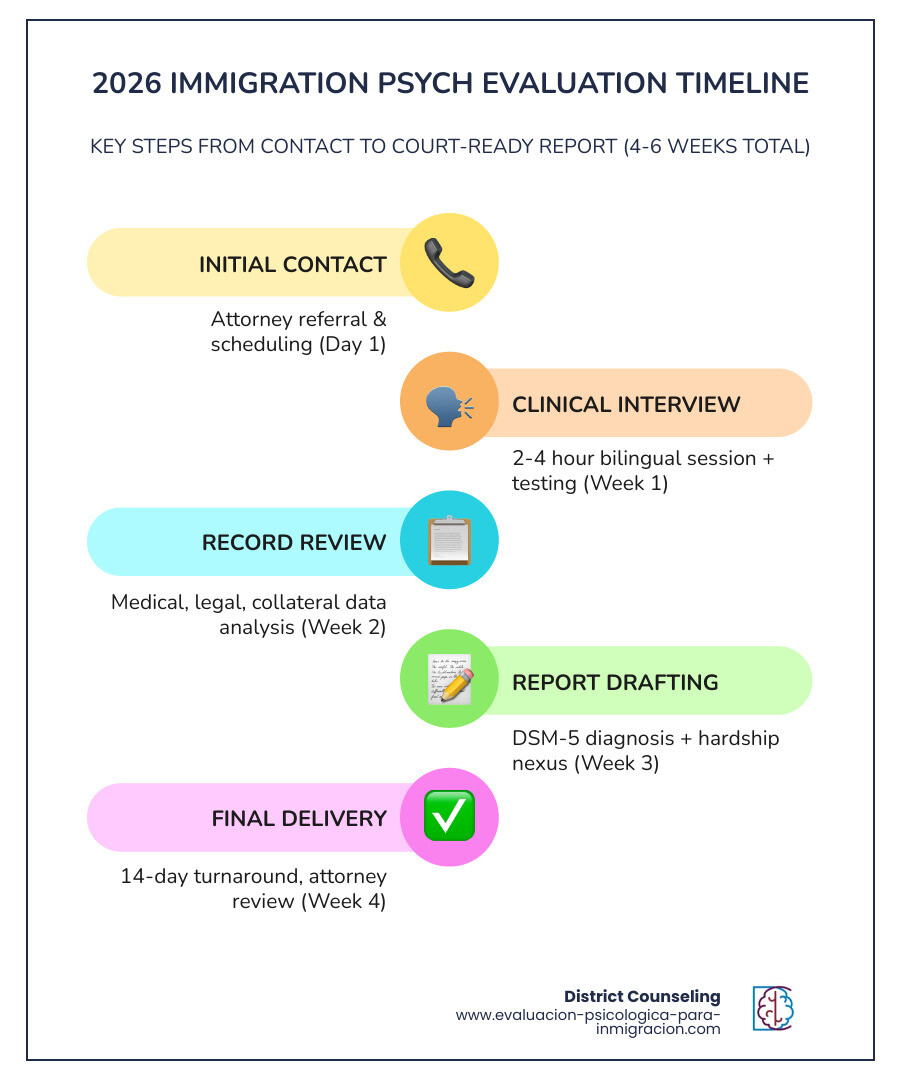
- How long it takes: 4–6 weeks from first contact to final report; most reports delivered within 14 business days
- Does it matter? Research shows asylum cases with a mental health evaluation were granted at an 89% rate, compared to just 37% without one
Facing deportation is one of the most stressful experiences a family can go through. For many Hispanic immigrants in Texas, the fear isn't just personal — it's about what happens to their U.S.-born children, their spouse, their whole life built here. A psychological evaluation can translate that fear and suffering into the kind of documented clinical evidence that immigration judges and USCIS officers can act on.
But not all evaluations are equal. A generic, one-session report can actually hurt your case. In 2026, USCIS and immigration courts are scrutinizing evaluations more closely than ever — looking for proper DSM-5 diagnoses, a clear connection between symptoms and hardship, and reports that reflect real clinical rigor.
That's where the right evaluator makes all the difference.
I'm Francisco Ortiz, Lead Forensic Mental Health Evaluator at District Counseling PLLC and a Certified Forensic Mental Health Evaluator (CFMHE) with advanced specialized training in asylum cancellation psych evaluation, hardship waiver assessments, and competency evaluations for immigration court. I'm licensed across six states and bring both the clinical expertise and bilingual, culturally informed approach that complex immigration cases demand.
The Role of an Asylum Cancellation Psych Evaluation in Removal Proceedings

In the high-stakes environment of an immigration court, your story needs to be more than just a testimony; it needs to be corroborated by objective, professional evidence. This is where the asylum cancellation psych evaluation comes into play. It acts as a bridge between your lived experience and the legal requirements of the Executive Office for Immigration Review (EOIR).
We often explain to our clients that there is a massive difference between a "therapeutic" evaluation and a "forensic" one. If you go to a regular therapist, they are there to help you heal. But in a forensic assessment, our role is to provide an objective clinical picture for the court. We aren't just looking at your feelings; we are looking at how those feelings meet specific legal standards like "exceptional and extremely unusual hardship."
For those facing removal, particularly under Form EOIR-42B (Cancellation of Removal for Non-Lawful Permanent Residents), the evaluation isn't just about you. It often focuses on your qualifying relatives—your U.S. citizen or Lawful Permanent Resident (LPR) spouse, children, or parents. We look at the family dynamics, the mental health history of the children, and the potential for psychological deterioration if the family is split apart. You can learn more about the specifics of these assessments at Evaluacion Psicologica Para Inmigracion.
Proving Extreme Hardship via an Asylum Cancellation Psych Evaluation
The term "extreme hardship" sounds simple, but legally, it’s a very high bar. It has to be more than the "normal" stress of moving to a new country or being away from a parent. We use clinical tools to show that the hardship in your case is exceptional.
For example, if a child has a developmental disability or a spouse has a history of severe depression, the deportation of the primary caregiver isn't just a "sad event"—it’s a catalyst for a total psychological breakdown. Our reports document this "nexus" or connection. We show the court: "If Person A is removed, Person B (the U.S. citizen) will suffer this specific, documented clinical harm." This level of detail is critical for a successful Evaluacion Psicologica Para Caso De Una Cancelacion De Deportacion.
Mitigating Legal Bars with Mental Health Evidence
Sometimes, an immigration case is complicated by a past mistake, such as a criminal conviction. In the past, the Board of Immigration Appeals (BIA) often tried to ignore mental health evidence when determining if a crime was "particularly serious." However, recent legal shifts, such as the Shazi v. Wilkinson ruling, have changed the landscape.
Courts are now increasingly required to consider mental health as a mitigating factor. If a person’s past actions were influenced by untreated PTSD from torture in their home country, that context matters. Forensic psychiatrists and psychologists play a vital role here, helping the judge understand that the individual isn't a "danger to the community" but rather a survivor in need of care. For a deeper dive into this legal evolution, see the Use of Mental Health Evidence in Immigration Court | Journal of the American Academy of Psychiatry and the Law.
How Psychological Evidence Strengthens Asylum and Cancellation Cases
Why do attorneys push so hard for these evaluations? Because they work. A landmark study by Lustig et al. found that asylum seekers who had a medical or mental health evaluation had an 89% grant rate. Compare that to the 37% grant rate for those who didn't. That is a staggering difference.
An evaluation humanizes the applicant. Instead of just being a "case number" or a "respondent," you become a person with a history, a family, and a documented reason for your fears. This objective documentation provides a safety net for the judge, giving them a professional basis to grant relief. You can read more about the intersection of mental illness and persecution in the Journal of the American Academy of Psychiatry and the Law.
Overcoming Credibility Issues and Trauma Memory Gaps
One of the biggest hurdles in asylum cases is "credibility." If you tell an asylum officer one thing during your credible fear interview and something slightly different in court three years later, they might think you are lying.
However, we know from the neurobiology of trauma that memory doesn't work like a video camera. Trauma causes memory fragmentation and dissociation. People often block out the most painful parts of their story or get dates confused because their brain was in "survival mode" during the event. Our asylum cancellation psych evaluation explains these gaps to the judge. We provide the clinical "why" behind inconsistencies, protecting your credibility. This is a core part of our work in an Evaluacion Psicologica Para Caso De Asilo.
What to Expect During Your Asylum Cancellation Psych Evaluation

If you’ve never seen a psychologist before, the process can feel intimidating. We try to make it as comfortable as possible. Here is what a typical process looks like at District Counseling:
- Clinical Interview: This usually takes 2 to 4 hours. We talk about your life back home, your journey to the U.S., your family, and your current symptoms (like trouble sleeping or panic attacks).
- Psychometric Testing: We use standardized tools (like the PCL-5 for PTSD or the GAD-7 for anxiety) to provide objective scores that back up our observations.
- Mental Status Exam: We observe your mood, thought processes, and memory during the interview.
- Record Review: We look at medical records, school reports for your children, or police reports from your home country to build a complete picture.
- Diagnostic Impression: We provide a formal DSM-5-TR diagnosis, which is the "gold standard" for clinical evidence in 2026.
Logistics of Obtaining an Evaluation in 2026: Costs and Timelines
Time is often your biggest enemy in immigration court. Ideally, you should start looking for an evaluator 8 to 12 weeks before your deadline.
- Cost: A standard evaluation in 2026 typically ranges from $1,200 to $2,000. Complex cases involving multiple family members can go higher, while some non-profits or sliding-scale providers might offer services for less. At District Counseling, we focus on providing a premium, forensic-grade report that stands up to cross-examination.
- Timeline: The total process usually takes 4 to 6 weeks. Once we have all your documents, we typically deliver the final report within 14 business days.
- Expedited Services: If you have a "rocket docket" court date, many evaluators (including us) offer rush services for an additional fee, sometimes turning around a report in as little as 48 to 72 hours.
Telehealth Accessibility and State Licensure
In 2026, you don't necessarily have to drive to an office in downtown Houston or Dallas to get a high-quality evaluation. Thanks to PSYPACT (an interstate compact), licensed psychologists can conduct remote evaluations across many states, including Texas, Florida, California, and New York.
We use secure, HIPAA-compliant video platforms. Telehealth evaluations have been shown to be just as effective and legally valid as in-person ones, provided the clinician is experienced in building rapport virtually. For our Spanish-speaking clients, having a bilingual evaluator who understands the cultural nuances of "nervios" or "susto" is just as important as the clinical diagnosis itself.
Preparing for Your Appointment and Avoiding Pitfalls
To get the best result from your asylum cancellation psych evaluation, preparation is key.
- Gather Documents: Have your I-589 application, medical records, and any declarations ready.
- Create a Timeline: Write down the major "bad events" in your life and when they happened. This helps you stay on track during the interview.
- Track Symptoms: For a week before your appointment, jot down how often you feel anxious, have nightmares, or struggle to concentrate.
- Avoid Generic Templates: Beware of providers who offer "cheap" reports that are only 2 or 3 pages long. USCIS is increasingly rejecting these. A strong report is usually 8 to 20 pages and tailored specifically to your life.
Frequently Asked Questions about Immigration Evaluations
What is the difference between a psych evaluation and therapy?
This is the question we hear most. Think of it this way: Therapy is for healing; an evaluation is for evidence.
- Therapy: Ongoing, confidential (mostly), focused on your goals, usually covered by insurance.
- Evaluation: Short-term (1-3 sessions), limited confidentiality (the report goes to the court), focused on legal questions, almost never covered by insurance.
At District Counseling, we actually bridge this gap by offering 6 free therapy sessions after your report is completed to help you process the trauma we discussed during the evaluation.
Who is qualified to perform these evaluations?
You want someone with "letters after their name"—typically a PhD or PsyD (Psychologist) or an LCSW/LPC with extensive forensic training. In 2026, the courts prefer evaluators who use the DSM-5-TR and have a track record of testifying as expert witnesses. Bilingual capabilities are a huge plus, as using an outside interpreter can sometimes "filter" the emotional weight of your words.
Can a psych evaluation help with VAWA or U-Visa cases?
Absolutely. While we've focused on asylum and cancellation, these evaluations are vital for survivors of domestic violence (VAWA) or victims of crime (U-Visa). We document the "coercive control" in VAWA cases or the long-term psychological damage caused by a violent crime for a U-Visa.
| Case Type | Primary Focus of Evaluation | Key Legal Standard |
|---|---|---|
| Asylum | Past trauma and fear of future persecution | Well-founded fear |
| Cancellation | Impact on U.S. citizen relatives | Exceptional & extremely unusual hardship |
| VAWA | Effects of domestic abuse/cruelty | Battery or extreme cruelty |
| U-Visa | Mental or physical abuse from a crime | Substantial physical or mental abuse |
Conclusion
At District Counseling, we understand that your immigration case isn't just about paperwork—it's about your future. Whether you are in Houston, Austin, Dallas, or San Antonio, our team is here to provide the clinical expertise you need. We specialize in Spanish-to-English evaluations, ensuring that nothing is "lost in translation" when your story reaches the judge's desk.
We pride ourselves on client comfort and clinical rigor. And because we know that reliving trauma for an evaluation is hard, we are the only practice in the region that provides 6 free therapy sessions to our evaluation clients. We want to help you win your case and help you heal.
If you are ready to take the next step in your asylum cancellation psych evaluation, we are here to help. You can learn more about our team and our mission at Quienes Somos Experto Evaluacion Psicologica Para Inmigracion.
For more specific details on how we handle deportation cases, visit our page on cancellation of removal evaluations. Your story deserves to be heard, and we have the tools to make sure the court understands it.