
U Visa to Green Card: From Victim to Lawful Permanent Resident
What It Means to Go From a U Visa to a Green Card

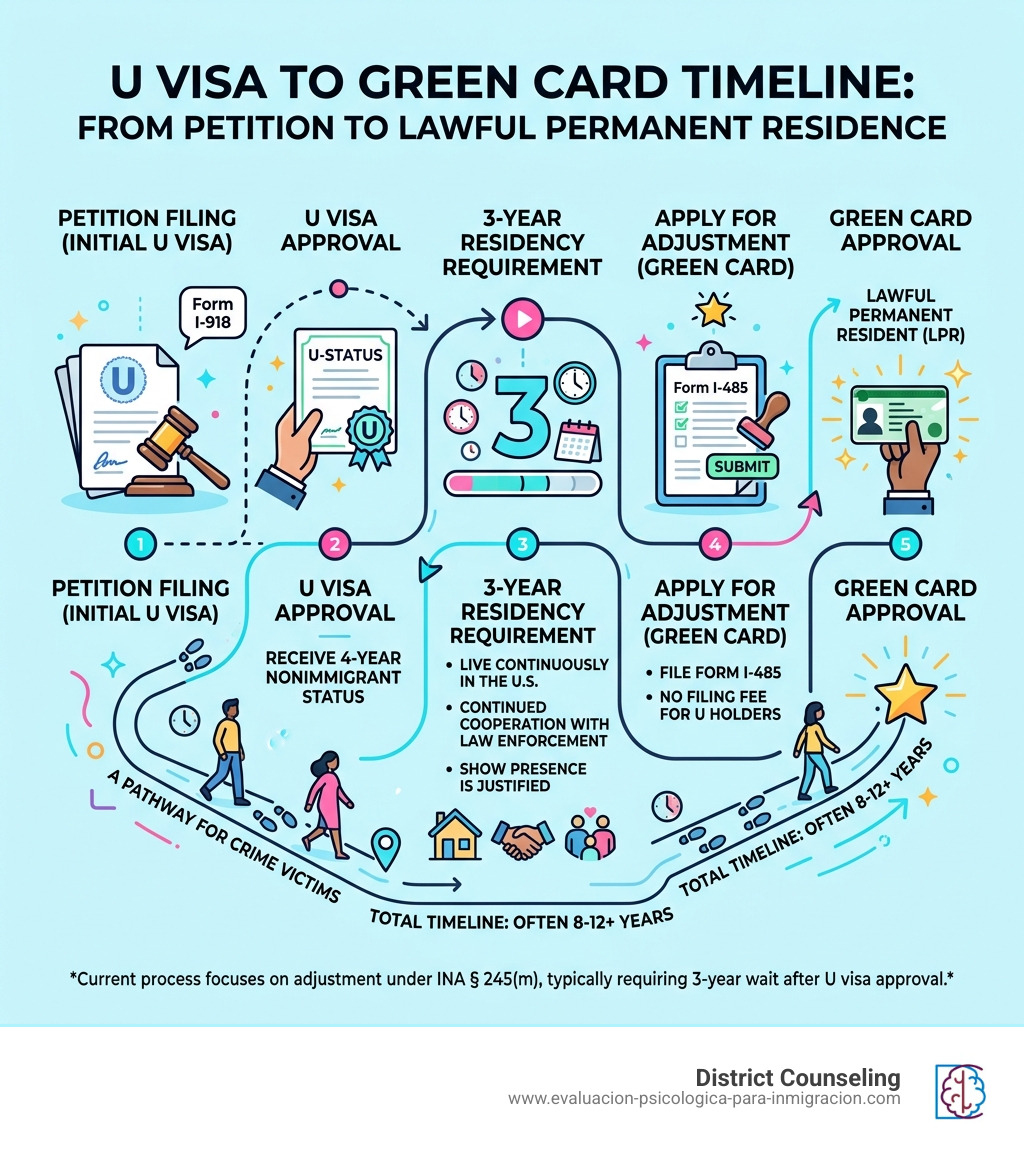
U visa to green card is a real, legal path available to crime victims who have held U nonimmigrant status in the United States. Here is the short answer:
How to get a green card from a U visa:
- Hold U nonimmigrant status (U-1 principal or U-2 through U-5 derivative)
- Live in the U.S. continuously for 3 years after your U visa was approved
- Continue cooperating with law enforcement (do not refuse requests for assistance)
- Show your presence is justified on humanitarian, family unity, or public interest grounds
- File Form I-485 (Application to Register Permanent Residence or Adjust Status) with USCIS — no filing fee for U visa holders
Important as of April 2026: A November 2025 USCIS policy change closed a faster pathway under INA § 245(a). Most U visa holders must now adjust status under INA § 245(m), which requires the full 3-year wait.
This process is long — the total timeline from first filing a U visa petition to receiving a green card is often 8 to 12 years or more. But the path exists, and understanding each step clearly makes a real difference.
I'm Francisco Ortiz, Lead Forensic Mental Health Evaluator at District Counseling PLLC, where I specialize in psychological evaluations for U visa and hardship waiver cases — the very evaluations that can strengthen a u visa to green card application by documenting trauma, abuse, and humanitarian need. In this guide, I'll walk you through every stage of the process so you know exactly what to expect.
Eligibility Requirements for a u visa to green card Adjustment
Transitioning from a U visa to a green card (lawful permanent residence) is not automatic. While the U visa provides a four-year period of legal status, the window to apply for your green card opens only after you have met several strict criteria. According to USCIS guidelines for crime victims, the primary path is through Section 245(m) of the Immigration and Nationality Act (INA).
To be eligible, you must:
- Be physically present in the U.S. for a continuous period of at least 3 years since the date you were admitted as a U nonimmigrant.
- Still hold valid U status at the time you file your Form I-485.
- Not have "unreasonably refused" to provide assistance to law enforcement since you received your U visa.
- Establish that your continued presence is justified based on humanitarian grounds, to ensure family unity, or because it is in the public interest.
One of the most critical pieces of evidence is the Form I-918 Supplement B. While you submitted one for your initial visa, USCIS often looks for evidence that your helpfulness to law enforcement has continued or, at the very least, that you haven't refused to help if asked.
Understanding Continuous Physical Presence for u visa to green card
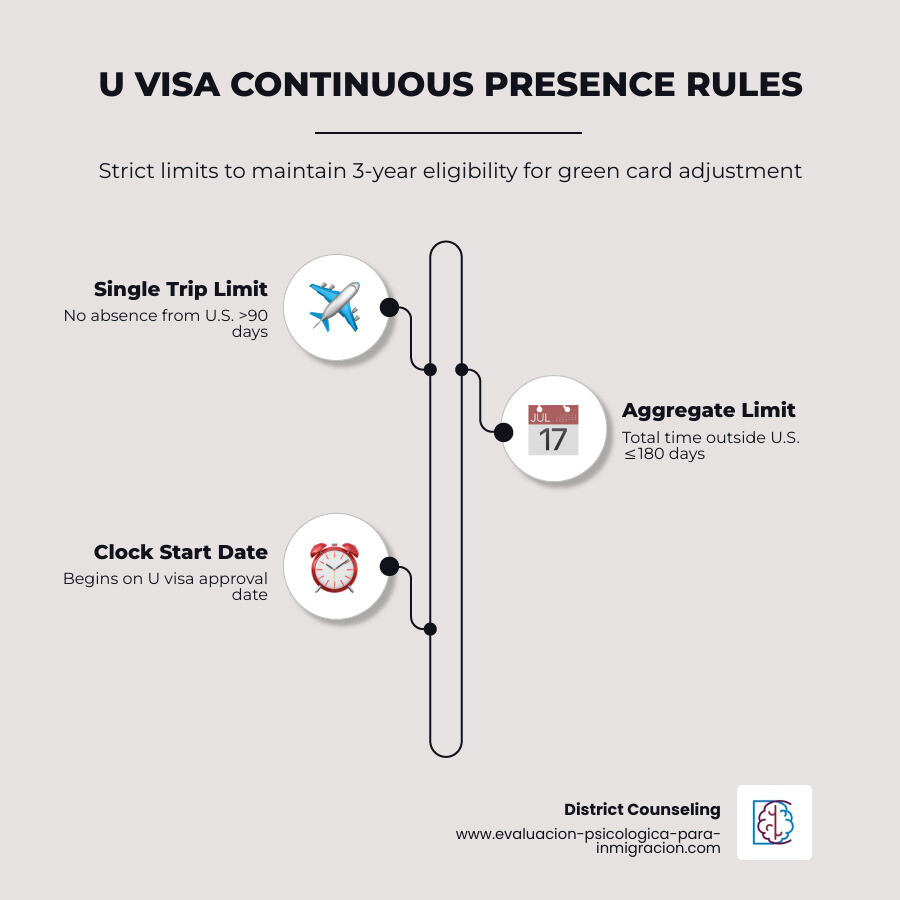
The "3-year rule" is where many people get tripped up. The clock does not start when you file your U visa petition or even when you receive a "Bona Fide Determination" (which grants deferred action and a work permit). The 3-year clock starts only on the day your actual U visa is approved.
USCIS is very strict about what "continuous" means. If you leave the U.S. during those three years, you must stay within these limits:
- Single Trip Limit: No single absence from the U.S. can exceed 90 days.
- Aggregate Limit: Your total time outside the U.S. across all trips cannot exceed 180 days.
If you exceed these limits, your "continuous presence" is considered broken unless you can provide a certification from the investigating law enforcement official stating that your absence was necessary for the investigation or prosecution. We always tell our clients in Houston and Sugarland: it is safest to stay in the U.S. entirely until your green card is in hand.
Discretionary Factors and Substantial Abuse Evidence
Unlike some other green card categories, u visa to green card adjustment is "discretionary." This means USCIS doesn't just check boxes; they decide if you deserve the green card based on the "totality of circumstances."
To tip the scales in your favor, you need to provide more than just tax returns. You need to demonstrate:
- Good Moral Character: A clean criminal record since your U visa was issued.
- Humanitarian Justification: This is where a professional Evaluacion Psicologica Para Caso De Uvisa becomes vital. We document the substantial physical or mental abuse you suffered and how your mental health would be impacted if you were forced to leave the U.S.
- Personal Statement: A detailed affidavit explaining your journey, your cooperation with the police, and your ties to the community.
Recent USCIS Policy Changes and the November 2025 Alert
In the past, some attorneys used a "shortcut" for U visa holders who were married to U.S. citizens. They would apply for adjustment of status under INA § 245(a), arguing that the grant of U status counted as an "admission" to the country.
However, following the logic of the Supreme Court case Sanchez v. Mayorkas, USCIS issued a major policy alert in November 2025. This alert clarified that being granted U status inside the U.S. does not count as a legal admission.
What this means for you in 2026: If you entered the U.S. without inspection (without a visa) and later got a U visa, you cannot use the family-based shortcut (245a). You must wait the full three years and apply under the 245(m) provision. If you have a pending 245(a) application that was filed before this change, USCIS is expected to deny it, though your underlying U status remains valid. You will simply need to refile under the correct 245(m) pathway once you hit your 3-year anniversary.

For a deeper dive into these technical shifts, you can read this complete guide for U visa holders.
The Application Process: Filing Form I-485
Once you have reached your three-year mark in U status, it’s time to file Form I-485. Because U visa holders are survivors of crime, the government provides a significant benefit: there is no filing fee for the I-485 or the biometrics for U-1 principals.
The Document Checklist
To ensure a smooth process, we recommend gathering:
- Copy of your U visa approval notice (Form I-797).
- Proof of 3 years of continuous presence: This includes apartment leases, utility bills, pay stubs, and tax transcripts for every year.
- Medical Exam (Form I-693): Must be completed by a USCIS-designated civil surgeon.
- Form I-918 Supplement B: While not always mandatory for the green card stage, many attorneys include a fresh one to prove ongoing cooperation.
- Psychological Evaluation: If you are also dealing with other immigration hurdles or need to prove humanitarian necessity, an Evaluacion Psicologica Para Caso De Tvisa or U-visa evaluation provides the clinical evidence USCIS needs to see the "substantial abuse" you've endured.

While your I-485 is pending, you can also file for Work Authorization (Form I-765) and a Travel Document (Form I-131), though we strongly caution against using that travel document without expert legal advice.
Family Members and the u visa to green card Pathway
If you have family members who received "derivative" U visas (U-2, U-3, U-4, or U-5), they can also apply for their green cards.
- Relationship Continuity: The relationship (marriage or parent-child) must have existed at the time the U visa was granted and must still exist when the green card is approved.
- Independent Filing: Derivative family members can actually file their I-485s even if the principal applicant hasn't filed yet, as long as they meet their own 3-year residency requirement.
- Form I-929: This is a special "safety net." If you are a principal U-1 holder and you have a qualifying family member (like a spouse or child) who never had a U visa, you can file Form I-929 for them. You must show that they would suffer extreme hardship if they were not allowed to stay with you in the U.S.
Overcoming Inadmissibility and Legal Protections
One of the most powerful aspects of the u visa to green card path is the "waiver." Most grounds of inadmissibility (like entering the country illegally or certain minor crimes) that would stop other people from getting a green card can be waived for U visa holders.
If you have an issue that makes you "inadmissible," your attorney will likely file Form I-192. USCIS has the power to waive almost any ground of inadmissibility if it's in the public or humanitarian interest—except for involvement in Nazi persecution, genocide, or torture.
Confidentiality and Safety
The law (specifically 8 U.S.C. § 1367) provides strict confidentiality protections for U visa applicants. The Department of Homeland Security is generally prohibited from sharing any information about your case with your abuser or the person who committed the crime against you.
If you are still in a situation where you fear for your safety, you can use a safe address (like a P.O. Box or an attorney’s office) for all USCIS correspondence. This ensures that your green card documents never fall into the wrong hands.
Frequently Asked Questions about U Visa Adjustments
How long does the process take as of April 2026?
As of April 2026, the backlog remains significant. While the "Bona Fide Determination" helps people get work permits faster, the wait for a full U visa approval is still approximately 60 months (5 years). Once you have the visa and wait your 3 years to file the I-485, the green card processing itself takes another 12 to 24 months. Total time from start to finish? Often a decade or more.
Can I travel outside the U.S. while my application is pending?
Technically, you can apply for "Advance Parole" to travel. However, for u visa to green card applicants, travel is very risky. If you stay out too long, you break your "continuous presence," and your green card application could be denied. Most experts advise staying in the U.S. until the physical green card is in your mailbox.
What happens if my adjustment of status application is denied?
If your application is denied because of the 2025 policy change (filing under the wrong section), don't panic. Your U status usually remains valid. You can typically refile under Section 245(m). If it’s denied for other reasons, you may have the option to appeal or refile with stronger evidence, such as a more detailed psychological evaluation to prove humanitarian need.
Conclusion
The journey from being a victim of a crime to becoming a lawful permanent resident is an endurance test. It requires patience, meticulous record-keeping, and the courage to relive painful memories to secure your future.
At District Counseling, we are honored to support the immigrant communities in Houston, Katy, Cypress, Sugarland, and across Texas. We understand that the "substantial abuse" required for a U visa isn't just a legal term—it's a lived experience that leaves deep scars.
Our bilingual (Spanish/English) team provides trauma-informed psychological evaluations that give a voice to your suffering and a clinical foundation for your u visa to green card application. We don't just write reports; we provide a bridge to healing by offering six free therapy sessions to every client we evaluate.
If you are ready to take the next step in your immigration journey, we are here to help you document your story with the care and professionalism it deserves.