
Why your Dallas psychological immigration assessment matters more than you think
Why a Dallas Psychological Immigration Assessment Could Decide Your Case

A Dallas psychological immigration assessment is a formal mental health evaluation conducted by a licensed professional to document trauma, hardship, or disability for use as legal evidence in immigration proceedings.
Quick answers for common needs:
| I need help with... | How an assessment helps |
|---|---|
| Stopping deportation | Documents extreme hardship to U.S. citizen family members |
| Asylum application | Proves trauma, PTSD, or credible fear of persecution |
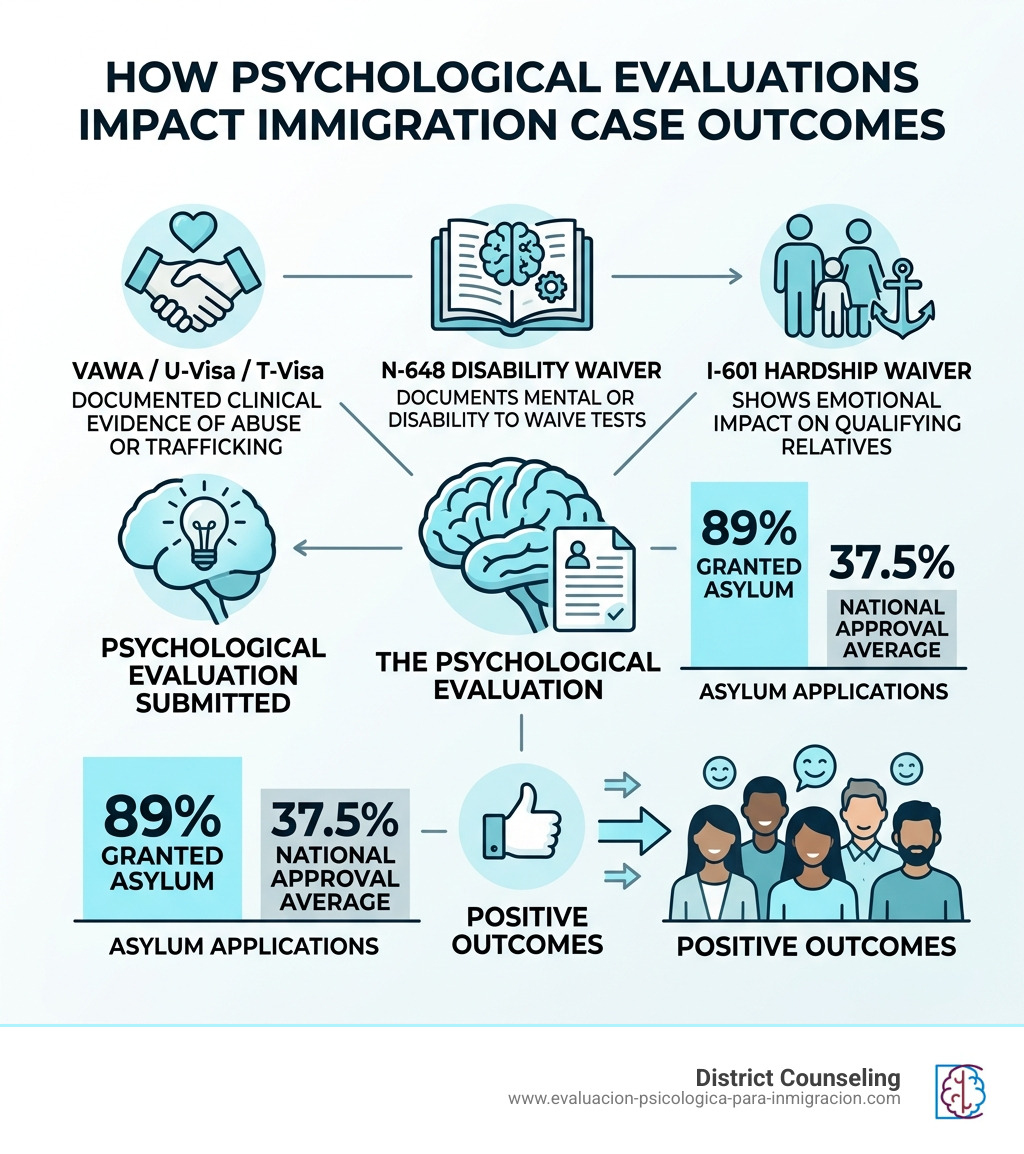
| VAWA, U-Visa, or T-Visa | Provides clinical evidence of abuse or trafficking trauma |
| N-648 disability waiver | Documents mental or physical disability to waive English/civics tests |
| I-601 hardship waiver | Shows emotional and psychological impact on qualifying relatives |
Here is something most people don't know: applicants who submit a psychological evaluation are 89% more likely to be granted asylum, compared to a national approval average of just 37.5%. That gap is not a coincidence. Immigration judges and USCIS officers respond to documented, clinically credible evidence — and a well-prepared psychological report delivers exactly that.
If you are facing deportation and have a U.S. citizen spouse or child, the fear you feel is real. But fear alone is not enough to win a case. A professional evaluation turns your lived experience into legal evidence.
I'm Francisco Ortiz, Lead Forensic Mental Health Evaluator at District Counseling PLLC and a Certified Forensic Mental Health Evaluator (CFMHE) with specialized training in hardship waivers, asylum evaluations, and U-Visa and T-Visa cases — the exact types of Dallas psychological immigration assessments covered in this guide. In the sections ahead, I'll walk you through everything you need to know to move forward with confidence.
Understanding the Role of a Dallas psychological immigration assessment
When we talk about a Dallas psychological immigration assessment, we aren't just talking about a standard therapy session. This is what we call a forensic evaluation. While traditional therapy focuses on healing and long-term growth, a forensic assessment is designed specifically for a legal audience—the judges and USCIS officers who will decide your future.
The primary goal is trauma documentation. Many of our clients have lived through experiences that are difficult to put into words. You might find yourself "blanking out" or feeling overwhelmed when trying to explain your history to an official. Our role is to provide a clinical diagnosis that explains why you are struggling. Whether it is PTSD, severe anxiety, or major depression, putting a clinical name to your symptoms gives the court a clear framework to understand your suffering.
The importance of professional assessments cannot be overstated. A licensed psychologist or therapist acts as an expert witness. By using standardized testing and specialized interviewing techniques, we provide expert testimony through a written report. This report bridges the gap between your personal story and the legal requirements of your case. For those interested in the deeper mechanics of these services, you can find more info about forensic services to see how we maintain the high standards required by the Executive Office for Immigration Review (EOIR).
Key Immigration Cases Requiring Mental Health Evidence
In the Dallas-Fort Worth area, various visa categories rely heavily on mental health evidence. At District Counseling, we see how a robust Dallas psychological immigration assessment serves as the backbone for several critical petitions:
- VAWA (Violence Against Women Act): Despite the name, VAWA protections apply to both men and women who have suffered domestic violence at the hands of a U.S. citizen or LPR spouse, parent, or child. An evaluation documents the psychological impact of the abuse, proving the "battery or extreme cruelty" required by law.
- U-Visa: This is for victims of qualifying crimes (like domestic violence or sexual assault) who have been helpful to law enforcement. We provide a detailed guide on U-Visa evaluations to help applicants document the "substantial mental abuse" they suffered.
- T-Visa: Specifically for survivors of human trafficking. These cases often involve deep-seated shame, dissociation, and chronic anxiety. Our evaluations help tell the story of the "unspeakable terror" encountered during trafficking.
- N-648 (Medical Certification for Disability Exceptions): For those seeking naturalization who have a physical or developmental disability or a mental impairment that prevents them from learning English or civics.
- Cancellation of Removal: This is often a "last line of defense" against deportation. We must prove that your departure would cause "exceptional and extremely unusual hardship" to your U.S. citizen or LPR relatives.

Understanding which path you are on is the first step. You can learn more about evaluation types to see which one fits your specific legal journey.
Strengthening Asylum Claims with a Dallas psychological immigration assessment
Asylum seekers often flee political oppression, violence, or persecution based on race, religion, or social group. However, the burden of proof is high. You must demonstrate a "credible fear" of returning to your home country.
A Dallas psychological immigration assessment is vital here because many asylum seekers suffer from PTSD. Symptoms like hypervigilance, nightmares, and memory gaps can make an applicant appear "unreliable" or "evasive" in a high-pressure court setting. Our reports explain these symptoms as natural responses to trauma, which helps the judge see you as a credible witness. As noted earlier, having this scientific research on evaluation impact behind your case can increase your chances of success by nearly 90%.
Hardship Waivers and the Dallas psychological immigration assessment
For the I-601 or I-601A hardship waiver, the focus shifts from you to your "qualifying relative" (usually a U.S. citizen spouse or parent). The government asks: What would happen to them if you were forced to leave?
We look at psychosocial stressors, such as the emotional impact of family separation. Would your spouse fall into a deep clinical depression? Would your child’s developmental progress be stunted? We use the latest insights on hardship cases to document these risks, showing that the hardship goes far beyond the "normal" sadness associated with moving.
The Evaluation Process: From Intake to Final Report
We know that the idea of a "psychological test" can be nerve-wracking. We like to tell our clients to think of it as a relaxed talk with a caring professional. We aren't here to "trick" you; we are here to hear you.
The process generally follows these steps:
- Intake & Documentation Review: We look at any medical records, police reports, or prior statements to understand the context of your case.
- Clinical Interview: This usually takes 1 to 3 sessions, lasting between 60 to 120 minutes each. We cover your background, education, work history, and the specific traumas or hardships you've faced.
- Standardized Testing: We may use scientifically validated tools to measure symptoms of depression, anxiety, or PTSD.
- Collateral Contacts: Sometimes, speaking with a family member or teacher can add another layer of evidence to the report.
- Report Preparation: We compile everything into a 12-15 page detailed report. This isn't just a summary; it's a deep dive into your mental health, often citing academic research to support our findings.
We prioritize attorney collaboration throughout this process to ensure the report addresses the specific legal questions of your case. For more on how we coordinate these steps, see our referral process details.
Choosing a Provider: Costs and Qualifications in Dallas
When searching for a Dallas psychological immigration assessment, you need more than just a licensed psychologist. You need someone who understands the "immigration" part of the equation.
What to look for:
- Licensure: Ensure the provider is a Licensed Psychologist, LCSW, or LPC in the state of Texas.
- Bilingual Services: If your first language is Spanish, you shouldn't have to rely on a third-party interpreter who might miss cultural nuances. At District Counseling, we offer Spanish evaluations that are then professionally translated into English.
- USCIS Training: The evaluator should be trained in clinical interviewing and trauma-informed care specifically for legal audiences.
- Telehealth Options: In April 2026, telehealth is more accessible than ever. We can conduct evaluations for anyone in Dallas, Houston, Austin, or anywhere in Texas via HIPAA-secure video platforms.
Cost and Turnaround Time
In the Dallas area, costs typically range from $650 to $1,500. Factors affecting price include the complexity of the case and the need for expedited services.
| Service Level | Typical Turnaround | Estimated Fee |
|---|---|---|
| Standard Evaluation | 2–4 Weeks | $700 – $1,000 |
| Comprehensive/Forensic | 4 Weeks | $1,000 – $1,500 |
| Expedited Service | 24–48 Hours | Additional $400+ |
Frequently Asked Questions about Dallas Immigration Assessments
Is the psychological report accepted by USCIS?
While no provider can guarantee a specific legal outcome, reports from licensed professionals who follow standard forensic protocols are widely accepted by USCIS and the EOIR. It is important that the evaluator is trained to write for a legal audience rather than just providing a clinical summary.
How long does it take to receive the final report?
Standard reports usually take about 10 days to 4 weeks after the final interview. However, if you have an upcoming court date, many providers (including us) offer expedited options that can deliver a report in as little as 48 hours.
Can the evaluation be conducted in Spanish?
Yes! In fact, we highly recommend it. Conducting the evaluation in your native language allows for a more accurate assessment of your emotional state. At District Counseling, we specialize in bilingual evaluations to ensure nothing is lost in translation.
Conclusion
A Dallas psychological immigration assessment is more than just paperwork; it is a vital tool that gives you a voice in a complex legal system. By documenting the invisible scars of trauma and the deep roots of family hardship, these evaluations provide the evidence necessary to move your case forward.
At District Counseling, we are committed to your comfort and success. We offer statewide service across Texas and a unique benefit: 6 free therapy sessions after your report is completed. We believe that documenting your trauma is only the first step—helping you heal from it is just as important.
Don't leave your future to chance. Schedule your Dallas psychological immigration assessment with us today and let us help you tell your story.