
Why Mental Health Matters for Your Immigration Case
Why an Evaluation for Immigration Can Change the Outcome of Your Case

An evaluation for immigration is a formal psychological assessment conducted by a licensed mental health clinician to document how your mental health, trauma history, and family situation affect your immigration case. It is one of the most powerful pieces of evidence you can submit to USCIS or immigration court.
Here is what you need to know at a glance:
| Question | Quick Answer |
|---|---|
| What is it? | A clinical assessment of your mental health for use in immigration proceedings |
| Who needs one? | Applicants for U Visa, T Visa, VAWA, Asylum, Extreme Hardship Waivers, or Cancellation of Removal |
| Who conducts it? | A licensed clinician — social worker, counselor, or psychologist — with immigration forensic training |
| What does it include? | Clinical interview, psychosocial history, possible psychological testing, and a written report |
| How is it used? | Submitted to USCIS or immigration court as evidence supporting your petition |
| How long does it take? | Typically 1–2 sessions, with reports delivered within a few business days to a few weeks |
If you are facing deportation, your immigration attorney may have already told you that a psychological evaluation could strengthen your case. That is because USCIS officers and immigration judges do not just look at legal facts — they consider the human impact of their decisions. A well-written forensic report can document the extreme hardship your U.S. citizen children or spouse would suffer if you were removed from the country. It can describe the trauma you have experienced. It can give a judge a clear, clinical picture of what is at stake.
Without that documentation, your suffering is invisible on paper.
I'm Francisco Ortiz, Lead Forensic Mental Health Evaluator at District Counseling PLLC, a Certified Forensic Mental Health Evaluator (CFMHE) licensed in six states, with specialized training in conducting an evaluation for immigration across case types including Hardship Waivers, Asylum, U Visa, and T Visa. In this guide, I'll walk you through exactly what to expect and how to use this process to support your case.
Understanding the Different Types of Evaluation for Immigration

When we talk about an evaluation for immigration, it is important to understand that there is no "one-size-fits-all" report. Each legal petition has specific criteria that the clinician must address. Whether you are applying for a visa because you were a victim of a crime or seeking protection from persecution, the psychological report must be tailored to your specific journey.
U Visa, T Visa, and VAWA
These cases focus heavily on the trauma you have experienced.
- U Visa: This is for victims of certain crimes (like domestic violence or assault) who have suffered mental or physical abuse and are helpful to law enforcement. Our role is to document the "substantial mental abuse" you suffered.
- T Visa: This is specifically for victims of human trafficking. We evaluate the emotional and psychological impact of the trafficking experience.
- VAWA (Violence Against Women Act): Despite the name, this applies to any spouse, child, or parent who has been abused by a U.S. citizen or permanent resident. A Evaluación psicológica para caso de VAWA focuses on documenting the cycle of domestic violence and the resulting Post-Traumatic Stress Disorder (PTSD) or depression.
Asylum Cases
For those fleeing persecution in their home countries, a Evaluación psicológica para caso de asilo is often the cornerstone of the application. Many asylum seekers have experienced horrific events that are difficult to talk about. A clinician can help explain why a client might have memory gaps (a common symptom of trauma) or how their current symptoms are consistent with the abuse they described in their home country.
Why a Professional Evaluation for Immigration is Essential for Your Case
You might wonder, "Can't I just tell the judge what happened to me?" While your testimony is vital, a Evaluación psicológica para inmigración provides an objective, professional diagnosis.
When a licensed clinician identifies PTSD, Anxiety, or Major Depressive Disorder using evidence-based tools, it moves the conversation from "personal opinion" to "clinical fact." We use our 20+ years of mental health experience to provide a report that meets the high demands of USCIS. In fact, many attorneys find that their clients share details with us that they were too ashamed or afraid to share in a legal office. We create a safe space where that trauma can be documented professionally.
Extreme Hardship Waivers and Cancellation of Removal
These are some of the most common cases we see in our Texas offices, including Houston and San Antonio.
- Extreme Hardship (I-601 and I-601A): This evaluation isn't actually about the immigrant; it’s about their "qualifying relative" (a U.S. citizen or resident spouse or parent). We must prove that the relative would suffer "extreme hardship" if the immigrant is deported. This includes financial strain, medical necessity, and the psychological impact of family separation. You can learn more about this via a Evaluación psicológica para caso de un perdón.
- Cancellation of Removal: If you are currently in deportation proceedings, a Evaluación psicológica para caso de una cancelación de deportación can be used to show the "exceptional and extremely unusual hardship" your departure would cause to your U.S. citizen family members.
The Step-by-Step Immigration Psychological Evaluation Process

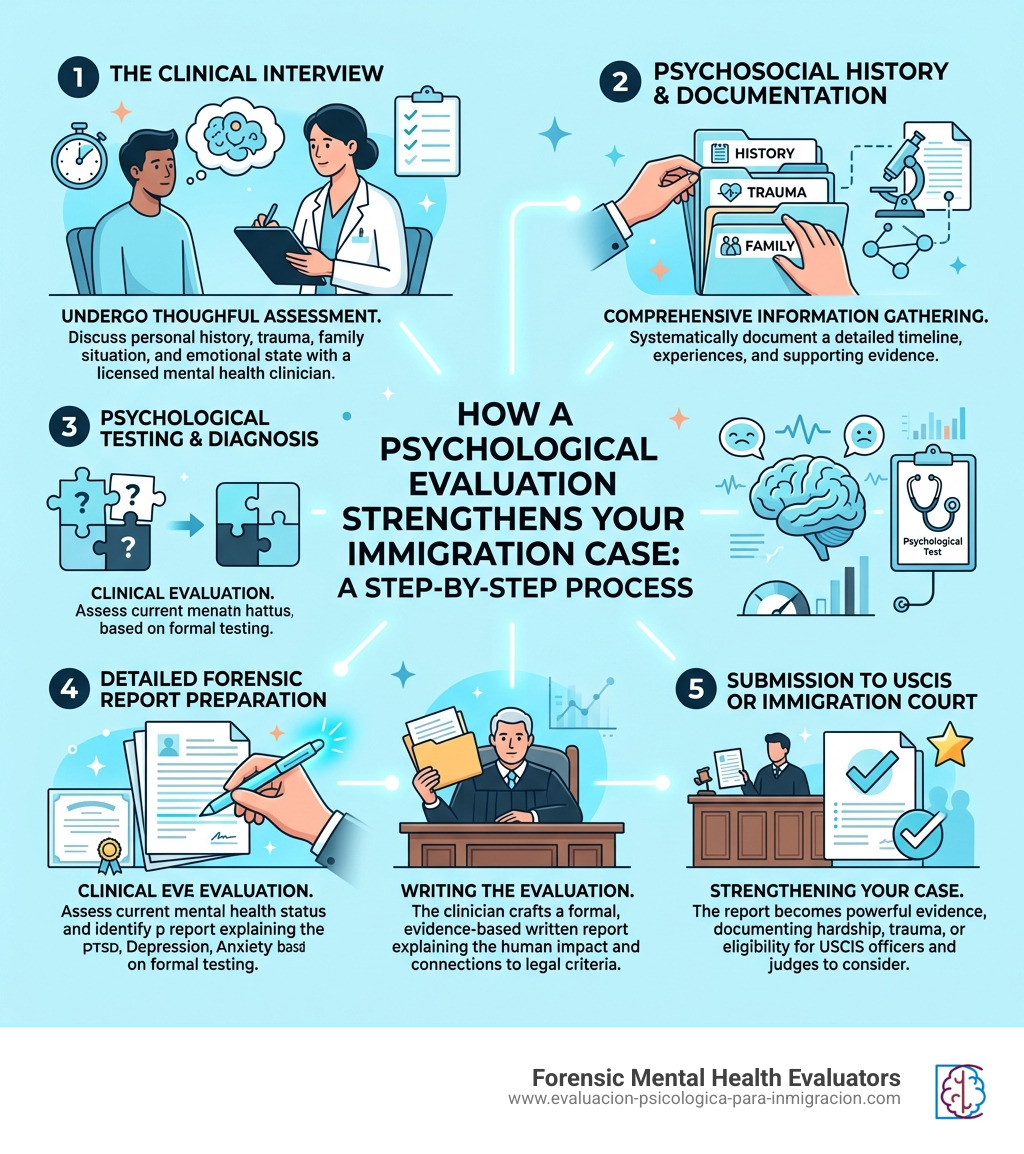
Entering a therapist's office for a legal matter can feel intimidating. We want to demystify the process for you. A standard Evaluación forense de inmigración typically follows these steps:
- Initial Consultation: We discuss your case type and what your attorney is looking for.
- Clinical Interviews: These are deep-dive conversations. We talk about your life in your home country, your journey to the U.S., your current family life, and your mental health symptoms.
- Psychological Testing: We may use standardized assessments (like the PCL-5 for trauma or the PHQ-9 for depression) to support our findings.
- Record Review: We look at medical records, police reports, or school records to build a "totality of circumstances."
- Report Finalization: We write a comprehensive report (often 10–15 pages) that details your history, diagnosis, and recommendations.
Preparing for Your Evaluation for Immigration Interview
To make the most of your appointment, we recommend organizing your documents beforehand. This includes any medical records or previous therapy notes. Most importantly, prepare to be honest. It is okay to cry; it is okay to take breaks. We are trained in cultural sensitivity and understand how difficult it can be to disclose trauma.
If you are applying for a U Visa, for example, your evaluation for immigration will require you to talk about the crime you witnessed or experienced. Our job is to listen with compassion and translate that experience into a format that a judge can use to make a fair decision.
Timelines and What to Expect in April 2026
As of April 2026, the demand for these evaluations remains high. At District Counseling, we prioritize efficiency because we know your legal deadlines are strict.
- Standard Turnaround: Most reports are finalized within 5 to 10 business days after the final interview.
- Expedited Services: If you have a court date next week, we often offer "rush" options to get your report ready in 48–72 hours.
- Attorney Collaboration: We work closely with your legal team to ensure every "i" is dotted and "t" is crossed. If you need a referral, you can visit our Evaluation Referral page.
Hardship Waivers and the Public Charge Rule
One area where mental health and finances overlap is the "Public Charge" rule. Under Chapter 4 - Prospective Determination Based on the Totality of the Circumstances | USCIS, officers look at an applicant's age, health, and financial status to decide if they are likely to become dependent on the government.
A psychological evaluation can help clarify a "health status" issue. For example, if an applicant has a mental health condition but is actively in treatment and capable of working, we can document that in the report to prevent a negative public charge determination.
U.S. vs. Canadian Evaluations
It is worth noting that the process in the U.S. is very different from our neighbors to the north. While U.S. evaluations focus on psychological trauma and hardship, Canadian immigration often relies on sponsorship and financial forms.
| Feature | U.S. Immigration Evaluation | Canadian Sponsorship Evaluation |
|---|---|---|
| Primary Focus | Psychological Trauma/Hardship | Financial Stability/Income |
| Key Document | Clinical Psychological Report | Financial Evaluation Form (IMM 1283) |
| Who Conducts It | Licensed Mental Health Professional | The Sponsor/Government |
| Goal | Prove hardship or trauma impact | Prove ability to support the immigrant |
Discretionary Analysis in Immigration Court
Even if you meet all the legal requirements for a visa, a judge still has "discretion" to say yes or no. According to Chapter 8 - Discretionary Analysis | USCIS, judges weigh "positive equities" against negative factors. A psychological evaluation is a fantastic way to highlight positive equities like:
- Your commitment to your family.
- Your steps toward rehabilitation or therapy.
- Your deep ties to the community.
Choosing a Qualified Clinician and Understanding Costs
Not every therapist is qualified to perform an evaluation for immigration. You should look for someone with specific forensic training and experience with USCIS requirements.
Licensing and Telehealth
In April 2026, telehealth has made it easier than ever to get an evaluation. We provide Evaluaciones psicológicas de inmigración por telehealth: tu guía en TX, CA, ID, UT y FL, allowing clients in rural areas of Idaho or Utah to access the same high-quality care as someone in downtown Houston.
Factors Influencing Evaluation Pricing
We know that immigration is expensive. The cost of an evaluation can vary based on several factors:
- Complexity: An asylum case with multiple family members takes longer than a single VAWA evaluation.
- Translation: At District Counseling, we offer Spanish evaluations that are then translated into English for the court.
- Experience: Clinicians with 20+ years of experience, like those described in our Quiénes somos section, may charge more but provide a more robust report that stands up better in court.
Frequently Asked Questions about Immigration Evaluations
How long does the evaluation process take?
Typically, the interview portion takes 2 to 4 hours, which can be split into two sessions. The written report usually takes another 5 to 10 days to finalize.
Can an evaluation be done in Spanish?
Yes! At District Counseling, we specialize in Spanish-language evaluations. It is vital that you speak your heart in your native language so that no detail of your story is lost in translation. We then provide the certified English translation for USCIS.
What is the difference between a mental health and a psychological evaluation?
A general mental health evaluation is usually for starting therapy. An evaluation for immigration is a "forensic" evaluation. This means it is specifically designed to answer legal questions and provide evidence for a court case. It is much more detailed and focuses on the specific legal standards (like "extreme hardship") required by immigration law.
Conclusion
Your journey to legal status is one of the most important chapters of your life. At District Counseling, we are honored to play a small part in that story. Whether you are in Houston, Austin, Dallas, San Antonio, or accessing us via telehealth in Florida or California, our goal is to provide a report that gives you the best possible chance of success.
We don't just stop at the report. We believe in holistic care, which is why we offer 6 free therapy sessions post-report to help you continue your healing journey. If you are ready to take the next step, visit our Home - Evaluación psicológica para inmigración page to schedule your consultation. Let's work together to make sure your voice—and your mental health—is heard.