
Why a Bilingual Immigration Evaluation Can Change the Outcome of Your Case

A bilingual immigration evaluation is one of the most powerful tools available to immigrants facing deportation or family separation in the U.S. legal system. Here is a quick summary of what it is and why it matters:
What is a bilingual immigration evaluation?
- A psychological assessment conducted in both English and the client's native language (commonly Spanish)
- Performed by a licensed mental health professional trained in forensic and immigration law contexts
- Produces a written clinical report used as legal evidence for USCIS or immigration court
- Covers emotional and psychological impact, trauma history, and hardship factors
- Supports cases involving hardship waivers, VAWA, U-Visa, T-Visa, asylum, and cancellation of removal
Why does bilingual matter?
- Psychological symptoms are often missed or misrepresented when a client cannot communicate in their first language
- Cultural nuance, trauma history, and emotional distress are best captured in the language the client thinks and feels in
- A report built on accurate, detailed information carries more weight with judges and USCIS officers
If you are a Hispanic immigrant in Texas facing deportation, the stakes could not be higher. The thought of being separated from your U.S. citizen children or spouse is devastating — and a strong psychological evaluation can be the evidence that keeps your family together.
Immigration applications are frequently denied not because the hardship isn't real, but because it isn't documented clearly enough. A professionally conducted bilingual evaluation gives your case the clinical voice it needs.
I'm Francisco Ortiz, Lead Forensic Mental Health Evaluator at District Counseling PLLC, a Certified Forensic Mental Health Evaluator (CFMHE) licensed across six states and specifically trained in hardship waiver, asylum, and U-Visa/T-Visa evaluations — with deep expertise in providing bilingual immigration evaluation services for Spanish-speaking clients. In this guide, I'll walk you through everything you need to know about the process, what to expect, and how to build the strongest possible case.
Understanding the Forensic Mental Health Assessment
In immigration law, a forensic mental health assessment is much more than a simple "check-up." It is a specialized Evaluación Psicológica para Inmigración designed to provide clinical evidence that meets the rigorous standards of U.S. Citizenship and Immigration Services (USCIS).
When we conduct these evaluations, we aren't just looking at how you feel today; we are documenting your entire psychological history, the impact of trauma, and the potential mental health consequences of your legal status. This assessment serves as a bridge between your personal experience and the legal requirements of your case. By translating emotional pain into professional clinical data, we help the court understand the "why" behind your petition.
Distinguishing Evaluations from Standard Therapy
One of the most common questions we hear is: "Is this the same as going to therapy?" The short answer is no. While therapy is designed to heal and support you over many months, an Immigration Mental Health Evaluation is a forensic tool used as independent evidence.
In therapy, the therapist is your advocate and "partner" in healing. In a forensic evaluation, we act as objective experts. Our goal is to provide a neutral, fact-based assessment of your mental state. This objectivity is exactly what makes the report so persuasive to judges. They aren't looking for a "friend" to vouch for you; they are looking for a licensed professional to provide a clinical diagnosis and expert opinion based on validated testing.
The Role of a Bilingual Immigration Evaluation in Hardship Waivers
For those applying for I-601 or I-601A waivers, the central theme is "extreme hardship." This means proving that a U.S. citizen spouse or parent would suffer more than the "usual" amount of distress if you were deported.
This is where a bilingual immigration evaluation becomes critical. To prove extreme hardship, we must explore deep psychological distress, family separation anxiety, and the medical or financial impact on your loved ones. Scientific research on acculturation and immigrant mental health shows that the stress of moving between cultures can significantly exacerbate depression and anxiety. If your evaluator cannot speak your language, these nuances—the specific ways your culture views family, duty, and suffering—can be lost in translation, weakening your claim of "extreme" hardship.
Common Case Types Requiring Psychological Evidence
Psychological evidence is often the "missing link" in various immigration petitions. Whether you are in Houston, San Antonio, or Dallas, the legal standards remain high.

As a Texas Immigration Psychological Expert, we frequently work on the following case types:
- VAWA (Violence Against Women Act): For victims of domestic abuse.
- U-Visa: For victims of serious crimes who have assisted law enforcement.
- T-Visa: For victims of human trafficking.
- Political Asylum: For those fearing persecution in their home country.
- Cancellation of Removal: For long-term residents facing deportation.
VAWA and U-Visa Assessments
In VAWA and U-Visa cases, the focus is on documenting the psychological impact of domestic violence or criminal victimization. Many people think abuse has to be physical to count, but emotional, financial, and sexual abuse are just as devastating. Our evaluations use trauma-informed care to document symptoms of PTSD, anxiety, and depression. We explain to USCIS how the abuse has affected your ability to function, work, and parent, providing a comprehensive picture of your resilience and your needs.
Asylum and T-Visa Evaluations
Asylum cases require a deep dive into your fear of persecution based on race, religion, or political opinion. We document your pre-torture and post-torture history, looking for specific markers of PTSD. Similarly, T-Visa evaluations address the psychological impact of sex or labor trafficking. These sessions are handled with extreme sensitivity. We also provide virtual bilingual support so clients across Texas, Florida, and New York can complete the process from the comfort of their homes.
The Process and Timeline of a Bilingual Immigration Evaluation
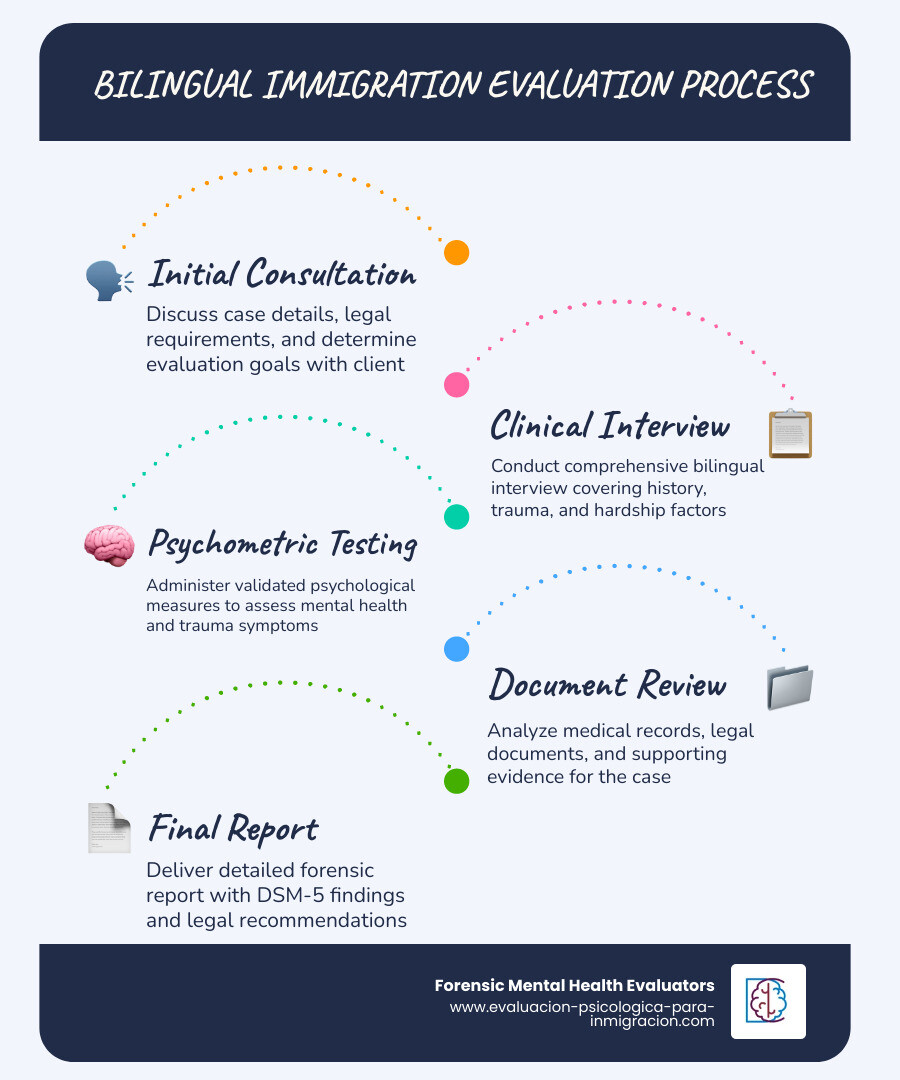
We know that immigration deadlines are stressful. That’s why we’ve streamlined our process to be as efficient as possible without sacrificing quality. A typical evaluation includes several key steps:
- Clinical Interview: A deep dive into your personal, family, and medical history.
- Psychometric Testing: Using validated tools to objectively measure symptoms.
- Document Review: We look at police reports, medical records, and school transcripts.
- Diagnosis: Integrating findings using DSM-5 criteria.
- Report Drafting: Writing a detailed, 10-15 page narrative for your attorney.
Service Timeline Comparison
| Service Type | Turnaround Time | Best For... |
|---|---|---|
| Standard Evaluation | 2–4 Weeks | Most cases with normal court dates |
| Expedited Evaluation | 7–10 Days | Urgent deadlines or "rush" filings |
| Super Express | 5 Business Days | Emergency situations (available on request) |
What to Expect During the Assessment Sessions
Most evaluations require 2 to 3 hours of your time, often split across two sessions. During this time, we perform a Mental Status Exam and ask about your history. It’s okay to be nervous! Our job is to make you feel safe.

We use validated measures—essentially specialized questionnaires—to confirm our clinical observations. This data makes the report much harder for the government to dispute because it isn't just an "opinion"; it’s backed by science.
Overcoming Language Barriers in a Bilingual Immigration Evaluation
Is it strictly required for an evaluator to be bilingual? Technically, no—an evaluator could use an interpreter. However, research on language assessment validation in immigration suggests that direct communication is far superior.
When an interpreter is used, the "rhythm" of the conversation is broken. Nuance is lost. As a bilingual provider, we catch the subtle emotional cues in Spanish that an English-only speaker might miss. We understand cultural idioms and the specific ways trauma is expressed in Hispanic communities. This native fluency ensures that your story is told accurately, with all its emotional weight intact.
Why Bilingual Capability is Critical for Legal Outcomes
A bilingual immigration evaluation does more than just translate words; it builds rapport. When you can speak your heart in your native tongue, you are more likely to share the difficult details that actually win cases.
Our Evaluaciones Psicológicas de Inmigración por Telehealth allow us to bring this cultural competence to you wherever you are. Whether you are in a rural part of Idaho or a busy street in New York, you deserve an evaluator who truly "gets it."
Credentials and Training for Evaluators
Don't be afraid to ask about credentials. You should look for a licensed psychologist or mental health professional with specialized forensic training.
At District Counseling, our lead evaluators have over 20 years of experience. We have completed dozens of specialized trainings in immigration law and forensic assessment. This level of expertise is vital because, in some cases, the psychologist may be called to provide expert witness testimony in court. You want someone who is as comfortable in a courtroom as they are in a clinic.
Cost Factors and Payment Options
We believe in transparency. Generally, a bilingual immigration evaluation ranges from $600 to $1,000. Factors that affect the price include:
- The complexity of the case (how many people need to be interviewed?).
- The timeline (do you need it in 7 days or 21 days?).
- The amount of medical or legal records we need to review.
Please note that because these are forensic evaluations (legal evidence) and not clinical treatment, they are almost never covered by insurance. However, we offer flexible payment plans to help families manage the cost during what we know is an expensive legal process.
Frequently Asked Questions about Immigration Evaluations
Is a mental health diagnosis required for my case?
Not necessarily. While a DSM-5 diagnosis (like PTSD or Major Depressive Disorder) can strengthen a case, it is not always a strict requirement for a hardship waiver. The judge looks at the "totality of circumstances." Our reports focus on your overall psychological functioning and the specific hardships you face, with or without a formal diagnosis.
Can evaluations be conducted via telehealth in May 2026?
Absolutely. Since the pandemic, USCIS and immigration courts have widely accepted evaluations conducted via secure, HIPAA-compliant video-conferencing. This is a huge benefit for clients in states like Utah, Virginia, or Florida who may not have a bilingual forensic expert in their local town.
How long is the final psychological report?
Our reports are typically 10 to 15 pages long. They include a detailed narrative of your life, results from psychometric testing, a mental status exam, and clear clinical recommendations. We don't just "fill out a form"; we write a comprehensive document that tells your story.
Conclusion
Navigating the immigration system is a marathon, not a sprint. At Forensic Mental Health Evaluators and District Counseling, we are here to provide the clinical endurance you need. From our offices in Houston, Katy, Cypress, and Sugarland, we serve the entire state of Texas—including Austin, Dallas, and San Antonio—as well as clients in Florida, California, New York, and beyond.
Our unique approach combines deep forensic expertise with a heart for the immigrant community. We don't just stop at the report; we offer Spanish-to-English translation of all findings and provide 6 free therapy sessions post-report to ensure you have the support you need as your case moves forward.
To learn more about our team and our mission, visit Quiénes Somos - Experto en Evaluación Psicológica para Inmigración. Let us help you turn your story into the evidence that secures your future in the United States.