
Everything You Need to Know About VAWA Psychological Evaluations
Why a VAWA Evaluation Can Change the Outcome of Your Immigration Case

A VAWA evaluation is a written psychological report prepared by a licensed mental health professional. It documents the abuse you experienced and its impact on your mental health — and it can be one of the most powerful pieces of evidence in your Form I-360 self-petition.
Here's what you need to know at a glance:
- What it is: A clinical or forensic report documenting trauma, abuse, and psychological impact for USCIS review
- Who needs it: Immigrants who experienced battery or extreme cruelty from a U.S. citizen or lawful permanent resident spouse, parent, or child
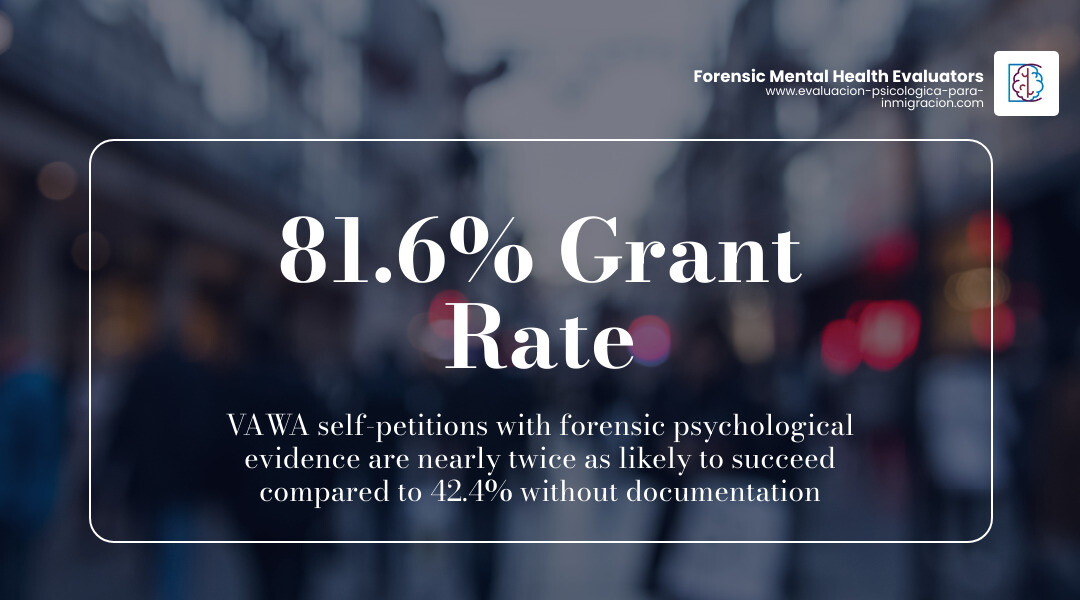
- Why it matters: Cases with forensic evaluations are approved at an 81.6% rate — compared to just 42.4% without such documentation
- When to get it: Before submitting your I-360 petition, especially if you have no police reports or medical records
- How long it takes: Typically 5–7 business days; expedited options available
- What it costs: Generally $600–$650, with reduced fees available for those who cannot afford full cost
Many immigrant survivors — especially in Hispanic communities in Texas — never called the police. They stayed silent out of fear, dependency, or because their abuser threatened their immigration status. That silence does not disqualify you. But it does mean your evidence has to work harder. A well-written psychological evaluation fills that gap.
I'm Francisco Ortiz, Lead Forensic Mental Health Evaluator at District Counseling, a Certified Forensic Mental Health Evaluator (CFMHE) licensed in six states with specialized training in VAWA evaluation and immigration forensics. In this guide, I'll walk you through everything you need to know — from eligibility and evidence to what happens during the evaluation itself.
What Is a VAWA Evaluation and Why Does It Matter?
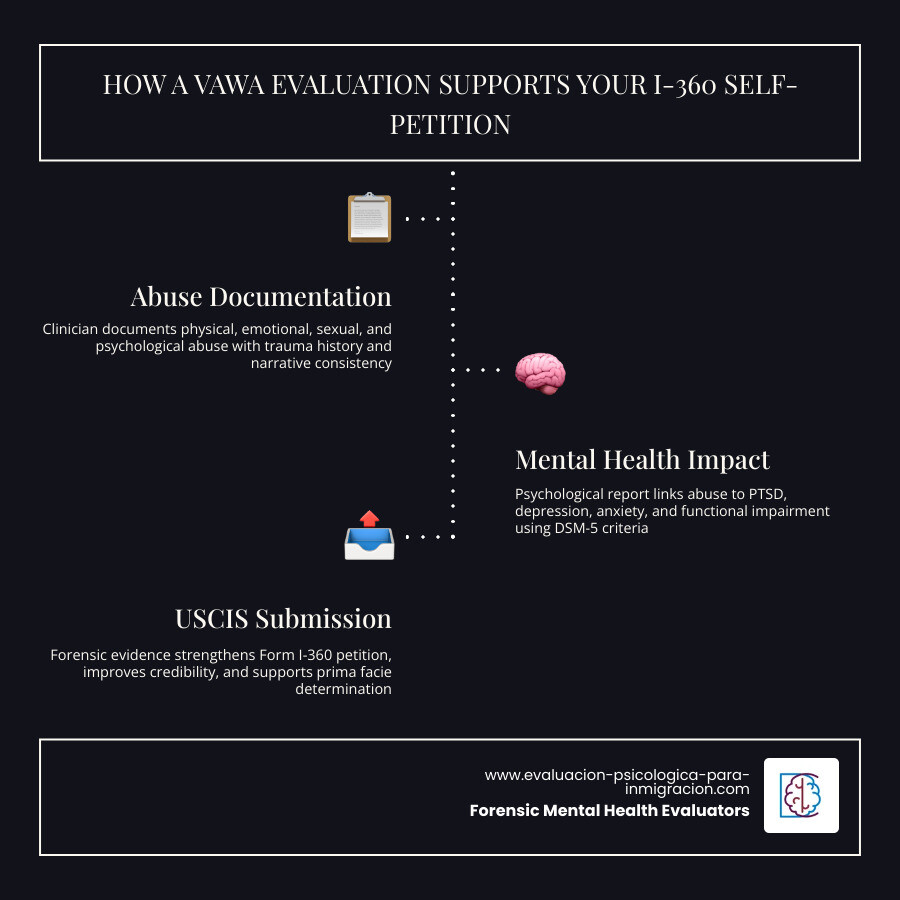
A VAWA evaluation is a psychological assessment used to support a VAWA self-petition filed on Form I-360. Its job is not to replace legal evidence, but to explain the abuse clearly, document trauma symptoms, and connect the survivor's experiences to clinically recognized mental health effects.
For many applicants, this report becomes the bridge between "something terrible happened" and "here is professional evidence showing how that abuse affected me."
If you want a broader overview of this type of service, see our page on VAWA psychological evaluations.
What a VAWA psychological evaluation documents
A strong evaluation usually documents:
- The history of the relationship with the abuser
- The pattern of abuse over time
- Physical abuse, if present
- Emotional abuse and coercive control
- Immigration-related threats
- Symptoms such as PTSD, anxiety, depression, panic, insomnia, or fear
- How the abuse affected work, parenting, sleep, concentration, and daily functioning
- Why the survivor may not have reported the abuse earlier
USCIS recognizes that abuse is not always visible. Many VAWA cases involve "extreme cruelty" rather than obvious physical injuries. That can include humiliation, isolation, stalking, threats to take the children, financial control, or threats like "If you leave me, I'll get you deported."

How a VAWA evaluation strengthens a self-petition
Psychological evaluations are especially useful as secondary evidence. They can:
- Corroborate your personal declaration
- Explain missing police or medical records
- Document nonphysical abuse
- Show consistency in the abuse narrative
- Help an officer understand trauma responses that may otherwise seem confusing
For example, trauma can affect memory. A survivor may remember events out of sequence, minimize the abuse, or leave out details on the first telling. That does not mean they are being dishonest. It often means their nervous system has been in survival mode. A trained evaluator can explain that in a professional, objective way.
Research cited in the materials above found an 81.6% grant rate in immigration relief cases that included forensic medical or psychological evaluations, compared with a 42.4% national grant rate for cases without that documentation. That does not mean an evaluation guarantees approval, but it does show why careful documentation matters.
Clinical vs. forensic evaluations for immigration cases
Not every mental health letter is equally useful in an immigration filing.
A clinical evaluation is usually focused on treatment: helping the client feel better, stabilizing symptoms, and planning care. A forensic evaluation is focused on legal questions: documenting facts, symptoms, diagnostic impressions, and the connection between the abuse and the immigration claim in a way USCIS can review.
| Clinical evaluation | Forensic evaluation |
|---|---|
| Treatment-focused | Evidence-focused |
| Built for therapy planning | Built for legal review |
| May be brief or informal | Usually structured and detailed |
| Emphasizes support | Emphasizes objectivity and documentation |
| May not address legal standards | Tailored to immigration standards and evidentiary needs |
Both can be valuable, but in immigration cases, forensic method matters. That includes neutral language, careful record review, DSM-5-informed analysis when appropriate, and coordination with the legal team. For more on this difference, visit our page on immigration forensic evaluations.
Who Qualifies for VAWA Immigration Relief?
VAWA immigration relief is available to certain abused family members of U.S. citizens or lawful permanent residents. Despite the name, VAWA protections are not limited by gender. Men, women, and nonbinary survivors may qualify.
Core VAWA eligibility requirements
In general, USCIS looks for these elements:
- A qualifying relationship to the abuser
- Abuse by a U.S. citizen or lawful permanent resident spouse, parent, or child
- Evidence of battery or extreme cruelty
- Residence with the abuser at some point
- Good moral character
- For spouses, proof that the marriage was entered into in good faith
Common qualifying categories include:
- Abused spouse of a U.S. citizen or lawful permanent resident
- Abused child of a U.S. citizen or lawful permanent resident
- Abused parent of a U.S. citizen son or daughter who is at least 21
There is no filing fee for a VAWA self-petition on Form I-360. In some cases, unmarried children under 21 can also be included as derivative beneficiaries.
Abuse can be physical, emotional, sexual, or psychological
A lot of people think abuse only "counts" if there are bruises, a police report, and dramatic movie-scene evidence. Real life is messier.
VAWA can cover:
- Hitting, pushing, choking, or other physical violence
- Sexual abuse or sexual coercion
- Verbal degradation
- Isolation from friends and family
- Financial control
- Stalking and intimidation
- Threats to report the survivor to immigration
- Threats involving children
- Extreme monitoring, jealousy, or control
In many cases, the most damaging pattern is coercive control. The survivor may be constantly afraid, unable to make choices, and trapped by dependency. That pattern can absolutely matter in a VAWA case.

Key evidence USCIS may expect with or without a psychological evaluation
USCIS does not require one perfect package of evidence. Instead, cases are often built from multiple pieces that support each other.
Common VAWA evidence includes:
- Personal declaration or affidavit
- Proof of the qualifying relationship
- Marriage certificate, birth certificate, or other family records
- Evidence of shared residence
- Police reports
- Medical records
- Protection orders
- Photos of injuries or property damage
- Shelter records
- Counseling or therapy records
- Witness affidavits from family, friends, clergy, or advocates
- Text messages, emails, or voicemails
- Evidence of good moral character
A psychological evaluation often becomes most important when some of those records do not exist.
When Psychological Evaluations Are Most Critical in VAWA Cases
Some cases are already well documented. Others are not. And honestly, many survivors do not have a neat folder labeled "proof of trauma." Abuse rarely organizes itself for USCIS.
Using a vawa evaluation when traditional evidence is unavailable
Evaluations are often critical when there is:
- No police report
- No hospital or doctor visit
- No restraining order
- Delayed disclosure
- Fear of deportation
- Financial dependency on the abuser
- Cultural or family pressure to stay silent
- Limited English proficiency
- Abuse that happened behind closed doors
A clinician can explain why a survivor did not report. For example, the abuser may have controlled transportation, money, identification documents, or access to phones. The survivor may have feared losing children, housing, or immigration options. These are common trauma dynamics, not red flags.
Cases involving primarily emotional abuse or extreme cruelty
Some of the strongest reasons to get a VAWA evaluation are cases centered on emotional abuse or extreme cruelty.
These cases may involve:
- Gaslighting
- Constant humiliation
- Threats to ruin immigration status
- Threats to take the children
- Forced isolation
- Sleep problems
- Panic attacks
- Trouble working or caring for family
- Depression, anxiety, or trauma symptoms without visible injuries
A well-prepared report can show that psychological abuse is still abuse, and that its effects are real, measurable, and serious.
Research on outcomes and why documentation matters
The evidence in your file matters because immigration decisions are documentation-driven. Research in the materials above shows a major difference in case outcomes when forensic medical or psychological evidence is included: 81.6% grant rates versus 42.4% without such documentation.
That matters even more in immigrant communities, where intimate partner violence may be underreported. Some studies cited in the research indicate that immigrant women experience IPV at rates equal to or higher than U.S.-born women, with some populations reporting lifetime rates as high as 93%, compared with 36.4% among U.S.-born women.
And the broader social value of VAWA is not just personal, but measurable. One cost-benefit analysis found that the original Violence Against Women Act generated an estimated $14.8 billion in net averted social costs. If you'd like to review that research, see A Cost-Benefit Analysis of the Violence Against Women Act of 1994 and Assessing the Impact of the Violence Against Women Act.
What Happens During the VAWA Evaluation Process?
People are often nervous before the evaluation. That is completely normal. The good news is that the process is usually structured, confidential, and paced carefully.
Step-by-step vawa evaluation process
A typical process includes:
- Initial screening or scheduling call
- Review of available records, if any
- One-on-one interview about background, relationship history, and abuse
- Questions about symptoms and daily functioning
- Psychometric or trauma-related questionnaires when appropriate
- Mental status examination
- Diagnostic impressions, if supported
- Drafting of the report for the legal case
Some evaluations are done in person, and many are completed by secure telehealth, which can be especially helpful for clients across Texas, Florida, California, New York, Utah, Virginia, and Idaho.
What questions the evaluator may ask
The evaluator may ask about:
- Your family and relationship history
- When and how the abuse started
- The worst incidents
- Patterns of control or threats
- Whether children were involved
- Physical, emotional, and psychological symptoms
- Sleep, appetite, concentration, and work functioning
- Prior counseling or treatment
- Current safety concerns
- Immigration-related stress
These questions are not meant to judge you. They are meant to understand your experience and document it accurately.
Report length, turnaround times, and expedited options
Turnaround times vary by provider and case complexity. Based on the research, common timelines include:
- Standard turnaround: 5 to 7 business days in some practices
- Other providers: about 2 to 3 weeks from interview to completed draft
- Expedited options: as fast as 48 to 72 hours or about 1 week, usually for an extra fee
Report length is commonly around 10 to 20 pages, depending on the facts, testing, and legal needs.
Cost of VAWA psychological evaluations and low-cost options
In the research provided, common fees were:
- Around $600 for a standard VAWA psychological evaluation
- Around $650 in some settings
- Additional interpreter fee in some cases
- Additional expedited fee for rush reports
Costs depend on complexity, turnaround time, records review, and whether an interpreter is needed. Some organizations offer negotiable rates, sliding scale options, or free services for certain immigrant crime victims and survivors with financial hardship.
If you are exploring the broader process, our page on immigration psychological evaluations may help.
VAWA Processing Times, Prima Facie Determination, and Next Steps
The evaluation is one part of the case. Applicants also want to know the bigger question: "How long is all this going to take?" Fair question. Immigration timelines are not exactly famous for speed.
Typical processing times in 2026
Based on the research provided, average processing times are approximately:
- Abused spouse self-petitions: 28.3 months
- Abused child self-petitions: 28.4 months
- Abused parent self-petitions: 19.7 months
These are averages, not promises. USCIS backlogs, RFEs, and case complexity can change the timeline. Most applicants first receive a receipt notice, then wait for further updates, possible prima facie review, and eventually adjudication.
What prima facie determination means
A prima facie determination means USCIS has conducted an initial review and found that the filing appears to establish eligibility on its face. It is not final approval.
Why it matters:
- It can show the case appears legally sufficient at an early stage
- It may help with access to certain public benefits in some jurisdictions
- It can provide an important sign that the filing is moving forward
But it is not the finish line. Think of it as "you cleared the first gate," not "you already won the marathon."
After filing or approval: work authorization, green card, and travel
Depending on the stage of the case, applicants may later pursue:
- Work authorization through Form I-765 in qualifying situations
- Adjustment of status through Form I-485 if eligible
- Advance parole before travel outside the U.S. during adjustment
USCIS also emphasizes confidentiality in VAWA cases, and using a safe mailing address is often important. Travel should always be discussed with an immigration attorney before leaving the country.
For a broader mental-health context in immigration cases, see immigration mental health evaluations.
How to Choose the Right Evaluator for Your VAWA Case
Not all evaluators write reports the same way. A warm clinician is important. A skilled forensic writer is also important. Ideally, you want both.
Qualifications that matter most
Look for an evaluator who has:
- Professional licensure
- Experience with immigration cases
- Forensic training or forensic writing experience
- Trauma-informed interviewing skills
- Familiarity with DSM-5 concepts
- Ability to produce clear, organized, court-ready reports
- Comfort coordinating with attorneys when appropriate
An evaluator does not need to make your story dramatic. They need to make it clear, credible, and well documented.
Questions to ask before you book
Before scheduling, ask:
- What is your turnaround time?
- Do you offer expedited reports?
- What are your total fees?
- Is there an extra interpreter fee?
- Do you offer telehealth?
- Do you coordinate with attorneys?
- What documents should I bring?
- Can you provide the report in Spanish and English, or translate Spanish interviews into English reports?
- What is your revision policy if the attorney needs clarification?
These questions can save stress later.
Why fit, language access, and trauma-informed care matter
A good evaluation depends on accurate disclosure. Accurate disclosure depends on trust.
That is why fit matters. If the client does not feel safe, heard, or culturally understood, important details may stay buried. Trauma-informed care helps reduce retraumatization and allows the story to emerge at a manageable pace.
For many of our clients, language access is a major issue. We serve clients in Texas and other listed states with Spanish-language evaluations translated into English, and we focus heavily on client comfort throughout the process. We also provide 6 free therapy sessions post-report, because the legal case may end on paper, but healing rarely does.
Frequently Asked Questions About VAWA Evaluation
Is a VAWA psychological evaluation required for every Form I-360 case?
No. It is not legally required in every case. But it can be highly persuasive, especially when the abuse was primarily emotional, when evidence is limited, or when the attorney wants stronger corroboration.
How much does a VAWA evaluation usually cost?
Based on the research above, typical fees are in the $600 to $650 range, with possible add-on costs for interpreter services or expedited turnaround. Some providers offer reduced fees, sliding scale arrangements, or nonprofit-supported services.
Can I still file if I never called the police?
Yes. Many survivors never contact law enforcement. A VAWA case can still be filed using a personal declaration, witness statements, relationship evidence, and a psychological evaluation that explains trauma, fear, coercion, and the lack of formal reports.
Do I need a lawyer for VAWA?
You can self-petition, but legal representation is strongly recommended because VAWA filings are document-heavy and strategy matters. A good attorney can help decide when a psychological evaluation is most useful and how to present it with the rest of the evidence.
Will there be an interview?
Sometimes. USCIS may request an interview for the I-360, and adjustment of status commonly involves an interview. These interviews should be handled with awareness of the trauma involved.
Conclusion
A VAWA evaluation can be one of the strongest pieces of evidence in a Form I-360 self-petition. It helps document abuse, explain trauma, support credibility, and fill gaps when police reports or medical records do not exist. For many survivors, that is the difference between a story that feels invisible and a record that USCIS can clearly understand.
At District Counseling, we provide immigration-focused psychological evaluations for clients in Houston, Katy, Cypress, Sugar Land, and across our listed service areas in Texas, Florida, California, New York, Utah, Virginia, and Idaho. We prioritize comfort, trauma-informed care, Spanish evaluations translated into English, and continued support through 6 free therapy sessions after the report.
If you want to learn more, visit our page on VAWA services or request help through our evaluation referral page.