
What to Expect During Your Hardship Evaluation
What a Hardship Evaluation Actually Is — and Why It Matters for Your Immigration Case

A hardship evaluation is a formal psychological assessment that documents how a U.S. citizen or permanent resident family member would suffer if their loved one is deported or denied entry into the United States.
Here is what you need to know quickly:
- What it is: A written report by a licensed mental health professional that describes the emotional, medical, financial, and social harm your qualifying relative would face
- Who it's for: Your U.S. citizen or permanent resident spouse, child, or parent — not you directly
- When you need it: When applying for an I-601 or I-601A waiver to overcome a ground of inadmissibility
- What it must show: Hardship that goes well beyond what most families normally experience from separation
- Standard of proof: You must prove extreme hardship by a preponderance of the evidence — meaning it is more likely than not that the hardship would occur
If you are a non-permanent resident facing deportation or visa denial, and you have a U.S. citizen child or spouse in Texas, this evaluation may be one of the most important documents in your entire immigration case.
The fear of being separated from your children or spouse is real. And it is exactly that kind of documented suffering — emotional, psychological, financial — that USCIS needs to see in writing from a qualified professional.
I am Francisco Ortiz, Lead Forensic Mental Health Evaluator at District Counseling PLLC and a Certified Forensic Mental Health Evaluator (CFMHE), and I have completed advanced forensic training specifically in hardship evaluation for immigration waivers. In this guide, I walk you through every step of the process so you know exactly what to expect.
Understanding the Hardship Evaluation in Immigration Law
In U.S. immigration law, a hardship evaluation is most commonly used to support I-601 and I-601A waivers. These waivers ask USCIS to forgive certain inadmissibility issues when denying admission would cause extreme hardship to a qualifying relative.
That last phrase matters: qualifying relative. In many waiver cases, USCIS is focused on the hardship to a U.S. citizen or lawful permanent resident spouse or parent. The law does not simply ask whether separation would be painful. Of course it would. It asks whether the consequences rise above ordinary family distress and become legally significant hardship.
USCIS explains this in its policy guidance on adjudicating extreme hardship claims. Officers review the total picture, including present hardship, future hardship, and whether the evidence shows that the claimed harm is more likely than not.
In Canada, hardship is considered in a different legal framework. Under section 25(1) of the Immigration and Refugee Protection Act, humanitarian and compassionate relief allows officers to consider a broad set of personal circumstances. The Canadian approach is not the same as a U.S. I-601 or I-601A waiver, but the comparison is useful because both systems wrestle with the same question: when does suffering become serious enough that the law should respond?
If you want a broader overview of immigration evaluations generally, our Hardship Evaluation Resources can help place this report in the larger immigration process.
Distinguishing Extreme from Normal Distress in a Hardship Evaluation
One of the biggest sources of confusion is the difference between normal hardship and extreme hardship.
Normal hardship includes consequences that most families would experience after separation, such as:
- Sadness
- Financial strain
- Disruption of routines
- Difficulty parenting alone
- Trouble adjusting to a move
Those consequences are real, but USCIS generally treats them as common. Extreme hardship requires more. Under USCIS extreme hardship factors, officers look at whether the hardship is intensified by medical issues, mental health conditions, caregiving obligations, dangerous country conditions, disability, military service, or a combination of factors that together become severe.
This is where a professional clinical assessment helps. We do not just say, "This family is suffering." We explain how and why the suffering is clinically serious, functionally impairing, and connected to the immigration outcome.
Think of it like this: rain is normal, a hurricane is not. Both are weather. Only one knocks the roof off.
The Legal Framework: From Kanthasamy to Rubio
Canadian hardship law changed significantly after Kanthasamy v. Canada in 2015. The Supreme Court of Canada rejected a rigid formula that treated "unusual and undeserved or disproportionate hardship" like a strict gatekeeping test. Instead, the Court emphasized a flexible, humanitarian assessment of all the circumstances.
That matters because it pushed decision-makers toward a more human, less mechanical analysis.
Later cases, including Rubio, Marshall, and other post-Kanthasamy decisions, reinforced that officers must meaningfully engage with evidence of personal vulnerability. Courts have criticized decisions that focus only on general country conditions while ignoring mental health evidence, trauma history, caregiving realities, or the actual impact of removal on children.
In other words, hardship cannot be reduced to a checklist.
In the U.S., the wording is different, but the logic is similar. USCIS officers must review hardship in the aggregate and apply the preponderance standard. A single factor may be enough in some cases, but often it is the cumulative effect of many factors that makes the case persuasive.
That is why our forensic work is structured around the totality of circumstances rather than isolated symptoms or one dramatic sentence. For more on this style of legal-clinical analysis, see Evaluación Forense de Inmigración.
The Role of Mental Health in a Hardship Evaluation

Mental health evidence can be central to a hardship evaluation. In many families, the most serious harm is not visible on a bank statement. It appears in panic attacks, depressive symptoms, insomnia, trauma responses, caregiver burnout, and declining ability to function at work, school, or home.
USCIS accepts probative evidence of many kinds, including expert opinions and mental health documentation. A psychological evaluation can help explain:
- PTSD symptoms related to trauma or fear of separation
- Clinical depression worsened by immigration uncertainty
- Anxiety that interferes with sleep, parenting, or employment
- The emotional dependence between family members
- The effect of relocation on a person already vulnerable due to illness, disability, or past abuse
A good evaluation is not dramatic for the sake of being dramatic. It is careful, evidence-based, and specific. We review records, conduct a clinical interview, take a psychosocial history, and where appropriate use diagnostic testing to support our conclusions.
If you want more background on this kind of work, see our page on immigration mental health evaluations.
Objective vs. Subjective Hardship Factors
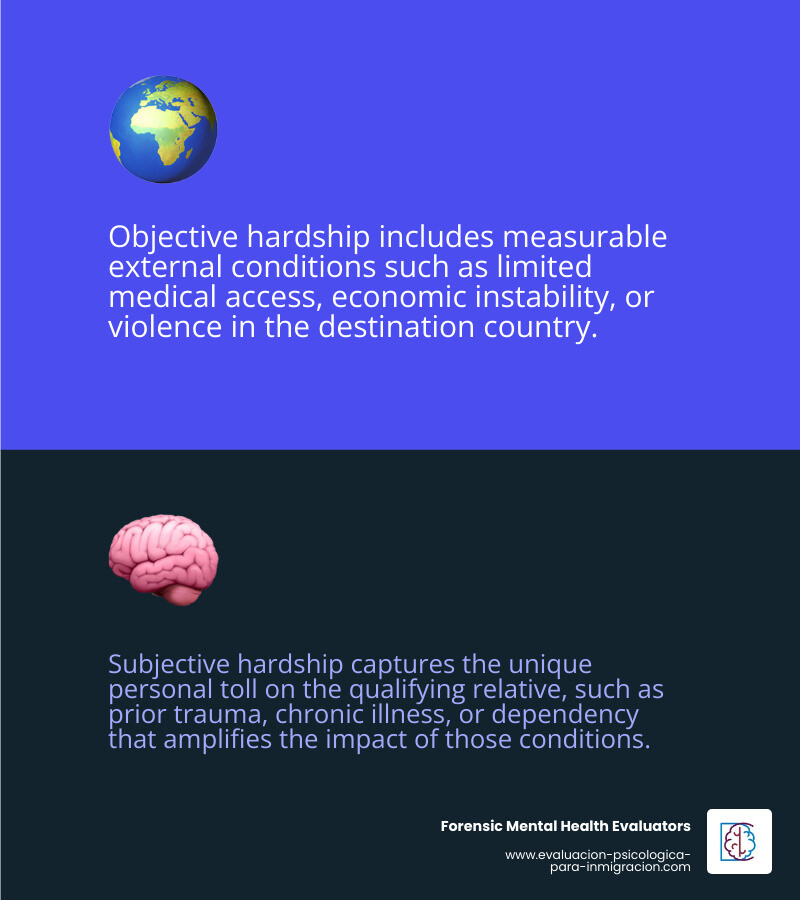
A strong hardship case usually includes both objective and subjective hardship.
Objective hardship refers to external facts, such as:
- Country conditions
- Economic instability
- Limited access to medical care
- Violence or unrest
- School disruption
- Loss of employment or housing stability
Subjective hardship refers to the personal impact of those facts on this specific family, such as:
- Prior trauma
- Anxiety sensitivity
- Chronic illness
- Developmental needs
- Intimate partner violence history
- Dependency on the applicant for caregiving or emotional regulation
This distinction is important because officers sometimes accept that a country has difficult conditions but still deny relief if the applicant fails to show why those conditions are uniquely harmful to the qualifying relative.
For example, "medical care is worse abroad" is too general by itself. But "the qualifying relative has a chronic condition, relies on ongoing specialist care, cannot interrupt treatment safely, and would lose both medical support and daily caregiving if forced to relocate" is much stronger.
The best reports connect the outside world to the inside experience. Facts matter. So does the human nervous system.
Best Interests of the Child Considerations
When children are affected, their best interests deserve special attention. In Canadian humanitarian law, the best interests of the child must be treated as a primary consideration. In U.S. cases, children may not always be the statutory qualifying relatives for every waiver, but their needs can still be highly relevant to the hardship analysis affecting a qualifying parent or spouse.
We look closely at issues such as:
- Educational disruption
- Language barriers
- Developmental milestones
- Medical and mental health needs
- Attachment to caregivers
- Risk of family separation
- Risk that a child could lose stable care arrangements
Research and case law both show that child hardship is often underestimated. Courts have criticized decisions that mention children in passing but fail to seriously analyze foster care risk, emotional attachment, special education needs, or the lasting psychological impact of separation.
If a child has asthma, autism, depression, trauma symptoms, learning challenges, or a strong dependence on the applicant for daily structure, that should be clearly documented. "Kids are resilient" is not a legal analysis. It is a bumper sticker.
For families seeking child-centered psychological evidence, our Evaluación Psicológica para Inmigración page explains how these evaluations fit into immigration cases.
Preparing for Your Hardship Evaluation: A Step-by-Step Guide
Most people feel nervous before a hardship evaluation. That is normal. The good news is that the process is usually more structured and more supportive than people expect.
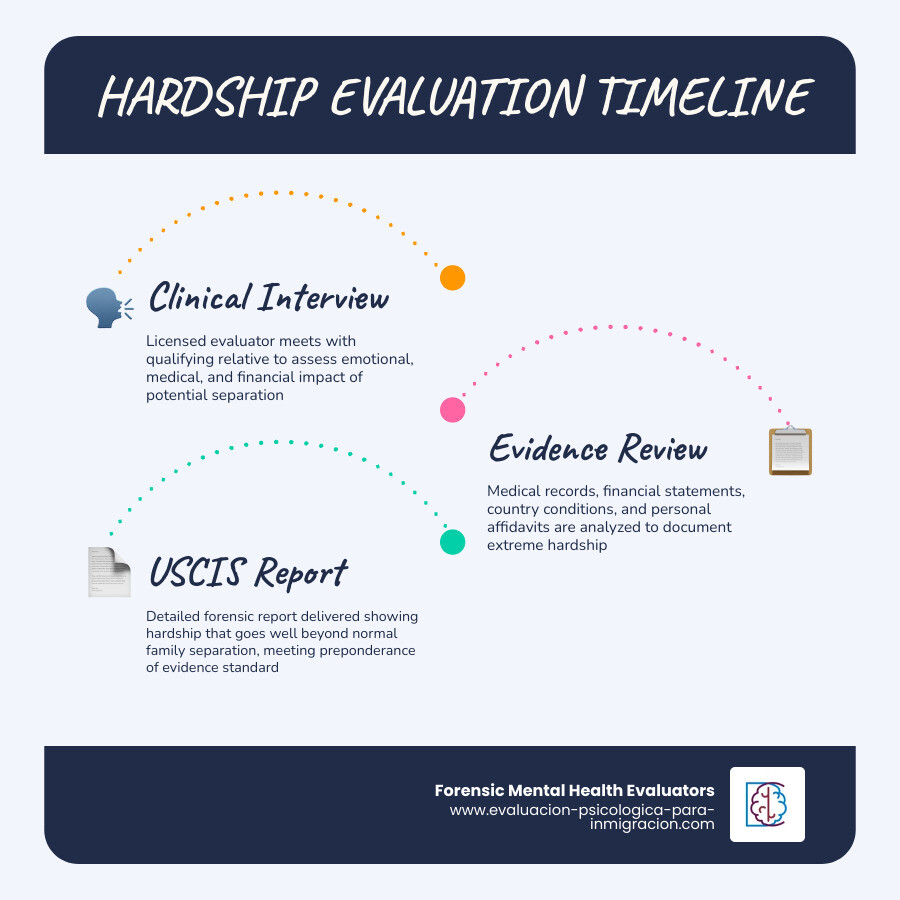
Here is what the process often looks like:
Initial scheduling and case screening
We confirm the type of immigration matter, whether a waiver or related proceeding is involved, and who the qualifying relative is.Document collection
We ask for records that support the hardship claim, such as medical records, therapy notes, school records, financial documents, and country condition evidence.Clinical interview
We meet with the relevant person or people and take a detailed psychosocial history. This includes family background, mental health symptoms, medical issues, caregiving roles, immigration stress, and daily functioning.Standardized testing when appropriate
In some cases, symptom inventories or other psychological measures help clarify severity and support diagnostic impressions.Attorney coordination
We align the report with the legal issues in the case. Clinical truth comes first, but legal relevance matters too.Report drafting
We write a clear, organized report that explains findings, diagnoses if applicable, and the connection between the immigration decision and the expected hardship.Final delivery
The report goes to the client or attorney for filing with the immigration application.
For a broader look at the evaluation process, you can also review our Immigration Evaluation Guide 2026.
Essential Evidence and Documentation
USCIS accepts many kinds of evidence, but not all evidence carries the same weight. The most persuasive submissions are specific, credible, and tied directly to the hardship claim.
| Evidence type | More persuasive | Less persuasive |
|---|---|---|
| Personal statements | Detailed affidavit with dates, examples, and daily impact | Short statement with general fear or sadness |
| Medical evidence | Recent records, diagnosis, treatment history, provider letter | Old records without explanation |
| Mental health evidence | Forensic psychological evaluation with clinical findings | Generic counseling letter with little detail |
| Financial evidence | Tax returns, pay stubs, bills, debt records, caregiving costs | Unsupported claim that money will be tight |
| Country conditions | Official reports tied to the family's specific risks | General internet printouts with no case connection |
| School evidence | Attendance records, IEPs, letters from educators | Vague claim that children will struggle |
| Corroboration | Letters from people with direct knowledge | Repetitive letters with no specifics |
Useful evidence may include:
- Medical and psychiatric records
- Prescription history
- Therapy records
- Pay stubs and tax returns
- Rent or mortgage records
- Debt and monthly expense records
- School records
- Disability documentation
- Evidence of caregiving duties
- Country reports from government or credible organizations
- Affidavits signed under penalty of perjury
- Professional credentials when employment disruption matters
USCIS policy makes clear that any probative evidence may be considered. If one important document is unavailable, it is often better to explain why and offer alternative proof than to leave a gap unexplained.
Structuring the Claim for Success
A persuasive hardship case does not just collect documents. It organizes them into a coherent story supported by evidence.
The strongest structure usually does the following:
- Identifies the qualifying relative clearly
- Explains both scenarios when relevant: separation and relocation
- Shows present hardship and future hardship
- Links each hardship claim to supporting evidence
- Analyzes cumulative effects rather than isolated problems
- Addresses discretion separately from eligibility
This last point is often missed. Even if extreme hardship is established, some waivers still involve a discretionary decision. That means positive equities matter too, such as family unity, caregiving, treatment participation, work history, and community ties.
We also recommend avoiding segmented analysis. A case should not treat depression, finances, childcare, and medical needs as unrelated boxes. Real life is messier than that. Hardship often becomes extreme because these problems stack on top of each other.
Common Pitfalls and Reasons for Rejection
Hardship claims are often weakened by problems that could have been avoided with better preparation. Common pitfalls include:
- Treating family separation alone as enough without showing unusual severity
- Relying only on general country conditions
- Ignoring the qualifying relative and focusing only on the applicant
- Submitting inconsistent statements across records, affidavits, and interviews
- Failing to provide corroboration for medical, financial, or caregiving claims
- Using letters that are emotional but not specific
- Providing a diagnosis without explaining functional impact
- Describing symptoms without connecting them to the immigration outcome
- Leaving future hardship unaddressed
- Failing to discuss children in a meaningful way
Canadian court decisions like Rubio and Marshall show another pitfall on the decision-maker side: cursory reasoning that does not truly engage with the evidence. But as applicants and evaluators, our job is to make that harder to do by presenting a report that is clear, organized, and responsive.
A strong evaluation creates a clinical nexus. That means it connects the facts of the case to the psychological and practical consequences in a way that is logical and well supported. Without that nexus, even real suffering can appear legally underdeveloped.
Frequently Asked Questions about Hardship Evaluations
How long does a hardship evaluation take to complete?
The timeline varies, but many evaluations involve 1 to 2 interview sessions plus time for document review and report writing. In many practices, a standard turnaround is around a few weeks, depending on urgency, complexity, and how quickly records are provided.
The report is not something we want to rush carelessly. USCIS-ready does not mean overnight magic. It means accurate, thorough, and legally useful.
Who qualifies as a "qualifying relative" for a waiver?
For many I-601 and I-601A waiver cases, the qualifying relative is a U.S. citizen or lawful permanent resident spouse or parent. Children may be highly relevant to the facts, especially when evaluating the impact on a qualifying parent, but they are not the qualifying relative in every waiver category.
This is one reason attorney coordination matters. The legal rule depends on the exact waiver ground and procedural posture.
For official background, USCIS guidance on adjudicating extreme hardship claims is a helpful reference.
Can a hardship evaluation be conducted in Spanish?
Yes. In our practice, we provide Spanish-language evaluations with translation into English for immigration use. That matters because people often describe trauma, fear, grief, and family roles more accurately in their first language.
Accuracy is not a luxury in a hardship case. It is the whole point.
If you are more comfortable speaking Spanish, we encourage that. We would rather hear the truth naturally than hear polished confusion in a second language.
Conclusion
A hardship evaluation is not just a mental health appointment with extra paperwork. It is a forensic document designed to help USCIS understand the real human cost of denying an immigration benefit or forcing family separation.
When done well, it shows the difference between ordinary distress and legally meaningful hardship. It explains how objective conditions and personal vulnerabilities interact. It addresses the best interests of children. And it supports the claim with evidence that meets the preponderance standard.
At District Counseling, we provide immigration evaluations in Texas, including Houston, Katy, Cypress, Sugar Land, Austin, Dallas, and San Antonio, with Spanish-to-English translation support and six free therapy sessions after the report. If you are preparing for an immigration case and need a careful, compassionate, legally informed assessment, learn more here: Evaluación Psicológica para Inmigración.
You can also explore our background at Quiénes Somos - Experto Evaluación Psicológica para Inmigración.