
Don't Let Fees Stop Your Appeal: A Guide to BIA and EOIR-42A Waivers
When a $1,030 Fee Stands Between You and Your Right to Appeal

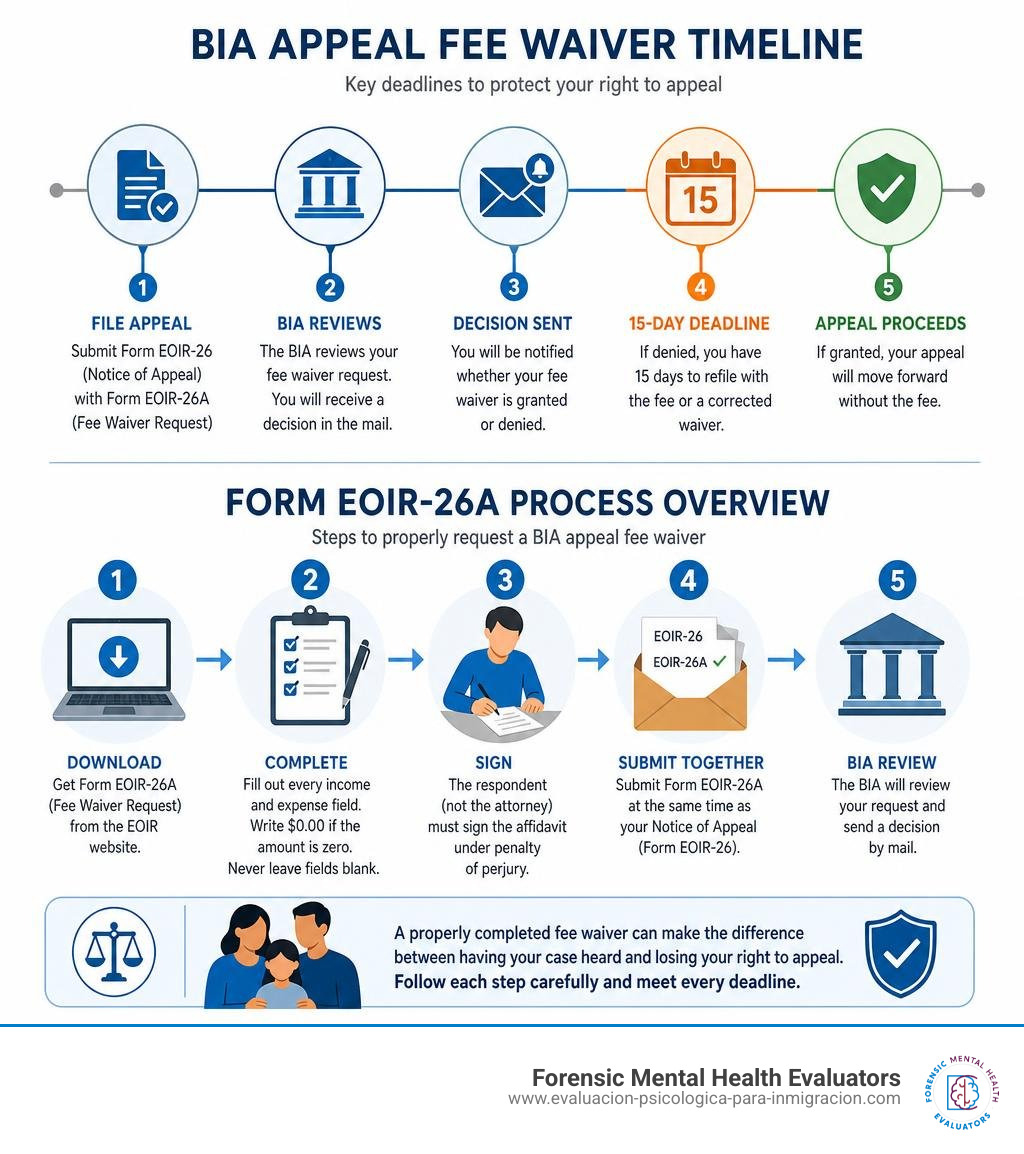
A BIA appeal fee waiver can be the difference between having your case heard and losing your right to appeal entirely. Here is what you need to know right away:
How to request a BIA appeal fee waiver:
- Download Form EOIR-26A (Fee Waiver Request) from the EOIR website
- Complete every income and expense field — write $0.00 if the amount is zero, never leave fields blank
- Have the respondent (not the attorney) sign the affidavit under penalty of perjury
- Submit Form EOIR-26A at the same time as your Notice of Appeal (Form EOIR-26)
- If denied, you have 15 days to refile with the fee or a corrected waiver
The current fee to appeal an Immigration Judge's decision to the Board of Immigration Appeals (BIA) is $1,030 — up from just $110 before recent fee increases. For many Hispanic immigrant families in Texas already struggling with legal costs, medical bills, and the stress of potential deportation, that amount is simply out of reach.
The good news: federal regulations allow you to request a waiver of this fee if you can demonstrate an inability to pay. But the process has real pitfalls. A simple mistake — like leaving a field blank, entering all zeros without explanation, or having your attorney sign instead of you — can cause your appeal to be rejected before anyone even reads it.
I am Francisco Ortiz, Lead Forensic Mental Health Evaluator at Forensic Mental Health Evaluators, and I work directly with non-permanent residents navigating removal proceedings where the BIA appeal fee waiver process intersects with psychological evaluations for extreme hardship cases. My forensic training in asylum, cancellation of removal, and hardship waiver evaluations gives me a front-row view of the procedural errors that derail cases before they ever get heard.
Understanding BIA Appeal Fees and the Role of the BIA Appeal Fee Waiver
The Board of Immigration Appeals (BIA) is the highest administrative body for interpreting and applying United States immigration laws. Located in Falls Church, Virginia, the BIA reviews decisions made by local Immigration Judges and certain Department of Homeland Security (DHS) officers.
For many respondents, receiving an unfavorable decision from an Immigration Judge is devastating. However, the BIA offers a vital safety net: the right to appeal. But this safety net is not free. In fact, under recent rule changes, the administrative costs associated with immigration court have skyrocketed. This is where understanding EOIR Fees Immigration Court and the fee waiver process becomes absolutely crucial.
Under federal regulations at 8 CFR § 1003.8, the BIA has the discretionary authority to waive filing fees for appeals, motions to reopen, and motions to reconsider. The legal mechanism to ask for this waiver is Form EOIR-26A (Fee Waiver Request). If you cannot afford the cost of filing your appeal, you must submit this form to prove your financial eligibility, ensuring that your financial limitations do not block your access to justice.
Current EOIR Fee Schedule and the BIA Appeal Fee Waiver Option
As we navigate through 2026, the financial hurdle of appealing a deportation order has grown significantly. Under the current fee schedule, the cost of filing a Notice of Appeal from a Decision of an Immigration Judge (Form EOIR-26) is $1,030 (a massive jump from the historic $110).
Furthermore, if you need to file a motion to reopen or a motion to reconsider before the BIA or an Immigration Judge, the fee is now $1,045 (up from $145).
Additionally, EOIR has fully transitioned to electronic payment methods. As of February 23, 2026, EOIR no longer accepts physical checks or money orders for fees paid directly to the agency. All payments must be made electronically through the EOIR Payment Portal.
Fortunately, the BIA appeal fee waiver remains a valid legal path. By submitting a properly completed Form EOIR-26A, you can request that the Board waive the $1,030 appeal fee or the $1,045 motion fee entirely. For more details on the authorized fees and the legal framework, you can refer to the official EOIR guidance in 3.4 - Filing Fees .
Fee Exemptions and Non-Waivable Fees
It is important to note that not all filings before the BIA require a fee, and conversely, some fees cannot be waived at all.
- Fee-Exempt Filings: You do not need to pay a fee or file a fee waiver for appeals of custody bond decisions. Additionally, DHS appeals, motions to reopen based exclusively on asylum claims, and certain jointly filed motions are exempt from fees under 8 CFR § 1003.8(a)(2).
- Non-Waivable Fees: Unlike BIA appeal fees, certain application fees cannot be waived. For example, the $100 initial asylum application fee and the $102 Annual Asylum Fee (AAF)—which applies to asylum applications pending for one year or more—are strictly non-waivable. Because there is currently no operationalized payment system for these specific asylum fees, applicants must often file a "Motion to Authorize Provisional Acceptance of the Asylum Application" to avoid rejection, rather than a standard fee waiver request.
How to Correctly Complete Form EOIR-26A to Request a Waiver
Requesting a fee waiver is not as simple as telling the BIA, "I cannot afford this." You must present a detailed, legally binding financial statement. The official document for this is EOIR-26: Fee Waiver Request , which serves as an affidavit of your financial circumstances.
Form EOIR-26A is a multi-page document where you must detail your monthly income, assets, and monthly expenses. The BIA uses this data to calculate your net monthly disposable income. If your income exceeds your basic living expenses, the Board will likely deny the request.
One of the most critical rules of Form EOIR-26A is the signature requirement. The affidavit must be signed and dated by the respondent themselves, under penalty of perjury. Even if you are represented by a highly qualified attorney, your attorney cannot sign the affidavit on your behalf. If an attorney signs the affidavit instead of the client, the BIA will reject the fee waiver as improperly filed, which can lead to the immediate rejection of your entire appeal.
Step-by-Step Instructions for Form EOIR-26A
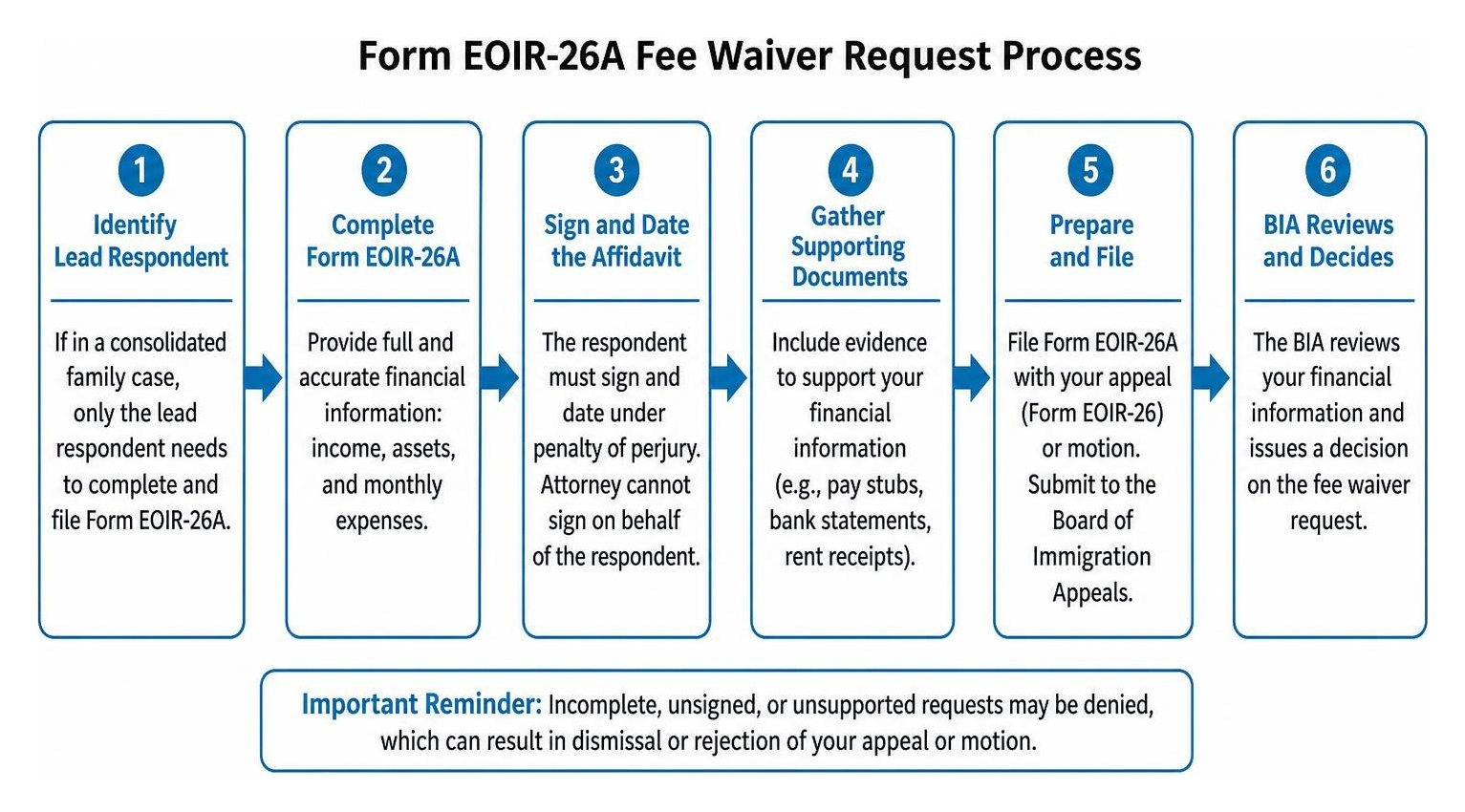
To ensure your fee waiver is accepted, follow these step-by-step best practices:
- Identify the Lead Respondent: If you are filing an appeal for a consolidated family case (such as a parent and minor children), the "lead respondent rule" applies. Only the lead respondent needs to complete and file Form EOIR-26A.
- Calculate Accurate Monthly Income: You must list all sources of income, including wages, public benefits, child support, or financial help from family. If you receive income weekly or biweekly, you must convert it to a monthly average. (For weekly income, multiply by 4.33; for biweekly, multiply by 2.16).
- Detail Monthly Expenses: List all regular monthly outlays. This includes rent or mortgage payments, utilities, food, clothing, transportation, insurance, and medical bills. Be realistic and precise. If you are applying for relief like cancellation of removal, ensure these numbers align with the financial hardship claims in your EOIR 42B Form.
- Perform the Net Monthly Calculation: Subtract your total monthly expenses from your total monthly income. This should ideally show a negative number or a nominal surplus, proving that paying a $1,030 fee would deprive you of basic life necessities.
- Attach Supporting Financial Evidence: Do not rely on your word alone. Attach copies of recent pay stubs, tax returns, bank statements, utility bills, or a personal declaration detailing your financial hardship.
Avoiding the "All-Zeros" Trap on Your BIA Appeal Fee Waiver
A very common and costly mistake made by self-represented (pro se) individuals is leaving sections blank or putting "$0.00" in every single income and expense category. While it may be true that you currently have no income—especially if you lack work authorization—the BIA views an "all-zeros" form with extreme suspicion.
The Board's logic is simple: if you are living in the United States, you must have some way of surviving. You are eating food, sleeping under a roof, and wearing clothes. Therefore, someone or some organization is covering these costs.
If you are a non-detained adult and submit a Form EOIR-26A with zeros in all income blocks, your request is presumptively invalid. To avoid a quick denial, you must write "$0.00" in the fields (never leave them blank) and attach a detailed personal declaration. In this declaration, explain exactly how you survive. For example:
- "I have no income because I do not have work authorization. I live with my brother, who pays my rent and utilities. Local community charities provide my food."
- "I am currently unable to work due to severe physical or mental trauma, and I rely entirely on church donations for my basic survival."
Legal Hurdles: Matter of Garcia Martinez and the Private Counsel Presumption
Filing a fee waiver became significantly more difficult following a major precedent decision by the BIA. In Matter of GARCIA MARTINEZ, 29 I&N Dec. 169 (BIA 2025) , the Board established strict new guidelines that adjudicators must follow when reviewing fee waiver requests.
The most critical takeaway from Matter of Garcia Martinez is the creation of a legal presumption regarding legal representation: a non-detained noncitizen who is represented by private (retained) counsel is presumed to have the ability to pay the required filing fee.
The BIA’s reasoning is that if you can afford to pay thousands of dollars to hire a private attorney, you are highly likely to have the financial means to pay the government's administrative filing fees. This decision dramatically shifted the burden of proof onto the applicant.
| Feature | Private Counsel Representation | Pro Bono Counsel / Pro Se |
|---|---|---|
| Legal Presumption | Presumed able to pay the filing fee | No presumption of ability to pay |
| Evidentiary Burden | Extremely high; must explicitly rebut the presumption | Standard; must show basic financial hardship |
| Required Attestation | Retained attorney must sign the good faith attestation on EOIR-26A | Attorney signs pro bono status or respondent files pro se |
| Risk of Denial | High if financial discrepancies are not explained | Moderate; depends on completing the form correctly |
Rebutting the Presumption of Ability to Pay
If you have a private attorney but genuinely cannot afford the $1,030 BIA appeal fee, you must actively rebut this presumption in your waiver request. You cannot simply submit Form EOIR-26A and hope for the best. You must provide a clear, detailed explanation of how your legal representation is being funded.
Common ways to successfully rebut this presumption include:
- Family-Funded Counsel: Explain that you did not pay the attorney yourself. For example, show that a relative, friend, or community organization gathered the funds to pay your legal fees because they wanted to save you from deportation, but they cannot afford to pay any more.
- Pro Bono or Low-Bono Status: If your attorney is representing you for free (pro bono) or at a highly discounted rate (low-bono) due to your financial hardship, your attorney should explicitly state this. The attorney must sign the "good faith attestation" section on Form EOIR-26A and indicate their pro bono status on the EOIR-27 entry of appearance.
- Changed Financial Circumstances: Explain if you were able to afford your attorney in the past, but have recently lost your job, suffered a medical emergency, or experienced a sudden drop in income that makes the filing fee impossible to pay now.
Impact on Underlying Relief and Credibility
A poorly prepared or contradictory fee waiver can do far more damage than just getting your waiver denied—it can destroy your entire immigration case. Adjudicators and DHS attorneys will compare the financial claims made in your fee waiver request with the testimonies and evidence in your underlying application for relief, such as an application for Cancellation of Removal.
In Matter of Garcia Martinez, the respondent claimed zero income and zero expenses on his fee waiver request. However, in his underlying application for cancellation of removal, he claimed that his family relied entirely on his financial support, and that his deportation would cause them extreme hardship.
The BIA pointed out this massive contradiction. How could his family suffer extreme financial hardship from his deportation if he claimed to have zero income and zero assets on his court paperwork? This discrepancy led to a negative credibility finding, which ultimately sank his entire case.
To protect your case, ensure that every document you submit is consistent. If you are preparing a cancellation case, consult our Cancellation of Removal Complete Guide to make sure your financial disclosures, hardship claims, and supporting evidence align perfectly.
What Happens If Your Fee Waiver Is Denied? The 15-Day Cure Period
Many immigrants fear that if the BIA denies their BIA appeal fee waiver, they will be immediately ordered deported without any further options. Fortunately, the regulations provide a critical safety net.
Under 8 CFR § 1003.8(a)(3), if the Board denies your fee waiver request, your appeal or motion is rejected as "improperly filed." However, this rejection is not final. The BIA is legally required to send you a rejection notice and grant you a 15-day cure period to fix the issue.
During this 15-day window, your original filing deadline is tolled (paused). You are given exactly 15 calendar days from the date of the rejection notice to re-file your rejected appeal or motion with either:
- The full filing fee (paid electronically via the EOIR Payment Portal), or
- A new, corrected fee waiver request that addresses the errors of the first one.
This rule is fully detailed in the BIA Practice Manual . It represents an essential lifeline, ensuring that a technical mistake on a financial form does not permanently cost you your right to appeal.
Navigating the 15-Day Tolling and Refiling Window
Because the 15-day cure period is incredibly strict, you must act immediately if you receive a rejection.
First, closely monitor your case status. If your attorney is registered in the ECAS (Electronic Case Access System) portal, they will receive an electronic notification. If you are pro se, you should regularly check the automated case portal online or call the EOIR automated hotline at 1-800-898-7180 using your 9-digit Alien Registration Number (A-Number).
If your waiver is rejected, do not delay. If you have managed to gather the $1,030, pay it immediately through the electronic portal, print the payment receipt, and mail or upload it along with your rejected appeal packet. If you must submit a new fee waiver, make sure you correct the issues—such as adding a missing signature, filling in blank fields with "$0.00", or attaching the required explanation of how your private attorney was funded.
Frequently Asked Questions about BIA Appeal Fee Waivers
Who must sign the Form EOIR-26A affidavit?
The Form EOIR-26A affidavit must be signed by the respondent themselves, under penalty of perjury. Even if you have a private attorney representing you, the attorney cannot sign this financial declaration for you. If an attorney signs the client's affidavit, the BIA will reject the fee waiver. The attorney’s role is limited to signing the "good faith attestation" section on page 2 of the form, confirming that they believe the client’s request is truthful and made in good faith.
Can I pay my EOIR fees with a check or money order?
No. As of February 23, 2026, EOIR completely stopped accepting paper checks and money orders for all immigration court and BIA fees. All payments must be made electronically through the official EOIR Payment Portal. If you do not qualify for a fee waiver and must pay the $1,030 fee, you must pay online and submit a copy of your electronic payment receipt along with your Notice of Appeal.
How do the March 2026 rule changes affect my appeal deadline?
A sweeping new DOJ appeals rule went into effect on March 9, 2026. This rule introduced significant changes:
- Briefing Schedule: The BIA now utilizes a simultaneous briefing schedule of 20 days. This means both you and the DHS attorney must submit your written legal arguments at the exact same time, rather than the historic consecutive schedule where you could review the government's arguments before writing your response.
- Appeal Deadline: While some elements of the rule were challenged in federal court, you should always assume the strictest deadlines apply. Ensure your Form EOIR-26 and Form EOIR-26A are completed and received by the BIA within 30 calendar days of the Immigration Judge's decision (or within 10 calendar days if your specific case falls under the expedited categories introduced in March 2026). Never wait until the last minute, as the BIA must receive the documents by the deadline, not just have them postmarked.
Conclusion: Strengthening Your Appeal with Professional Support
Successfully securing a BIA appeal fee waiver requires absolute precision, transparency, and consistency. Navigating the financial forms, avoiding the "all-zeros" trap, and overcoming the private counsel presumption established in Matter of Garcia Martinez are critical steps to keeping your immigration appeal on track.
But a successful appeal is about more than just waiving a fee—it is about winning the underlying case. For many families facing deportation, proving "exceptional and extremely unusual hardship" is the core of their legal defense.
At District Counseling (operating under Forensic Mental Health Evaluators), we specialize in providing comprehensive, culturally sensitive psychological evaluations to support immigration cases, including asylum, U-Visas, and cancellation of removal. We serve clients across our locations in Texas (Houston, Katy, Cypress, Sugar Land) as well as clients in California, Florida, New York, Utah, Virginia, and Idaho.
Our unique services are designed to give your legal defense the strongest possible foundation:
- Spanish-Language Evaluations: We conduct evaluations directly in Spanish and provide certified English translations.
- Client Comfort: We focus on creating a safe, supportive environment to discuss difficult life experiences.
- Post-Report Support: We offer 6 free therapy sessions to our clients after the evaluation report is completed to help them manage the emotional toll of immigration proceedings.
A professional psychological evaluation can provide the scientific, objective evidence needed to prove the profound mental health impact of deportation on your family, helping you meet the high legal standard of Extreme and Exceptionally Unusual Hardship.
If you are navigating a BIA appeal or preparing a cancellation of removal defense, do not leave your family’s future to chance. Contact us today to schedule a professional evaluación psicológica para caso de una cancelación de deportación and take a vital step toward securing your life in the United States.