
What You Need to Know About EOIR Fees in 2026
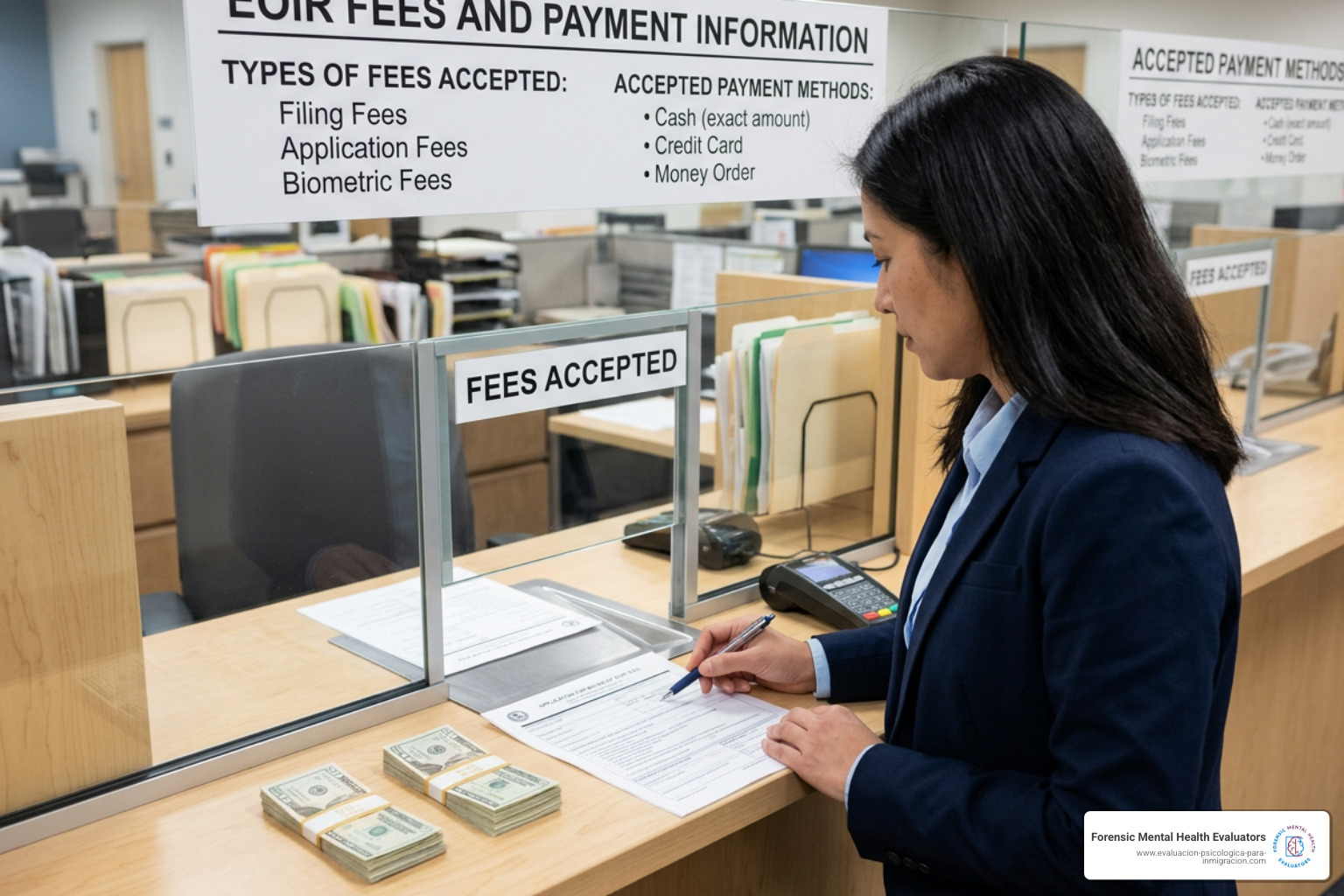
EOIR fees are the filing costs required to appeal, reopen, or file applications in U.S. Immigration Court and before the Board of Immigration Appeals (BIA). Here is a quick look at the current 2026 fee schedule:
| Filing Type | Form | Fee (2026) |
|---|---|---|
| Appeal from Immigration Judge decision | EOIR-26 | $1,030.00 |
| Appeal from DHS Officer decision | EOIR-29 | $1,030.00 |
| Motion to Reopen/Reconsider (BIA) | — | $1,030.00 |
| Motion to Reopen/Reconsider (IJ) | — | $1,065.00 |
| Cancellation of Removal (non-LPR) | EOIR-42B | $1,640.00 + $30 biometrics |
| Cancellation of Removal (LPR) | EOIR-42A | $710.00 + $30 biometrics |
| Suspension of Deportation | EOIR-40 | $710.00 + $30 biometrics |
| Practitioner Disciplinary Appeal | EOIR-45 | $2,030.00 |
| Bond Appeal | — | No fee |
| Annual Asylum Fee (AAF) | I-589 | $102/year |
Key facts to know right away:
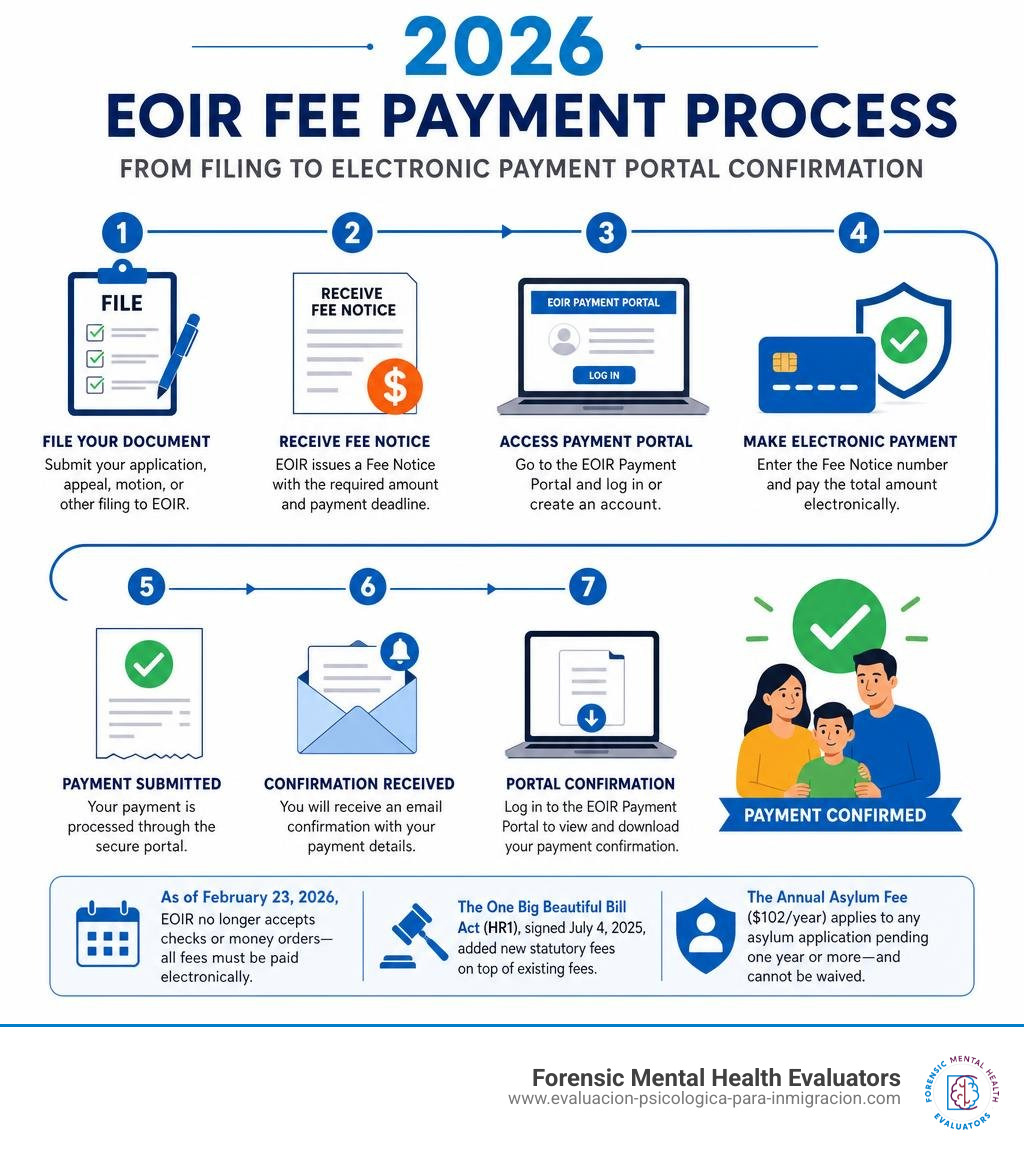
- As of February 23, 2026, EOIR no longer accepts checks or money orders — all fees must be paid electronically through the EOIR Payment Portal
- The One Big Beautiful Bill Act (HR1), signed July 4, 2025, added new statutory fees on top of existing fees
- The Annual Asylum Fee ($102/year) applies to any asylum application pending one year or more — and cannot be waived
For many immigrants facing removal, these numbers are more than line items on a form. They represent real barriers at one of the most stressful moments of a family's life. Fees have risen sharply, new charges have been added by federal law, and the payment system itself has changed entirely. If you miss a deadline or pay the wrong amount, your case can be rejected.
This guide breaks down every major EOIR fee for 2026, explains how the new HR1 law changed things, and walks you through what to do — step by step.
I'm Francisco Ortiz, Lead Forensic Mental Health Evaluator at District Counseling PLLC, and my work sits at the intersection of immigration law and mental health — where EOIR fees and the stress of navigating the immigration court system have real psychological consequences for families. Understanding these costs is something I encounter directly when clients come to me mid-case, often surprised by fees they didn't expect.
Complete Guide to Current EOIR Fees in 2026
Filing applications and appeals before the Executive Office for Immigration Review (EOIR) requires a clear understanding of the exact administrative and statutory costs involved. Since the major fee restructuring of recent years, the cost of seeking relief has risen significantly. Let's look at the specific forms and fees required in 2026.
Appeals and Motions
- Form EOIR-26 (Appeal from an Immigration Judge Decision): If you are appealing a decision made by an Immigration Judge to the Board of Immigration Appeals (BIA), the fee is $1,030.00. This is a major increase from the historic $110 fee that stood for decades, and it represents an inflation-adjusted increase from the $1,010 fee set in late 2025.
- Form EOIR-29 (Appeal from a DHS Officer Decision): For appeals of decisions made by Department of Homeland Security (DHS) officers, the fee is also $1,030.00. While this is an EOIR form, the fee itself is paid to the appropriate DHS office rather than directly through the EOIR portal.
- Motions to Reopen or Reconsider: If you are asking a court to look at your case again based on new evidence or a legal error, the cost depends on where your case is pending. A motion before the BIA costs $1,030.00, while a motion before an Immigration Judge (IJ) carries a combined cost of $1,065.00 due to stacked statutory fees.
- Bond Appeals: Fortunately, there remains no fee to appeal an Immigration Judge's bond determination.
- Form EOIR-45 (Practitioner Disciplinary Appeal): Appeals involving adjudicating officials in practitioner disciplinary cases carry a fee of $2,030.00.
Applications for Relief
When defending against removal, respondents often apply for specific forms of relief to remain in the United States. These applications carry substantial administrative costs:
- Form EOIR-42B (Cancellation of Removal for Nonpermanent Residents): This application is one of the most common pathways for individuals who have lived in the U.S. for over ten years and whose removal would cause "exceptional and extremely unusual hardship" to a qualifying U.S. citizen or permanent resident relative. The fee is $1,640.00, plus a $30.00 biometrics fee.
- Form EOIR-42A (Cancellation of Removal for Certain Permanent Residents): For lawful permanent residents facing deportation, the fee is $710.00, plus a $30.00 biometrics fee.
- Form EOIR-40 (Suspension of Deportation): This older form of relief, still applicable in certain legacy cases, requires a fee of $710.00 plus a $30.00 biometrics fee.
To review the official and most up-to-date schedule of these forms, practitioners and applicants should consult the Executive Office for Immigration Review | Types of Appeals, Motions, and Required Fees and the official Executive Office for Immigration Review | Forms & Fees pages.
The Impact of HR1 and the One Big Beautiful Bill Act on Immigration Costs
The legislative landscape of U.S. immigration underwent a massive shift when President Trump signed a reconciliation bill known as H.R. 1, the "One Big Beautiful Bill Act" (OBBBA), into law on July 4, 2025.

The OBBBA established statutory minimum fees for various forms of immigration relief, creating a new fee regime that took effect at EOIR on July 17, 2025. Under this law, many fees that were previously determined purely by agency rulemaking are now anchored in statutory minimums. Furthermore, starting in fiscal year 2026, these fees are subject to automatic annual inflation adjustments. This explains why standard appeal and motion fees have ticked upward to their current 2026 rates.
How HR1 Stacks New Statutory Charges on Existing EOIR Fees
One of the most complex aspects of the post-HR1 landscape is how these new statutory charges interact with existing agency fees. Initially, there was confusion over whether the new legislative charges would replace old fees. However, the Department of Justice clarified that the statutory charges are "stacked" on top of existing agency fees.
To simplify the process for applicants, EOIR combines these administrative and statutory fees into single, consolidated payment amounts on its portal. For example:
- A Motion to Reopen before an Immigration Judge combines the underlying agency processing fee with the new statutory HR1 surcharge, resulting in a single payment of $1,065.00.
- An Appeal to the BIA (Form EOIR-26) combines the baseline appeal cost with the HR1 statutory fee, totaling $1,030.00.
This stacked fee structure is codified under 8 CFR § 1103.7 - Fees. | Electronic Code of Federal Regulations (e-CFR) | US Law | LII / Legal Information Institute, which outlines the regulatory framework governing how these combined payments must be processed and documented.
The Annual Asylum Fee (AAF) and the EOIR Payment Portal
Perhaps the most controversial change introduced by the OBBBA is the creation of the Annual Asylum Fee (AAF).
Historically, applying for asylum in the United States carried no fee. Under the new law, a $100 baseline asylum fee was introduced, which has adjusted for inflation to $102.00 as of 2026. Crucially, if an asylum application (Form I-589) remains pending for one year or more, the applicant must pay a recurring maintenance fee of $102.00 each year the case remains open.
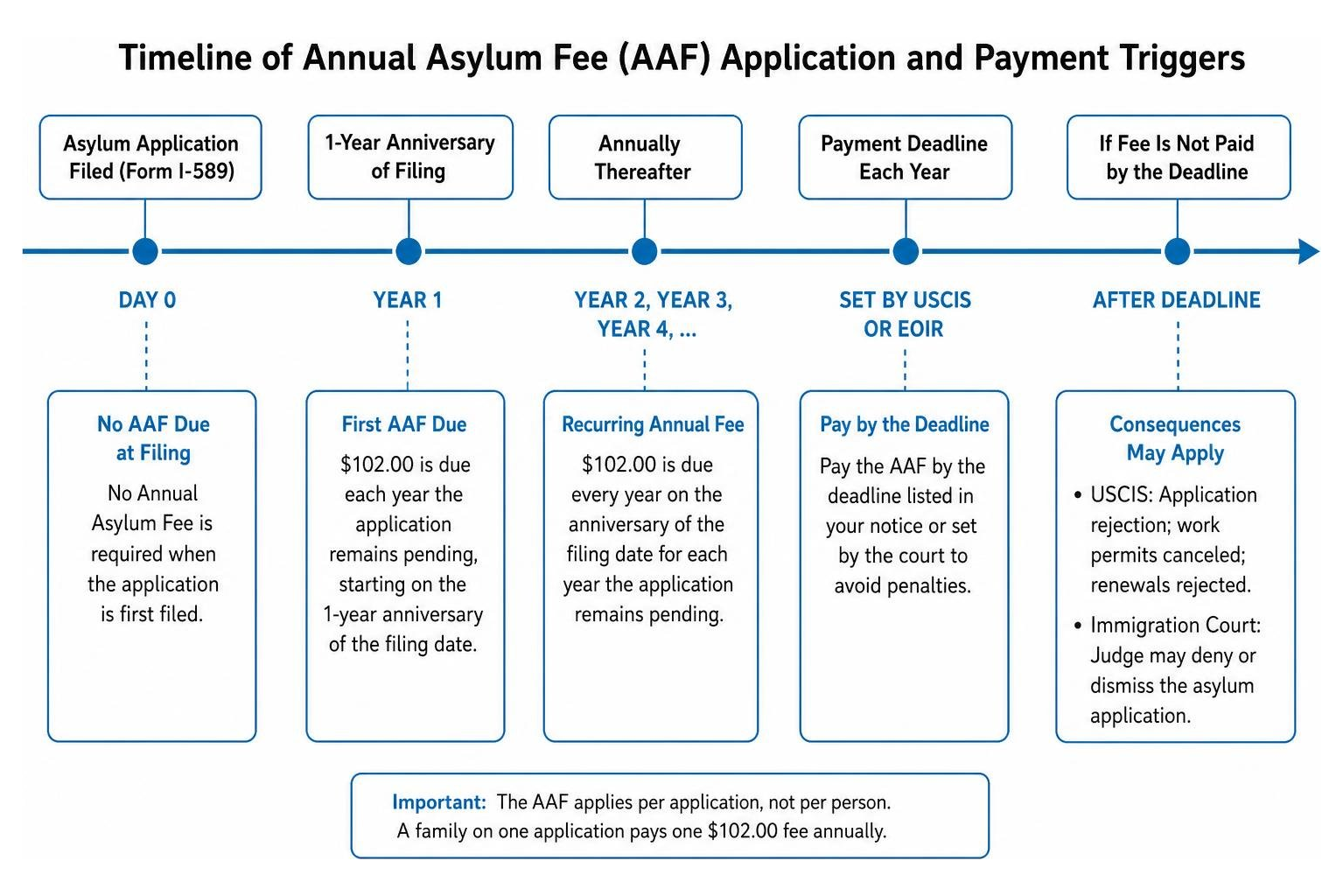
This fee applies per application (not per person), meaning a family of four on a single application pays only one $102.00 fee annually. However, the consequences of failing to pay are severe:
- USCIS Cases: Failure to pay on time can lead to the rejection of the asylum application, the cancellation of existing work permits, and the automatic rejection of any pending work permit renewals.
- Immigration Court Cases: If an Immigration Judge orders the payment of the AAF and the respondent fails to pay within the court's deadline, the judge may deny or dismiss the asylum application entirely, potentially leading to deportation proceedings.
Because the system does not always send out paper notices, applicants must proactively check their case status. For detailed answers on how to navigate this process, review the Executive Office for Immigration Review | EOIR Payment Portal Frequently Asked Questions (FAQ).
Fee Waivers and the Matter of Garcia-Martinez Presumption
Given the steep rise in eoir fees, many lower-income respondents find themselves unable to pay. In these situations, applicants can request a fee waiver using Form EOIR-26A (Fee Waiver Request). This form requires the applicant to list their income, assets, and monthly expenses under penalty of perjury to prove severe economic hardship.

However, obtaining a fee waiver has become significantly more difficult due to the Board of Immigration Appeals' precedent decision in Matter of Garcia-Martinez. This ruling establishes a legal presumption of ineligibility for fee waivers if the respondent is:
- An adult,
- Not currently detained, and
- Represented by private legal counsel.
The reasoning behind this presumption is that if an individual can afford to pay a private attorney, they are presumed to have the financial resources to pay court filing fees. To overcome this presumption, represented applicants must submit highly detailed, specific financial evidence. They must prove that their legal representation is being provided pro bono, at a drastically reduced rate, or that a relative is paying the legal fees while the respondent remains entirely destitute.
If a fee waiver request is denied, the filing is deemed defective. However, EOIR provides a 15-day cure period. The applicant has exactly 15 days from the date of the rejection notice to submit the correct fee or file a new, better-documented fee waiver request. If they do so, their original filing date is preserved (tolled), preventing them from missing critical legal deadlines.
Eligible vs. Non-Waivable EOIR Fees Under Post-HR1 Rules
It is vital to understand that post-HR1, not all EOIR fees are eligible for waivers.
While traditional agency fees (such as those for appeals or motions) can still be waived at the discretion of an Immigration Judge or the BIA, the statutory fees introduced by the OBBBA are generally non-waivable.
Specifically, the Annual Asylum Fee (AAF) cannot be waived under any circumstances. Congress explicitly prohibited fee waivers for the AAF, meaning every asylum seeker whose application has been pending for over a year must find a way to pay the $102.00 annual fee, regardless of their level of poverty.
For other applications, such as those seeking a Cancellation of Removal Complete Guide or defending against deportation through a Cancellation of Deportation, the underlying agency fee may be waived, but any statutory HR1 surcharges must still be accounted for.
Frequently Asked Questions about Immigration Court Costs
What happens if I miss the deadline to pay my EOIR fees?
If you submit an application or appeal without the required fee or an approved fee waiver, your filing will be rejected as defective. The court will send a rejection notice, starting a strict 15-day cure period. You must submit the full payment through the electronic portal and file the receipt with the court within those 15 days. If you fail to cure the defect in time, your application may be deemed abandoned, leading to the potential dismissal of your case or an order of deportation.
Can I pay for multiple family members at once on the portal?
Yes. In consolidated proceedings—where a family's cases are grouped together under a single lead respondent—you only need to make a single consolidated payment. When using the EOIR Payment Portal, you must enter the lead respondent's Alien Registration Number (A-Number) to pay the combined fee for the entire family. Always keep the payment receipt showing the lead A-Number and attach copies of it to each family member's individual filing.
How do EOIR fees differ from USCIS fees post-HR1?
While both agencies implemented the OBBBA fee increases, they handle payments differently:
- Payment Consolidation: EOIR combines agency fees and HR1 statutory surcharges into a single payment amount on its portal. USCIS, on the other hand, often requires separate payments for standard fees and statutory surcharges.
- Waiver Policies: USCIS has strict, non-waivable statutory fees for forms like the I-485 (Adjustment of Status), which currently costs $2,980.00. EOIR allows judges broader discretion to waive court-specific fees (except the AAF) if the applicant meets the strict standards to overcome Matter of Garcia-Martinez.
- Form Differences: For example, filing the EOIR 42B Form in court costs $1,640.00 plus biometrics, whereas similar affirmative applications filed with USCIS carry entirely different fee structures and processing timelines.
Conclusion
The 2026 immigration landscape is more expensive and procedurally demanding than ever before. With standard appeal fees at $1,030.00, motions to reopen before an Immigration Judge at $1,065.00, and the mandatory, non-waivable Annual Asylum Fee at $102.00, families face immense financial pressure. Navigating the transition to mandatory electronic payments on the EOIR Payment Portal requires careful attention to avoid rejections and missed deadlines.
At District Counseling, we understand that the financial cost of immigration proceedings is only one part of the burden. The psychological toll of facing removal, proving extreme hardship, and keeping up with complex legal rules can be overwhelming.
We provide professional forensic psychological evaluations for immigration cases, including asylum, U-visas, and cancellation of removal. We serve clients across major Texas cities, including Houston, Katy, Cypress, Sugar Land, Austin, Dallas, and San Antonio. To make our services as accessible and supportive as possible, we conduct our evaluations in Spanish (with English translations included), prioritize our clients' emotional comfort, and provide 6 free therapy sessions following the completion of your evaluation report.
If you or a loved one are preparing a case for immigration court, we are here to help you document the psychological impact of your situation. For a comprehensive look at how these evaluations support your legal strategy, read our Immigration Evaluations Complete Guide 2026. If you are specifically preparing a cancellation case, you can also explore our specialized services for Evaluación Psicológica para Cancelación de Deportación. Reach out to us today to schedule a consultation and take a vital step forward in your journey.