
A Comprehensive Guide to Cancellation of Removal
When Deportation Is Not the End: What Cancellation of Removal Can Do for You

Cancellation of removal is a form of immigration relief that can stop your deportation and give you a green card — even if you have never had legal status in the United States.
Here is a quick summary of how it works:
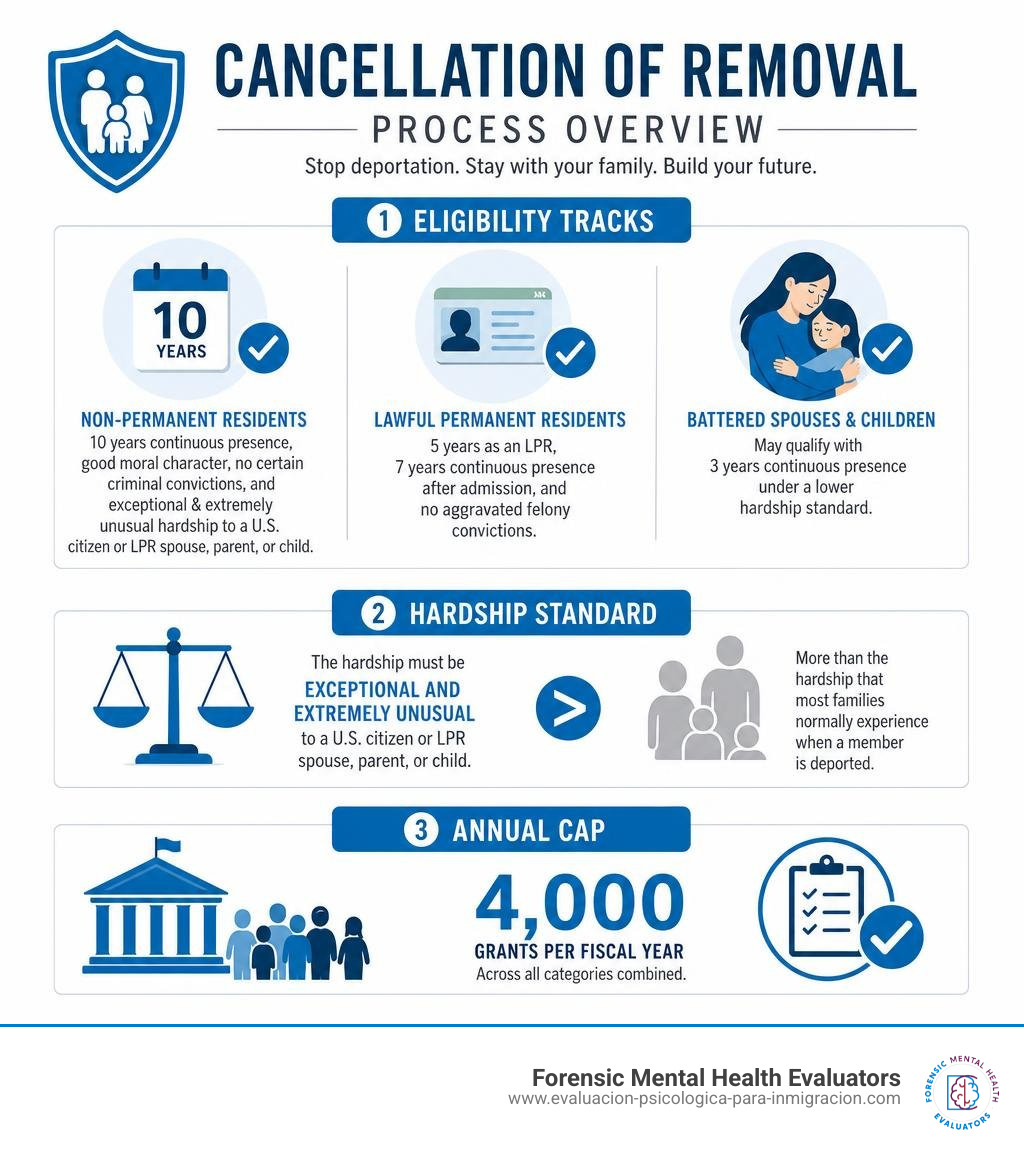
What is cancellation of removal? It is a defense you can raise in immigration court under INA § 240A. If an immigration judge grants it, your removal is cancelled and you become a lawful permanent resident.
Who can apply?
- Non-permanent residents (non-LPRs): Must have lived in the U.S. for at least 10 continuous years, shown good moral character, avoided certain criminal convictions, and proved that deportation would cause exceptional and extremely unusual hardship to a U.S. citizen or lawful permanent resident (LPR) spouse, parent, or child.
- Lawful permanent residents (LPRs): Must have held LPR status for at least 5 years, lived continuously in the U.S. for at least 7 years after any admission, and not been convicted of an aggravated felony.
- Battered spouses and children (VAWA): May qualify with only 3 years of continuous presence under a lower hardship standard.
The hardship standard is the hardest part. Normal family separation is not enough. You must show hardship that goes well beyond what most families experience when a member is deported.
There is also an annual limit. Only 4,000 people per fiscal year can be granted cancellation of removal across all categories combined.
If you are a non-LPR facing removal in Texas, this guide will walk you through every part of the process — from proving your 10 years of presence to building a hardship case that holds up in court.
I am Francisco Ortiz, Lead Forensic Mental Health Evaluator at District Counseling PLLC, and I specialize in providing the clinical evidence that immigration courts need to evaluate hardship in cancellation of removal cases. My work bridges forensic psychology and immigration law to help families like yours present the strongest possible case.
Understanding Cancellation of Removal: An Overview
At its core, cancellation of removal is a discretionary shield. It is not an automatic benefit that you can apply for through a routine mail-in application to USCIS. Instead, it is a defensive remedy available exclusively to individuals who are currently in removal (deportation) proceedings before an immigration judge.
The statutory framework governing this relief is found under Section 240A of the Immigration and Nationality Act (INA), which is codified at 8 USC 1229b: Cancellation of removal; adjustment of status. Because the relief is discretionary, meeting the baseline statutory requirements is only the first step. Even if you satisfy every single legal criterion, the immigration judge must still decide whether you deserve to stay in the United States. They will weigh positive factors—such as deep family ties, community service, a clean record, and stable employment—against negative factors like immigration violations or minor criminal history.
To understand how this relief applies to your situation, we must first look at the two distinct pathways: one for lawful permanent residents (LPRs) and one for non-permanent residents (non-LPRs).
Eligibility for LPR Cancellation of Removal
Many people are surprised to learn that green card holders can face deportation. If a lawful permanent resident is convicted of certain crimes or violates immigration laws, the government can initiate removal proceedings. Fortunately, INA § 240A(a) provides a way for LPRs to save their status.
To qualify for LPR cancellation of removal, you must prove to the immigration judge that you meet three strict requirements:
- LPR Status: You must have been a lawful permanent resident of the United States for at least 5 years.
- Continuous Residence: You must have resided in the United States continuously for at least 7 years after being admitted in any lawful status (for example, if you entered on a student visa and adjusted to a green card later, that initial entry counts toward your 7 years).
- No Aggravated Felonies: You must not have been convicted of an "aggravated felony" as defined under immigration law. This is a crucial distinction, as the immigration definition of an aggravated felony is notoriously broad and can include offenses that state courts classify as misdemeanors.
If you meet these guidelines, you do not have to prove hardship to a qualifying relative. However, you must still convince the judge that your positive contributions to the community outweigh your mistakes. If you are facing this situation in Florida, consulting a specialized professional like an Orlando Cancellation of Removal Lawyer (Lawful Permanent ... can help you build a robust defense.
Eligibility for Non-LPR Cancellation of Removal
For those who do not currently hold a green card, the path to obtaining one through immigration court is much steeper. This process is governed by INA § 240A(b)(1). If you are a non-LPR, you must meet four rigorous statutory requirements:
- Continuous Physical Presence: You must have been physically present in the United States for a continuous period of not less than 10 years immediately preceding the date of your application.
- Good Moral Character: You must show that you have been a person of good moral character during the entire 10-year period.
- No Disqualifying Convictions: You must not have been convicted of certain offenses, including crimes involving moral turpitude, drug offenses, or domestic violence.
- Exceptional and Extremely Unusual Hardship: You must establish that your removal would result in "exceptional and extremely unusual hardship" to your qualifying relative. A qualifying relative must be a U.S. citizen (USC) or lawful permanent resident (LPR) spouse, parent, or child under the age of 21.
To initiate this application, you must complete and file the EOIR-42B - Application for Cancellation of Removal and Adjustment of Status for Certain Nonpermanent Residents. Filling out this form requires meticulous attention to detail. Every claim you make about your history, residences, and family must be backed up by objective evidence. For a step-by-step breakdown of how to approach this critical application, you can read our comprehensive guide on the EOIR 42B Form.
Proving Continuous Physical Presence and Good Moral Character
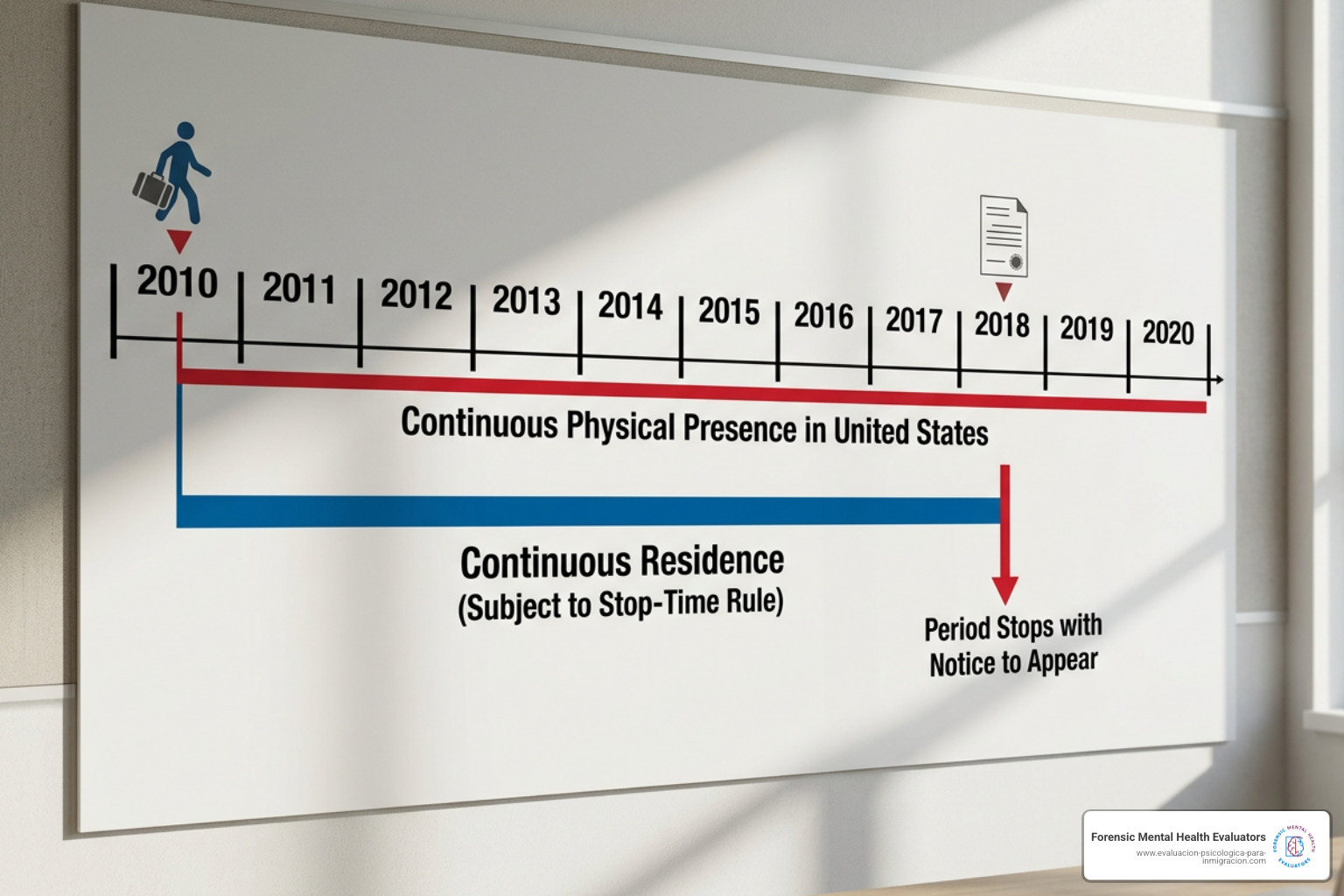
Proving that you have lived in the United States for a full decade is more complicated than simply showing up in court and saying, "I've been here since 2016." The law requires objective, paper-based proof for every single year of that 10-year timeline.
To build a solid physical presence record, we recommend gathering:
- Tax transcripts and W-2 forms for each of the last 10 years.
- Lease agreements, rent receipts, or home deeds.
- School records for yourself or your children.
- Medical, dental, and immunization records.
- Utility bills (electricity, water, gas, or phone bills) spread out across each year.
- Bank statements and credit card histories showing consistent activity in your local area.
For a deeper dive into organizing this mountain of paperwork, you can consult [PDF] A Guide to 10-Year Cancellation of Removal - ICE Portal.
The Stop-Time Rule: Why Your 10-Year Clock May Stop Running
One of the most dangerous traps in cancellation cases is the "stop-time rule." Under INA § 240A(d)(1), your 10-year continuous physical presence clock stops running when:
- The government serves you with a Notice to Appear (NTA) in immigration court, or
- You commit certain criminal offenses that make you inadmissible or deportable.
Historically, the government would send out "two-step" NTAs—serving a document without a court date first, and sending the date later. However, landmark Supreme Court rulings like Niz-Chavez v. Garland established that the continuous presence clock only stops when the government provides a single, complete NTA containing all required statutory information, including the time and place of the hearing. If your NTA was defective, your clock might still be running!
Additionally, your 10-year physical presence is broken if you leave the United States for more than 90 days in a single trip, or for more than 180 days in total across multiple trips during the 10-year period.
Good Moral Character
You must also prove that you have maintained "good moral character" (GMC) throughout the statutory 10-year period. While the law lists specific bars to GMC (such as habitual drunk driving, illegal gambling, or lying under oath to obtain immigration benefits), the judge can look at your entire life history. Submitting character letters from employers, church leaders, and neighbors is vital to showing the judge who you truly are.
Evaluating Exceptional and Extremely Unusual Hardship
The absolute heart of any non-LPR cancellation of removal case is proving "exceptional and extremely unusual hardship." The Board of Immigration Appeals (BIA) has made it clear that this is the highest hardship standard in U.S. immigration law.
To win, you must demonstrate that the hardship your qualifying U.S. citizen or LPR relative (spouse, parent, or child) will suffer if you are deported is substantially different from, and much more severe than, the normal sadness, financial strain, and disruption that naturally occur when a family is separated.
The Supreme Court recently clarified this standard in the landmark case 22-666 Wilkinson v. Garland (03/19/2024). In Wilkinson, the Court held that an immigration judge's determination of "exceptional and extremely unusual hardship" is a mixed question of law and fact, meaning it is subject to judicial review by federal courts of appeals. This was a massive victory for immigrants, as it ensures that judges must apply the legal standard correctly to the facts of your life.
To understand the difference between ordinary hardship and the standard required for cancellation, we look at several factors:
- Severe Medical Conditions: If your qualifying relative has a serious physical or mental illness (like cancer, severe autism, or advanced diabetes) and relies entirely on you for specialized care or financial support that they cannot get in your home country.
- Special Educational Needs: A child who requires highly specialized special education services or speech therapy that is completely unavailable in the country of relocation.
- Extreme Psychological Vulnerability: A relative who suffers from severe, documented clinical depression, PTSD, or anxiety, whose mental health would completely collapse if you were deported.
For a detailed analysis of how courts define this standard, explore our guide on Extreme and Exceptionally Unusual Hardship.
The Role of Psychological Evaluations in Hardship Claims
Because the legal standard is so incredibly high, relying solely on your own testimony or a basic letter from a relative is rarely enough. This is where a professional, forensic clinical assessment becomes the turning point of your case.
At District Counseling, we conduct comprehensive clinical evaluations designed specifically for immigration court. As forensic mental health evaluators, we do not just write a friendly letter saying "this family will miss each other." We conduct scientific, objective diagnostic assessments.
Our clinical reports provide:
- Objective Diagnostic Testing: We use standardized clinical measures to assess for conditions like Major Depressive Disorder, Generalized Anxiety Disorder, and PTSD.
- In-Depth Psychosocial History: We trace the family's history, trauma, and deep psychological bonds.
- Country Conditions Context: We evaluate how relocation to your home country would impact your relative's mental health, taking into account safety, medical infrastructure, and social stigma.
A professional Cancellation of Removal Psych Eval translates your family's emotional pain into the clinical and legal language that immigration judges and government attorneys respect. For more information on how these assessments are structured, you can read our Immigration Psychological Evaluations Guide 2026.
We provide these critical services across our offices in Houston, Katy, Cypress, and Sugar Land, Texas, as well as via secure telehealth for clients throughout Florida, California, New York, Utah, Virginia, and Idaho. To understand how we construct these reports, read our guides on Immigration Mental Health Evaluation and Texas Immigration Psych Evaluation.
Special Rules, Disqualifying Factors, and the Annual Cap
The law provides a special, more lenient track for victims of domestic violence under the Violence Against Women Act (VAWA) cancellation of removal. The table below highlights the key differences between standard non-LPR cancellation and VAWA cancellation:
| Requirement | Standard Non-LPR Cancellation | VAWA Cancellation of Removal |
|---|---|---|
| Continuous Physical Presence | 10 Years | 3 Years |
| Hardship Standard | Exceptional and extremely unusual hardship to a USC/LPR spouse, parent, or child | Extreme hardship to the applicant, their child, or their parent |
| Qualifying Relative | USC/LPR Spouse, Parent, or Child | Self, Child, or Parent (abuse must be by a USC/LPR spouse or parent) |
| Good Moral Character | Required for 10 years | Required for 3 years (with domestic abuse exceptions) |
To learn more about the specific evidentiary standards for proving abuse and meeting the lower "extreme hardship" standard, see the resources available at Cancellation of Removal for Nonpermanent Residents.
Disqualifying Factors and Criminal Bars
Your cancellation case can be instantly derailed if you have certain criminal convictions. You are statutorily barred from cancellation of removal if you have been convicted of:
- An aggravated felony (which completely bars both LPRs and non-LPRs).
- A crime involving moral turpitude (CIMT), unless it qualifies under the narrow "petty offense" exception.
- Any drug offense (except for a single offense of simple possession of 30 grams or less of marijuana).
- Domestic violence, stalking, child abuse, or violating a protective order.
The 4,000 Annual Cap
Even if you have lived in the U.S. for 10 years, have clean records, and prove that your deportation would cause devastating hardship to your family, you face one final, systemic hurdle: the annual statutory cap.
By law, the Attorney General may not grant cancellation of removal and adjust the status of more than 4,000 applicants per fiscal year. Because the demand for this relief vastly exceeds the 4,000 limit, immigration courts often issue "conditional approvals." If the judge conditionally grants your application, you will be placed on a waiting list until a visa number becomes available in a future fiscal year. During this waiting period, you are typically eligible to apply for and renew a work permit (Employment Authorization Document).
Frequently Asked Questions about Cancellation of Removal

What is the difference between LPR and non-LPR cancellation of removal?
The main differences lie in who can apply, the length of required residence, and the hardship standard. Lawful Permanent Residents (LPRs) apply under INA § 240A(a) and must show 5 years of green card status and 7 years of continuous residence; they do not have to prove hardship to any relatives. Non-LPRs apply under INA § 240A(b)(1) and must show 10 years of continuous physical presence and prove that their deportation would cause "exceptional and extremely unusual hardship" to a qualifying USC or LPR relative.
How does the stop-time rule affect my 10-year continuous physical presence?
The "stop-time" rule pauses your 10-year continuous presence clock. The clock stops the moment you are served with a legally sufficient Notice to Appear (NTA) in court, or if you commit certain disqualifying crimes. If the clock stops before you hit your 10-year mark, you are ineligible for standard non-LPR cancellation.
What happens if the 4,000 annual cap is reached?
If the 4,000 annual cap is reached for the current fiscal year, the immigration judge cannot issue a final grant of cancellation. Instead, the judge will issue a "reserved" or "conditional" decision. You will remain in a legal limbo, but you will generally be allowed to remain in the United States and hold a work permit until a slot opens up in a subsequent fiscal year.
Conclusion
Navigating a cancellation of removal case is one of the most stressful experiences an immigrant family can face. The stakes could not be higher—it is the difference between keeping your family together in safety and being permanently separated.
At District Counseling, we believe that no family should have to face the immigration court system alone or unprepared. We specialize in providing the high-quality, culturally sensitive, and scientifically rigorous psychological evaluations that help bridge the gap between your family's daily reality and the legal standard of "exceptional and extremely unusual hardship."
Our unique approach is designed to support you every step of the way:
- Bilingual Evaluations: We conduct our evaluations in Spanish and provide certified English translations for the court.
- Client Comfort: We create a warm, trauma-informed environment where you and your children can feel safe sharing your story.
- Continuous Care: Because we know how stressful this process is, we provide 6 free therapy sessions to our clients after their evaluation report is completed.
Whether you are based in Houston, Katy, Cypress, Sugar Land, or anywhere else across Texas, Florida, California, New York, Utah, Virginia, and Idaho, we are here to help you defend your life in the United States.
To take the first step in documenting your family's hardship, visit our dedicated page on Evaluacion Psicologica Para Caso De Una Cancelacion De Deportacion and schedule a consultation with our clinical team today.