
Demystifying Immigration Psychological Evaluations for Your Case
What Are Immigration Psychological Evaluations — and Do You Need One?

Immigration psychological evaluations are formal written assessments prepared by a licensed mental health professional for use in immigration legal proceedings. They document your mental health, trauma history, and the emotional impact of your immigration situation — and they can be the difference between a case being approved or denied.
Quick answer: Here is what you need to know.
| Question | Answer |
|---|---|
| What is it? | A clinical report documenting mental health, trauma, or hardship for immigration court or USCIS |
| Who needs one? | Applicants for hardship waivers, VAWA, asylum, U/T visas, cancellation of removal, or N-648 |
| Who writes it? | A licensed psychologist, psychiatrist, or qualified mental health clinician |
| Is it required? | Not always — but it strongly supports most hardship and trauma-based cases |
| How long is it? | Typically 8–20 pages, based on multiple clinical interviews and objective testing |
| How long does it take? | Usually 2–3 weeks from your first appointment |
If you are a non-U.S. citizen facing deportation, the thought of being separated from your children or spouse is devastating. You may be wondering: will anyone in this legal system understand what my family is going through? A psychological evaluation gives a trained clinician the chance to document exactly that — in clinical language that USCIS officers and immigration judges are trained to weigh seriously.
The stakes are real. With global forced displacement projected to exceed 120 million people by the end of 2024, and the U.S. foreign-born population now surpassing 51 million, immigration courts are handling more complex, trauma-heavy cases than ever before. Yet many applicants submit evaluations that are too short, too generic, or missing key clinical components — and they pay for it with delays, Requests for Evidence (RFEs), or outright denials.
This guide breaks down exactly how these evaluations work, what makes them strong, and how to avoid the most common mistakes.
I'm Francisco Ortiz, Lead Forensic Mental Health Evaluator at District Counseling PLLC, a Certified Forensic Mental Health Evaluator (CFMHE) licensed across six states, and I have completed specialized advanced training in immigration psychological evaluations for hardship waivers, asylum cases, and U-Visa and T-Visa applications. In this guide, I will walk you through everything you need to understand about this process — clearly and without the legal jargon.
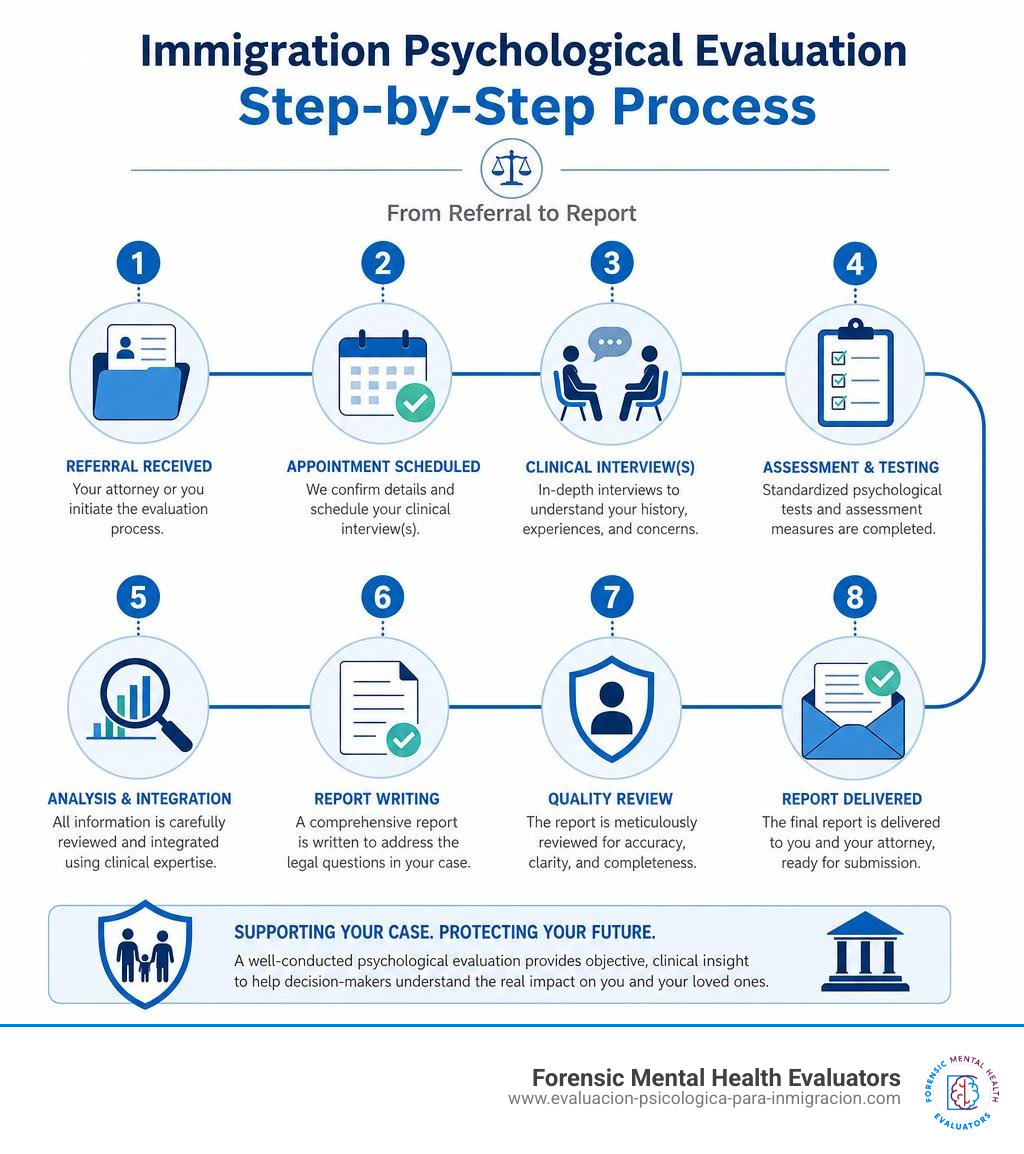
Understanding the Purpose of Immigration Psychological Evaluations

When you undergo an Immigration Mental Health Evaluation, you are not just getting a routine check-up. This is a highly specialized forensic document designed to answer specific legal questions.
Whether you are applying for a hardship waiver or seeking refuge from persecution, we use these assessments to translate your lived experiences into objective clinical evidence. This process is deeply analyzed in literature such as the Challenges and Opportunities for Forensic Mental Health in Immigration Courts | Journal of the American Academy of Psychiatry and the Law , which highlights how critical these reports are in high-stakes legal proceedings.
Clinical vs. Forensic Assessments
It is common to confuse a standard therapy assessment with a forensic evaluation, but they serve completely different purposes:
- Clinical Therapy Assessments: Focus on building a therapeutic alliance to help you heal. They rely heavily on subjective testing (what you tell the therapist) and are designed to guide ongoing treatment.
- Forensic Evaluations: Focus on forensic objectivity. While we maintain a warm and compassionate environment, our primary job is to act as an objective expert witness for the court or USCIS. We use objective testing, structural interviews, and diagnostic criteria to present an unbiased, scientifically grounded picture of your mental health.
Key Legal Standards and Admissibility
For a clinical report to be useful in court, it must meet strict legal criteria. USCIS officers and Executive Office for Immigration Review (EOIR) judges look closely at the credibility assessment of both the applicant and the evaluator. Under the Federal Rules of Evidence, a report must show a clear, logical methodology.
If a report is too short or reads like a generic template, adjudicators will dismiss it. Our evaluations are built to withstand this intense scrutiny, providing the thorough documentation required to back up your claims. For a deeper look at these requirements, check out our Immigration Evaluation Complete Guide.
Common Immigration Cases That Benefit from Mental Health Evidence
Different immigration cases require different types of psychological evidence. We tailor each evaluation to the specific legal standards of your petition.
| Case Type | Legal Standard / Form | Key Psychological Focus |
|---|---|---|
| Extreme Hardship Waiver | I-601 / I-601A | Emotional, medical, and financial impact on qualifying U.S. citizen or LPR relatives. |
| VAWA Self-Petition | I-360 | Documentation of battery, extreme cruelty, and coercive control. |
| Asylum Claim | Form I-589 | Well-founded fear of persecution, PTSD, and explaining testimony inconsistencies. |
| U / T Visas | I-918 / I-914 | Mental or physical abuse from being a victim of a crime or human trafficking in the U.S. |
| Cancellation of Removal | EOIR-42B | Exceptional and extremely unusual hardship to U.S. citizen or LPR family members. |
| N-648 Medical Waiver | Form N-648 | Cognitive or physical impairments preventing English and civics testing. |
To learn more about how these apply to your specific situation, you can read our page on Evaluación Psicológica para Inmigración.
Extreme Hardship Waivers (I-601 and I-601A)
In waiver cases, the focus is not on the immigrant, but on their qualifying relatives (a U.S. citizen or Lawful Permanent Resident spouse, parent, or child). We must prove that deporting the applicant would cause "extreme hardship" to these loved ones.
We assess the financial impact, medical conditions, and relocation barriers the family would face. If the family relocates to the home country, what are the country conditions? If they remain in the U.S. separated, how will the relative cope? We detail these scenarios clinically to show that the resulting emotional distress goes far beyond what is typical during a deportation.
VAWA Self-Petitions and Trauma Documentation
Under the Violence Against Women Act (VAWA), spouses, children, or parents of abusive U.S. citizens or LPRs can self-petition for legal status. Many people think VAWA requires physical battery, but the law also covers "extreme cruelty" and coercive control.
Our evaluations document the psychological impact of emotional, verbal, and financial abuse. We screen for PTSD symptoms, depression, and anxiety, showing a clear connection between the domestic violence and your current mental health state.
Asylum Claims and Credibility Support
Asylum seekers must demonstrate a well-founded fear of persecution in their home country based on race, religion, nationality, political opinion, or membership in a particular social group.
Trauma often causes memory fragmentation, making it hard for survivors to recall dates and events in a linear way during legal interviews. This can make an applicant look "unreliable" to an officer. A trauma-informed interview allows us to explain these memory gaps clinically, helping to repair credibility concerns for the court.
U and T Visas, Cancellation of Removal, and N-648 Exemptions
- U Visas (Crime Victims) & T Visas (Trafficking Victims): We document the severe mental or physical abuse suffered by victims who assist law enforcement.
- Cancellation of Removal: This requires proving "exceptional and extremely unusual hardship" to U.S. citizen or LPR relatives. It is a very high legal bar, and children's evaluations showing developmental or educational regression are often the strongest evidence here.
- N-648 Exemptions: For citizenship applicants with severe cognitive impairments or intellectual disabilities, we document why they are unable to learn English or pass civics exams, adhering to the standard Mental Health | Technical Instructions for Civil Surgeons | Immigrant and Refugee Health | CDC .
Key Components of a Strong Forensic Report

A strong evaluation is much more than a simple letter saying you are stressed. To see an example of what a professional report looks like, view our Immigration Psychological Evaluation Sample. A robust forensic report typically spans 8 to 20 pages and contains several vital components.
Clinical Methodology and Multi-Session Interviews
USCIS and immigration judges are trained to spot "template" reports. A credible report must show a rigorous clinical methodology. This means we conduct multiple clinical sessions to thoroughly understand your background. We gather a detailed psychosocial history, conduct behavioral observations, and perform a formal mental status exam.
Objective Psychometric Testing and DSM-5 Diagnoses
To back up our clinical observations, we use standardized, objective testing. This includes scientifically validated screening tools such as:
- PHQ-9 (Patient Health Questionnaire for depression)
- GAD-7 (Generalized Anxiety Disorder scale)
- PCL-5 (PTSD Checklist for DSM-5)
Importantly, we also include symptom validity and malingering screening. Showing that we tested for feigned symptoms makes the evaluation highly credible to judges and prosecutors.
Establishing the Crucial "Nexus" to Hardship or Persecution
The most important part of the report is the "nexus" — the direct causal link between your mental health diagnoses and the immigration legal question. We must explain why relocation is impossible, why treatment in the home country is unavailable, and how future risks will impact your family. We conclude with clear, realistic treatment recommendations.
Best Practices for Trauma-Informed and Culturally Sensitive Assessments
Evaluating individuals from diverse backgrounds requires more than general clinical skills; it requires deep cultural humility. For residents in our home state, you can read more about our specific approach on our Texas Immigration Psych Evaluation page.
Navigating Language Barriers and Bilingual Evaluations
Working through ad-hoc interpreters (like friends or family members) is highly discouraged because it can compromise the accuracy of the clinical interview. At District Counseling, we provide bilingual evaluations in Spanish and English. We understand cultural idioms of distress — such as somatic complaints like "nervios" or "dolor de cerebro" — and translate these concepts into recognized DSM-5 clinical formulations so American adjudicators fully understand your pain.
Avoiding Common Mistakes That Trigger RFEs or Denials
Many applicants face unnecessary delays because of weak evaluations. The most common mistakes include:
- Template Reports: Reports where only the names and dates seem changed.
- Single-Session Evaluations: Spending only 45 minutes with a clinician does not show a reliable methodology.
- Lack of Objective Testing: Relying solely on the applicant's word without psychometric data.
- Role Confusion: When a treating therapist tries to act as an objective forensic expert, which compromises credibility.
Frequently Asked Questions about Immigration Evaluations
Who is Qualified to Conduct Immigration Psychological Evaluations?
Evaluations should be conducted by licensed mental health professionals with specialized training in forensic assessments. This includes doctoral-level psychologists (PhD/PsyD), licensed clinical social workers (LCSW), and Licensed Marriage and Family Therapists (LMFT) or Licensed Professional Counselors (LPC) who have advanced clinical training. Always ensure your evaluator holds an active state license in the state where you reside.
What is the Typical Cost and Timeline for Immigration Psychological Evaluations?
The average cost for a comprehensive forensic evaluation ranges from $900 to $2,000, depending on the complexity of the case and the credentials of the practitioner. The turnaround time is typically 2 to 3 weeks, though many offices offer expedited rush services for an additional fee. Telehealth options are widely available and fully accepted by USCIS, provided the clinician is licensed in your state.
Can a Psychological Evaluation Help If I Have Memory Gaps?
Yes. Trauma science shows that extreme stress and fear physically alter how the brain stores memories, often leading to memory fragmentation. If you have trouble remembering details of your trauma, our reports can explain this scientifically. This helps prevent judges from assuming that your inconsistent testimony is a sign of lying.
Conclusion
At District Counseling, we provide professional immigration psychological evaluations across our physical locations in Texas (including Houston, Katy, Cypress, and Sugarland) as well as secure telehealth services for clients residing throughout Texas, Florida, California, New York, Utah, Virginia, and Idaho.
We are committed to client comfort, offering bilingual Spanish-to-English evaluations and a unique post-report support system that includes 6 free therapy sessions to help you process your experience. If you are ready to strengthen your case with professional, 2026-standard forensic evidence, visit our Evaluación Forense de Inmigración page to get started.