
An Essential Guide to Immigration Evaluation
What an Immigration Evaluation Is — and Why It Can Change Everything

An immigration evaluation is a formal psychological assessment conducted by a licensed mental health professional to produce a written report used as legal evidence in your immigration case.
Quick answer — what you need to know:
- What it is: A clinical assessment of your mental health, trauma history, and the hardship your family would face if you were deported
- Who needs it: People applying for extreme hardship waivers (I-601/I-601A), asylum, VAWA, U Visa, T Visa, or cancellation of removal
- Who conducts it: A licensed therapist, clinical social worker, or psychologist — not your immigration attorney
- How long it takes: Typically 4–6 weeks from first contact to final signed report
- What it costs: Usually between $1,200 and $2,000, paid out of pocket
- What it produces: A formal written report submitted to USCIS or immigration court as evidence
If you are a non-U.S. citizen in Texas facing deportation, this report can be one of the most powerful tools in your case. It gives a voice to the emotional and psychological reality that your family is living — the fear, the instability, the very real harm that separation would cause to your U.S. citizen children or spouse.
A well-documented evaluation does not just describe your pain. It translates it into clinical language that USCIS officers and immigration judges are trained to take seriously.
I'm Francisco Ortiz, Lead Forensic Mental Health Evaluator at District Counseling PLLC and a Certified Forensic Mental Health Evaluator (CFMHE) with specialized training in immigration evaluations for hardship waivers, asylum cases, and U Visa and T Visa applications. In the sections below, I'll walk you through everything you need to know — from what happens during the evaluation to how to prepare and what it costs.
Understanding the Role of an Immigration Evaluation
When we talk about a forensic assessment in the context of legal status, we are looking at an Evaluación Psicológica para Inmigración. This isn't just a casual conversation about your feelings; it is a rigorous, evidence-based process designed to answer specific legal questions.
In many cases, the law requires a "favorable exercise of discretion." As outlined in the USCIS Policy Manual Chapter 8 - Discretionary Analysis, officers must weigh positive and negative factors to decide if a person deserves a benefit. A professional evaluation provides the "weight" for those positive factors by documenting your character, your family ties, and the psychological impact of your circumstances. We use diagnostic criteria from the DSM-5 to identify conditions like Post-Traumatic Stress Disorder (PTSD), Major Depressive Disorder, or Generalized Anxiety Disorder, which provides the court with a clear, clinical picture of your mental state.
How an Immigration Evaluation Differs from Regular Therapy
It is a common misconception that getting an evaluation is the same as "going to therapy." While both involve speaking with a mental health professional, the goals are quite different.
In regular therapy, the focus is on treatment and healing over a long period. In an Immigration Mental Health Evaluation, the focus is on assessment and documentation. We are not there to provide ongoing counseling (though we do offer support after the report is done); we are there to act as objective forensic experts.
The provider-client relationship is also different. In therapy, the therapist is your advocate for personal growth. In a forensic focus, we maintain clinical objectivity to ensure the report holds up under legal scrutiny. We gather data through interviews and testing to create a snapshot of your psychological health that can serve as expert testimony in written form.
Common Case Types Requiring Psychological Evidence
Not every immigration case requires a psychological report, but for many, it is the deciding factor. We generally categorize these into trauma-based cases and hardship-based cases.
| Case Type | Focus of Evaluation | Primary Goal |
|---|---|---|
| Asylum | Past persecution and fear of future harm | Document PTSD and trauma |
| Extreme Hardship (I-601) | Impact on U.S. citizen relatives | Show "extreme" suffering |
| VAWA | Domestic abuse by a legal resident/citizen | Document the cycle of abuse |
| U Visa | Victim of a serious crime in the U.S. | Show helpfulness and mental harm |
| T Visa | Victim of human trafficking | Document severe physical/mental harm |
Whether it is an Evaluación Psicológica para Caso de Asilo or an Evaluación Psicológica para Caso de VAWA, the goal is to provide the "why" behind your request for protection or a waiver.
Extreme Hardship and Cancellation of Removal
For those filing I-601 or I-601A waivers, the central question is whether a U.S. citizen or Permanent Resident relative would suffer "extreme hardship" if you were deported. This goes beyond the normal sadness of separation. We look at the Cancellation of Removal Psych Eval to see if there is "exceptional and extremely unusual hardship."
We use the Appendix-TotalityoftheCircumstancesFramework.pdf to address factors like:
- Medical Necessity: Is the U.S. relative dependent on the applicant for care?
- Financial Impact: Would the family fall into poverty without the applicant's income?
- Child Well-being: How would separation affect the developmental and emotional health of the children?
Protection for Victims: VAWA, U Visa, and T Visa
For survivors of domestic abuse or crime, the evaluation is a way to document the invisible scars. A U Visa Psychological Assessment focuses on the mental harm caused by the crime and the victim's willingness to assist law enforcement.
Similarly, a T Visa Psych Report is vital for victims of human trafficking to show the severe trauma they endured. In an Evaluación Psicológica para Caso de U Visa, we look for specific PTSD symptoms, such as flashbacks or hypervigilance, that directly result from the incident.
The Immigration Evaluation Process and Timeline

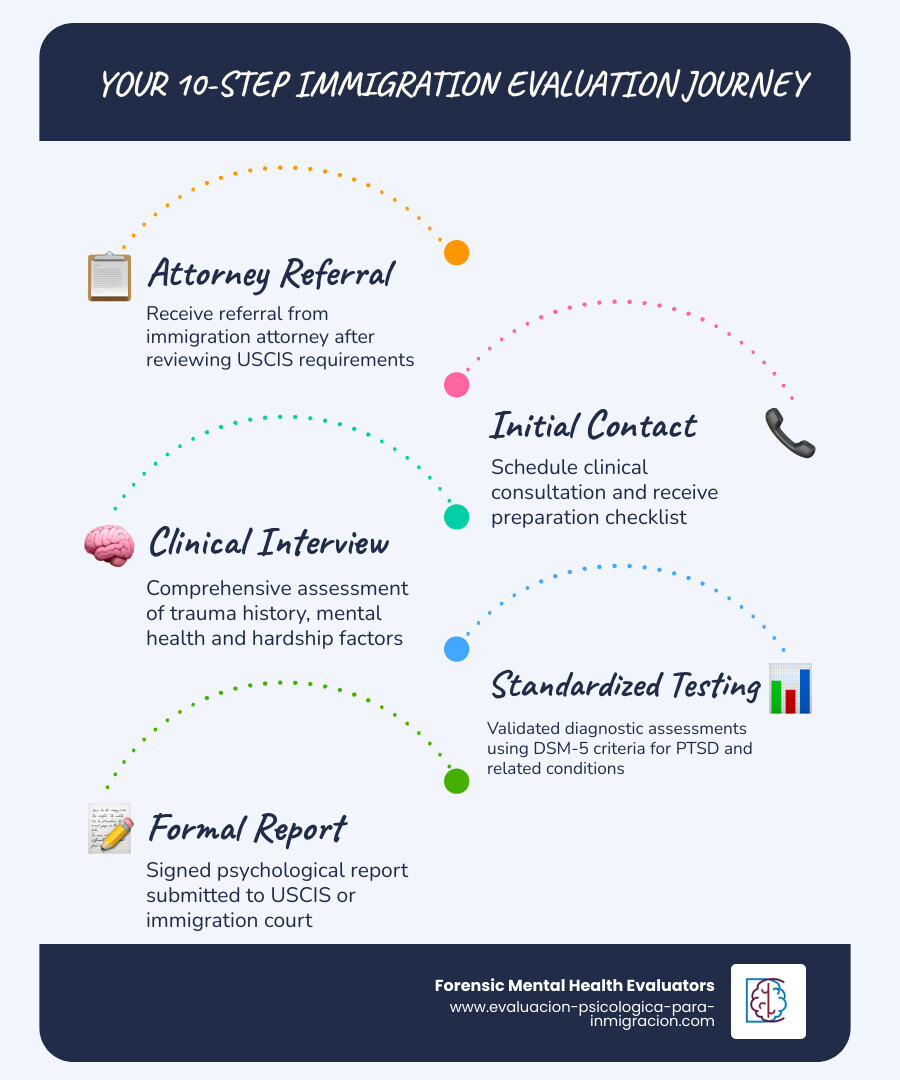
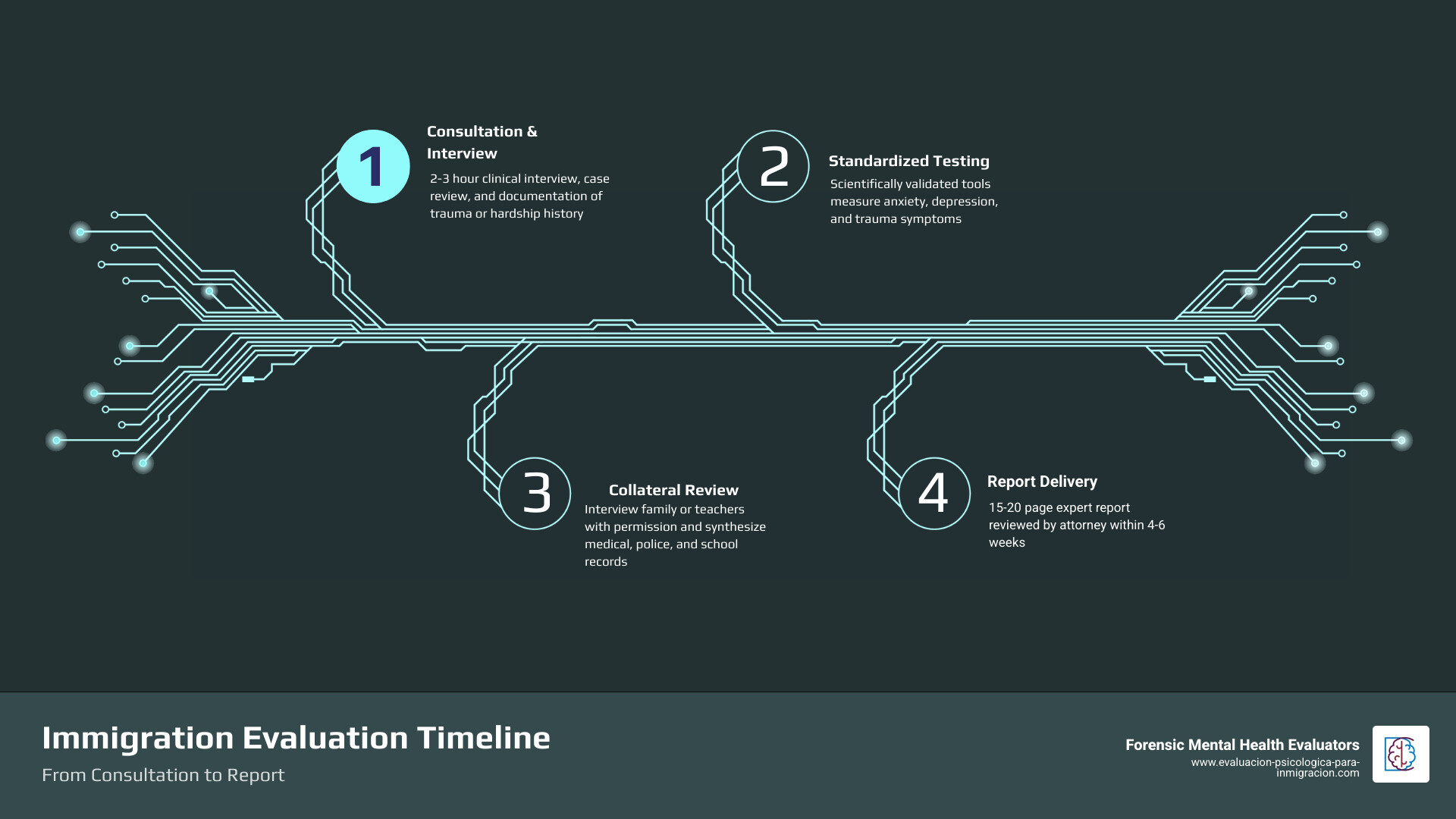
The process is structured to be as thorough as possible while respecting your time. Generally, the 4–6 week window from start to finish ensures that every detail is captured accurately.
- Consultation: We discuss your case type and legal needs.
- Clinical Interview: This usually takes 2 to 3 hours. For those in remote areas, we offer Evaluaciones Psicológicas de Inmigración por Telehealth, which allows you to complete the process from the comfort of your home in Texas, Florida, or California.
- Standardized Testing: We use scientifically validated tools to measure symptoms of anxiety, depression, and trauma.
- Collateral Contacts: With your permission, we may speak to family members or teachers to get a broader view of the situation.
- Report Drafting: We spend several hours synthesizing all the data into a 15–20 page document.
- Attorney Review: Your lawyer reviews the draft to ensure it aligns with the legal strategy.
Preparing for Your Immigration Evaluation Interview
Preparation is key to a smooth experience. As a Texas Immigration Psychological Expert, I recommend gathering the following items before our meeting:
- Personal Timeline: A list of important dates (when you arrived, when traumatic events occurred, births of children).
- Medical and School Records: These provide "hard evidence" of existing conditions or developmental needs.
- Police Reports: Essential for VAWA and U Visa cases.
- Symptom Tracking: Keep a small notebook of how you feel—are you having trouble sleeping? Do you have panic attacks?
Costs and Factors Influencing Professional Fees
We understand that the financial burden of immigration can be heavy. In May 2026, the standard price range for a comprehensive immigration evaluation is typically between $1,200 and $2,000.
Several factors can influence the final cost:
- Case Complexity: A case involving multiple family members or complex medical histories requires more time.
- Expedited Services: If you have a court date in a week, "rush" fees (usually $250–$500) may apply.
- Interpreter Fees: If a clinician isn't bilingual, you may need to pay for a professional translator ($50–$150 per hour).
- Documentation Needs: Some cases require more extensive testing or review of hundreds of pages of records.
While forms like the Financial Evaluation Form (IMM 1283) are used for sponsorship in other countries like Canada, in the U.S., these psychological evaluations are private, out-of-pocket expenses that are not subsidized by the government.
Frequently Asked Questions about Immigration Evaluations
Does insurance cover the cost of an immigration evaluation?
Unfortunately, no. Health insurance companies cover "medically necessary" treatment for mental illness. Because an Evaluación Forense de Inmigración is a legal service performed for a court case rather than a medical treatment, insurance providers do not reimburse for it. We view this as an investment in your legal future and your family's stability.
How long does it take to receive the final report?
Once the interviews and testing are complete, the standard turnaround time is 2 to 3 weeks. This allows us to carefully analyze the data and write a high-quality report. If you are using Texas Asylum Psychological Services, we recommend starting the process at least 8 weeks before your filing deadline to account for any unforeseen delays.
Can the evaluation be conducted in Spanish?
Absolutely. In fact, it should be. For the most accurate results, you need to be able to express your trauma and emotions in your native language. We offer an Austin Spanish Immigration Evaluation (and services across Texas) where the entire interview is conducted in Spanish. We then provide a certified English translation of the report for USCIS. Cultural sensitivity is at the heart of what we do; we understand the nuances of Hispanic culture and how they impact mental health.
Conclusion
Navigating the legal system is scary, but you don't have to do it alone. At District Counseling, we specialize in providing high-quality, professional immigration evaluations that help families stay together. Whether you are in Houston, Austin, Dallas, or San Antonio, we are here to support your journey.
We pride ourselves on client comfort. Our USP is simple: we provide expert Spanish evaluations translated to English, and because we believe in your long-term well-being, we offer 6 free therapy sessions after your report is completed. This ensures that while we help you with your legal case, we also help you start the healing process.
If you are ready to take the next step in your Evaluación Psicológica para Inmigración, reach out to us today. Let’s work together to give your story the clinical voice it deserves.