
When a Family's Future Depends on Two Words: Extreme Hardship

Extreme hardship is the legal standard the U.S. government uses to decide whether a qualifying U.S. citizen or lawful permanent resident (LPR) family member would suffer enough harm to justify granting an immigration waiver.
Here is a quick answer to what it means and when it applies:
| Question | Answer |
|---|---|
| What is it? | A legal standard requiring proof of hardship beyond the normal pain of family separation |
| Who must suffer it? | A qualifying relative — usually a U.S. citizen or LPR spouse or parent |
| Which forms require it? | Form I-601 and Form I-601A (provisional unlawful presence waiver) |
| How is it judged? | Under a totality of the circumstances standard — all factors are weighed together |
| Is marriage alone enough? | No. You must document specific, concrete hardship with supporting evidence |
Every year, USCIS receives roughly 20,000–25,000 Form I-601 waiver applications — and most of them require a showing of extreme hardship to a qualifying relative. In fiscal year 2022, about 68% were approved, which means preparation and documentation make a real difference.
But many families still get denied — not because their hardship isn't real, but because they don't know how to prove it in the way USCIS requires.
This guide breaks down the legal standard, the factors USCIS weighs, and what evidence actually works — in plain language.
My name is Francisco Ortiz, Lead Forensic Mental Health Evaluator at District Counseling PLLC and a Certified Forensic Mental Health Evaluator (CFMHE), and I have spent years providing expert psychological evaluations specifically designed to document extreme hardship in immigration waiver cases across Texas and five other states. In the sections that follow, I will walk you through exactly what USCIS looks for and how a professional evaluation can strengthen your case.
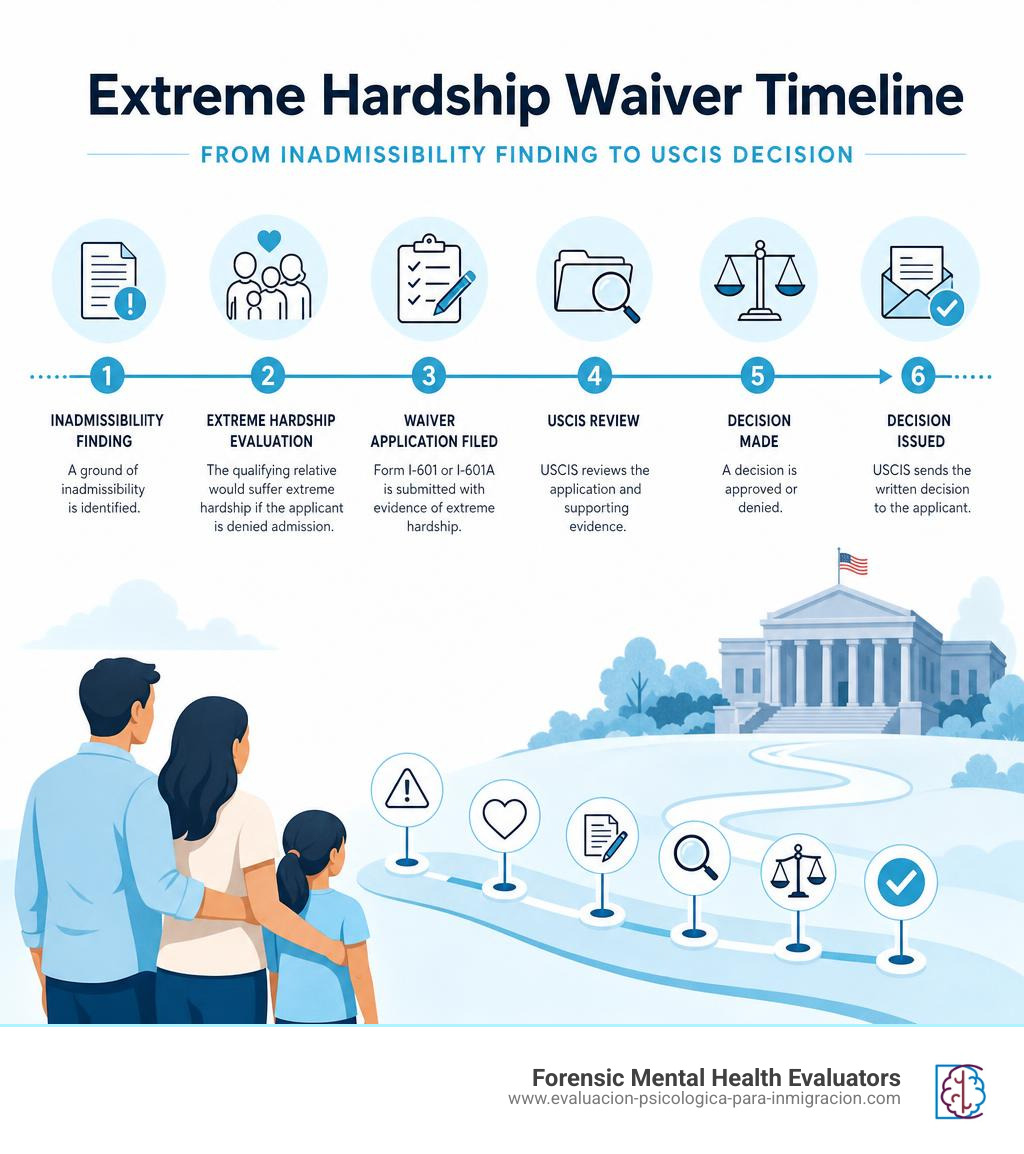
Defining the Legal Standard of Extreme Hardship
To win an immigration waiver, we must understand that extreme hardship is a highly specific legal term. It is not just about the sadness of being apart from your spouse or the financial strain of paying bills on a single income. USCIS considers those "common consequences" of deportation.
Instead, we must prove that the hardship our qualifying relative would face goes far beyond what is normally expected when a family is separated.
The burden of proof rests entirely on the applicant. Under the law, we must establish our claim by a "preponderance of the evidence." This means we must show that it is "more likely than not" (greater than a 50% chance) that the qualifying relative would suffer extreme hardship if the waiver is denied.
If we meet this standard, the USCIS officer then makes a discretionary decision based on the "totality of the circumstances"—meaning they look at all positive and negative factors in the case to decide if the waiver should be granted.
| Feature | Extreme Hardship (e.g., I-601, I-601A) | Exceptional and Extremely Unusual Hardship (e.g., Cancellation of Removal) |
|---|---|---|
| Legal Standard | Hardship that is "greater than what is usually expected" from deportation. | Hardship that is "substantially beyond" the ordinary; a much higher bar. |
| Who Must Suffer | Qualifying relative (USC/LPR spouse or parent; sometimes children depending on waiver). | Qualifying relative (USC/LPR spouse, parent, or child). |
| Where It Is Filed | USCIS (via Form I-601 or I-601A). | Immigration Court (EOIR) during deportation proceedings. |
| Key Precedent | Matter of Cervantes-Gonzalez | Matter of Recinas |
How Extreme Hardship Differs from Exceptional Hardship
It is easy to confuse different hardship standards in immigration law, but they are not the same. The standard required for waivers of inadmissibility is extreme hardship. This is legally lower than the "exceptional and extremely unusual hardship" standard required for a Cancellation of Removal in immigration court.
To understand the difference, we look at key Board of Immigration Appeals (BIA) precedents:
- Matter of Cervantes-Gonzalez (1999): This landmark case established the baseline factors for extreme hardship. It clarified that while family separation is difficult, we must show unique, compounded factors—such as significant health conditions, deep financial ties, or dangerous country conditions—to rise to the "extreme" level.
- Matter of Recinas (2002): This case represents the higher "exceptional and extremely unusual" standard. The applicant was a single mother of six U.S. citizen children with no family support in her home country and no realistic way to provide for them. This case showed that while the standard is incredibly high, it does not have to be "unconscionable" to be approved.
For a deeper dive into how these two standards diverge, you can read our detailed comparison on Extreme and Exceptionally Unusual Hardship.
Who Qualifies as a Relative for Extreme Hardship Waivers?
One of the most common mistakes families make is focusing their entire application on the hardship of the immigrant. Under the law, hardship to the immigrant applicant does not count. The law focuses almost exclusively on the hardship of the "qualifying relative."
Who counts as a qualifying relative depends entirely on the specific waiver under the Immigration and Nationality Act (INA):
- INA § 212(a)(9)(B)(v) (Unlawful Presence Waiver / I-601A): Only a U.S. citizen (USC) or Lawful Permanent Resident (LPR) spouse or parent qualifies. U.S. citizen children do not count as qualifying relatives for this waiver.
- INA § 212(i) (Fraud or Misrepresentation Waiver): Only a USC or LPR spouse or parent qualifies.
- INA § 212(h) (Criminal Grounds Waiver): A USC or LPR spouse, parent, son, or daughter qualifies. This is one of the few waivers where children are considered qualifying relatives.
Even when children do not qualify directly (such as in I-601A cases), we can still include their struggles in our arguments. We do this by demonstrating how the child’s suffering causes indirect, severe emotional and mental health trauma to the qualifying parent.
To learn more about how USCIS officers verify these relationships and process these claims, consult the USCIS Adjudication Steps.
Key Factors USCIS Considers in Hardship Evaluations

When we submit a waiver application, the USCIS officer does not look at our factors in isolation. They perform a "cumulative analysis." This means that even if no single issue (like a mild medical condition) rises to the level of extreme hardship on its own, the aggregate of several smaller issues (medical bills + language barriers + separation anxiety) can collectively meet the standard.
The Five Broad Categories of Hardship
According to the USCIS Policy Manual, officers are instructed to weigh factors across five broad categories. We must document how these categories affect our qualifying relative in both the separation and relocation scenarios:
- Health Conditions and Care: This is one of the most powerful factors. Approximately 40% of approved I-601 waivers cite health-related hardships (physical medical conditions or psychological impacts) as a primary factor. We must document chronic illnesses, ongoing treatments, and the psychological impact of separation.
- Financial and Economic Impact: We look at the loss of the primary breadwinner, the cost of maintaining two separate households, substantial debts, or the inability of a spouse to work due to childcare responsibilities.
- Personal Ties and Education: This includes the qualifying relative's ties to the United States, their age, how long they have lived here, and their access to education or specialized training.
- Social and Cultural Impact: This covers challenges like language barriers, religious or cultural differences, and the social stigmatization the relative would face if forced to relocate abroad.
- Country Conditions: We must document safety concerns, civil unrest, economic instability, or a lack of adequate medical infrastructure in the country of return.
To explore these official categories in detail, you can read the USCIS Extreme Hardship Considerations.
Particularly Significant Factors That Strengthen a Case
USCIS policy recognizes certain "Particularly Significant Factors" (PSFs) that carry extraordinary weight. If we can prove one or more of these exist in our case, it strongly supports a finding of extreme hardship:
- Active Military Service: The qualifying relative is a member of the U.S. Armed Forces.
- Disability Determinations: The qualifying relative or a dependent family member has a formally determined physical or mental disability.
- DOS Travel Warnings: The Department of State has issued a Level 3 (Reconsider Travel) or Level 4 (Do Not Travel) advisory for the country of relocation. This is cited in roughly 15–20% of relocation cases.
- Prior Grants of Status: The qualifying relative was previously granted asylum, refugee status, or T nonimmigrant status from the country of relocation.
- Substantial Caregiving Displacement: The applicant is the primary caregiver for the qualifying relative's children or elderly parents, and their removal would severely disrupt daily care.
For more information on how these specific factors are weighted during adjudication, see the USCIS Extreme Hardship Determinations.
Proving Hardship in Separation vs. Relocation Scenarios

When preparing an extreme hardship waiver, we must address the "dual-question framework." This means we must show what would happen under two distinct scenarios:
- The Separation Scenario: The qualifying relative stays in the United States while the applicant is deported or remains abroad.
- The Relocation Scenario: The qualifying relative relocates to the applicant's home country to keep the family together.
While USCIS guidelines state that we only need to prove extreme hardship in one of these scenarios, we highly recommend documenting both. This leaves no gaps in our legal argument.
Documenting the Separation Scenario
If the qualifying relative stays in the U.S. alone, they often face severe emotional trauma and financial distress.
To document this scenario effectively, we gather:
- Clinical Psychological Evaluations: A professional evaluation from a licensed clinician is crucial. At District Counseling, we conduct in-depth clinical interviews to diagnose conditions like Major Depressive Disorder (MDD), Generalized Anxiety Disorder (GAD), or Post-Traumatic Stress Disorder (PTSD) triggered by the threat of separation.
- Financial Records: Tax returns, mortgage statements, and utility bills showing that the household cannot survive financially without the applicant's income.
- Childcare Records: Evidence showing how the applicant's absence would displace childcare, forcing the qualifying relative to reduce work hours or pay for expensive care.
If you need professional clinical documentation for your waiver, you can read about our specialized Evaluación Psicológica para Caso de un Perdón.
Documenting the Relocation Scenario
If the qualifying relative chooses to move abroad to avoid separation, they often face entirely different, severe hardships.
To document this scenario, we focus on:
- Language and Cultural Barriers: If a U.S. citizen spouse does not speak the language of the home country, they will struggle to find employment or navigate daily life.
- Medical Disruption: If the relative requires specialized medical care or mental health therapy that is unavailable or inferior in the home country.
- Safety and Security Risks: We use official U.S. Department of State travel advisories and country condition reports to document high crime rates, cartel violence, or civil unrest.
For a comprehensive overview of what qualifies under these scenarios, read What Counts as Extreme Hardship.
Frequently Asked Questions about Extreme Hardship
What is the difference between common consequences and extreme hardship?
Common consequences are the typical, expected difficulties of deportation—such as normal emotional sadness, standard financial readjustment, and the general stress of moving. Extreme hardship requires showing a cumulative impact of factors that are unusual, severe, and go beyond these typical difficulties, such as a severe medical condition that cannot be treated abroad or a total financial collapse of the U.S. household.
Can children be considered qualifying relatives for an I-601A waiver?
No. Under the law, children are not qualifying relatives for the Form I-601A provisional waiver. However, we can document how the separation would devastate the child, which in turn causes severe psychological and emotional trauma to the qualifying parent (the USC or LPR spouse).
How do you write a strong hardship letter for an immigration waiver?
A strong sponsor letter must be written in the first person by the qualifying relative. It should avoid generic, emotional templates and focus on specific details, dates, and financial figures. Most importantly, every single claim made in the letter must be backed up by a labeled supporting exhibit (such as medical records, tax transcripts, or a psychological evaluation).
For step-by-step guidance and templates, see our Sample Hardship Letter Guide.
Conclusion
Proving extreme hardship is a complex legal challenge, but it is a challenge you do not have to face alone. A professional psychological evaluation can be the key piece of evidence that connects your family's real-world suffering to the strict legal standards required by USCIS.
At District Counseling (operating as Forensic Mental Health Evaluators), we specialize in providing comprehensive, legally robust psychological evaluations for immigration cases—including U-visas, asylum, and cancellation of removal.
We proudly serve clients across our office locations in:
- Houston, TX
- Katy, TX
- Cypress, TX
- Sugar Land, TX
We also offer remote evaluations for clients living throughout Texas, Florida, California, New York, Utah, Virginia, and Idaho.
We understand how stressful this process is for your family. That is why we offer:
- Bilingual Services: Evaluations conducted directly in Spanish and professionally translated to English.
- Client Comfort: A warm, compassionate, and non-judgmental environment.
- Ongoing Support: We provide 6 free therapy sessions post-report to help our clients process their trauma and navigate the emotional weight of their immigration journey.
Your family's future is too important to leave to chance. If you are preparing an immigration waiver and need a clinical evaluation to document your hardship, contact us today to schedule your consultation. Let us help you keep your family together.
To get started, learn more about our Evaluación Psicológica para Inmigración.