
Everything You Need to Know About the U Visa
What the Immigration U Visa Actually Is (And Why It Matters)
The immigration U visa is a special form of legal protection for immigrants who have been victims of serious crimes in the United States. It offers temporary legal status, work authorization, and — eventually — a path to a green card.
Here is a quick overview:
| Question | Quick Answer |
|---|---|
| What is it? | A nonimmigrant visa for crime victims who help law enforcement |
| Who qualifies? | Immigrants who suffered substantial abuse from a qualifying crime |
| How long does it last? | Up to 4 years, with possible extensions |
| Does it include work authorization? | Yes |
| Can it lead to a green card? | Yes, after 3 years in U status |
| Is there an annual cap? | Yes — 10,000 visas per year for principal applicants |
Many crime victims — especially undocumented immigrants — stay silent out of fear. Fear of deportation. Fear of losing their family. The U visa was created specifically to change that. Congress designed it to protect victims and help law enforcement investigate and prosecute serious crimes.
If you are an immigrant in the U.S. who has experienced domestic violence, sexual assault, trafficking, or another qualifying crime, this guide explains everything you need to know.
I'm Francisco Ortiz, Lead Forensic Mental Health Evaluator at District Counseling PLLC, and I specialize in psychological evaluations for immigration U visa cases — including bilingual Spanish-language assessments for victims navigating this process. Understanding the mental health component of a U visa application is a critical piece that many applicants overlook, and that is exactly what this guide addresses.
What is the Immigration U Visa and Who is it For?
The immigration U visa (officially known as U nonimmigrant status) is a vital humanitarian pathway established under the Victims of Trafficking and Violence Protection Act of 2000. It is specifically designed to provide temporary shelter and legal standing to noncitizens who have survived devastating crimes on U.S. soil or crimes that violated U.S. laws.

At its heart, the program is built on a simple, cooperative idea: crime victims should not have to hide in the shadows. By offering a safe, lawful way to remain in the country, the government encourages victims to come forward, report crimes, and cooperate with investigators. This collaboration makes entire communities safer for everyone.
According to the official USCIS U Visa guidelines, this status provides a safe haven from deportation, grants immediate access to work authorization, and opens the door to legal permanent residency. For many survivors, obtaining a U Visa | Immigration - NY Crime Victims Legal Help or utilizing similar programs in states like California and Florida is the first step toward reclaiming their lives and finding peace of mind.
Key Eligibility Requirements for the U Visa
To qualify for an immigration U visa, an applicant must meet several strict legal benchmarks set by the Department of Homeland Security. It is not enough to simply have been present when a crime occurred; you must prove that you meet the following four foundational criteria:
- You are the victim of a qualifying criminal activity that occurred within the United States or violated U.S. federal laws.
- You have suffered substantial physical or mental abuse as a direct result of this criminal activity.
- You possess credible, reliable information about the details of the crime. (If the victim is under 16 or is incapacitated, a parent, guardian, or "next friend" may provide this information on their behalf).
- You have been helpful, are currently being helpful, or are likely to be helpful to federal, state, or local law enforcement officials investigating or prosecuting the crime.
Additionally, applicants must be legally admissible to the United States. If you entered the country without inspection, have certain immigration violations, or have a criminal record, you may be considered "inadmissible." Fortunately, U visa applicants have access to a very generous waiver process. By filing a Form I-192 (Application for Advance Permission to Enter as a Nonimmigrant), you can ask USCIS to waive almost any ground of inadmissibility in the interest of humanitarian protection or public utility.
To help you understand how this program differs from other humanitarian options, such as those detailed in the Victims of Human Trafficking: T Nonimmigrant Status | USCIS guidelines, we have put together a comparison table:
Comparing U Visa and T Visa Requirements
| Feature | U Nonimmigrant Status (U Visa) | T Nonimmigrant Status (T Visa) |
|---|---|---|
| Primary Focus | Victims of a wide range of qualifying crimes | Victims of severe forms of human trafficking |
| Location of Crime | Must have occurred in the U.S. or violated U.S. laws | Must be physically present in the U.S. on account of trafficking |
| Cooperation Requirement | Must be helpful at all stages of investigation/prosecution | Must comply with reasonable law enforcement requests (exempt if under 18) |
| Hardship Standard | Must show substantial physical or mental abuse | Must show extreme hardship involving severe harm if removed |
| Law Enforcement Form | Requires Form I-918, Supplement B | Form I-914, Supplement B is preferred but not strictly mandatory |
Qualifying Crimes for the Immigration U Visa
The law designates a specific list of criminal activities that can make a victim eligible for a U visa. These crimes are generally violent in nature or involve severe exploitation, coercion, or obstruction of justice.
According to Victims of Human Trafficking and Other Crimes | USCIS , qualifying criminal activities include, but are not limited to:
- Abduction and Kidnapping
- Abusive Sexual Contact, Rape, and Sexual Assault
- Blackmail and Extortion
- Domestic Violence
- False Imprisonment and Unlawful Criminal Restraint
- Felonious Assault
- Hostage-taking
- Incest
- Involuntary Servitude, Slave Trade, and Peonage
- Manslaughter and Murder
- Obstruction of Justice and Witness Tampering
- Perjury
- Prostitution and Sexual Exploitation
- Stalking
- Torture
- Trafficking
It is also important to note that attempts, conspiracies, or solicitation to commit any of these qualifying crimes are also considered qualifying activities. If you experienced a crime that is not explicitly named on this list but is highly similar in its elements under local state laws, you may still qualify. For example, many state-level crimes like robbery can occasionally meet the standard of felonious assault depending on how the crime was committed.
Demonstrating Substantial Physical or Mental Abuse
One of the most critical—yet highly subjective—requirements for the immigration U visa is proving that you suffered "substantial physical or mental abuse" as a result of the crime.
USCIS does not use a single, rigid formula to measure your suffering. Instead, they look at the big picture. They evaluate factors such as:
- The severity and duration of the abuse.
- The physical or mental harm inflicted on you.
- The long-term impact on your daily life, physical health, and emotional well-being.
- Whether the abuse has aggravated any pre-existing physical or psychological conditions.
While physical injuries can be documented with medical records and photographs, psychological trauma is much harder to "see." Many survivors experience severe post-traumatic stress disorder (PTSD), debilitating anxiety, depression, panic attacks, and sleep disturbances long after the physical wounds have healed.
This is where a professional U Visa Psychological Assessment becomes incredibly valuable. A detailed clinical evaluation by a licensed mental health professional translates your invisible emotional wounds into an objective, clinical narrative that USCIS officers can easily understand and verify.
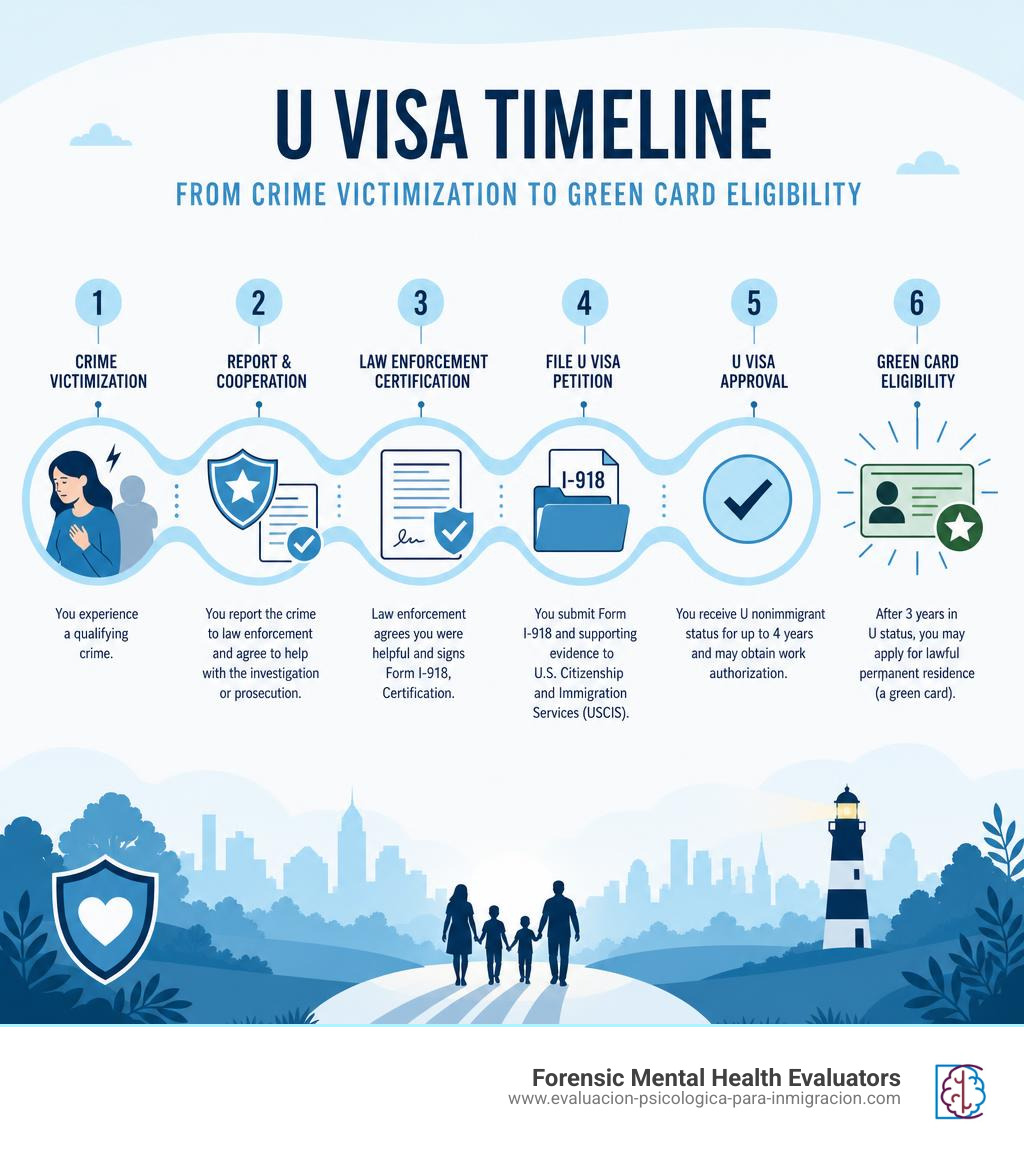
The U Visa Application Process Step-by-Step
Filing for a U visa is a multi-step journey that requires careful documentation, patience, and attention to detail.

Here is a step-by-step breakdown of how the application process generally unfolds in 2026:
- Obtain the Law Enforcement Certification (Form I-918, Supplement B): You must request that a qualifying agency certify that you were a victim and were helpful in their investigation. Without this signed form, your application cannot proceed.
- Prepare Your Personal Statement: Write a detailed, heartfelt statement describing the crime, your cooperation with the police, and the physical and mental toll the event took on your life.
- Gather Supporting Evidence: Collect police reports, court documents, medical records, photographs of injuries, and a professional psychological evaluation.
- Complete Form I-918 (and Supplement A for Family): Fill out the main petition. If you have qualifying family members (such as a spouse, children, or—if you are under 21—parents and unmarried minor siblings), you can file Form I-918 Supplement A to include them as derivative beneficiaries.
- Address Inadmissibility (Form I-192): If you have any immigration or criminal history that makes you inadmissible, prepare and submit a waiver application.
- Submit the Package to USCIS: Mail your completed petition package to the designated USCIS Service Center.
- Await Bona Fide Determination (BFD) Review: Because of the massive backlog, USCIS will first review your case to see if it is complete and "bona fide." If approved, you will receive temporary work authorization and deferred action while waiting for a final visa.
Obtaining the Law Enforcement Certification
The Law Enforcement Certification, officially submitted on Form I-918 Supplement B, is the gatekeeper of the U visa process. USCIS cannot approve a U visa without it.
This form must be signed by an authorized official from a qualifying "certifying agency" that was involved in detecting, investigating, or prosecuting the criminal activity. Qualifying agencies include:
- Local police departments (such as those providing Victim Services - POLICE Department - City of Houston ).
- County sheriffs and state prosecutors.
- Federal investigative agencies (like the FBI, DHS, or DOL).
- Family court judges or other judicial authorities.
- Labor protection agencies (such as the Department of Labor's Wage and Hour Division).
According to the U Visa Law Enforcement Resource Guide , signing this certification is entirely at the discretion of the agency. They are not legally required to sign it. However, many agencies readily sign these forms as part of a victim-centered approach to community policing. The certification does not grant you an immigration status on its own; it simply certifies your helpfulness, leaving the final decision of eligibility up to USCIS.
The Role of a Psychological Evaluation in Your Immigration U Visa Case
While the police certification proves your helpfulness, a professional mental health evaluation is often what proves your abuse. The trauma of being victimized by a crime can linger for years, impacting your ability to work, maintain relationships, and feel safe in your daily life.
At District Counseling, we specialize in conducting thorough, trauma-informed clinical evaluations designed specifically for immigration cases. We understand how difficult it can be to talk about these painful experiences. That is why we focus heavily on client comfort, providing a warm and supportive environment where you can safely share your story.
We offer:
- Bilingual Spanish Evaluations: Conducted directly in Spanish and translated into professional English, ensuring that no details of your experience are lost in translation.
- Comprehensive Written Reports: Detailed psychological evaluations that explicitly document the mental health impact of the crime, including diagnoses like PTSD, anxiety, or major depressive disorder.
- Ongoing Support: To help you heal, we provide 6 free therapy sessions after your evaluation report is completed.
A professional Evaluación Psicológica para Caso de UVisa serves as a powerful piece of secondary evidence, giving USCIS a clear, clinical understanding of the deep emotional scars left behind by the crime.
Benefits, Limitations, and the Path to a Green Card
Obtaining a U visa is a life-changing milestone. It provides immense relief, safety, and a clear path toward permanent integration into American society.
Key Benefits of the U Visa:
- Protection from Deportation: Approved applicants receive deferred action, meaning the government agrees not to deport them.
- Work Authorization: You receive an Employment Authorization Document (EAD) allowing you to work legally in the United States.
- Family Protection: You can extend these same protections to your spouse, children, and other qualifying family members.
- Path to Lawful Permanent Residence: After holding a U visa for 3 continuous years, you can apply to adjust your status to a permanent green card holder.
Limitations to Keep in Mind:
- Validity Period: The U visa is temporary and valid for up to 4 years. Extensions are only granted in very specific circumstances, such as law enforcement requests or delays in consular processing.
- Annual Cap Backlog: Because of the annual limit of 10,000 visas, the wait times for a full U visa are exceptionally long.
- Public Benefit Restrictions: Unlike some other humanitarian statuses, U visa holders are generally not classified as "qualified immigrants" and are ineligible for most federal public benefits (like Medicaid or federal financial aid).
To transition from a U Visa to Green Card, you must file a Form I-485. You must prove that you have maintained at least 3 years of continuous physical presence in the U.S. while in U status, and that you have not unreasonably refused to assist law enforcement since receiving your visa. Given the complexities of calculating these timelines, it is highly recommended to monitor the U Visa to Green Card Processing Time closely as you prepare your adjustment package.
Frequently Asked Questions About the U Visa
What is a bona fide determination (BFD) for a U visa?
Because the U visa backlog has grown significantly over the years, the Department of Homeland Security introduced the Bona Fide Determination (BFD) process. Under this policy, USCIS performs an initial, basic review of your pending petition. If they find that your application is complete (including a signed Supplement B and a personal statement) and you pass a background check, they will grant you a "bona fide determination." This gives you deferred action protection and a work permit while you wait in the queue for your actual U visa to become available, providing vital relief years ahead of schedule.
How long is a U visa valid and can it be extended?
A U visa is typically valid for 4 years. However, you can apply to extend your stay using Form I-539 under specific circumstances. These include requests from the certifying law enforcement agency, exceptional humanitarian circumstances, delays in consular processing, or if you have a pending Form I-485 application to adjust your status to a permanent resident. For more details on maintaining your status, you can consult the official Visas for Victims of Criminal Activity portal.
Is there an annual cap on U visas?
Yes, Congress has set an annual cap of 10,000 U visas per fiscal year for principal petitioners. Once this cap is reached, eligible applicants are placed on an official waiting list. Fortunately, there is no cap for derivative family members, meaning your spouse and children do not count against the 10,000 limit.
Conclusion
Navigating the immigration U visa process can feel overwhelming, but you do not have to walk this path alone. Documenting your story and proving the mental and emotional toll of victimization is a heavy burden, but it is also one of the most powerful ways to secure your future in the United States.
At District Counseling, we are proud to offer professional, compassionate forensic mental health evaluations for immigration cases. We serve clients across Texas (including Houston, Katy, Cypress, and Sugar Land) as well as in Florida, California, New York, Utah, Virginia, and Idaho. Our team of experienced evaluators provides bilingual Spanish-language assessments, ensuring you feel comfortable and understood every step of the way. Plus, to support your ongoing healing, we provide 6 free therapy sessions after your evaluation is complete.
If you are ready to take the next step in your immigration journey, we are here to help. Schedule an Evaluación Psicológica para Caso de UVisa with us today, and let us help you build the strongest possible case for your future.