
U Visa to Green Card: Navigating the USCIS Processing Timeline
What to Expect: U Visa to Green Card Processing Time in 2026

Understanding the u visa to green card processing time is critical for any crime victim navigating the U.S. immigration system — and the honest answer is that it takes a long time.
Here is a quick snapshot of the key timeframes:
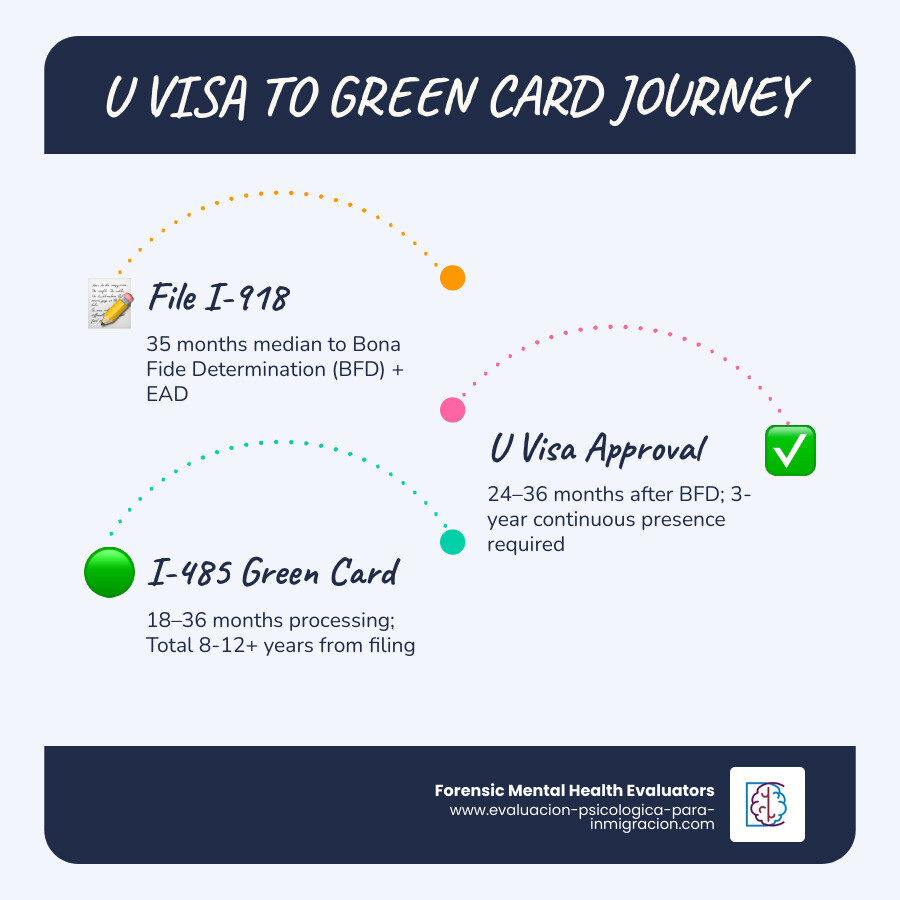
| Stage | Estimated Time |
|---|---|
| Filing Form I-918 to Bona Fide Determination (BFD) | ~35 months |
| BFD to final U visa approval | 24–36 months |
| Minimum U status before filing for green card | 3 years |
| Form I-485 (green card) processing | 18–36 months |
| Total: Initial filing to green card | 8 to 12+ years |
These are not worst-case numbers. For most applicants, this is the realistic range as of May 2026.
The backlog is enormous — an estimated 180,000 to 250,000 pending U visa cases, measured against a congressionally mandated cap of just 10,000 approvals per year. USCIS is currently reviewing cases filed back in 2017 and 2018. Waiting for a U visa is, without question, one of the most difficult experiences a crime survivor will ever face. The uncertainty compounds the trauma.
This guide walks you through each stage of the process, what affects your timeline, and what you can do to protect your case.
I am Francisco Ortiz, Lead Forensic Mental Health Evaluator at District Counseling PLLC, and I work directly with U visa applicants — conducting the psychological evaluations that document trauma, abuse, and ongoing harm that support cases throughout every stage of the u visa to green card processing time. Understanding both the clinical and procedural sides of this journey shapes everything I share below.
The Multi-Year Journey: From Initial Filing to U Visa Approval
The road to permanent residency begins with the initial USCIS U Visa petition (Form I-918). Because of the massive backlog, the government introduced the Bona Fide Determination (BFD) process in 2021 to provide some relief while applicants wait for their actual visa number.
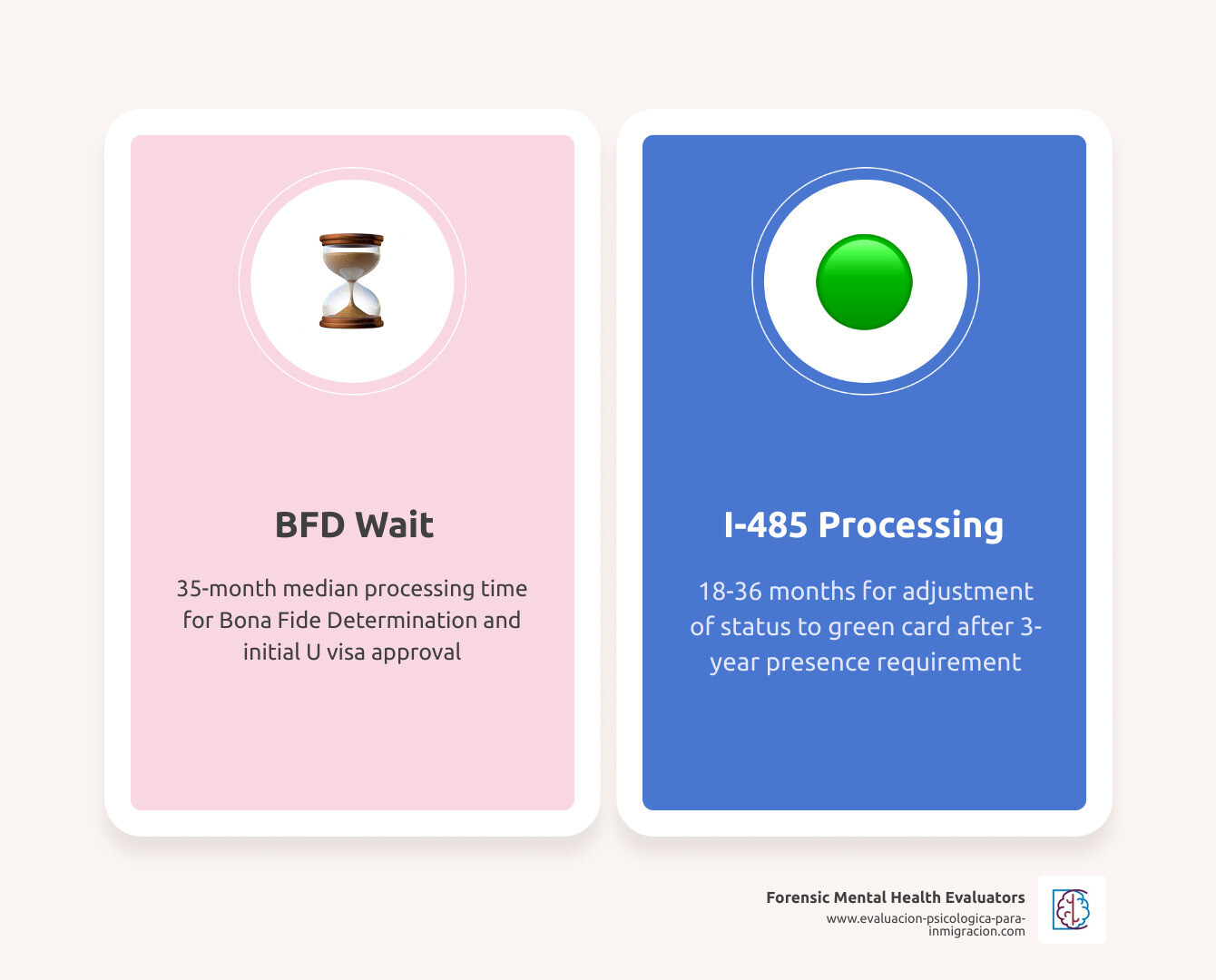
As of May 2026, the BFD process takes a median of 35 months. This is a significant improvement from previous years when it often took over five years just to get a work permit. Once USCIS determines your case is "bona fide" (meaning it was filed in good faith and includes all required documents like the law enforcement certification), they grant you deferred action. This protects you from deportation and allows you to receive an Employment Authorization Document (EAD).
However, a BFD is not a final visa approval. Because Congress only allows 10,000 principal U visas per year, you must wait for a visa number to become available. Currently, USCIS is adjudicating final approvals for cases filed in 2017 and 2018. This means even after your BFD, you may wait another 24 to 36 months for your actual U status to be granted.
During this long wait, it is vital to stay "admissible" and continue cooperating with law enforcement. Any new criminal history could jeopardize your BFD or your spot on the waitlist.
Eligibility and the Three-Year Continuous Presence Rule
Once your U visa is finally approved, the "green card clock" begins. You cannot apply for a green card the moment you get your U visa. Instead, you must hold U nonimmigrant status for at least three continuous years before you become eligible to file Form I-485.
The start date of this three-year period is the date printed on your I-797 Approval Notice. It is a common mistake to think the clock starts when you first applied or when you received your BFD—it does not. It only starts when you are officially in U status.
To maintain eligibility, you must prove continuous physical presence. This means:
- You cannot take a single trip outside the U.S. that lasts longer than 90 days.
- Your total time outside the U.S. across the three years cannot exceed 180 days.
If you must travel for longer, you generally need a certification from the investigating law enforcement agency stating that your absence was necessary to the investigation or prosecution. However, we strongly advise against international travel during this time, as Will a U Visa Ever Lead to a Green Card? depends heavily on meeting these strict presence requirements.
Additionally, you must show that you have not "unreasonably refused" to provide assistance to law enforcement since your U visa was granted. A U Visa Psychological Assessment can be helpful here to document the ongoing mental health impact of the crime, which can serve as evidence of the "substantial harm" required to maintain your status and eventually adjust to a green card.
How to File Form I-485: The Adjustment of Status Process

When you hit your three-year anniversary of U status, you can file Form I-485, Application to Register Permanent Residence or Adjust Status. This is the final step in the u visa to green card processing time.
One of the best pieces of news for U visa holders is that, as of April 1, 2024, USCIS eliminated the filing fees for U-based adjustment of status. This means you generally pay $0 in government fees for the I-485, which is a huge relief for many families.
To file a successful application, you will need:
- Form I-485 and Supplement E: The primary application forms.
- Form I-693: A medical exam completed by a USCIS-approved civil surgeon.
- Personal Affidavit: A written statement where you swear to your continuous presence in the U.S. and your ongoing cooperation with the police.
- Evidence of Presence: Leases, tax transcripts, utility bills, or school records for every month of those three years.
- Psychological Evidence: An updated Evaluación Psicológica para Caso de U Visa can be a powerful discretionary tool. Because the green card is a "discretionary benefit," you must prove that you deserve it on humanitarian grounds or for family unity. Our evaluations help tell the human story behind the legal forms.
Do not file your I-485 even one day before your three-year anniversary. If you do, USCIS will likely reject the entire package, forcing you to start over.
Factors Influencing U Visa to Green Card Processing Time
Several factors can speed up or slow down your journey. The Vermont Service Center handles the vast majority of these cases, and their workload fluctuates.
| Factor | Potential Impact |
|---|---|
| Request for Evidence (RFE) | Adds 3–6 months to the timeline. |
| Travel History | Complexity in documenting trips can cause delays. |
| Incomplete Evidence | Missing medical exams or biometrics will stall the case. |
| Service Center Backlogs | Current I-485 processing for U holders is 18–36 months. |
If USCIS sends an RFE, you must respond immediately. Common RFEs for U visa holders include requests for more proof of continuous presence or a new certification of helpfulness from the police. While a new Supplement B is not always strictly required, having one can prevent delays. You can always check When to Expect Your Green Card via the official USCIS portal for the most current service center averages.
Current Estimates for U Visa to Green Card Processing Time
As of May 2026, the u visa to green card processing time (for the I-485 stage specifically) ranges from 18 to 36 months. Because this is a discretionary grant, officers spend significant time reviewing the "merits" of the case. They look at your criminal record, your contributions to the community, and the hardship your family would face if you were not granted residency.
How to Check Your U Visa to Green Card Processing Time
You can track your case using the USCIS Case Status Online tool. You will need your 13-character receipt number (starting with letters like "EAC" or "WAC"). If your case falls outside the "normal processing time" listed on the USCIS website, your attorney can file an e-request to ask for an update.
Derivative Family Members and the I-929 Pathway

The U visa pathway also extends to your family. Spouses and children (U-2 through U-5) who held derivative status can apply for their green cards alongside the principal applicant or shortly after.
However, what happens if you have a family member—like a child born after you applied—who never had a U visa? In this case, you use Form I-929. This allows a principal U-1 holder who is applying for (or has received) a green card to petition for certain qualifying relatives.
This process has its own timeline. If your family members are outside the U.S., they must go through consular processing, which can add several years to the wait. It is critical to ensure your U visa status does not expire while they are waiting for their interview abroad. If your status is nearing the four-year mark, you may need to file for an extension to keep their derivative cases alive.
Frequently Asked Questions about U Visa Timelines
Does time spent on the U visa waitlist count toward the three-year requirement?
No. This is a common point of confusion. Time spent with a "Bona Fide Determination" or on the "Waitlist" with deferred action does not count toward the three-year continuous presence requirement. The clock only starts on the date your U nonimmigrant status is officially approved (the date on your I-797 approval notice).
Can I renew my work permit while waiting for a green card?
Yes. If you have a pending Form I-485, you are eligible to apply for a new work permit (category c9). This is important because your original U-based work permit (category a19 or a20) usually expires after four years. Filing the I-485 allows you to maintain work authorization until the green card is decided.
What happens if my U visa expires before my green card is approved?
Typically, filing a "bona fide" (properly filed) Form I-485 before your U visa expires will automatically extend your legal status while the application is pending. However, you must remain in the U.S. during this time. Leaving the country without "Advance Parole" while your green card is pending will result in your application being considered abandoned.
Conclusion: Your Partners in the Journey
The u visa to green card processing time is a marathon, not a sprint. From the first filing to the final green card, you are looking at a decade or more of waiting, documenting, and hoping. We know how much weight this puts on a person's mental health.
At District Counseling, we specialize in providing the forensic mental health evaluations needed to strengthen your case. Whether you are in Houston, Katy, Cypress, or Sugarland, or elsewhere in Texas, Florida, or California, we offer Spanish-language evaluations that are professionally translated into English.
We don't just provide a report; we provide support. We offer six free therapy sessions post-report to help you manage the trauma and the stress of the immigration process. If you are ready to take the next step in your adjustment of status, an Evaluación Psicológica para Caso de U Visa can be the piece of evidence that helps a USCIS officer see the human need for your permanent residency.
The road is long, but you don't have to walk it alone. Contact us today to learn how we can support your path from U visa to green card.