
Detailed Guide to T Visa Eligibility
Understanding the T Visa and Severe Forms of Human Trafficking
To understand if you are eligible for a t visa, we first have to look at how the law defines "severe forms of human trafficking." Under U.S. law, trafficking isn't just about moving people across borders; it is about the exploitation of a human being. There are two main categories: sex trafficking and labor trafficking.
Sex Trafficking
Sex trafficking occurs when someone recruits, harbors, transports, provides, or obtains a person for a commercial sex act. For an adult (18 or older), this must involve the use of force, fraud, or coercion. However, for a minor under the age of 18, any commercial sex act is legally considered trafficking, even if no force or fraud was used, because the law recognizes that children cannot consent to such acts.
Labor Trafficking
Labor trafficking involves the recruitment, harboring, or obtaining of a person for labor or services through force, fraud, or coercion. The goal of the trafficker is to subject the victim to involuntary servitude, peonage, debt bondage, or slavery.
- Involuntary Servitude: Being forced to work through physical threats or legal coercion.
- Debt Bondage: A common tactic where traffickers charge victims for "travel fees" or "rent" that can never be paid off, essentially owning the person's labor indefinitely.
Whether it was a "false promise" of a high-paying job in a hotel or being held in a private home for domestic work without pay, these situations qualify as severe forms of trafficking. You can find more official definitions on the USCIS Victims of Human Trafficking: T Nonimmigrant Status page.
The Four Core Requirements for T-1 Nonimmigrant Status
Getting a t visa isn't automatic just because a crime happened. We must prove four specific things to USCIS:
- Victimization: You are or were a victim of a severe form of human trafficking as defined above.
- Physical Presence: You are physically present in the U.S. (or at a port of entry) because of the trafficking.
- Cooperation: You have complied with any reasonable request from law enforcement for assistance in the investigation or prosecution (unless an exception applies).
- Extreme Hardship: You would suffer extreme hardship involving unusual and severe harm if you were removed from the United States.
| Requirement | T-1 Principal Applicant | Derivative (Family) Members |
|---|---|---|
| Victim of Trafficking | Must prove personal victimization | Must prove relationship to principal |
| Physical Presence | Must be in U.S. due to trafficking | Can be in U.S. or abroad |
| Law Enforcement Cooperation | Required (unless exempt) | Not required |
| Extreme Hardship | Required | Not required (but helpful for waivers) |
Physical Presence and the T Visa Connection
This requirement can be tricky. You must show that you are in the U.S. because of the trafficking. This includes people who were trafficked into the country, but it also covers people who were recruited abroad and then exploited once they arrived.
What if you escaped your trafficker years ago? USCIS looks at whether your "continuing presence" is related to the original trafficking. For example, if you haven't left the U.S. since the trafficking occurred, or if you are only here because you are participating in a trial against your trafficker, you likely meet this requirement.
A warning about travel: If you leave the United States after the trafficking has occurred, you might lose your eligibility for the t visa unless your departure was part of the trafficking itself or you were re-trafficked. According to the USCIS Policy Manual update on Victims of Trafficking, USCIS evaluates the connection between the original victimization and your current presence very carefully.
Cooperation with Law Enforcement and the Trauma Exception
The t visa was designed to help the police catch traffickers. Because of this, the law usually requires you to report the crime and help with the investigation. One way to prove this is by having a law enforcement agency (like the police, FBI, or even the Department of Labor) sign Form I-914, Supplement B.
However, we know that talking to the police can be terrifying, especially if the trafficker threatened your family. There are two major exceptions to the cooperation rule:
- Minors: If you were under 18 years of age at the time of the trafficking, you do not have to cooperate with law enforcement to qualify.
- The Trauma Exception: If you can show that you are unable to cooperate due to physical or psychological trauma, you may be exempt. This is where a clinical evaluation becomes vital. If a mental health professional can document that the mere thought of talking about the crime causes severe PTSD or a mental breakdown, USCIS can waive the cooperation requirement.
For those in California, the Civil Rights Department provides specific resources for T visa certifications in that state.
Proving Extreme Hardship and the Role of Psychological Evaluations
The fourth requirement—extreme hardship—is often the most complex. You must prove that leaving the U.S. would cause "unusual and severe harm." This goes beyond just being sad to leave or having less money in your home country.
USCIS considers factors like:
- Your age and health.
- Severe physical or mental illness that cannot be treated in your home country.
- The likelihood of being re-trafficked if you return.
- The safety of your family members.
- The laws (or lack thereof) in your country to protect trafficking victims.

This is where our work at District Counseling comes in. When you undergo an evaluacion psicologica para caso de t visa, we aren't just checking boxes. We are looking for the deep, often hidden scars of human trafficking. We document the symptoms of depression, anxiety, and PTSD that many survivors carry. By providing a detailed clinical report, we help the immigration officer see the "unusual and severe harm" that would occur if you were forced to return to the place where your trauma began.
In cities like Houston, Katy, and San Antonio, we provide these evaluations in Spanish and translate them to English. Our goal is to make you feel safe and heard, providing a report that serves as powerful evidence for your t visa application. The USCIS Policy Manual explicitly mentions that medical and psychological records are key forms of evidence for proving hardship.
Application Procedures, Family Derivatives, and Benefits
Applying for a t visa is a multi-step process. One of the most important recent changes is the bona fide determination process. As of August 28, 2024, USCIS has streamlined how they review applications. If they look at your initial filing and decide it is "bona fide" (made in good faith and complete), they can grant you deferred action. This protects you from deportation and allows you to get a work permit (Form I-765) while you wait for the final decision on your visa.
Filing Form I-914 for a T Visa
The main application is Form I-914. Along with this form, you should submit:
- A personal statement detailing the trafficking.
- Evidence of physical presence.
- Evidence of cooperation (or an exception).
- Evidence of extreme hardship (like your psychological evaluation).
- Form I-192: This is a "waiver of inadmissibility." If you entered the U.S. illegally or were forced to commit crimes by your trafficker, you may be "inadmissible." This form asks the government to forgive those issues because they were a result of your trafficking.

Derivative Status for Family Members (T-2 to T-6)
One of the greatest benefits of the t visa is the ability to help your family. If your application is approved, your family members can apply for "derivative" status.
- If you are under 21: You can apply for your spouse, children, parents, and unmarried siblings under age 18.
- If you are 21 or older: You can apply for your spouse and children.
- Retaliation Danger: Regardless of your age, if there is a present danger of retaliation against your family members because of your escape or cooperation, you may be able to include parents and siblings.
The USCIS newsroom recently highlighted how these protections have been strengthened to keep families safe from traffickers.
Conclusion and Frequently Asked Questions
Surviving human trafficking is an incredible feat of strength. The t visa program exists to honor that strength by providing a path to safety, work, and eventually, a Green Card. After three years of holding a T visa, you can apply to become a Lawful Permanent Resident.
At District Counseling, we are proud to support survivors across Texas, Florida, California, and beyond. We understand that the process is overwhelming, and we are here to provide the clinical expertise needed to document your story. If you need a professional evaluation to support your case, you can learn more about our Evaluacion Psicologica Para Caso De T Visa services.
How long does T visa processing take?
While USCIS aims for efficiency, processing times generally range from 6 to 18 months. However, with the new bona fide determination process, you may be able to receive work authorization much sooner than the final approval.
Is there an annual cap on T visas?
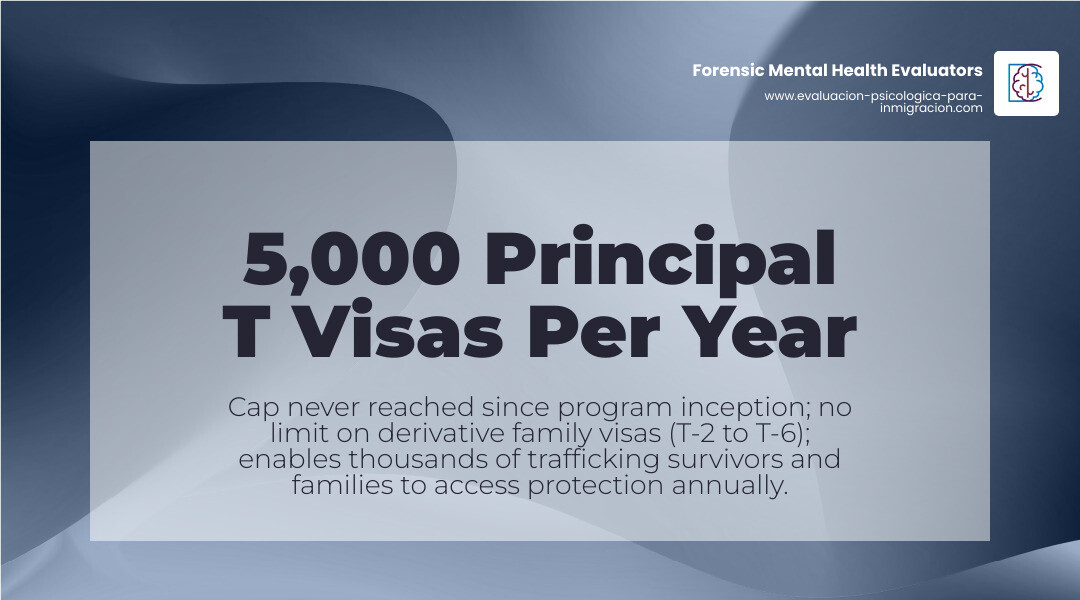
Yes, there is a cap of 5,000 principal (T-1) visas per fiscal year. However, it is important to note that this cap has never been reached since the program began. There is no cap for derivative family members (T-2 through T-6).
Can I apply if I am in removal proceedings?
Yes. Even if you are currently in immigration court or have a deportation order, you can still apply for a t visa. If you apply, you can ask the Immigration Judge to "stay" or pause your removal proceedings while USCIS decides on your application. USCIS has the "sole jurisdiction" (the only power) to decide T visa cases, not the judge.
If you or someone you know is a victim of trafficking, please reach out for help. You can contact the National Human Trafficking Hotline at 1-888-373-7888. For psychological support and evaluations that can help secure your legal status, we are here for you.