
Proving Extreme and Exceptionally Unusual Hardship for Your Family
Why "Extreme and Exceptionally Unusual Hardship" Decides Whether Your Family Stays Together

Extreme and exceptionally unusual hardship is the legal standard you must meet to win Non-LPR Cancellation of Removal — and it is one of the hardest immigration burdens to prove.
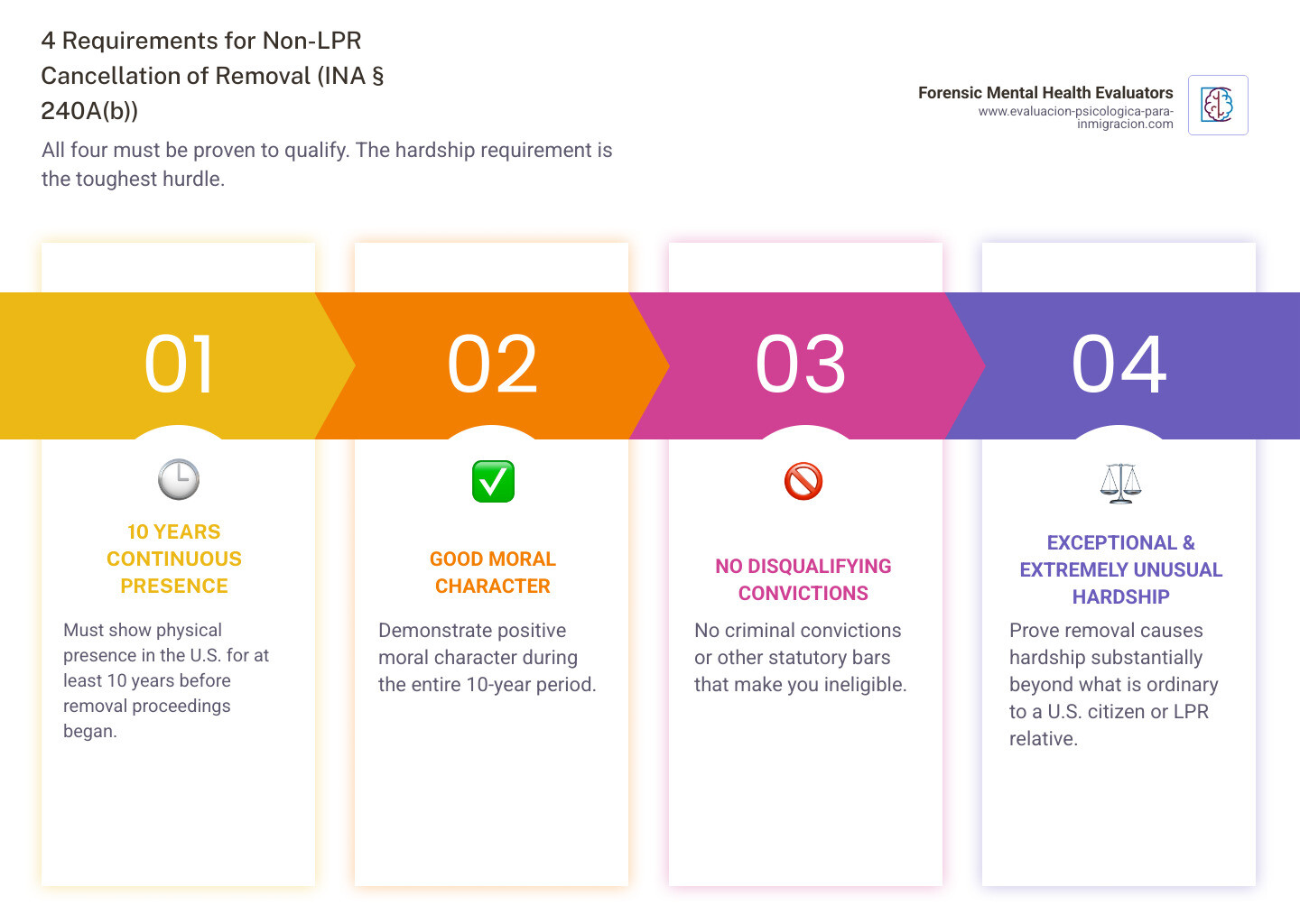
To qualify for Cancellation of Removal under INA § 240A(b), you must meet all four of these requirements:
- 10 years of continuous physical presence in the United States
- Good moral character during those 10 years
- No disqualifying criminal convictions or other statutory bars
- Proof that removal would cause exceptional and extremely unusual hardship to a qualifying relative — a U.S. citizen or lawful permanent resident (LPR) spouse, parent, or child
That fourth requirement is where most cases are won or lost.
The hardship standard is deliberately high. It is not enough to show that your family will be sad, financially strained, or separated. The Board of Immigration Appeals (BIA) has made clear that the hardship must be substantially beyond what any family would ordinarily experience when a parent or spouse is deported. Think of it as a scale — common consequences of removal sit at the bottom, and only truly exceptional circumstances tip the scale in your favor.
For Hispanic families in Texas facing deportation, the stakes could not be higher. U.S. citizen children, elderly parents who depend on you for care, or a spouse managing a serious medical condition — these are the kinds of real, documented situations that courts look for.
My name is Francisco Ortiz, and as a Certified Forensic Mental Health Evaluator (CFMHE) and Lead Forensic Mental Health Evaluator at District Counseling PLLC, I have conducted expert psychological evaluations specifically designed to document extreme and exceptionally unusual hardship for families in removal proceedings. In this guide, I will walk you through exactly what the law requires and how the right evidence can make the difference in your case.
Defining extreme and exceptionally unusual hardship in 2026

When we talk about Exceptional and extremely unusual hardship, we are dealing with a standard that is often described by "nebulous adjectives." In immigration law, words like "exceptional" and "unusual" aren't just descriptions; they are high bars that require specific types of proof.
The Board of Immigration Appeals (BIA) provided the foundational definitions for this standard in several seminal cases. In Matter of Monreal, the BIA established that the hardship must be "substantially beyond" that which would ordinarily result from deportation. While the law doesn't require the situation to be "unconscionable" (a standard that was once considered but ultimately rejected), it is still a very high hill to climb.
Another key case is Matter of Recinas, which showed that a combination of factors—such as being a single mother with many children, having no family support in the home country, and facing limited economic opportunities—could cumulatively meet the standard. In 2026, the courts continue to look for cases that are "truly exceptional" and involve "the most deserving candidates."
How it Differs from the Extreme Hardship Standard
It is common for applicants to confuse "extreme hardship" with "extreme and exceptionally unusual hardship." While they sound similar, they are legally distinct.
The "extreme hardship" standard is used for waivers like the I-601 or I-601A (Provisional Unlawful Presence Waiver). You can find detailed guidance on this lower standard in the Part B - Extreme Hardship | USCIS policy manual.
To help you visualize the difference, we have put together a comparison:
| Feature | Extreme Hardship (Waivers) | Exceptional & Extremely Unusual (Cancellation) |
|---|---|---|
| Legal Threshold | High, but manageable | Very high; "substantially beyond" ordinary |
| Statutory Basis | INA § 212(i), 212(h), etc. | INA § 240A(b)(1)(D) |
| Commonly Used For | I-601, I-601A, I-212 | Non-LPR Cancellation of Removal |
| Focus | Qualifying relative's suffering | "Truly exceptional" suffering of relative |
In short, while all "exceptional and extremely unusual" hardships are extreme, not all "extreme" hardships are "exceptional and extremely unusual." If you are in removal proceedings, the "standard" hardship of family separation—missing each other, losing a second income, or feeling sad—is generally considered "ordinary" by the court and will not win your case.
Key Factors in Proving Eligibility for Cancellation of Removal

To win a Cancellation of Removal case, we must look at the "totality of the circumstances." This means the Immigration Judge (IJ) will look at every factor in your life and your family's life. According to Chapter 5 - Extreme Hardship Considerations and Factors | USCIS, these factors often include:
- Age of the Qualifying Relative: Is the child at a critical stage of development? Is a parent elderly and unable to care for themselves?
- Health Status: Does the relative have a chronic or life-threatening illness?
- Financial Dependency: Is the applicant the sole provider for the family?
- Country Conditions: What is the safety and economic situation in the applicant's home country?
- Educational Needs: Does a child have special education requirements (IEP) that cannot be met abroad?
- Family Ties: Does the family have a deep-rooted support network in the U.S. that would be destroyed?
The Role of Medical Evidence in Meeting extreme and exceptionally unusual hardship
Medical and psychological factors are often the strongest pillars of a successful hardship claim. However, simply having a medical condition is not enough. The BIA's decision in Matter of J-J-G- set a high bar for medical-based claims.
In that case, the court ruled that conditions like hypertension or successfully treated anxiety/ADHD might not be considered "serious" enough on their own. To win, you must prove two things:
- The relative has a serious medical or psychological condition.
- Adequate care for that condition is not reasonably available in the country of removal.
This is where a professional Evaluación Psicológica para Caso de una Cancelación de Deportación becomes vital. At District Counseling, we don't just state that a relative is "stressed." we document the clinical severity of their condition, the specific psychological trauma they would face upon separation, and the lack of comparable mental health resources in countries like Mexico, Guatemala, or El Salvador.
Expert testimony and detailed reports provide the "corroborating evidence" that judges require. As noted in Matter of J-J-G-, judges are not required to accept your word alone regarding medical costs or availability; they want to see professional evaluations and reliable data.
Documenting the Totality of Circumstances for Your Case
Proving extreme and exceptionally unusual hardship is like building a puzzle. No single piece (like a low income or a minor illness) might be enough, but when you put them all together, they create a picture of a "truly exceptional" situation. This is known as a cumulative evaluation.
When we perform an Evaluación Psicológica para Inmigración, we look at the biopsychosocial impact on the qualifying relative. This includes:
- Psychological Trauma: The irreversible harm done to a child’s mental development when a parent is removed.
- Economic Detriment: Not just "making less money," but the potential for total financial collapse or the inability to afford life-saving medication.
- Social Stigma: How the family would be treated in the home country (e.g., stigma against children with disabilities).
- Caregiving Displacement: If you are the primary caregiver for an LPR parent, who will take them to the doctor? If there is no one else, that is a "particularly significant factor."
We also look at Department of State (DOS) travel warnings. If the country you are being sent to is under a high-level travel advisory, and your U.S. citizen child would have to relocate there with you, the danger they face is a major component of the hardship.
Overcoming Adverse Precedents to Prove extreme and exceptionally unusual hardship
Cases like In Re: Aguinaga show how difficult these cases can be. In Aguinaga, a 34-year-old father was denied relief even though he had U.S. citizen children and LPR parents. The court presumed that because he had a large family, they could support each other without him.
To overcome these kinds of precedents, we must distinguish your case. This involves proving that your family's relationship is not "ordinary." We use an Evaluación Psicológica para Caso de un Perdón (even in cancellation contexts) to highlight unique dependencies.
For example, if your child has a specific psychological diagnosis that requires your presence for stability, or if your elderly mother has a "special relationship" with you that cannot be replaced by other siblings, we document that in detail. Reliability is key—judges are wary of internet-sourced data. They want expert opinions from licensed professionals who understand the specific legal standards of 2026.
Frequently Asked Questions about extreme and exceptionally unusual hardship
Who counts as a qualifying relative for this hardship standard?
Under INA § 240A(b), the hardship must be suffered by a qualifying relative, not the applicant themselves. Qualifying relatives include:
- A U.S. citizen or Lawful Permanent Resident (LPR) spouse.
- A U.S. citizen or LPR parent.
- A U.S. citizen or LPR child (unmarried and under 21).
You must provide birth certificates, marriage licenses, and proof of their legal status to establish these bona fide relationships.
Can I use my own health issues to prove my case?
This is a common point of confusion. The law specifically states the hardship must be to the qualifying relative. However, your own health issues can be relevant indirectly.
If your illness makes it impossible for you to work or care for your U.S. citizen children in your home country, and that causes them to suffer extreme and exceptionally unusual hardship, the judge can consider it. But the focus always remains on the relative, not you.
What are "particularly significant factors" in a hardship claim?
In 2026, USCIS and Immigration Courts recognize certain factors as carrying extra weight. These are often referred to as "particularly significant factors."
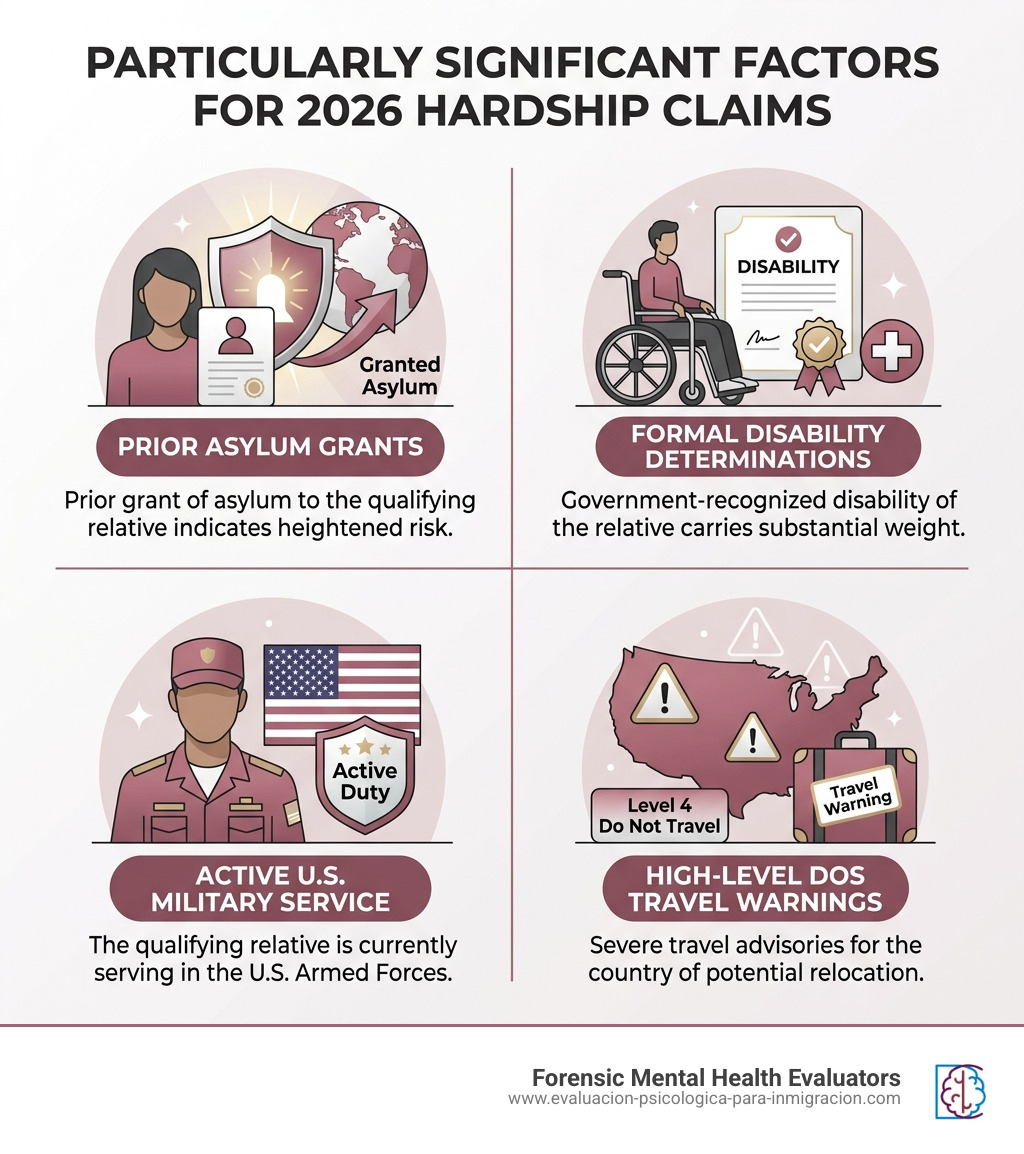
These include:
- Prior Asylum Grants: If the relative was previously granted asylum, it suggests they face heightened risk.
- Disability Determinations: A formal government finding of disability for a relative is a heavy factor.
- Military Service: If the qualifying relative is an active-duty member of the U.S. armed forces.
- DOS Travel Warnings: High-level warnings for the country of relocation.
- Caregiving Shifts: When the applicant’s removal would leave a vulnerable relative without any source of care.
Conclusion
Winning a case based on extreme and exceptionally unusual hardship requires more than just a good story; it requires a rigorous legal and clinical strategy. The burden of proof is entirely on you, the applicant, to show that your family’s situation is "substantially beyond" the norm.
At District Counseling, we specialize in helping families in Houston, Austin, Dallas, and San Antonio bridge the gap between their lived reality and the high evidentiary standards of the immigration court. Our team provides expert Evaluación Psicológica para Inmigración services in both Spanish and English.
We understand that the evaluation process can be emotional. That’s why we offer a comfortable environment and, uniquely, include 6 free therapy sessions post-report to help your family manage the stress of the legal process.
If you are fighting to keep your family together in Texas, don't leave your evidence to chance. A professional psychological evaluation can provide the critical, corroborated proof you need to meet the highest hardship standard in immigration law.
For more information or to schedule an evaluation, visit our Home - Evaluación Psicológica para Inmigración page today. We are here to help you document your family's "truly exceptional" story.