
Dallas Mental Health Evaluations for U Visa Success
What Is a Dallas U Visa Mental Evaluation — and Do You Need One?
If you are a crime victim in Texas trying to protect your immigration status, getting a Dallas U Visa mental evaluation is one of the most important steps you can take. Here is a quick overview of what it involves:
Quick Answer: Dallas U Visa Mental Evaluation at a Glance
| Question | Answer |
|---|---|
| What is it? | A clinical assessment documenting psychological harm from a qualifying crime |
| Who needs it? | Crime victims applying for U Visa status in the Dallas area |
| Why does it matter? | Proves "substantial mental abuse" — a core USCIS requirement |
| Who conducts it? | A licensed mental health professional trained in forensic immigration evaluations |
| How long does it take? | 1–2 interview sessions; report typically ready in 7–14 business days |
| Is it available in Spanish? | Yes — bilingual evaluations are available |
The U Visa was created in 2000 to protect undocumented crime victims who cooperate with law enforcement. But one requirement trips up many applicants: proving that you suffered substantial physical or mental abuse. This is not something a police report alone can show. USCIS needs objective clinical evidence — and that is exactly what a psychological evaluation provides.
With over 400,000 U Visa petitions pending as of 2023 and only 10,000 approvals available each year, a strong, well-documented application is not optional. It is essential.
I am Francisco Ortiz, Lead Forensic Mental Health Evaluator at District Counseling PLLC, a Certified Forensic Mental Health Evaluator licensed in Texas and five other states, with specialized training in U Visa and T Visa psychological evaluations for crime victims — including bilingual Dallas U Visa mental evaluation services for Spanish-speaking clients. In this guide, I will walk you through everything you need to know to get the right evaluation and build the strongest possible case.
Why You Need a Dallas U Visa Mental Evaluation
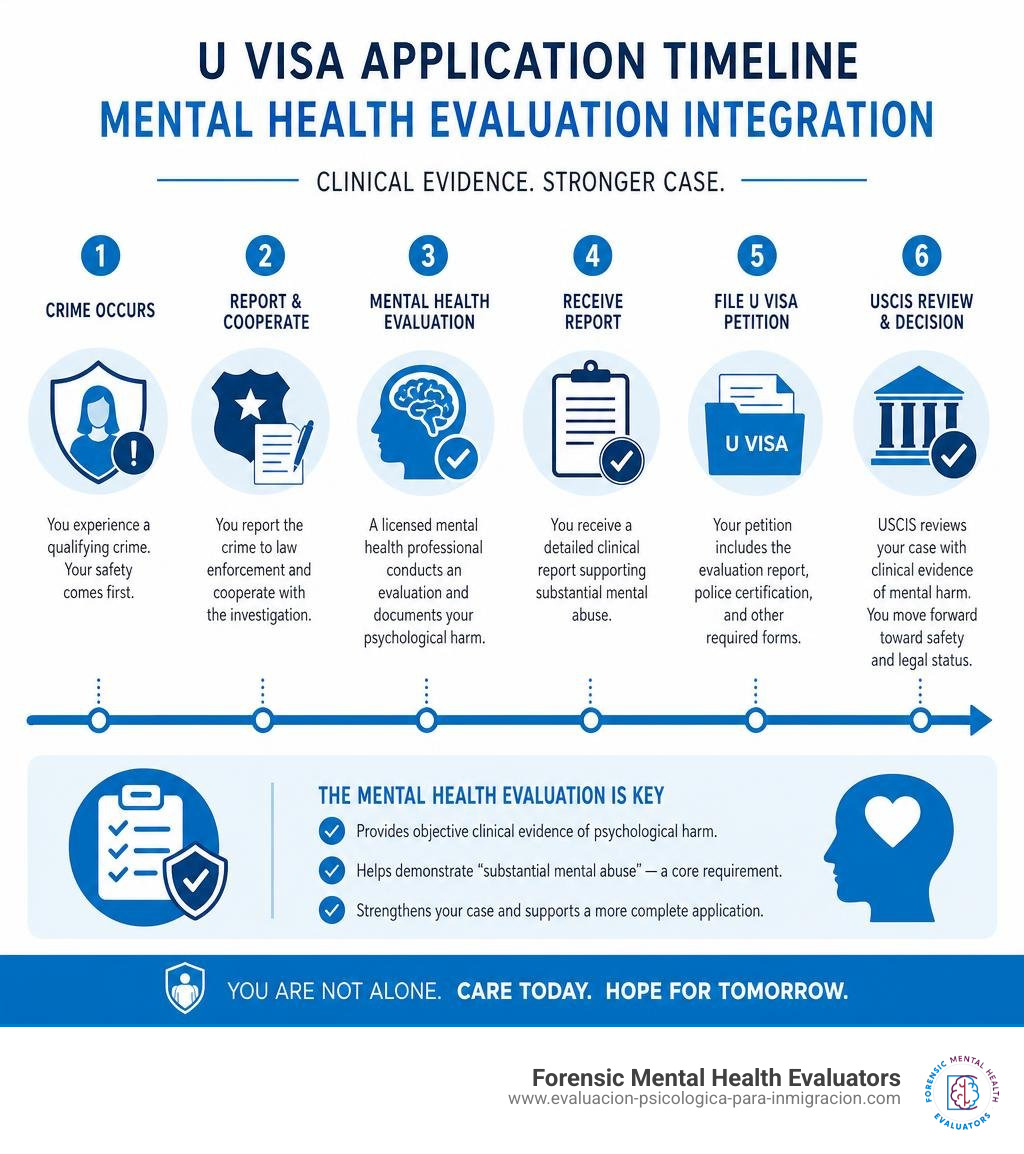
Applying for a U Visa is a brave step toward safety and legal status, but it requires meeting strict legal standards. While a police report proves that a crime occurred and that you cooperated with the investigation, it cannot measure the invisible scars left behind. That is where a dallas u visa mental evaluation comes in. It bridges the "evidence gap" by translating your emotional pain into objective, clinical terms that USCIS officers understand.
To qualify for a U Visa, you must demonstrate that you have suffered "substantial physical or mental abuse" as a result of a qualifying criminal activity. USCIS does not provide a rigid, one-size-fits-all definition of what constitutes "substantial" abuse. Instead, adjudicators evaluate cases individually, looking at factors such as the severity of the crime, the duration of the harm, and the long-term impact on your well-being.
A comprehensive forensic evaluation acts as a powerful voice for your trauma. Without a professional mental health report, you are relying solely on a personal declaration, which may lack the clinical authority required under current 2026 USCIS scrutiny. By working with professionals who understand both the clinical and legal standards, you can present a robust case. For a deeper look into how these assessments are structured, you can read more about U Visa psychological assessments.
Furthermore, the legal landscape surrounding U Visa certifications is highly complex. Research on Disparities in the U Visa Certification Process highlights how much the certification rates and requirements vary across different cities and police departments. Because the process of obtaining a signed law enforcement certification can be highly unpredictable, having an airtight psychological evaluation is your best defense to ensure your application stands strong once it reaches federal review.
Proving Substantial Mental Abuse to USCIS
When USCIS reviews your application, they look for credible, documented proof of your psychological injuries. Trauma is complex; it often manifests in ways that are difficult to explain in a simple written statement. An expert evaluation provides a formal diagnosis and links your symptoms directly to the crime.
Common mental health conditions documented in U Visa cases include:
- Post-Traumatic Stress Disorder (PTSD): Flashbacks, severe anxiety, hypervigilance, and nightmares.
- Major Depressive Disorder (MDD): Persistent sadness, loss of interest in daily activities, and feelings of hopelessness.
- Generalized Anxiety Disorder: Constant worry, panic attacks, and physical symptoms like chronic headaches or stomach pain.
Our clinical documentation outlines how these symptoms impair your social, occupational, and daily functioning. This clinical "nexus" — the direct link between the crime and your current psychological struggles — is exactly what USCIS looks for when determining if the abuse meets the "substantial" threshold. To learn more about how USCIS evaluates these claims, check out our detailed breakdown of the USCIS U Visa.
The Role of Dallas Police and Certifying Agencies
Before you can submit your U Visa petition (Form I-918) to USCIS, you must obtain a signed Law Enforcement Certification (Form I-918, Supplement B). This form must be signed by a certifying official, such as the Dallas Police Department, the Dallas County Sheriff's Department, or a local judge, confirming that you were a victim of a qualifying crime and were helpful in the investigation.
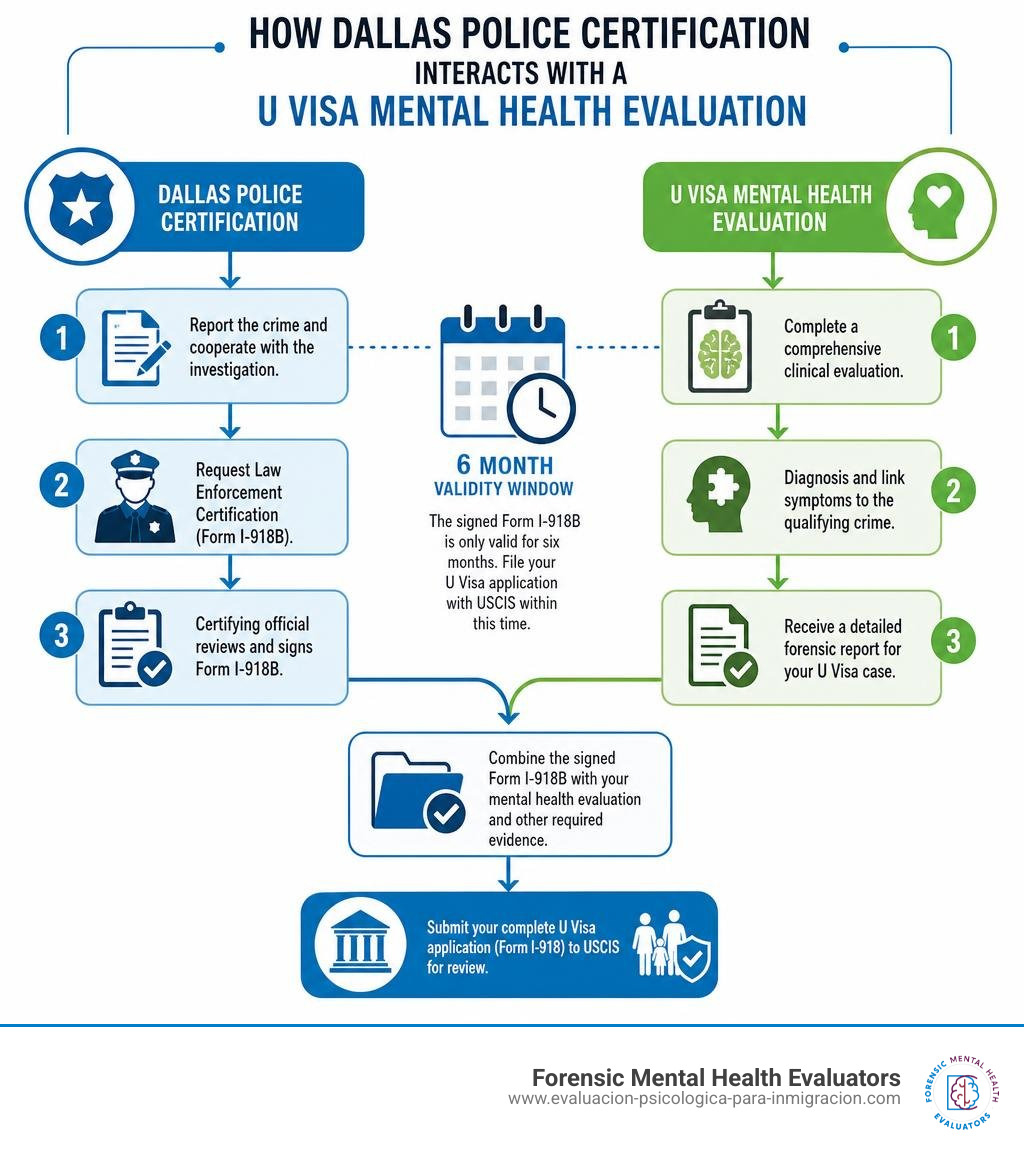
There is a critical catch: once the certifying agency signs Form I-918B, it is only valid for six months. If you do not file your complete U Visa application with USCIS within that six-month window, you must start the certification process all over again.
Because of this tight timeline, coordinating your psychological evaluation quickly is vital. We work in tandem with immigration attorneys to ensure your mental health report is completed and polished well before your law enforcement certification expires, avoiding costly delays or denials.
How to Get a Psychological Evaluation for Your U Visa in Texas
Navigating the clinical side of an immigration case can feel intimidating, but the right support makes all the difference. To ensure your evaluation carries weight with USCIS, you should work with a licensed mental health professional who specializes in forensic immigration assessments, rather than a general treating therapist.
A treating therapist's job is to support your ongoing healing, which is wonderful and necessary. However, a forensic evaluator's job is to remain objective, use standardized clinical testing, and construct a highly detailed, 10-to-20-page legal-psychological report that can withstand intense USCIS scrutiny. For Texans seeking this specialized expertise, we offer dedicated Texas immigration psychological expert services designed to meet these exact legal standards.
Step-by-Step Process for Your Dallas U Visa Mental Evaluation
Getting your evaluation is a structured, collaborative process. Here is what you can expect when working with us:
- Initial Consultation & Intake: We begin by gathering your basic information, reviewing your legal goals, and ensuring we coordinate directly with your immigration attorney.
- Document Review: We review relevant documents, such as police reports, personal statements, and past medical or school records, to understand the context of your experience.
- The Clinical Interview: We conduct a thorough, sensitive clinical interview (usually split into one or two sessions) to discuss your background, the traumatic event, and your current mental health symptoms.
- Standardized Testing: We administer scientifically validated questionnaires to objectively measure levels of trauma, anxiety, and depression.
- Report Drafting & Delivery: We compile all clinical findings into a comprehensive, professional report. Our standard turnaround time is 7 to 10 business days, though expedited options are available if your Form I-918B is nearing its expiration date.
For a complete look at how we manage this journey from start to finish, read through our Texas immigration psych evaluation guide.
What To Expect During Your Dallas U Visa Mental Evaluation Interview
We understand that talking about trauma is incredibly difficult. Our primary goal during your clinical interview is to create a safe, warm, and entirely non-judgmental space. We utilize trauma-informed care techniques, which means we go at your pace, allow you to take breaks, and never force you to share details that feel too overwhelming.
During the interview, we will talk about:
- Your childhood, family background, and life before the crime.
- The details of the qualifying crime and your emotional reactions during and after the event.
- Your current daily struggles, sleep patterns, relationships, and ability to work.
- Your hopes and fears regarding your future and safety.
To make this process as comfortable as possible, we offer fully bilingual services. You can complete your evaluation entirely in Spanish or English. If you prefer Spanish, your clinical interview will be conducted in Spanish, and we will translate the final report into professional English for USCIS, ensuring nothing is lost in translation.
Comparing U Visa Evaluations to Other Immigration Assessments
While all immigration psychological evaluations document emotional distress, they serve very different legal purposes. It is crucial that your therapist tailors your report to the specific visa or waiver you are seeking.
| Evaluation Type | Legal Purpose | Focus of the Mental Health Report |
|---|---|---|
| U Visa (Form I-918) | Protects victims of qualifying crimes who assist law enforcement | Must prove "substantial physical or mental abuse" and link current trauma to the specific crime. |
| VAWA (Form I-360) | Protects spouses, children, or parents abused by a U.S. citizen or LPR | Documents the psychological impact of domestic violence, extreme cruelty, or coercive control. |
| T Visa (Form I-914) | Protects victims of human trafficking | Focuses on extreme trauma, coercion, and how the trauma may have impacted the ability to cooperate with police. |
| Hardship Waiver (I-601/A) | Waives grounds of inadmissibility to keep families together | Focuses on the "extreme hardship" a qualifying U.S. citizen or LPR relative would suffer if the applicant is deported. |
Using a generic "template" evaluation for different visa types is a major red flag for USCIS. For example, a T Visa evaluation must address specific elements of coercion and trafficking, whereas a U Visa evaluation must explicitly establish the "abuse" threshold resulting from a qualifying crime. To understand how these assessments differ in detail, read our complete guide to immigration evaluations.
Frequently Asked Questions About Dallas U Visa Evaluations
How long does a U Visa mental health evaluation take and what is the turnaround time?
The clinical interview process typically takes between 2 to 3 hours total, which we often split into two comfortable sessions to prevent emotional fatigue. Once the interviews and standardized testing are complete, our standard turnaround time to write, edit, and deliver the final forensic report to you and your attorney is 7 to 10 business days.
If you are facing an urgent deadline—such as a rapidly expiring law enforcement certification—we offer expedited services to deliver your report in as little as 48 hours to 5 days for an additional fee. For more information on how this fits into your long-term legal journey, check out our guide on the U Visa to green card processing timeline.
What are the typical costs and payment options for a U Visa evaluation in Dallas?
A professional, high-quality forensic psychological evaluation is a highly specialized legal document. On average, these evaluations cost around $700. Because forensic evaluations are conducted for legal proceedings rather than medical treatment, health insurance plans typically do not cover them.
To help make this essential service accessible, we offer flexible, interest-free payment plans. We believe that financial stress should never stand in the way of your safety and peace of mind.
What common mistakes should I avoid when getting a U Visa evaluation?
Undergoing a dallas u visa mental evaluation can dramatically boost your chances of approval, but only if it is done correctly. Avoid these common pitfalls:
- Submitting a "Template" Evaluation: USCIS officers easily spot generic, copy-and-paste reports. Your report must contain your unique voice, cultural background, and personal history.
- A-File Inconsistencies: If you tell your evaluator one version of events but told the police or your attorney something different, USCIS will flag this as a credibility issue. We review your files beforehand to ensure your trauma-related memory gaps are clinically explained rather than appearing as contradictions.
- Rushing the Narrative: Trying to get an evaluation done in a rushed, 30-minute session often results in a weak report that leads to a Request for Evidence (RFE). Give yourself and your evaluator enough time to build a thorough case.
- Using an Unlicensed or Out-of-State Evaluator: Ensure your evaluator is licensed to practice in Texas (or the state where you reside) and has specific training in forensic immigration evaluations.
Conclusion

A dallas u visa mental evaluation is far more than a legal requirement; it is an opportunity to have your pain acknowledged, your story validated, and your future secured.
At District Counseling PLLC, we specialize in providing professional, compassionate, and culturally sensitive immigration evaluations for families throughout Texas, including Houston, Katy, Cypress, Sugar Land, and Dallas. We are committed to your comfort and success, which is why we offer:
- Fully bilingual (Spanish-English) clinical evaluations.
- A warm, trauma-informed environment.
- 6 free therapy sessions after your report is completed to support your ongoing healing journey.
Let us help you take the next step toward safety and legal status with confidence. Schedule your evaluation today and let us stand by your side.