
The Ultimate Guide to the EOIR-42B Application
What the EOIR-42B Form Is — and Why It Matters If You're Facing Deportation

The EOIR-42B form is your formal application to ask an immigration judge to cancel your removal and adjust your status to lawful permanent resident. If you're a nonpermanent resident in removal proceedings, this form may be the most important document you ever file.
Here's what you need to know at a glance:
- What it is: Application for Cancellation of Removal and Adjustment of Status for Certain Nonpermanent Residents
- Who it's for: Nonpermanent residents in immigration court proceedings (including VAWA-protected individuals)
- Where to get it: Download directly from the U.S. Department of Justice EOIR website
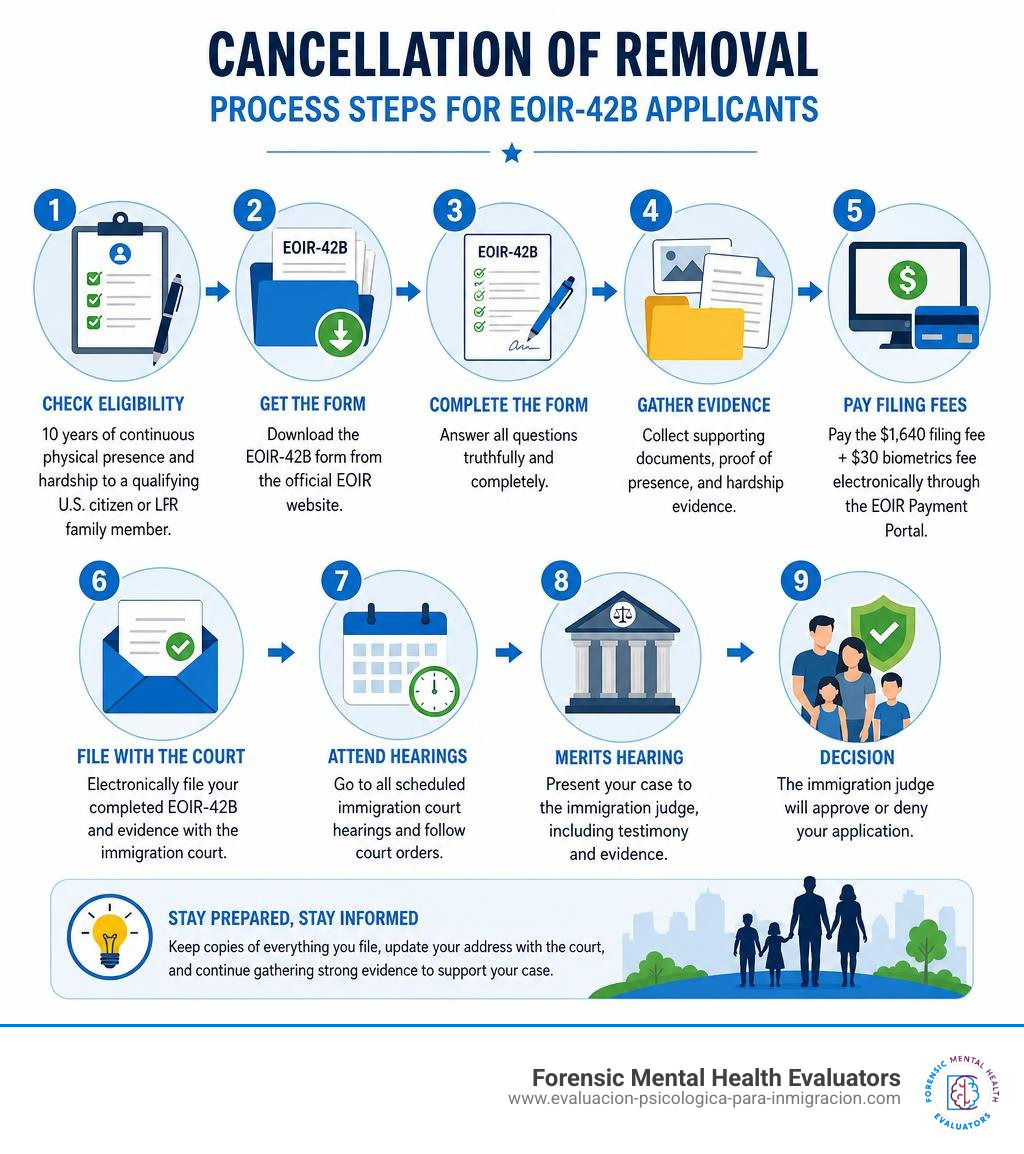
- Current filing fee: $1,640 + $30 biometrics fee (paid electronically through the EOIR Payment Portal)
- Key requirement: 10 years of continuous physical presence in the U.S. plus proof that your removal would cause exceptional and extremely unusual hardship to a qualifying U.S. citizen or lawful permanent resident family member
- Time to complete: Expect roughly 5 hours and 50 minutes to learn about, complete, and file the application
Facing deportation is terrifying — especially when your children, spouse, or parents depend on you being here. The stakes couldn't be higher. One incomplete answer, one missing document, or one misunderstood legal standard can cost you everything.
This guide walks you through every part of the EOIR-42B process — from eligibility and hardship standards to filing fees, supporting evidence, and the role a psychological evaluation can play in strengthening your case.
I'm Francisco Ortiz, Lead Forensic Mental Health Evaluator at District Counseling PLLC and a Certified Forensic Mental Health Evaluator (CFMHE), and I have extensive experience conducting psychological evaluations specifically designed to support EOIR-42B form applications by documenting the emotional and psychological impact of deportation on U.S. citizen family members. My goal in this guide is to give you clear, accurate information so you can move forward with confidence.
Understanding the eoir 42b form and Eligibility Criteria
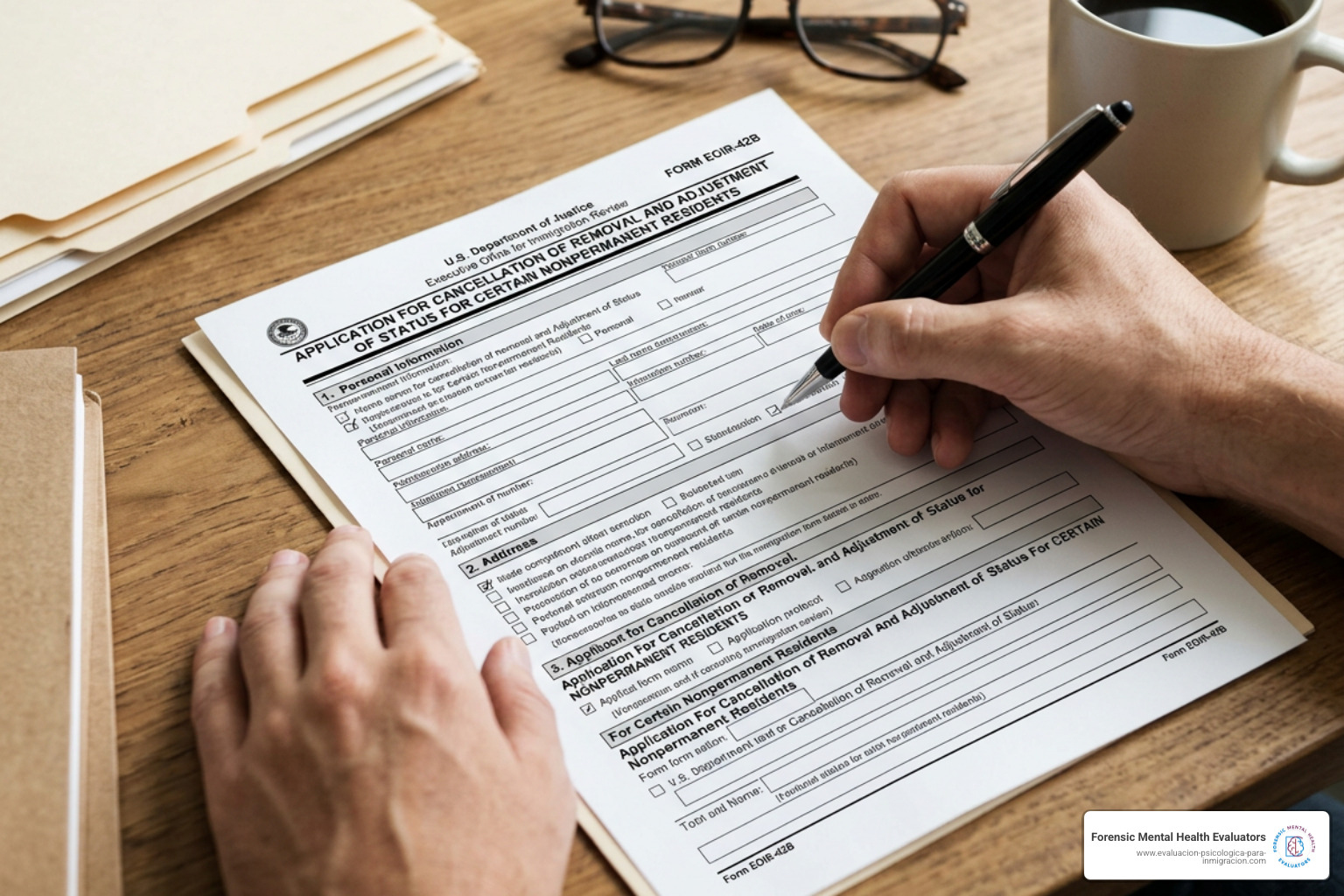
When we look at the eoir 42b form, we are looking at a highly specialized tool designed for deportation defense. Officially known as the Application for Cancellation of Removal and Adjustment of Status for Certain Nonpermanent Residents, this form is used exclusively within the United States immigration court system.
It is important to understand that you cannot simply mail this form to U.S. Citizenship and Immigration Services (USCIS) out of the blue to get a green card. You must already be in active removal (deportation) proceedings before an immigration judge to submit this application. Under Section 240A(b) of the Immigration and Nationality Act (INA), a successful application allows an immigration judge to stop your deportation and grant you adjustment of status to a lawful permanent resident (LPR).
To download the official, up-to-date version of this document, you can access the Official EOIR-42B Form PDF.
Core Eligibility Requirements for the eoir 42b form
To successfully apply for cancellation of removal using the eoir 42b form, you must meet four extremely strict statutory requirements. If you fail to meet even one of these, the immigration judge cannot legally grant you relief:
- 10 Years of Continuous Physical Presence: You must have lived continuously in the United States for at least 10 years immediately preceding the date you were served with the Notice to Appear (NTA) in court. A single trip outside the U.S. of more than 90 days, or multiple trips totaling more than 180 days, will break this continuity.
- Good Moral Character: You must show that you have been a person of good moral character during the entire 10-year period. This means paying your taxes, supporting your family, and avoiding activities that the law defines as showing a lack of good moral character.
- No Disqualifying Criminal Convictions: You cannot have been convicted of certain crimes, including crimes involving moral turpitude, drug offenses, or aggravated felonies.
- Exceptional and Extremely Unusual Hardship: You must prove that your deportation would cause extreme and exceptionally unusual hardship to a qualifying relative who is a U.S. citizen (USC) or lawful permanent resident (LPR). Qualifying relatives include your spouse, parent, or unmarried child under the age of 21.
Special Rules and VAWA Provisions on the eoir 42b form
The law recognizes that victims of domestic abuse face unique dangers and barriers. Because of this, the eoir 42b form includes "Special Rule" provisions under the Violence Against Women Act (VAWA) for battered spouses or children.
If you have been battered or subjected to extreme cruelty by a U.S. citizen or LPR spouse or parent, your requirements are modified:
- Reduced Physical Presence: You only need to prove 3 years of continuous physical presence in the U.S. instead of 10.
- Modified Hardship Standard: Instead of "exceptional and extremely unusual" hardship to a relative, you must prove that your removal would cause extreme hardship to yourself, your child, or your parent. This is known as the extreme hardship standard, which is a lower legal hurdle to clear but still requires detailed documentation.
Proving Exceptional and Extremely Unusual Hardship

The "exceptional and extremely unusual hardship" standard is widely considered one of the highest bars in all of U.S. immigration law. The Board of Immigration Appeals (BIA) has ruled that the hardship must be "substantially beyond" what would normally be expected from deportation. Ordinary hardships—such as the sadness of separation, the financial struggle of moving to a new country, or leaving behind a career—are generally not enough on their own.
To win your case, we must paint a complete picture of cumulative hardship across multiple areas of your family's life:
- Medical Conditions: If your qualifying relative has a severe chronic illness, developmental disability, or medical condition that requires specialized care not readily available or affordable in your home country, this is a strong hardship factor.
- Financial Impact: If you are the sole breadwinner and your family would fall into extreme poverty, lose their home, or be unable to afford essential needs without your income, this must be documented.
- Educational Disruption: If your U.S. citizen children do not speak the language of your home country, have special educational needs (such as an IEP), or would have their academic progress completely derailed, this is highly relevant.
- Country Conditions: High rates of violence, lack of infrastructure, or political instability in your home country that would directly threaten your family's safety or well-being must be presented.
- Psychological and Emotional Impact: The threat of losing a parent or spouse causes deep trauma, anxiety, and depression.
This is where a professional psychological evaluation for cancellation of removal becomes invaluable. An objective, clinical report from a mental health professional provides the immigration court with clear evidence of the psychological toll your deportation would take on your loved ones. For a deeper look into how these assessments work, you can read our comprehensive immigration evaluation guide.
Step-by-Step Instructions for Completing and Filing the Application
Completing and filing the eoir 42b form is a meticulous process. To help you visualize the two main paths available on this form, we have put together a comparison table below:
| Requirement / Feature | Standard Cancellation (Non-LPR) | VAWA Special Rule Cancellation |
|---|---|---|
| Required Physical Presence | 10 Years | 3 Years |
| Hardship Standard | Exceptional and extremely unusual hardship | Extreme hardship |
| Who Suffers the Hardship? | Qualifying USC/LPR relative (spouse, parent, child) | The applicant, their child, or their parent |
| Filing Fee | $1,640.00 + $30.00 Biometrics | $1,640.00 + $30.00 Biometrics (Waivers available) |
| Good Moral Character | Required for the 10-year period | Required for the 3-year period |
When filling out the application, we recommend following these precise steps:
- Download and Read: Obtain the most current version of the form and read the official instructions thoroughly.
- Complete Every Section: Type or print legibly in black ink. Do not leave any questions blank. If a question does not apply to you, write "N/A" (Not Applicable) or "None."
- Sign Under Oath: Under recent proposed revisions, you should sign the application in the presence of the immigration judge or ensure your signature complies exactly with the court's current rules.
- Prepare Translations: Any supporting document that is not in English must be accompanied by a full English translation. The translator must sign a certificate stating they are competent to translate and that the translation is accurate.
- Attach Passport Photos: Submit two identical, unretouched, color passport-style photographs taken within 30 days of filing. Write your Alien Registration Number (A-Number) lightly in pencil on the back of each photo.
- Serve DHS/ICE First: You must serve a complete copy of your application and all supporting documents on the Department of Homeland Security (DHS) / Immigration and Customs Enforcement (ICE) Assistant Chief Counsel.
- File with the Immigration Court: Submit the original application, along with a completed Certificate of Service showing you served ICE, to the immigration court where your case is being heard.
Gathering Supporting Documents and Evidence
A completed eoir 42b form is only as strong as the evidence attached to it. You must systematically gather documents to prove every element of your eligibility.
Useful evidence includes:
- Continuous Presence: Tax returns, school transcripts, apartment leases, utility bills, employment records, and bank statements covering every single year of the 10-year (or 3-year) period.
- Good Moral Character: Letters of recommendation from employers, church leaders, and community members, as well as police clearance records showing you have no criminal history.
- Hardship Evidence: Medical records, psychological evaluations, school reports, expert reports on country conditions, and detailed personal affidavits.
For additional structural tips and checklists, you can consult the Immigration Justice Campaign Guide.
Filing Fees, Biometrics, and Recent Policy Revisions
Navigating the financial and administrative side of the eoir 42b form requires paying close attention to current court policies.
Crucial Payment Portal Rules
As of Monday, February 23, 2026, the Executive Office for Immigration Review (EOIR) has completely stopped accepting paper checks or money orders for immigration fees. All fees must be submitted electronically through the official online EOIR Payment Portal. If you attempt to mail a physical check or money order with your application, it will be rejected, which could cause you to miss critical filing deadlines set by the immigration judge.
Current Fee Breakdown
- Filing Fee: $1,640.00
- Biometrics Fee: $30.00 per person (reduced from $85.00 to $30.00 under recent updates)
Once you pay online, you will receive an electronic receipt. You must print this receipt and submit it to the court as proof of payment.
Proposed Revisions and Policy Changes
Under recent regulatory updates, several changes have affected how applicants navigate the eoir 42b form:
- Fee Increases: The standard filing fee was adjusted to $1,640.00 to align with updated agency processing costs.
- Signature Rules: Revisions have emphasized strict signature requirements, sometimes requiring signatures to be executed directly in front of an immigration judge during hearings.
- Evidence Restrictions: Proposed changes have sought to streamline physical presence evidence, limiting the use of certain redundant records (like excessive medical visits) in favor of primary tax and employment documents.
Fee Waivers and Financial Resources
If you cannot afford the $1,640.00 filing fee or the biometrics fee, you are not automatically barred from applying. You can request that the immigration judge waive your fees due to financial hardship.
To request a waiver, you must file Form EOIR-26A (Fee Waiver Request) along with your application. In this form, you must provide a detailed breakdown of your monthly income, assets, and expenses to prove that you are genuinely unable to pay. The decision to grant a fee waiver is entirely at the discretion of the immigration judge, so it is vital to provide clear, honest financial documentation.
Penalties for Fraud and False Information
We cannot overstate the importance of complete honesty when filling out the eoir 42b form. Immigration courts verify all information, and the consequences of providing false statements or fraudulent documents are severe.
Under federal law (including 18 U.S.C. Section 1546), submitting a fraudulent application or making false statements under penalty of perjury can lead to:
- Criminal Prosecution: Fines of up to $250,000 and up to 10 years in federal prison.
- Civil Penalties: Fines of up to $2,000 for a first document fraud offense, and up to $5,000 for subsequent offenses.
- Permanent Inadmissibility: A finding of willful misrepresentation or filing a frivolous application will permanently bar you from ever obtaining any immigration benefits in the United States.
Always tell the truth. If you have a criminal record or a gap in your physical presence, work with a licensed immigration attorney to address these issues legally rather than trying to hide them.
Frequently Asked Questions about the EOIR-42B
What is the current filing fee for the EOIR-42B?
The current filing fee for the eoir 42b form is $1,640.00, plus a $30.00 biometrics fee. Both of these fees must be paid electronically using the online EOIR Payment Portal. Paper checks and money orders are no longer accepted.
How does the stop-time rule affect my 10-year physical presence?
The "stop-time rule" is a legal mechanism that freezes your continuous physical presence clock. The clock stops running the moment you are served with a Notice to Appear (NTA) in immigration court, or if you commit certain disqualifying criminal offenses. If you have not reached a full 10 years of continuous presence before the NTA is served, you will not qualify for standard cancellation of removal.
Can I apply for a fee waiver if I cannot afford the filing fees?
Yes. If you cannot afford the fees, you can submit Form EOIR-26A (Fee Waiver Request) along with your application. You will need to provide detailed evidence of your financial situation, and the immigration judge will decide whether to waive the fees.
Conclusion
Filing the eoir 42b form is a life-changing step. It represents a real path to safety, stability, and a permanent future in the United States for you and your family. However, because the legal standards are so high, success requires meticulous preparation, overwhelming evidence, and professional support.
At District Counseling PLLC, we specialize in providing high-quality psychological evaluations that clearly document the emotional and mental health challenges your family would face if you were deported. We offer our services across our physical locations in Texas—including Houston, Katy, Cypress, and Sugarland—as well as virtually for clients in Florida, California, New York, Utah, Virginia, and Idaho.
To ensure our clients feel supported throughout this stressful legal process, we offer bilingual Spanish-to-English evaluations and provide 6 free therapy sessions following the completion of your report.
If you are preparing your cancellation of removal case and want to learn more about how we can support your application, please visit our page on Evaluación Psicológica para Caso de una Cancelación de Deportación to schedule a consultation with us today.