
VAWA Is Not Just for Women
Understanding VAWA for Men: Eligibility and Legal Rights

VAWA for men is real, legal, and fully available right now. Despite its name, the Violence Against Women Act protects all survivors of domestic abuse — including men, regardless of immigration status.
Quick answer: Can men apply for VAWA?
- Yes. Men can file a VAWA self-petition (Form I-360) just like women can.
- No police report required. You do not need to have reported the abuse to law enforcement.
- Undocumented men qualify. You do not need a current visa or legal status to apply.
- Your abuser will not be notified. Federal law prohibits USCIS from sharing your filing with the abuser.
- Benefits include: protection from deportation, work authorization, and a path to a green card.
The numbers tell a clear story. Nearly 1 in 7 men report experiencing severe physical violence from an intimate partner during their lifetime. About 1 in 3 men in the U.S. have experienced contact sexual violence, physical violence, or stalking by a partner. Yet most never seek help — because they don't know they have legal options, or because shame and stigma get in the way.
If you are an immigrant man in Texas who has been abused by a U.S. citizen or lawful permanent resident spouse, parent, or adult child, you may have more protection than you realize.
I'm Francisco Ortiz, Lead Forensic Mental Health Evaluator at District Counseling PLLC, and I have worked extensively with male immigrant survivors navigating VAWA for men — conducting the psychological evaluations that support their petitions and document the real trauma behind their cases. In the sections below, I'll walk you through everything you need to know: who qualifies, what evidence you need, and how a clinical evaluation can strengthen your case.
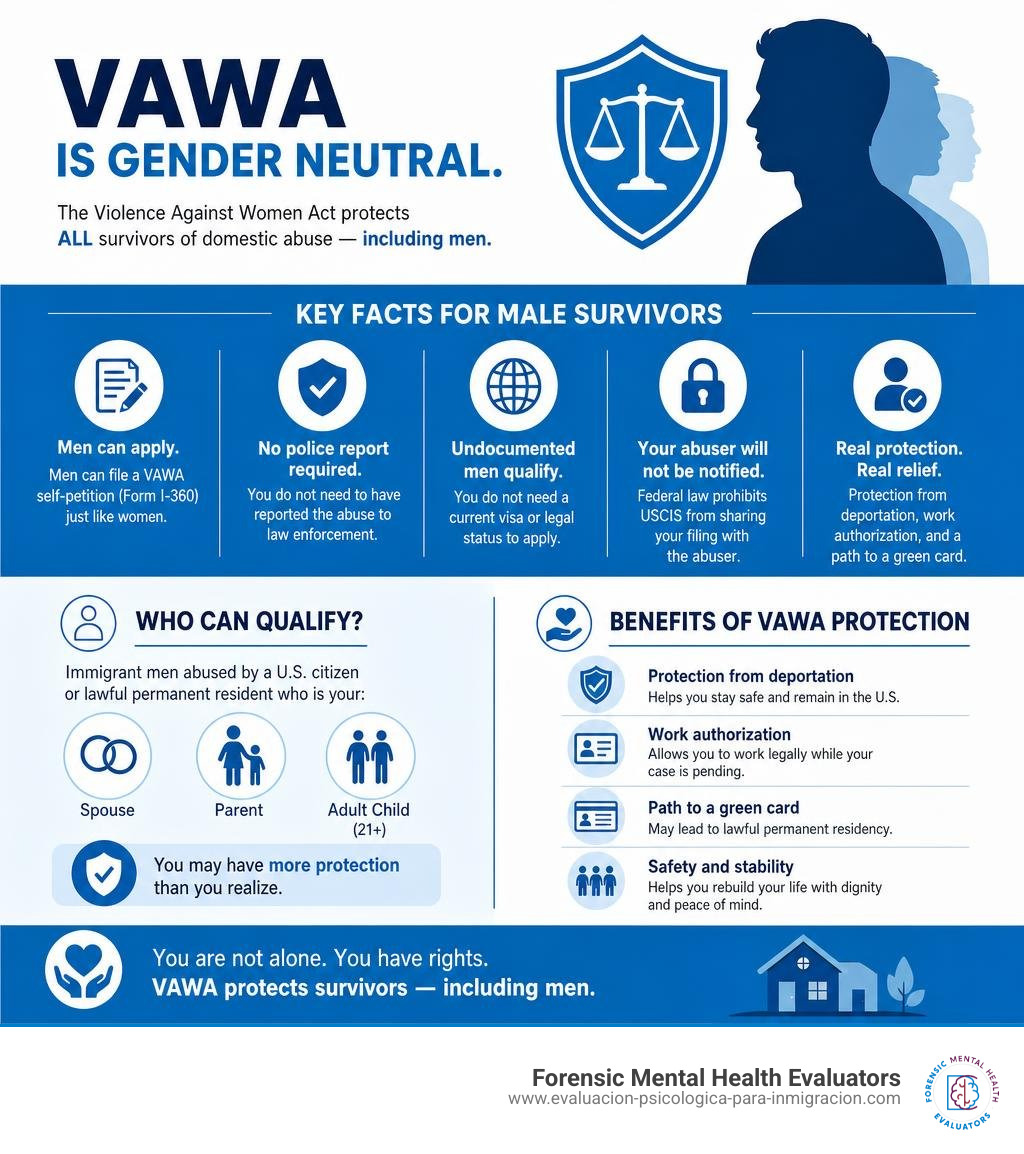
The most common misconception about the Violence Against Women Act is right there in the title. Because it contains the word "Women," many male survivors assume they are excluded from its protections. This is completely false.
According to the official guidelines on USCIS Abused Spouses, Children and Parents, the law is entirely gender-neutral. Federal statutes protect noncitizen victims of abuse regardless of whether they identify as male, female, or nonbinary. This gender-neutral stance is also emphasized by federal advocacy groups like WomensLaw VAWA self-petitioning, which clarify that abused men can file a self-petition as long as they meet the standard eligibility criteria.
The Legislative History of Gender Neutrality under VAWA
To understand how we arrived at a fully gender-neutral law, it helps to look at how VAWA has evolved over the years:
- VAWA 1994: The original law established foundational protections. While the public focus was heavily on female victims, the underlying statutory language for immigration relief remained accessible to any "alien" spouse or child who suffered abuse.
- VAWA 2000 & 2005: Reauthorizations explicitly added gender-neutral language. The 2005 update introduced a clear nonexclusivity clause, ensuring that federal funds and legal protections must be distributed without discrimination based on sex or gender.
- VAWA 2013 & 2022: These updates went even further, explicitly prohibiting discrimination based on sexual orientation and gender identity. The 2022 reauthorization also modernized the definition of abuse to include technological abuse, recognizing how perpetrators use smart devices and social media to control their victims.
Because of these legislative updates, any male survivor applying in June 2026 stands on equal legal footing with female applicants. Adjudicators at USCIS are legally bound to evaluate a man's self-petition using the exact same standards.
Who Qualifies Under VAWA for Men?
To successfully file a VAWA self-petition as a man, you must meet five primary eligibility requirements:
- A Qualifying Relationship: You must have a qualifying family relationship with a U.S. citizen (USC) or Lawful Permanent Resident (LPR). This includes:
- Being the spouse or former spouse of a USC or LPR.
- Being the parent of an abusive USC son or daughter (who is at least 21 years old).
- Being the child (under 21 and unmarried) of an abusive USC or LPR.
- A Good Faith Marriage: If you are applying as an abused spouse, you must prove that you entered the marriage in "good faith" — meaning you married for love and a shared life, not solely for immigration benefits.
- Co-residence: You must have lived with the abuser at some point during the relationship. Under a crucial USCIS policy update, you do not need to be living with the abuser at the time of filing, but you must prove that joint residence occurred during the qualifying relationship.
- Battery or Extreme Cruelty: You must have been subjected to physical battery or "extreme cruelty" by your USC or LPR relative.
- Good Moral Character: You must demonstrate that you are a person of good moral character. While certain criminal records can complicate this, exceptions exist for "reactive arrests" — instances where an abuser called the police on you as a manipulation tactic, resulting in an arrest where you were actually the victim.
Types of Abuse That Qualify Under VAWA for Men
When people think of domestic abuse, they often picture physical violence. However, immigration law recognizes that domestic abuse is a complex pattern of power and control. Under the legal definition of "extreme cruelty," several non-physical forms of abuse qualify for VAWA protections:
- Emotional and Psychological Abuse: This includes constant humiliation, verbal threats of violence, extreme jealousy, and relentless insults designed to destroy your self-worth.
- Deportation Threats: Abusers frequently weaponize an immigrant's lack of status. Threats like "If you don't do what I say, I will call ICE and have you deported" are classic examples of extreme cruelty.
- Financial Sabotage: Preventing you from working, taking control of your earnings, refusing to let you open a bank account, or running up debt in your name to keep you financially dependent.
- Parental Alienation: Threatening to take your children away, telling your children that you do not love them, or using custody as a tool to force your compliance.
- Isolation and Surveillance: Restricting your contact with friends, family, or community resources, monitoring your phone calls, tracking your location via GPS, or demanding passwords to your personal accounts.
If you have experienced any of these behaviors from a USC or LPR spouse, parent, or adult child, you have suffered qualifying abuse under the law.
The VAWA Self-Petition Process (Form I-360) and Required Evidence
The path to legal status under VAWA begins with Form I-360, the Petition for Amerasian, Widow(er), or Special Immigrant. This form is submitted directly to the USCIS Humanitarian Division, specifically processed through specialized units like the HART (Humanitarian, Adjustment, Removing Obstacles, and Travel) Service Center.
One of the most compassionate aspects of VAWA is the "any credible evidence" standard. Because abusers often control documents and isolate their victims, USCIS cannot expect applicants to have a perfect paper trail. They are legally required to consider any credible evidence you submit.
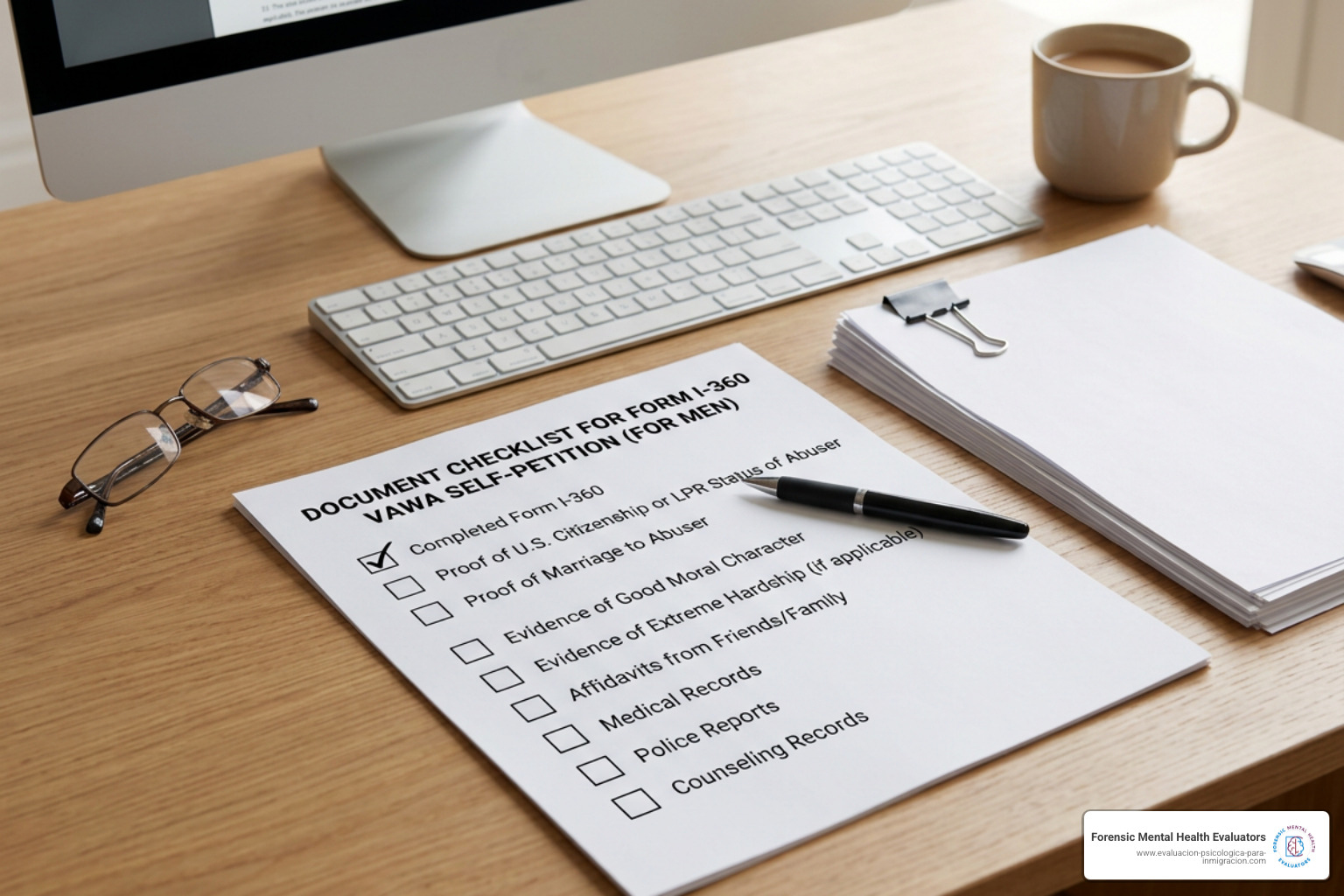
Essential Evidence for a Strong Case
To build a compelling case, your petition should include a mix of primary and secondary evidence:
- Your Personal Declaration: This is the heart of your petition. It is a detailed, written narrative of your relationship, detailing how you met, your hopes for the future, and a chronological account of the abuse you suffered.
- Proof of the Abuser's Status: Copies of your spouse’s or parent’s U.S. passport, birth certificate, or green card. (If you cannot access these because of safety risks, USCIS can search their own databases to verify the abuser's status).
- Proof of a Good Faith Marriage: Shared leases, joint bank accounts, family photos, utility bills, and letters from friends or family members who witnessed your relationship.
- Proof of Co-residence: Rental agreements, tax returns, or mail addressed to both of you at the same address.
- Clinical Psychological Evaluation: Because male survivors are highly likely to suffer in silence, a professional mental health evaluation is often the most critical piece of evidence.
At District Counseling, we specialize in conducting these evaluations. A detailed Evaluación Psicológica para Caso de VAWA documents the clinical reality of the trauma you have endured. We look closely at the somatic symptoms of trauma — such as chronic anxiety, depression, hypervigilance, insomnia, and the deep psychological impact of emotional abuse — translating your lived experience into objective, professional terms that USCIS officers can easily understand.
Filing Without a Police Report or Legal Status
A major barrier for many male survivors is the fear that they cannot apply because they never called the police.
Let us be completely clear: You do not need a police report to file a VAWA self-petition.
In fact, many male survivors avoid calling law enforcement out of fear that the police will not believe them, or that the abuser will twist the situation to get the male victim arrested. This is a well-documented phenomenon. Fortunately, USCIS understands these dynamics. Your personal declaration, witness letters, and a professional psychological evaluation are more than enough to establish the abuse.
Furthermore, undocumented men can apply. Your current immigration status — whether you entered without inspection, overstayed a visa, or are currently in removal proceedings — does not bar you from seeking VAWA relief.
To protect you during this process, federal law under INA Section 1367 enforces strict confidentiality. USCIS is legally prohibited from disclosing any information about your application to your abuser or their family members. Doing so carries severe federal penalties. You can also provide a "safe mailing address" (such as a friend's home, a P.O. Box, or your attorney’s office) to ensure that no correspondence from USCIS ever arrives at the home you share with, or lived in with, the abuser.
Benefits, Post-Approval Steps, and Overcoming Challenges
Filing a successful VAWA petition opens up a life-changing array of benefits and protections.
- Prima Facie Determination: Shortly after filing, if your petition contains the basic required elements, USCIS will issue a "Prima Facie Approval." This temporary notice acts as a shield, granting you access to certain public benefits and protecting you from deportation while your case is pending.
- Work Authorization: Once your Form I-360 is approved (or while it is pending, if filed concurrently with an adjustment of status application when a visa is available), you can apply for an Employment Authorization Document (EAD) using Form I-765. This allows you to work legally in the United States.
- Path to a Green Card: Approved self-petitioners are eligible to apply for Lawful Permanent Residence. For detailed guidelines on adjusting your status, refer to the USCIS Green Card for VAWA Self-Petitioner page.
To help you understand your options, here is a comparison of the VAWA self-petition process versus another common humanitarian option, the U Visa:
| Feature | VAWA Self-Petition (Form I-360) | U Visa (Form I-918) |
|---|---|---|
| Target Audience | Abused spouses, parents, or children of USCs/LPRs | Victims of qualifying crimes who assist law enforcement |
| Law Enforcement Certification | Not required | Strictly required (Form I-918, Supplement B) |
| Annual Visa Cap | No annual cap | Strict cap of 10,000 visas per year (massive backlogs) |
| Path to Green Card | Direct path to permanent residency | Eligible after 3 years of continuous presence on U status |
| Confidentiality | Highly protected under INA Section 1367 | Protected, but requires interaction with local police |
Overcoming the Unique Challenges Faced by Male Survivors
While the legal path is clear, the emotional and social path for male survivors is often paved with unique obstacles. Societal expectations surrounding masculinity create a heavy burden of shame. Men are often told that they must be strong, that they cannot be victims, and that admitting to abuse is a sign of weakness.
As highlighted in the national guidelines on Serving Male-Identified Survivors of Intimate Partner Violence, male victims are significantly less likely to report abuse to anyone. They fear ridicule from friends, disbelief from medical professionals, and bias within the legal system.

This is why finding culturally competent, compassionate support is so vital. Recognizing your trauma is not a sign of weakness; it is the first step toward reclaiming your life and your independence.
Frequently Asked Questions About VAWA for Men
Can an undocumented man apply for VAWA?
Yes. Your current immigration status does not affect your eligibility to apply for VAWA. Even if you entered the country without inspection or overstayed a previous visa, you can self-petition. Once approved, VAWA offers protection from deportation and a direct path to apply for a green card.
Will my abuser find out if I file a VAWA petition?
No. Under INA Section 1367, your application is strictly confidential. USCIS cannot contact your abuser, notify them of your application, or use any information provided by your abuser to make a decision on your case. You can also use a safe mailing address to ensure all physical mail is sent to a location where your abuser cannot access it.
How long does the VAWA process take for male applicants in 2026?
As of June 2026, the average processing time for a Form I-360 at the HART Service Center is approximately 36 to 48 months. However, you will typically receive a Prima Facie Determination within a few months of filing, which provides immediate protection against deportation and access to certain resources while your case is being fully processed.
Conclusion
Taking the step to escape an abusive relationship takes immense courage. If you are a male survivor, please know that you do not have to carry this burden alone, and you do not have to live in fear of deportation. The law is on your side, and vawa for men is designed to give you a safe, independent path to a peaceful life.
At District Counseling, we are dedicated to helping survivors find their voice and secure their future. We provide comprehensive psychological evaluations for immigration cases across our physical locations in Texas — including Houston, Katy, Cypress, and Sugar Land — as well as virtual evaluations for clients in Florida, California, New York, Utah, Virginia, and Idaho.
We understand that speaking about trauma can be difficult, which is why we offer:
- Fully bilingual evaluations (conducted in Spanish and professionally translated to English).
- A warm, safe, and comfortable environment where you are heard and believed.
- Our unique commitment to your healing: 6 free therapy sessions following the completion of your evaluation report to support your ongoing mental health journey.
If you are ready to take the next step in your immigration case and start your healing process, we invite you to explore our Blog for more resources, learn about our general Evaluación Psicológica para Inmigración services, or contact us directly today to Schedule a VAWA Psychological Evaluation. Your safety, your dignity, and your future are worth it.