
Mind Matters: Finding Trusted Immigration Psychological Evaluations Nearby
When Your Family's Future Depends on the Right Evaluation

If you need immigration psychological evaluations near me, here is what you should know right away:
Quick Answer: What to Look For
- A licensed psychologist or counselor with forensic immigration experience
- Evaluations available for hardship waivers, asylum, VAWA, U visa, T visa, and cancellation of removal
- Reports typically delivered in 2–4 weeks (rush options often available)
- Bilingual (Spanish/English) services widely available
- Telehealth options mean you don't have to be local — many providers serve all of Texas and beyond
Facing deportation is one of the most frightening experiences a family can go through. If you have a U.S. citizen spouse or children here, the thought of being separated from them is not just painful — it is the kind of trauma that can define the outcome of your immigration case.
The good news: a professional psychological evaluation can document exactly that trauma. It gives immigration courts and USCIS something concrete — a detailed, evidence-based report that shows what your removal would actually cost your family, emotionally and psychologically.
These evaluations are not about proving you are "sick." They are forensic tools designed to capture the real human impact of your situation and present it in a format that attorneys and judges can act on.
My name is Francisco Ortiz, Lead Forensic Mental Health Evaluator at District Counseling PLLC and a Certified Forensic Mental Health Evaluator (CFMHE) licensed across six states — including Texas — with specialized training in hardship waiver evaluations, asylum cases, and U visa/T visa assessments for survivors of crime and trafficking. I have dedicated my career to providing the kind of rigorous, culturally competent immigration psychological evaluations near me that families in Texas need when the stakes are highest.
What is an Immigration Psychological Evaluation and Why is it Needed?
An immigration psychological evaluation is a highly specialized clinical assessment performed by a licensed mental health professional. Unlike traditional therapy sessions—which focus on long-term healing and treatment—an immigration evaluation is a structured forensic tool. Its primary goal is to provide objective, clinical evidence to the United States Citizenship and Immigration Services (USCIS) or an immigration court.
When you are navigating the complex web of immigration law, your personal statement is vital. However, a legal case is vastly strengthened when backed by objective documentation. A comprehensive Immigration Mental Health Evaluation translates your emotional pain, psychological trauma, and life history into a professional clinical framework. By utilizing standardized clinical assessments and diagnostic criteria, we can document conditions such as Post-Traumatic Stress Disorder (PTSD), Major Depressive Disorder, or Generalized Anxiety Disorder in a way that legal authorities recognize.
This clinical process is a detailed Psychological Evaluation that goes far beyond a simple diagnostic checklist. It explores your psychosocial history, childhood experiences, family dynamics, and the specific circumstances surrounding your immigration journey. In short, it brings life to your story, transforming dry legal paperwork into a deeply human narrative that highlights your resilience and vulnerability.
Key Cases Requiring Immigration Psychological Evaluations Near Me
Different immigration pathways require different types of psychological documentation. When searching for immigration psychological evaluations near me, it is crucial to find a provider who understands the specific legal standards for your type of case.
Here are the primary cases we specialize in:
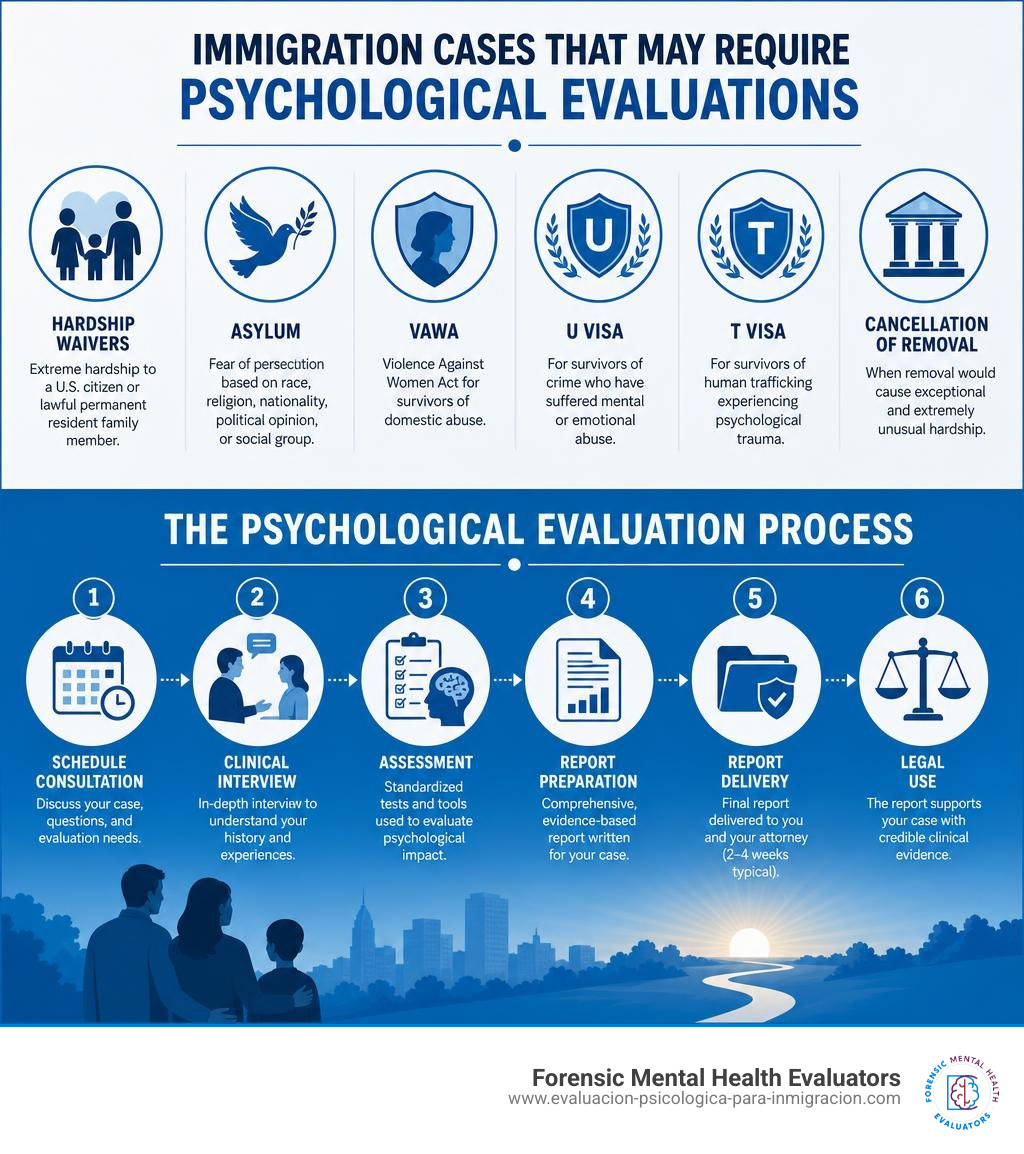
- Extreme Hardship Waivers (I-601 and I-601A): If a U.S. citizen or lawful permanent resident (LPR) spouse or parent faces extreme hardship due to the potential deportation or exclusion of their loved one, an evaluation is critical. We document the emotional, cognitive, financial, physical, and educational impact of family separation or relocation to an adverse home country.
- Asylum Petitions: For individuals fleeing persecution based on race, religion, nationality, social group, or political opinion. Our evaluations document the psychological scars of past trauma and explain how symptoms like PTSD affect memory, which can help explain why an asylum seeker might struggle with dates or details during interviews. To understand the specific nuances, read our Immigration Psychological Evaluations Guide.
- VAWA (Violence Against Women Act) Self-Petitions: Available to spouses, children, or parents of U.S. citizens or LPRs who have been subjected to battery or extreme cruelty. We provide objective clinical evidence of domestic abuse—whether physical, sexual, financial, or emotional—helping to establish credibility even when physical evidence is scarce.
- U Visas and T Visas: Designed for victims of serious crimes (U Visa) or human trafficking (T Visa) who have assisted law enforcement. The evaluation documents the severe mental and physical abuse suffered as a result of the crime.
- Cancellation of Removal: For individuals in deportation proceedings who must prove that their removal would result in exceptional and extremely unusual hardship to a qualifying U.S. citizen or LPR family member.
For those navigating these complex legal pathways in the Lone Star State, our specialized Texas Asylum Psychological Services are designed to meet the strict evidentiary requirements of regional immigration courts.
How a Professional Assessment Strengthens Your Legal Case
An immigration application is essentially a legal argument, and every strong argument requires proof. While an immigration attorney builds the legal framework, a mental health professional provides the clinical foundation. This close collaboration between your attorney and your evaluator ensures that the final report aligns with specific legal standards while remaining completely objective.
USCIS officers and immigration judges are trained to look for objective, credible evidence. A weak or superficial report can cause delays, requests for evidence (RFEs), or even denials. By contrast, a thorough, evidence-based psychological report provides a clear diagnostic analysis that links your emotional struggles directly to your legal circumstances.

For a deeper dive into how these reports function as legal evidence, consult our Immigration Evaluation Complete Guide.
The Role of Clinical Evidence in Court Proceedings
In court proceedings, a judge must decide whether your situation meets high legal thresholds, such as "extreme hardship" or "exceptional and extremely unusual hardship." These are not just everyday terms; they are specific legal standards.
A professional evaluator uses standardized clinical testing, trauma-informed interviewing, and a review of your medical and psychiatric history to build a robust evidentiary package. For instance, if an applicant suffers from severe PTSD, we document how their symptoms—such as hypervigilance, flashbacks, and cognitive avoidance—directly stem from past persecution. This objective documentation is particularly powerful in cases where physical evidence of abuse or persecution is long gone or impossible to obtain.
To explore how these evaluations are structured for court presentation, you can read more about our professional Evaluación Forense de Inmigración services.
What to Expect: Process, Timelines, and Costs
If you are feeling nervous about your evaluation, take a deep breath. The process is designed to be supportive, safe, and respectful. You will not be judged, and you do not have to "prove" anything other than sharing your honest experiences.
Here is what the typical process looks like:
- Initial Consultation: A brief discussion to understand your immigration case, coordinate with your attorney, and schedule your clinical sessions.
- Clinical Interviews: Typically conducted over two or three sessions, totaling 3 to 4 hours. We will discuss your family history, childhood, educational background, work history, physical health, and the specific trauma or hardships you face.
- Psychometric Testing: We use standardized clinical questionnaires and rating scales to measure symptoms of depression, anxiety, trauma, and cognitive functioning. In some complex cases, specialized Neuro Psych Testing Near Me may be recommended to assess memory or cognitive impairments.
- Document Review: We analyze relevant medical records, police reports, and personal declarations to ensure our clinical findings are fully integrated with your history.
- Report Writing: The evaluator spends 8 to 10 hours analyzing the data and writing a comprehensive, 12-to-35-page forensic report.

Timeline and Turnaround for the Final Report
We know that immigration timelines are incredibly tight, and a missed deadline can have severe consequences.
- Standard Turnaround: Typically takes 2 to 3 weeks from the date of your final interview. This allows the evaluator to carefully score your tests, review your records, and write a detailed, defensible report.
- Express/Rush Service: If you have an urgent court date or a tight USCIS deadline, rush options can deliver your completed report in 7 to 10 days (or even sooner in extreme emergencies) for an additional rush fee.
For more details on preparing for these timelines, see our Immigration Evaluation Guide 2026.
Choosing the Right Provider for Immigration Psychological Evaluations Near Me
When searching for immigration psychological evaluations near me, not all therapists are qualified to write legal-grade forensic reports. A standard clinical therapist focuses on treatment, but a forensic evaluator must possess specialized training in legal standards, objective diagnostic testing, and cross-cultural psychology.
Look for a licensed clinician (a PhD, PsyD, LCSW, or LPC) who has completed specialized training in immigration evaluations. They should demonstrate cultural competence and show a deep understanding of the unique struggles faced by immigrant communities.
Bilingual support is also essential. If you feel most comfortable speaking Spanish, you should work with a provider who offers bilingual evaluations or utilizes professional interpreters. For those in Texas, working with a Texas Immigration Psychological Expert ensures that your evaluator is intimately familiar with the regional legal landscape. If you are located in or around Central Texas, you can learn more about our Austin Spanish Immigration Evaluation services.
Comparing In-Person vs. Telehealth Evaluations
Thanks to modern telehealth regulations and secure platforms, you no longer have to live next door to a forensic specialist to get a high-quality evaluation. Many states participate in interstate compacts (like PSYPACT) or allow licensed clinicians to practice statewide via secure, HIPAA-compliant video conferencing.
Here is a quick comparison of your options:
| Feature | In-Person Evaluations | Telehealth (Online) Evaluations |
|---|---|---|
| Convenience | Requires travel to a physical office; might require taking time off work. | Conducted from the comfort and privacy of your own home. |
| Anxiety Levels | Some clients find clinical offices intimidating or stressful. | Often feels more relaxed and safer, especially for trauma survivors. |
| Geographic Reach | Limited to your local city or driving distance. | Available to anyone living anywhere in the licensed state (e.g., all of Texas, Florida, California, New York, Utah, Virginia, or Idaho). |
| Technology | No special technology or internet connection required. | Requires a reliable internet connection and a smartphone, tablet, or computer. |
| Bilingual Support | Dependent on local staff availability. | Easier to match with specialized bilingual clinicians across the state. |
Whether you choose to meet in person at one of our locations or connect online, we utilize secure, HIPAA-compliant platforms to protect your privacy. For a complete guide to online services, review our resources on Evaluaciones Psicológicas de Inmigración por Telehealth.
Frequently Asked Questions About Immigration Psychological Evaluations
How do I find trusted immigration psychological evaluations near me?
The best way to find a trusted evaluator is through a direct referral from your immigration attorney. Attorneys know which evaluators write highly credible, court-approved reports. You can also search national directories or look for specialized practices in your state. For residents of North Texas, our Dallas Psychological Immigration Assessment services provide highly trusted local support.
Why would my attorney suggest an evaluation if I feel fine?
It is common to think, "I feel fine, so why do I need a psychological evaluation?"
These assessments are not about proving you have a severe mental illness. Instead, they are forensic tools used to document hidden trauma, coping mechanisms, and the profound psychological impact of potential family separation. Even if you feel stable today, the threat of deportation causes a level of chronic stress and anxiety that must be professionally documented to meet legal standards. To learn more about why these tools are so vital, read our guide on Texas Immigration Psych Evaluation.
Are bilingual evaluations available near me?
Yes! We believe that you should always tell your story in the language you feel most comfortable speaking. We provide bilingual evaluations in Spanish and English, ensuring that no details of your experience are lost in translation. If you speak another language, we coordinate with professional, certified interpreters. For those pursuing a U Visa, you can explore our Dallas U Visa Mental Evaluation Clinical Consultation for specialized language and clinical support.
Conclusion
At District Counseling PLLC (operating as Forensic Mental Health Evaluators), we understand that navigating the immigration system is one of the most stressful journeys a person can take. Your future, your family, and your peace of mind are on the line. That is why we do not just write reports—we walk alongside you with compassion, respect, and clinical excellence.
We provide expert forensic evaluations for immigration cases across major Texas cities—including Houston, Austin, Dallas, and San Antonio—as well as statewide services in Florida, California, New York, Utah, Virginia, and Idaho. To make your journey as smooth and supportive as possible, we offer bilingual evaluations, prioritize client comfort at every step, and provide six free therapy sessions after your report is completed to help you process your experiences and find healing.
To learn more about our team and our dedication to your journey, visit our Quiénes Somos - Experto Evaluación Psicológica para Inmigración page. If you are ready to take the next step, you can learn more about scheduling an Evaluación Psicológica para Inmigración or contact us directly to begin your professional Evaluación Forense de Inmigración. Let us help you bring your story to light.