
A–Z Guide to VAWA Eligibility
What VAWA Means for Immigrant Survivors of Abuse

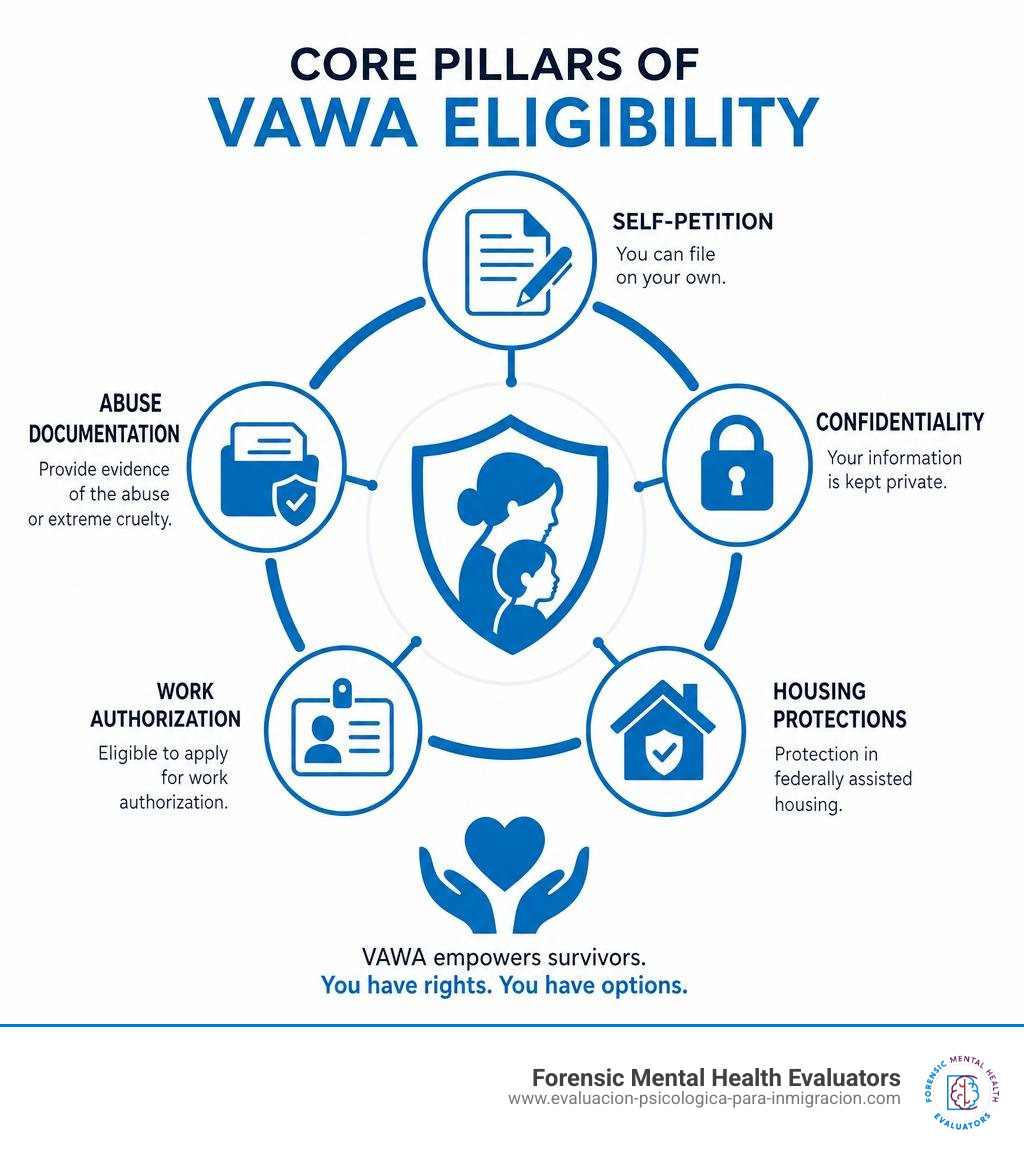
VAWA — the Violence Against Women Act — is a federal law that gives immigrant survivors of domestic violence, sexual assault, and stalking a way to seek legal protection without relying on their abuser.
Quick answer: What does VAWA do for immigrants?
| What VAWA Offers | Who It Applies To |
|---|---|
| Self-petition for a green card | Spouses, children, and parents abused by a U.S. citizen or lawful permanent resident |
| Confidential filing process | Victims who fear their abuser finding out |
| Protection from deportation during review | Approved self-petitioners |
| Work authorization | Eligible VAWA self-petitioners |
| Housing protections | Survivors in federally assisted housing |
You do not need your abuser's help or permission to apply. VAWA lets you file on your own — confidentially.
If you or a family member has experienced abuse at the hands of a U.S. citizen or green card holder, this law may be your path to safety and legal status in the United States.
Living under the threat of abuse while also facing immigration uncertainty is an enormous burden — especially when children or a spouse depend on you staying in the country. For many Hispanic immigrant families in Texas, the fear of separation makes an already painful situation feel impossible. VAWA exists specifically to protect people in this situation, and understanding how it works is the first step toward safety.
My name is Francisco Ortiz, Lead Forensic Mental Health Evaluator at Forensic Mental Health Evaluators, and I have conducted psychological evaluations specifically for VAWA cases, helping document the psychological impact of abuse and extreme cruelty for immigration proceedings. My work bridges clinical mental health assessment with the legal standards required to support survivors through this process.
What is the Violence Against Women Act (VAWA)?

The Violence Against Women Act (VAWA) is a landmark piece of federal legislation in the United States designed to protect survivors of domestic abuse, sexual assault, dating violence, and stalking. First enacted in 1994, this bipartisan act completely transformed how our legal system, law enforcement agencies, and community organizations respond to intimate partner violence.
Before VAWA was passed, domestic violence was frequently treated as a private family matter rather than a serious crime. The law changed this narrative by providing federal funding to investigate and prosecute violent crimes against women, establishing a network of shelters, and creating specialized training programs for law enforcement officers.
To ensure the law's mandates are carried out effectively, the federal government established the Office on Violence Against Women (OVW) within the Department of Justice. The OVW administers financial grants to local communities, supporting legal aid programs, transitional housing, and crisis intervention services.
Over the years, Congress has reauthorized and updated VAWA to address emerging gaps in coverage. The most recent reauthorization in 2022 expanded tribal jurisdiction, allowing Native American tribes to prosecute non-Native offenders for domestic violence and stalking committed on tribal lands. It also increased funding for culturally specific services, recognizing that survivors from immigrant, rural, or marginalized communities face unique cultural and linguistic barriers when seeking help.
Key Protections Under the VAWA Framework
While the name of the act mentions women, the actual protections offered under the VAWA framework are completely gender-neutral. The law protects all victims of:
- Domestic violence
- Sexual assault
- Dating violence
- Stalking
These protections apply to individuals regardless of their gender identity or sexual orientation. Under federal guidelines, local programs and shelters funded by VAWA cannot turn someone away because of their gender identity.
For a complete look at how this law has evolved over the decades to protect different populations, you can read the detailed VAWA history on Wikipedia. For immigrant survivors, one of the most vital components of this framework is the ability to seek legal residency independently of an abusive partner or relative.
Understanding the VAWA Self-Petition and Green Card Process
In a typical family-based immigration scenario, a U.S. citizen or Lawful Permanent Resident (LPR) must sponsor their foreign-national spouse, child, or parent. This dynamic gives the sponsor immense power. In abusive relationships, abusers frequently use this power as a tool of control, threatening to withdraw the immigration petition or report the victim to immigration authorities if they do not comply with their demands.
The VAWA self-petition process completely changes this power dynamic. It allows eligible victims of abuse to bypass the abusive sponsor entirely. By filing a self-petition, you are taking control of your own immigration path.
The process begins by submitting Form I-360 (Petition for Amerasian, Widow(er), or Special Immigrant) to U.S. Citizenship and Immigration Services (USCIS). If your self-petition is approved, you become eligible to apply for a Green Card (Lawful Permanent Residency) using Form I-485, which is the application for adjustment of status. Depending on your abuser's legal status (U.S. citizen vs. LPR), you may even be allowed to file Form I-360 and Form I-485 at the same time. You can learn more about these specific filing steps directly from the USCIS Green Card for VAWA Self-Petitioners page.
Eligibility Requirements for a VAWA Self-Petition
To qualify for a VAWA self-petition, you must meet several strict legal requirements. USCIS reviews these applications carefully, so it is essential to understand each element:
- Qualifying Relationship: You must be the spouse, child (under 21 and unmarried), or parent of an abusive U.S. citizen. Alternatively, you can be the spouse or child of an abusive Lawful Permanent Resident (Green Card holder).
- Good Faith Marriage: If you are filing as an abused spouse, you must prove that your marriage was entered into in "good faith" — meaning you married for love and to build a life together, not solely to obtain an immigration benefit.
- Shared Residence: You must show that you lived with the abuser at some point during your relationship. There is no requirement showing how long you lived together, only that you shared a home.
- Battery or Extreme Cruelty: You must have been subjected to battery (physical violence) or "extreme cruelty" by your U.S. citizen or LPR relative. Extreme cruelty includes emotional abuse, psychological terror, isolation, extreme financial control, and threats of deportation.
- Good Moral Character: You must demonstrate that you are a person of good moral character. This is typically shown through a clean criminal record, though certain minor infractions directly linked to the abuse can sometimes be waived.
It is highly important to note that these eligibility rules apply to everyone equally. Male survivors of domestic abuse face the exact same challenges, yet they often hesitate to apply due to social stigma. If you are a male survivor seeking protection, you can read our specialized guide on VAWA for Men to understand how these rules protect you.
Confidentiality and Safety Measures for Applicants
Filing an immigration petition against an abuser can be terrifying. Many survivors worry that their abuser will find out, leading to retaliation or increased violence.
To protect you, federal law under 8 U.S.C. section 1367 establishes strict confidentiality rules for all VAWA applications. Under these rules:
- USCIS is legally prohibited from disclosing any information about your application to your abuser or their family members.
- USCIS cannot contact your abuser for information or notify them that you have filed a petition.
- Immigration officials cannot make deportation decisions based solely on information provided by your abuser.
Additionally, you can provide USCIS with a "safe address" (such as a post office box, the address of a trusted friend, or your attorney's office) where all correspondence will be sent. This ensures that no official mail from USCIS ever arrives at the home you share with your abuser.
Once your Form I-360 is approved or receives a "Prima Facie" (initial review) determination, you gain protection from deportation and become eligible to apply for work authorization, allowing you to support yourself and your children independently.
Housing Protections and Campus Safety Regulations
Beyond immigration relief, VAWA provides crucial safety nets in daily life, particularly regarding housing. Finding a safe place to live is often the biggest obstacle a survivor faces when trying to leave an abusive partner.
Under the HUD VAWA Housing Protections, survivors living in federally assisted housing programs cannot be denied housing, evicted, or have their assistance terminated simply because they are victims of domestic violence, dating violence, sexual assault, or stalking.
Key housing rights under VAWA include:
- Lease Bifurcation: This legal tool allows a housing provider to split a lease, removing the abuser from the contract while allowing the survivor to remain in the home.
- Emergency Transfers: If you face an imminent threat of physical harm in your current unit, you have the right to request an emergency transfer to another safe, federally assisted housing unit.
- Self-Certification: To claim these protections, you do not need to show a police report. You can submit Form HUD-5382, which is a self-certification form verifying your status as a survivor.
Intersection with Clery Act, FERPA, and DFSCA
For survivors attending colleges or universities, VAWA's reach extends into campus life. The act amended the Jeanne Clery Disclosure of Campus Security Policy and Campus Crime Statistics Act (Clery Act). This intersection requires institutions of higher education to:
- Compile and publish annual security reports detailing campus crime statistics, including domestic violence and stalking.
- Provide written explanations of rights to student survivors, including housing accommodations and academic adjustments.
- Offer evidence-based prevention and awareness programs for incoming students and employees.
These requirements work alongside the Family Educational Rights and Privacy Act (FERPA) to protect student privacy, ensuring that a survivor's academic and disciplinary records remain strictly confidential. Furthermore, under the Drug-Free Schools and Communities Act (DFSCA), campuses must maintain clear drug and alcohol policies, which often intersect with campus safety initiatives designed to prevent sexual assault and facilitate safe crime reporting.
Frequently Asked Questions About VAWA Eligibility
Navigating the legalities of immigration and domestic abuse can feel overwhelming. Here are some of the most common questions survivors ask when exploring their options.
What evidence is needed to prove battery or extreme cruelty?
USCIS operates under an "any credible evidence" standard. This means you do not need a perfect paper trail to prove your case. Useful evidence includes:
- Police reports and restraining orders.
- Medical records documenting physical injuries.
- Text messages, emails, or voicemails showing abusive behavior.
- Affidavits from friends, family, or shelter workers who witnessed the abuse.
- A detailed, personal declaration written by you describing the relationship.
In many cases—especially those involving emotional abuse, isolation, and psychological torment—there are no physical scars or police records. This is where a clinical psychological evaluation is incredibly valuable. At District Counseling, we specialize in conducting these evaluations.
A professional Evaluación Psicológica para Caso de VAWA documents the deep psychological impact of the abuse, detailing symptoms of PTSD, anxiety, and depression caused by extreme cruelty. This clinical report serves as powerful objective evidence for your USCIS application.
Can men apply for immigration relief under VAWA?
Yes, absolutely. The law is completely gender-blind. Unfortunately, many male survivors do not seek help because of societal expectations or fear of not being believed.
Male survivors of abuse by a U.S. citizen or LPR spouse have the exact same rights to self-petition, receive work authorization, and apply for a Green Card. If you are a man experiencing domestic abuse, you can read more about your legal rights and clinical support options in our guide on VAWA for Men.
What happens if the abuser and self-petitioner divorce?
If you divorce your abuser, you can still file a VAWA self-petition, but you must do so within two years of the date your divorce became final.
Additionally, you must be able to demonstrate to USCIS that there was a direct connection between the divorce and the abuse you suffered during the marriage. Keeping track of this timeline is critical to preserving your eligibility.
Conclusion
Taking the first step toward safety and legal independence is a profound act of courage. VAWA is designed to empower you, giving you the legal tools to build a stable, secure life free from fear and control. You do not have to walk this path alone.
At District Counseling, we are dedicated to supporting survivors through their healing and legal journeys. We provide professional psychological evaluations for immigration cases across Texas, including Houston, Katy, Cypress, Sugar Land, Austin, Dallas, and San Antonio.
Our services are tailored to your safety and comfort:
- We conduct comprehensive evaluations in Spanish, which are then translated into English for USCIS.
- We prioritize client comfort and emotional safety during every step of the evaluation.
- To support your long-term healing, we offer 6 free therapy sessions after your evaluation report is completed.
If you are ready to document your story and take control of your future, learn more about how we can help you with a professional Evaluación Psicológica para Caso de VAWA. Your safety, dignity, and peace of mind are worth protecting.