
No Easy Task: Demystifying the USCIS Extreme Hardship Standard
When Family Is on the Line: Understanding the Immigration Extreme Hardship Waiver

An immigration extreme hardship waiver is a legal tool that allows certain people facing deportation or a bar on re-entry to stay connected with their U.S. family — but only if they can prove that their absence would cause more than ordinary hardship to a qualifying relative.
Here is a quick overview of what you need to know:
| Question | Quick Answer |
|---|---|
| What is it? | A waiver that excuses certain immigration violations if denial would cause extreme hardship to a U.S. citizen or LPR family member |
| Who can it help? | People barred due to unlawful presence, fraud, or certain criminal grounds |
| Who is the hardship for? | A qualifying relative — usually a U.S. citizen or LPR spouse or parent |
| What is the standard? | Hardship that goes beyond the normal pain of family separation |
| Key forms | I-601 (abroad or in the U.S.) and I-601A (provisional, filed before departure) |
| Does hardship to children count? | Only indirectly — through the impact on the qualifying relative |
This is not a simple process. There is no official definition of "extreme hardship" in U.S. immigration law. USCIS officers weigh dozens of factors — medical, financial, psychological, and more — and evaluate them together, not one by one. A single bad factor usually will not win a case. And a strong personal story, without clinical documentation, may not be enough either.
As of June 2026, hardship waiver filings are surging. Over 1.6 million people have lost legal status in the past year, and more than 121,000 I-601A applications are currently pending. The stakes have never been higher.
I am Francisco Ortiz, Lead Forensic Mental Health Evaluator at District Counseling PLLC, and I have specialized training in conducting psychological evaluations specifically designed to support immigration extreme hardship waiver applications. In this guide, I will walk you through exactly how this standard works, what USCIS is actually looking for, and how a clinical evaluation can make the difference between approval and denial.
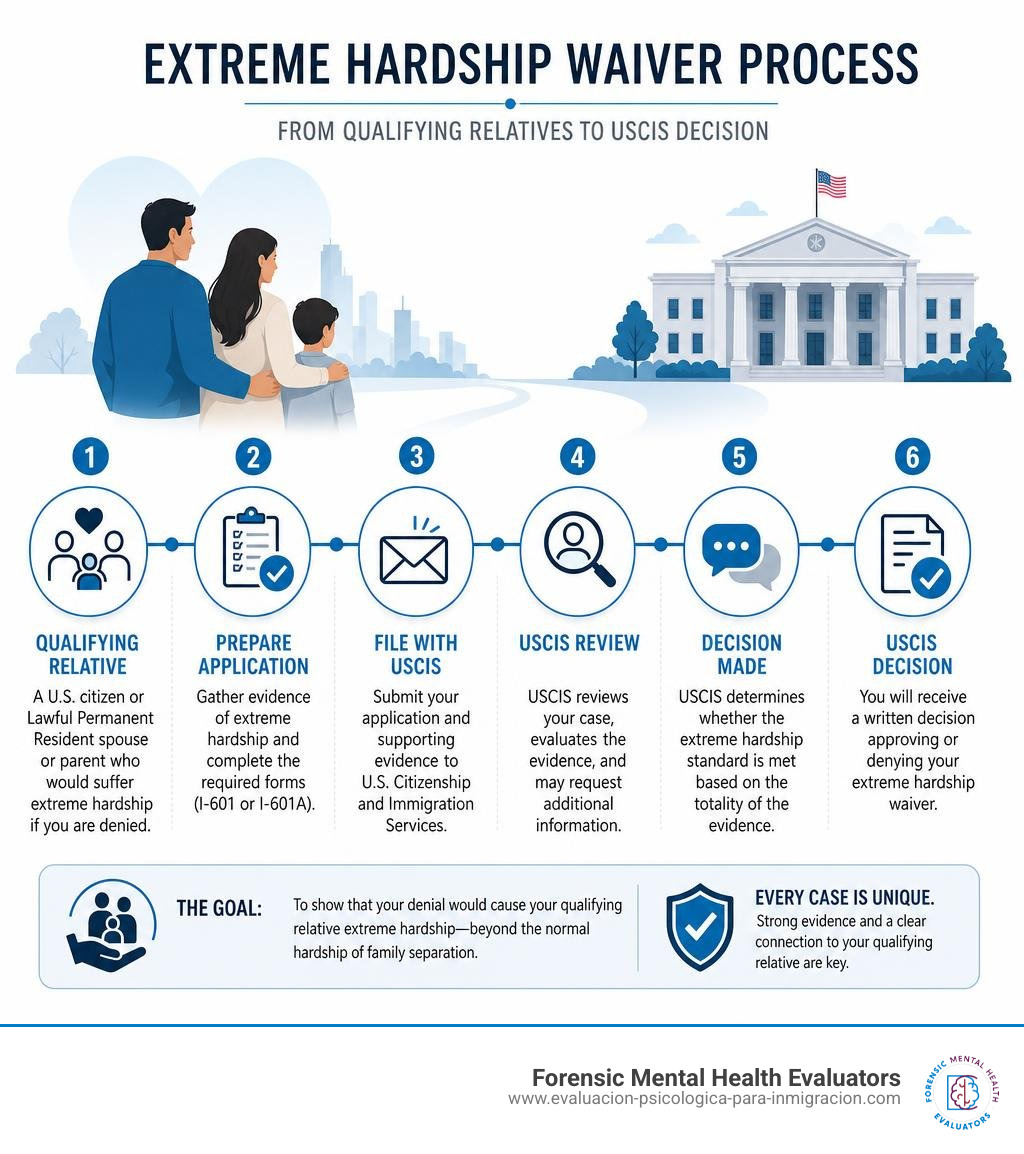
What is an Immigration Extreme Hardship Waiver?
When a foreign national is found inadmissible to the United States, they cannot obtain an immigrant visa or adjust their status to become a Lawful Permanent Resident (LPR). Inadmissibility can stem from several issues, such as accumulating unlawful presence, committing immigration fraud or misrepresentation, or having certain criminal convictions on record.
Fortunately, U.S. immigration law provides a safety valve. Under provisions like INA § 212(a)(9)(B)(v) (for unlawful presence), INA § 212(i) (for fraud or misrepresentation), and INA § 212(h) (for certain criminal grounds), applicants can request an Extreme Hardship waiver. This waiver essentially asks the government to forgive the underlying ground of inadmissibility because denying entry would result in devastating consequences for their legally recognized family members in the United States.
Adjudicating these claims is a structured, two-step process. As outlined in Chapter 3 - Adjudicating Extreme Hardship Claims | USCIS , a USCIS officer must first determine whether the applicant has established that their qualifying relative would suffer extreme hardship under either a separation or relocation scenario. If the applicant successfully proves this hardship, the officer then moves to the second step: exercising administrative discretion. The officer must weigh the positive factors of the case against the negative factors to decide if the applicant deserves to have their inadmissibility waived.
Who Qualifies as a Qualifying Relative for the Waiver?
One of the most common points of confusion in waiver cases is whose suffering actually matters in the eyes of the law. The legal standard does not look at the hardship of the immigrant applicant. Instead, it focuses entirely on the "qualifying relative."
For the majority of extreme hardship waivers — including the highly common I-601A provisional unlawful presence waiver and the I-601 fraud waiver — a qualifying relative is defined strictly as a:
- U.S. citizen spouse or parent
- Lawful Permanent Resident (LPR) spouse or parent

You will notice a glaring omission here: children. Under the statutes for unlawful presence and fraud waivers, children are not considered qualifying relatives. This means you cannot argue that your deportation should be waived solely because it would be hard on your U.S. citizen children. However, as we will discuss later, there is a legal way to frame the hardship of children so that it is considered "imputed" hardship to the qualifying spouse or parent.
For certain criminal waivers under INA § 212(h), the definition of a qualifying relative is slightly broader and can include U.S. citizen or LPR sons and daughters. It is essential to work closely with an immigration attorney to identify exactly whose hardship counts for your specific waiver type.
Legal Standards: Extreme Hardship vs. Exceptional and Extremely Unusual Hardship
To successfully navigate this process, we must understand where "extreme hardship" sits on the legal spectrum. It is a middle-tier standard. It requires proving a level of suffering that goes well beyond the typical, expected difficulties of deportation (such as general sadness, missing each other, or minor financial adjustments).
However, it is a lower standard than the "exceptional and extremely unusual hardship" standard required in Non-LPR Cancellation of Removal cases. Under the precedent case Matter of Cervantes, the Board of Immigration Appeals (BIA) clarified that while extreme hardship is highly demanding, it does not require the applicant to show that the hardship would be completely unique or unprecedented.
We can compare these two standards directly to see how they differ in practice:
| Feature | Extreme Hardship Waiver (I-601 / I-601A) | Exceptional & Extremely Unusual Hardship (Cancellation of Removal) |
|---|---|---|
| Statutory Standard | Must exceed the common, expected consequences of separation or relocation. | Must be "substantially beyond" that which would ordinarily result from deportation. |
| Qualifying Relatives | Spouse or parent (U.S. citizen or LPR). Note: Son/daughter included ONLY for 212(h). | Spouse, parent, or child (U.S. citizen or LPR). |
| Legal Threshold | High, but achievable by showing a combination of compounded moderate hardships. | Extremely high; generally reserved for severe medical issues or extreme country conditions. |
| Core Precedent | Matter of Cervantes, 22 I&N Dec. 560 (BIA 1999) | Matter of Recinas, 23 I&N Dec. 467 (BIA 2002) |
| More Information | Extreme Hardship | Extreme and Exceptionally Unusual Hardship |
Key Factors and Categories Considered by USCIS
When evaluating an immigration extreme hardship waiver claim, USCIS officers do not look at factors in isolation. They are legally required to evaluate the "totality of the circumstances." This means that even if no single factor in your life rises to the level of "extreme" hardship, the cumulative effect of several smaller hardships combined can meet the legal standard.
According to the official guidance in Chapter 5 - Extreme Hardship Considerations and Factors | USCIS , officers must distinguish between "common consequences" of deportation and true extreme hardship. Common consequences include things like standard emotional distress, general economic detriment, the difficulty of adjusting to a new country, or a drop in educational quality abroad. While these are painful, they are considered normal results of deportation and are insufficient on their own. However, when these factors compound, they transition from common to extreme.
Core Hardship Categories: Health, Financial, and Education
To build a strong case, we must organize the evidence into clear, verifiable categories. USCIS typically looks at the following areas:
- Health and Medical Conditions: This is often the strongest category. If your qualifying relative has a chronic physical or mental health condition that requires ongoing care, specialized treatment, or daily assistance that only you can provide, this must be documented. We must prove that treatment is either unavailable, unaffordable, or of significantly lower quality in the home country if they were to relocate, or that they would lack care if separated.
- Financial Detriment: Proving financial hardship requires showing more than just a lower income. We must demonstrate the loss of a primary breadwinner, the inability of the qualifying relative to pay for basic necessities (mortgage, healthcare, insurance), the cost of maintaining two separate households (one in the U.S. and one abroad), or the devastating financial impact of abandoning a family business.
- Education and Social Ties: This involves the disruption of educational paths for the qualifying relative or their dependents, the loss of community ties, language barriers that would make employment or schooling impossible abroad, and the psychological impact of leaving a lifelong support network.
Particularly Significant Factors in an Immigration Extreme Hardship Waiver Claim
To make adjudications more consistent, USCIS has identified several "Particularly Significant Factors" (PSFs). If your case involves one of these factors, the policy manual states that it should weigh heavily in favor of finding extreme hardship. These factors include:
- Prior Humanitarian Status: The qualifying relative was previously granted asylum, refugee status, or T nonimmigrant status from the country where the applicant would be relocated.
- Disability Determinations: The qualifying relative (or a family member they care for) has a formal disability determination from a government agency like the Social Security Administration.
- Active Military Service: The qualifying relative is an active-duty member of the U.S. Armed Forces, or is in the Selected Reserve.
- DOS Travel Warnings: The Department of State has issued a Level 3 (Reconsider Travel) or Level 4 (Do Not Travel) warning for the country of relocation.
- Substantial Displacement of Care: The applicant's deportation would cause a massive, unsustainable shift in who cares for the qualifying relative's children, elderly parents, or disabled family members.
Navigating the Two Scenarios: Separation vs. Relocation
When you submit an immigration extreme hardship waiver application, you must address two distinct paths:
- The Separation Scenario: What happens to the qualifying relative if the applicant is deported and the qualifying relative stays behind in the United States?
- The Relocation Scenario: What happens to the qualifying relative if they choose to leave the United States to live in the home country with the deported applicant?

Under USCIS policy, you technically only need to prove extreme hardship in one of these scenarios. However, unless your qualifying relative has an absolute, unyielding reason why they cannot relocate (or cannot separate), we highly recommend arguing both scenarios. If you only argue separation, USCIS may deny the waiver by claiming, "Yes, separation would be hard, but your spouse can simply relocate to your home country with you, and we see no evidence that relocation would cause extreme hardship."
The Role of Country Conditions and Special Statuses
The relocation scenario is heavily influenced by the conditions in the applicant's home country. This is where objective, third-party evidence becomes vital. We must submit detailed country condition reports, U.S. Department of State travel advisories, and reports from non-governmental organizations (NGOs) to show what life would look like for the qualifying relative abroad.
For example, if your U.S. citizen spouse has a history of trauma or belongs to a marginalized group (such as the LGBTQ+ community), relocating to a country with high rates of violence, systemic discrimination, or active travel warnings represents a severe threat to their safety and mental well-being. This was a key element in the landmark case Matter of Recinas, where the court looked at the total lack of family support, economic depression, and language barriers in the home country to find that relocation would be an exceptional hardship.
How to Build and Document a Strong Hardship Case
The legal burden of proof rests entirely on the applicant. Under the law, you must establish eligibility by a "preponderance of the evidence." In simple terms, this means you must prove that your claims are "more likely than not" to be true (a 51% threshold of certainty).
To meet this standard, every single claim you make in your personal hardship letter must be backed up by objective, secondary evidence. As outlined in Chapter 6 - Extreme Hardship Determinations | USCIS , officers are trained to look for consistency and credibility.
If you say your spouse has severe asthma, you must provide medical records and prescriptions. If you claim financial ruin, you must provide tax returns, bank statements, and utility bills. If you claim that your spouse cannot survive without you emotionally, a simple letter saying "I love him and will miss him" is not enough. You need professional, clinical proof.
The Power of a Psychological Evaluation in an Immigration Extreme Hardship Waiver Case
This is where our work at District Counseling becomes a critical asset to your legal team. A personal letter from a family member is considered "self-serving" by USCIS officers. They expect you to say you are sad. But a comprehensive, professional clinical evaluation changes the entire dynamic of the case. It turns a subjective emotional plea into an objective medical fact.
When we conduct a mental health evaluation for an Immigration Psychological Evaluation Complete Guide or a specific Psychological Evaluation for Waiver Cases, we do not just write down that your spouse is anxious. We perform a series of clinical interviews, administer standardized diagnostic tests, and review their personal history.
Our evaluations provide:
- A Formal Clinical Diagnosis: If the qualifying relative is suffering from Major Depressive Disorder, Generalized Anxiety Disorder, or Post-Traumatic Stress Disorder (PTSD), we document it using official DSM-5 criteria.
- The Legal Nexus: We clearly explain why and how the prospect of family separation or relocation is the direct cause (or major aggravator) of this mental health crisis.
- Functional Impairment Analysis: We document how their mental health condition impacts their daily life — their ability to work, care for their children, pay their bills, and maintain physical health.
This level of professional documentation makes it incredibly difficult for a USCIS officer to dismiss the emotional and psychological hardship as a "common consequence" of deportation.
Common Mistakes to Avoid When Preparing Your Application
Even with strong facts, many waiver applications are delayed or denied due to easily avoidable mistakes. Be sure to avoid the following pitfalls:
- Submitting Generic Hardship Letters: Avoid templates you find on the internet. USCIS officers read thousands of these letters and can spot a generic template instantly. Your story must be deeply personal and specific.
- Ignoring the Relocation Scenario: As mentioned, failing to explain why your qualifying relative cannot move abroad with you is one of the most common reasons for a Request for Evidence (RFE) or an outright denial.
- Failing to Provide a Nexus: If you show that your spouse has a medical condition, but fail to explain how your absence will make that medical condition worse, you have failed to establish the legal "nexus" required for the waiver.
- Uncorroborated Assertions: Never make a claim you cannot prove with paper. If you say you have $50,000 in medical debt, you must attach the medical bills.
Frequently Asked Questions about Extreme Hardship Waivers
Can hardship to my children be considered in a waiver application?
Directly? No, not for unlawful presence (I-601A) or fraud (I-601) waivers, because children are not defined as qualifying relatives under those specific statutes.
However, we can use a legal strategy known as imputed hardship. If your children are going to suffer severely due to your deportation (for example, if a child has severe asthma, autism, or educational developmental delays), that suffering will inevitably cause immense emotional, physical, and financial distress to your qualifying relative spouse. By documenting how the child's struggles will directly compromise the mental health and physical capacity of your spouse, the child’s hardship is "imputed" to the qualifying relative.
How long does it take USCIS to process an I-601 or I-601A waiver in 2026?
As of June 2026, processing times remain highly backed up due to a massive surge in filings over the last several years. Currently, an I-601A provisional unlawful presence waiver can take anywhere from 32 to 43+ months to be adjudicated.
Because of these long timelines, it is absolutely vital that your initial application is as strong and complete as possible. If USCIS has to issue a Request for Evidence (RFE) because you lacked a psychological evaluation or proper financial records, it can add many months of painful waiting to an already exhausting process.
Do I need an immigration attorney to file an extreme hardship waiver?
While the law does not strictly require you to hire a lawyer, attempting to navigate an immigration extreme hardship waiver on your own is highly risky.
Immigration law is incredibly complex, and the standards for what constitutes "extreme" are constantly shifting. An experienced immigration attorney knows how to draft a compelling legal brief, organize your evidence to align with the USCIS Policy Manual, and ensure that all statutory requirements are met. Our clinical team at District Counseling regularly collaborates directly with immigration attorneys to ensure our psychological reports integrate seamlessly with their legal strategy.
Conclusion
Proving extreme hardship is no easy task. It requires a delicate blend of legal strategy, meticulous financial and medical documentation, and a deep, honest look at your family's psychological well-being.
At District Counseling, we are here to help you carry that weight. We provide professional, forensic psychological evaluations for immigration cases across our physical office locations in Houston TX, Katy TX, Cypress TX, and Sugarland TX, as well as virtually for clients throughout Texas, Florida, California, New York, Utah, Virginia, and Idaho.
We understand how stressful this process is for families. To make things as comfortable and supportive as possible, we offer:
- Bilingual Evaluations: We conduct evaluations in Spanish and provide fully certified English translations for USCIS.
- Client-Centered Care: We focus on making you feel safe, heard, and respected during our clinical interviews.
- Post-Report Support: To help your family cope with the stress of the immigration process, we offer 6 free therapy sessions to our clients after their clinical report is completed.
If you are ready to take the next step and strengthen your waiver application with a professional clinical evaluation, we invite you to read our Immigration Evaluation Guide 2026 or schedule your consultation today through our Psychological Evaluation for Waiver Cases portal. Let us help you keep your family where they belong: together.