
Deportation Defense 101: The Ultimate Guide to Cancellation of Removal
When Deportation Feels Inevitable, Cancellation of Removal Can Change Everything

Cancellation of deportation — also called cancellation of removal — is a legal defense that can stop your removal and lead to a green card, even if you have no other immigration options.
Here is a quick answer to what it is and who qualifies:
What is cancellation of removal? It is a form of relief granted by an immigration judge under INA § 240A that cancels your deportation order and adjusts your status to lawful permanent resident.
Who can apply?
- Non-permanent residents (non-LPRs): Must have lived in the U.S. for at least 10 continuous years, show good moral character, and prove that a U.S. citizen or green card-holding spouse, parent, or child would suffer exceptional and extremely unusual hardship if you are deported
- Lawful permanent residents (LPRs): Must have held a green card for at least 5 years, lived continuously in the U.S. for 7 years, and have no aggravated felony conviction
- Battered spouses and children (VAWA): May qualify with only 3 years of continuous presence under a separate, more flexible standard
If you are a non-permanent resident in Texas with U.S. citizen children or a spouse, and you are currently in removal proceedings, this guide is written for you. The path forward is hard — but it exists.
Facing a deportation order is one of the most frightening experiences a family can go through. The fear of being separated from your children, your spouse, and the life you have built here is real. And the legal process can feel impossible to navigate alone.
But here is what matters: immigration judges can cancel removal orders. In fact, in FY 2021, immigration judges granted relief in 1,876 cancellation cases. The key is understanding exactly what you need to prove — and gathering the right evidence to prove it.
I'm Francisco Ortiz, Lead Forensic Mental Health Evaluator at District Counseling PLLC and a Certified Forensic Mental Health Evaluator (CFMHE), with specialized training in hardship waiver evaluations that directly support cancellation of deportation cases. I have conducted high-stakes psychological evaluations for immigration proceedings across Texas, California, Florida, and beyond, helping families document the emotional and psychological toll that deportation would cause to their U.S. citizen loved ones.
In this guide, I will walk you through every step of the cancellation of removal process — from eligibility requirements to court hearings — so you know exactly what to expect and how to build the strongest case possible.
Understanding the Legal Framework for Cancellation of Deportation
When a non-citizen is placed in removal proceedings, the government is actively seeking to deport them. However, the law provides specific avenues of immigration relief designed to keep families together. Under the Immigration and Nationality Act, cancellation of deportation acts as a powerful defense. Rather than relying purely on prosecutorial discretion—where the government simply decides to pause your deportation—winning a cancellation case results in a permanent legal status.
The Attorney General, through immigration judges, has the authority to grant this relief under 8 USC 1229b: Cancellation of removal; adjustment of status. If your application is approved, the judge cancels the deportation proceedings and adjusts your status to that of a Lawful Permanent Resident (LPR). This means you receive a green card. To explore this legal framework in full, you can consult our Cancellation Of Removal Complete Guide.
How Cancellation Differs from Other Forms of Immigration Relief
It is vital to understand that cancellation of removal is not a benefit you can apply for proactively through U.S. Citizenship and Immigration Services (USCIS) while living undocumented in the community. You can only apply for it if you are already in removal proceedings before an immigration judge.
This sets it apart from other green card pathways and forms of relief:
- Asylum: Asylum is based on a well-founded fear of persecution in your home country due to race, religion, nationality, political opinion, or membership in a particular social group. Cancellation, on the other hand, focuses primarily on the hardship your U.S. citizen or LPR family members would face if you were deported.
- Adjustment of Status: While standard adjustment of status usually requires an immediate relative petition and a lawful entry (or a waiver), cancellation allows the judge to adjust your status even if you originally entered without inspection and have no other pathway to a green card.
- Voluntary Departure: If you have no defense against deportation, an immigration judge might grant voluntary departure. This allows you to leave the United States on your own terms and at your own expense, avoiding the severe 10-year bar associated with a formal deportation order. However, unlike cancellation, voluntary departure still requires you to leave the country.
Eligibility Pathways: Non-LPR vs. LPR Relief
The requirements for cancellation vary dramatically depending on whether you already hold a green card. The table below outlines the core differences between the two pathways:
| Requirement | Non-LPR Cancellation (INA § 240A(b)(1)) | LPR Cancellation (INA § 240A(a)) |
|---|---|---|
| U.S. Immigration Status | Undocumented, temporary visa holders, non-permanent residents | Lawful Permanent Residents (Green Card holders) |
| Required U.S. Residence | 10 years of continuous physical presence | 7 years of continuous residence (in any lawful status) |
| Status Duration | N/A | Must have been an LPR for at least 5 years |
| Qualifying Relatives | Must have a U.S. citizen or LPR spouse, parent, or child | None required (the judge weighs positive vs. negative factors) |
| Hardship Standard | "Exceptional and extremely unusual hardship" to the qualifying relative | Hardship is considered, but is not a strict statutory threshold |
| Criminal Record | Highly restrictive; no disqualifying crimes | No "aggravated felony" convictions |
Statutory Requirements for Non-LPR Cancellation of Deportation
For non-permanent residents, the statutory bar is exceptionally high. Under INA § 240A(b)(1), you must meet four strict criteria:
- 10 Years of Continuous Physical Presence: You must have lived in the United States continuously for at least 10 years immediately preceding the date of your application or the date your removal proceedings began.
- Good Moral Character: You must demonstrate that you have been a person of good moral character during the entire 10-year period.
- No Disqualifying Convictions: You must not have been convicted of certain crimes, including crimes involving moral turpitude, drug offenses, or domestic violence.
- Exceptional and Extremely Unusual Hardship: You must prove that your deportation would result in "exceptional and extremely unusual hardship" to your U.S. citizen or LPR spouse, parent, or child under the age of 21. Hardship to yourself does not count under this standard.
For a detailed breakdown of these rules, you can review A Guide to 10-Year Cancellation of Removal.
Key Requirements for Lawful Permanent Residents (LPRs)
Green card holders are not immune to deportation. If an LPR is convicted of certain crimes, the government can place them in removal proceedings. However, LPRs have a lower threshold to meet to win cancellation of removal.
To qualify, an LPR must show they have been a lawful permanent resident for at least 5 years, have resided in the United States continuously for 7 years after being admitted in any status, and have not been convicted of an "aggravated felony." In LPR cases, the judge does not look for "exceptional and extremely unusual hardship." Instead, they perform a balancing test, weighing the negative factors (such as the applicant's criminal history) against positive factors (such as family ties, employment history, and community service). In the landmark case Welch v. Ashcroft, courts highlighted how constitutional due process protects LPRs facing prolonged detention while their eligibility for such discretionary relief is evaluated.
Proving Continuous Physical Presence and Good Moral Character
To successfully defend against deportation, you must present an airtight case showing you meet the residency and character standards.

The "continuous physical presence" clock is highly sensitive. Under the "stop-time rule," your accrual of the required 10 years (for non-LPRs) or 7 years (for LPRs) stops immediately when the government serves you with a Notice to Appear (NTA) in immigration court, or when you commit certain criminal offenses.
Additionally, your continuous presence is legally broken if you have left the United States for more than 90 days in a single trip, or for an aggregate total of more than 180 days across the entire required period.
Documenting Your Presence in the United States
To prove you have physically been in the country for every single year of the required decade, we recommend gathering a comprehensive paper trail. Do not leave gaps in your timeline. Useful documents include:
- Tax Returns: Certified IRS tax transcripts for the last 10 years are among the strongest pieces of evidence.
- School Records: Transcripts, report cards, or enrollment letters for yourself or your children.
- Rent Receipts and Leases: Signed lease agreements, utility bills (electricity, water, gas), and rent payment receipts.
- Employment History: Pay stubs, W-2 forms, and notarized letters from past and present employers.
- Medical Records: Vaccination records, hospital bills, and doctor visit summaries.
Demonstrating Good Moral Character and Navigating Criminal Bars
Good moral character is evaluated over the statutory 10-year period. While minor traffic infractions generally will not destroy your case, serious criminal convictions will.
Certain offenses, like aggravated felonies, drug trafficking, or crimes of moral turpitude, act as absolute statutory bars to relief. However, under the "petty offense exception," a single conviction for a crime of moral turpitude may not disqualify you if the maximum possible penalty for the crime did not exceed one year and you were not sentenced to more than six months in prison.
To prove good moral character, you should submit:
- Certified police records and background checks from every jurisdiction where you have lived.
- Proof of rehabilitation if you have a past arrest, such as certificates from counseling, anger management, or drug rehabilitation programs.
- Notarized letters of support from church leaders, employers, neighbors, and community organizations attesting to your honesty, work ethic, and civic contributions.
The Hardship Standard: Proving Exceptional and Extremely Unusual Hardship
The single most challenging element of a non-LPR cancellation case is proving "exceptional and extremely unusual hardship." This standard is significantly higher than the "extreme hardship" standard used in other immigration waivers.
To win, you must prove that the hardship your qualifying relative (U.S. citizen or LPR spouse, parent, or child) would suffer is substantially beyond the ordinary difficulties associated with deportation. Normal hardships—such as the sadness of separation, adjusting to a new school, or a lower standard of living in your home country—are generally considered "ordinary" by immigration judges.
To meet the legal threshold, you must show that your family would face truly devastating consequences. Examples include a child with severe, life-threatening medical conditions that cannot be treated in your home country, or a family member who is entirely dependent on you for specialized care or financial survival. You can read more about how this is defined in our guide on Extreme And Exceptionally Unusual Hardship.
The Critical Role of Psychological Evaluations in Hardship Claims
When arguing a hardship claim, physical medical records are vital, but the mental and emotional devastation of family separation is often the most compelling factor. This is where a clinical psychological evaluation becomes the cornerstone of your defense.

At District Counseling, we conduct comprehensive, culturally sensitive psychological evaluations in Spanish and English. We assess the profound psychological impact that deportation would have on your qualifying relatives. Our evaluations document clinical conditions such as Major Depressive Disorder, Generalized Anxiety Disorder, and Post-Traumatic Stress Disorder (PTSD) triggered by the threat of family separation.
A professional psychological report provides the immigration judge with objective, clinical evidence of how deportation would shatter your family's mental health. To understand how these evaluations are structured and why they are so effective in court, please read our article on the Cancellation Of Removal Psych Eval.
The Application Process: Form EOIR-42B and Court Hearings
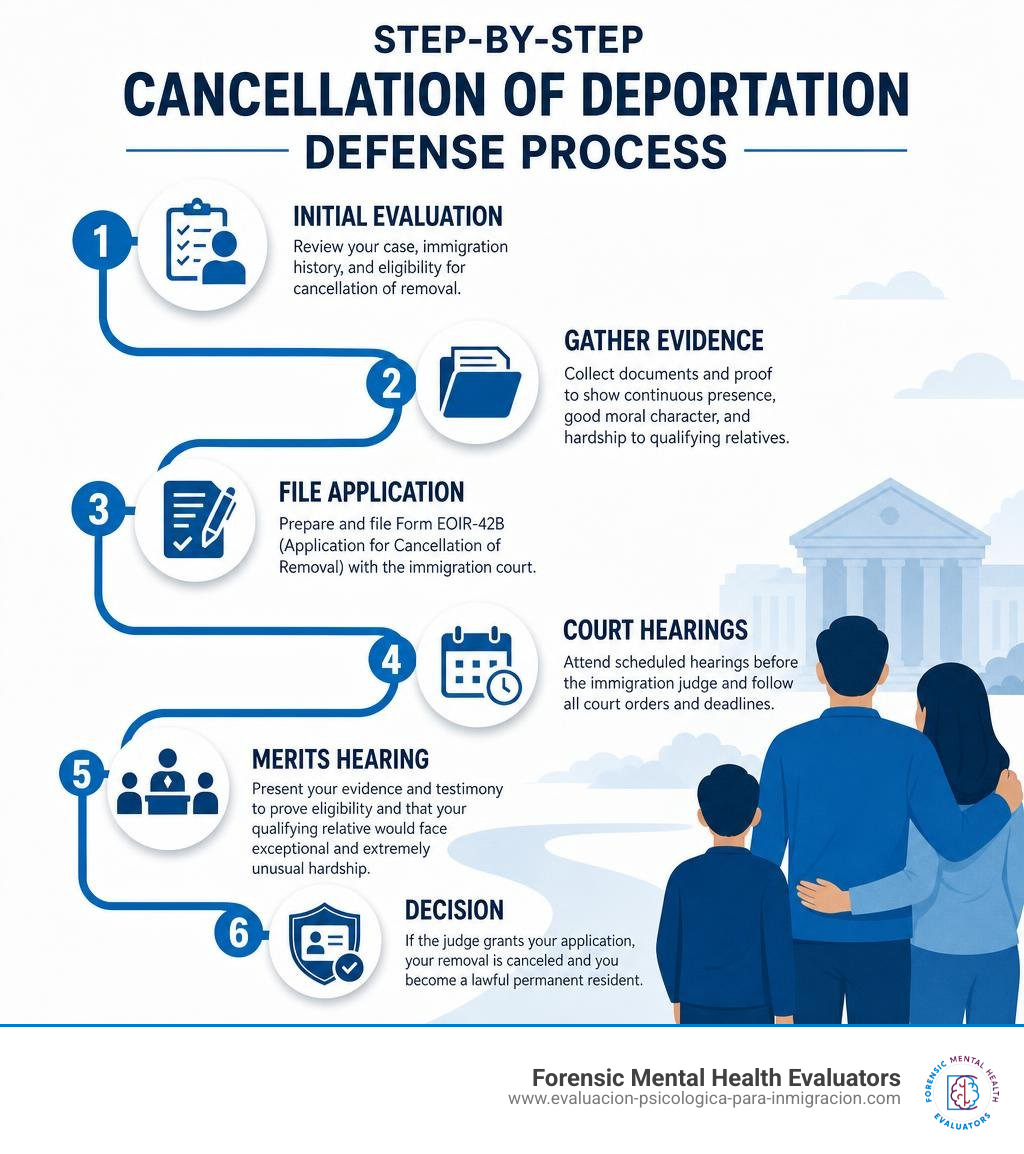
Applying for cancellation of removal is a multi-step process that takes place entirely within the Executive Office for Immigration Review (EOIR) court system.
Preparing Your Case for Cancellation of Deportation
The actual application is submitted using Form EOIR-42B (for non-LPRs) or Form EOIR-42A (for LPRs). It is critical to fill out this form with absolute accuracy. Any discrepancies between your application, your tax records, and your court testimony can be used by the Department of Homeland Security (DHS) counsel to challenge your credibility.
To learn more about the specific fields and how to avoid costly filing errors, check out our resource on the Eoir 42B Form.
When filing, you must pay the required government fees (or submit a fee waiver request), complete your biometrics (fingerprints and background checks) at a designated Application Support Center, and formally serve a copy of your entire application package on the DHS Assistant Chief Counsel.
What to Expect During Immigration Court Hearings
Your case will proceed through two main types of hearings:
- Master Calendar Hearings: These are short, preliminary hearings where the judge schedules deadlines, takes pleadings on the charges of removability, and schedules your final trial date.
- Individual (Merits) Hearings: This is your actual trial. During this hearing, your immigration attorney will present your evidence, including tax transcripts, character letters, and our clinical psychological evaluation. You, your qualifying relatives, and other witnesses will testify under oath. The DHS counsel will cross-examine you and your witnesses, attempting to find inconsistencies in your story.
At the end of this trial, the immigration judge will make a final decision on whether to grant your cancellation of deportation.
Frequently Asked Questions About Cancellation of Deportation
What happens if my application for cancellation of removal is denied?
If the immigration judge denies your application, they will issue a removal order. However, you do not have to accept this as the end of the road. You have the right to appeal the judge's decision to the Board of Immigration Appeals (BIA) within 30 days of the denial.
If the BIA denies your appeal, you may be able to seek review in the federal U.S. Court of Appeals. In fact, in the landmark March 2024 Supreme Court decision Wilkinson v. Garland, the court ruled that federal appeals courts have the jurisdiction to review whether an immigration judge correctly applied the statutory hardship standard to the facts of a case. This provides a critical legal safety net for families facing denial. If all appeals fail, you may still request voluntary departure to avoid the harsh legal penalties of a formal deportation order.
How does the annual 4,000-grant cap affect my case?
By law, the Attorney General is capped at granting a maximum of 4,000 cancellations of removal and adjustments of status per fiscal year for non-LPR applicants. Because the demand for this relief vastly exceeds the supply, immigration judges often "reserve" decisions.
If the 4,000 cap is reached during the fiscal year, a judge who intends to approve your case must hold the final grant until a new slot opens up in the next fiscal year. As of July 2026, the massive backlog of pending cases in the immigration courts means that applicants often wait years for their final merits hearing, during which time they are eligible to apply for and renew a work permit (Employment Authorization Document).
Can a vacated conviction restore my eligibility for cancellation?
Yes, in many cases. If you were previously convicted of a disqualifying crime, such as an aggravated felony or a crime of moral turpitude, you are legally barred from receiving cancellation. However, if an experienced criminal defense attorney successfully vacates that conviction in state court due to a constitutional defect or ineffective assistance of counsel, your eligibility can be restored.
If the conviction is modified to a non-disqualifying misdemeanor, the immigration court can once again consider your application for relief.
Conclusion
Defending your family against deportation is a grueling, emotional journey. But with the right legal strategy, exhaustive documentation, and clinical mental health support, you can win your case and secure your permanent future in the United States.
At District Counseling PLLC, we specialize in providing the high-quality, professional psychological evaluations that immigration judges rely on to understand the true human cost of deportation. We serve clients across our key locations, including Houston TX, Katy TX, Cypress TX, Sugarland TX, and throughout Texas, Florida, California, New York, Utah, Virginia, and Idaho.
We are committed to your family’s comfort and success. We provide comprehensive evaluations in Spanish, complete with certified English translations for the court. To help your loved ones heal from the trauma of removal proceedings, we also offer 6 free therapy sessions post-report to every client who completes an evaluation with us.
If you are preparing for a cancellation of deportation case, do not wait. Protect your family's future today. Visit our service page to learn more about our Evaluacion Psicologica Para Caso De Una Cancelacion De Deportacion and schedule your consultation.