
The Mind Matters: Navigating Your Cancellation of Removal Evaluation in Texas
What Is a Cancellation Removal Psychological Evaluation — and Do You Need One?

A cancellation removal psychological evaluation is a formal clinical assessment that documents the emotional, psychological, and functional harm that deportation would cause to your U.S. citizen or lawful permanent resident (LPR) family members — and it can be one of the most important documents in your immigration case.
Here's what you need to know at a glance:
- What it is: A forensic-level mental health report prepared by a licensed psychologist or clinician
- Who it's for: Non-permanent residents in removal proceedings who file Form EOIR-42B
- Who gets evaluated: Primarily your qualifying relatives — U.S. citizen or LPR children, spouse, or parents
- What it proves: That your removal would cause exceptional and extremely unusual hardship — a very high legal standard
- How long it takes: Typically 4–5 days, with expedited 48-hour options available
- How it's done: Via a structured clinical interview (often by telehealth), standardized testing, records review, and a 15–20 page written report
Facing removal proceedings is one of the most stressful experiences a family can go through. The fear of being separated from your children, your spouse, or your parents — people who depend on you every single day — is real and overwhelming.
But immigration courts need more than a personal story. They need documented clinical evidence that shows exactly how your removal would harm your loved ones in ways that go far beyond what any typical family faces when a parent or spouse is deported.
That's where a psychological evaluation comes in.
Without strong clinical documentation, even the most heartbreaking family situations can fail to meet the legal threshold. The difference between approval and deportation often comes down to how well the hardship is documented.
My name is Francisco Ortiz, and as Lead Forensic Mental Health Evaluator at Forensic Mental Health Evaluators, I specialize in conducting cancellation removal psychological evaluations for families across Texas and beyond, licensed in six states and certified through the National Board of Forensic Evaluators. In this guide, I'll walk you through exactly what the evaluation process involves, what courts look for, and how to give your case the strongest possible foundation.
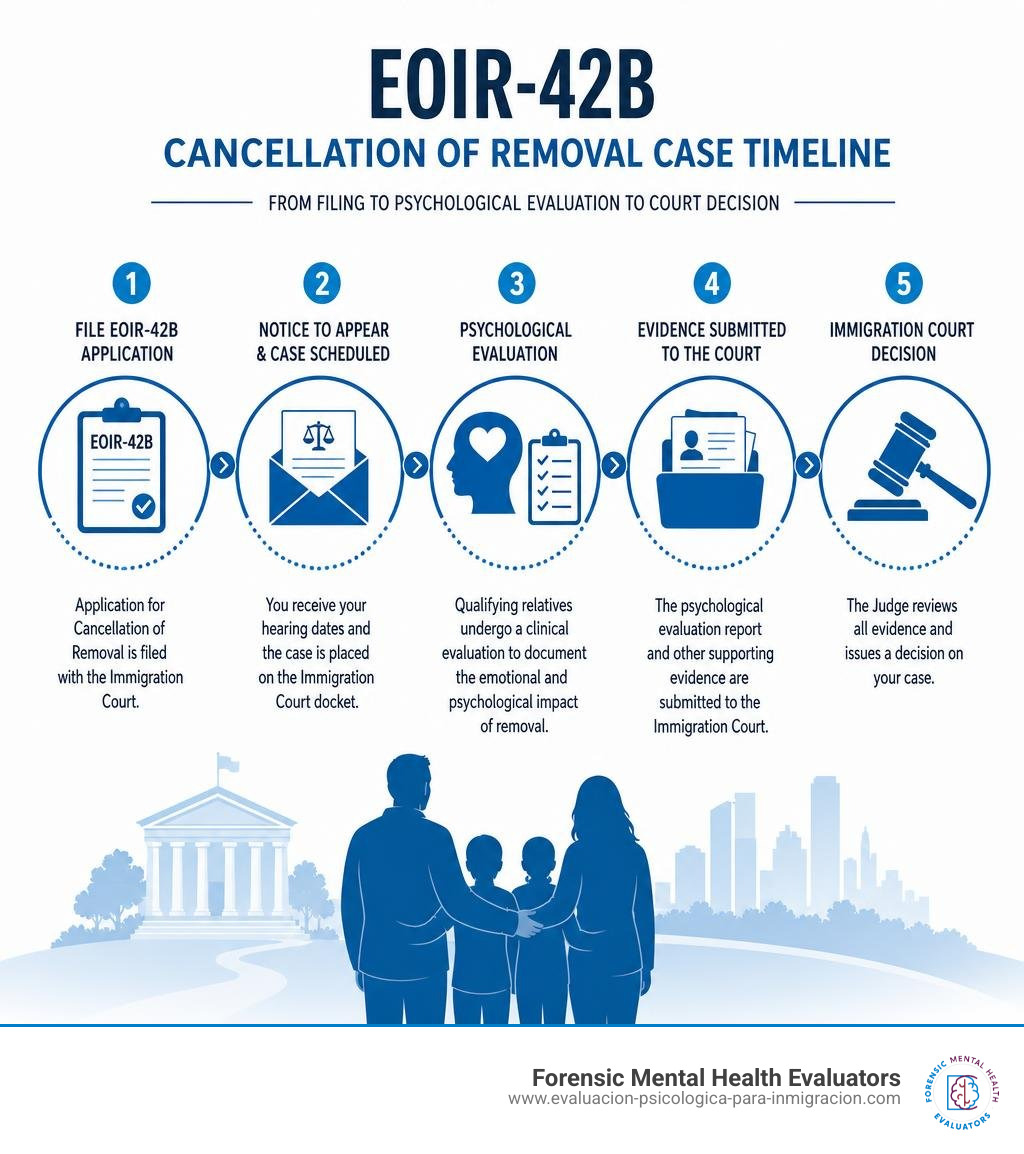
Understanding Cancellation of Removal: EOIR-42B vs. EOIR-42A
When an individual is placed in removal proceedings, they may be eligible to apply for relief through a process called Cancellation of Removal. However, the path you take depends entirely on your current legal status in the United States. The Executive Office for Immigration Review (EOIR) utilizes two primary forms for these applications: Form EOIR-42A and Form EOIR-42B.
For non-lawful permanent residents (non-LPRs), the application is filed using the EOIR 42B Form. This form is designed for individuals who do not currently hold green cards but have built deep roots in the United States over many years. To qualify for non-LPR cancellation of removal, the applicant must meet strict statutory requirements:
- Maintain continuous physical presence in the United States for at least 10 years.
- Demonstrate good moral character during that entire 10-year period.
- Have no disqualifying criminal convictions.
- Establish that their removal would result in "exceptional and extremely unusual hardship" to a qualifying relative who is a U.S. citizen or LPR spouse, child, or parent.
In contrast, Form EOIR-42A is used by lawful permanent residents (LPRs) who are facing deportation, usually due to certain criminal convictions. The legal standards for LPRs under EOIR-42A are different; they do not have to prove the same level of "exceptional and extremely unusual hardship" to qualifying relatives, though documenting family ties and rehabilitation remains vital.
| Requirement | EOIR-42A (LPR Cancellation) | EOIR-42B (Non-LPR Cancellation) |
|---|---|---|
| Current Status | Lawful Permanent Resident (LPR) | Non-Lawful Permanent Resident (Non-LPR) |
| U.S. Physical Presence | At least 7 years after admission | At least 10 years continuously |
| Good Moral Character | Not explicitly a 10-year statutory bar | Must prove for at least 10 years |
| Hardship Standard | Hardship is a discretionary factor | "Exceptional and extremely unusual hardship" |
| Qualifying Relatives | Not strictly limited to specific relatives | Must be U.S. citizen or LPR spouse, child, or parent |
The Role of a Cancellation Removal Psychological Evaluation in Court
Immigration judges hear hundreds of emotional testimonies every year. While personal stories are essential, judges require objective, forensic-level documentation to substantiate claims of extreme distress. A cancellation removal psychological evaluation provides the court with a professional, clinical assessment of the family's mental and emotional reality.
Rather than relying solely on subjective claims of "stress," a comprehensive Cancellation of Removal Psych Eval translates family suffering into clinical terms that the court can formally recognize. Our reports, which typically span 15 to 20 pages, provide DSM-5-TR diagnoses, quantitative data from standardized psychological testing, and expert prognostic opinions.
By conducting a thorough Immigration Mental Health Evaluation, we document how the removal of the applicant would physically and emotionally destabilize the family unit. We look at the cumulative effect of medical, financial, and psychological stressors, providing the judge with a clear picture of the family's vulnerability.
Who is Evaluated in a Cancellation Removal Psychological Evaluation?
A common misconception is that the applicant facing removal is the primary focus of the evaluation. In an EOIR-42B case, the legal standard focuses almost entirely on the qualifying relatives. Therefore, we primarily evaluate the U.S. citizen or LPR spouses, children, or parents.
Our clinical team assesses the qualifying relatives to identify:
- Existing mental health diagnoses (such as Major Depressive Disorder or PTSD) that would worsen upon separation or relocation.
- Developmental or learning disabilities in children that require specialized, continuous care.
- The severe attachment disruption children would experience if separated from their primary caregiver.
- The physical and emotional dependency of elderly or disabled parents who rely on the applicant for daily survival.
To understand the full scope of how these family dynamics are analyzed, you can refer to our Cancellation of Removal Complete Guide.
Documenting 'Exceptional and Extremely Unusual Hardship'
The phrase "exceptional and extremely unusual hardship" is the highest hardship standard in U.S. immigration law. It is substantially more demanding than the "extreme hardship" standard used in standard I-601 waiver cases. The Board of Immigration Appeals (BIA) has defined this standard through several landmark cases:
- Matter of Monreal-Aguinaga (2001): Established that the hardship must be "substantially beyond" what would normally be expected from deportation. Ordinary difficulties, such as economic loss or the pain of family separation, are not enough on their own.
- Matter of Recinas (2002): Demonstrated that a combination of cumulative factors—such as being a single mother with multiple U.S. citizen children, lack of family support in the home country, and limited economic opportunities—can meet the high threshold.
- Matter of J-J-G- (2020): Clarified that if a hardship claim is based on medical or psychological conditions, the applicant must establish that the qualifying relative has a "serious" medical condition and that adequate medical care is not reasonably available in the home country.
To meet these high standards, our evaluations compile objective evidence linking the psychological well-being of the qualifying relative to the physical presence of the applicant.

Separation vs. Relocation Hardship Scenarios
A thorough psychological evaluation must address the two potential scenarios the family faces if the applicant is deported: separation (the applicant leaves, but the family remains in the U.S.) and relocation (the family accompanies the applicant to the home country).
In a separation scenario, we document the immediate psychological impact of breaking up the family. This includes assessing the risk of severe depression, anxiety, and behavioral regression in children, as well as the loss of caregiving support for disabled relatives.
In a relocation scenario, we examine the barriers the family would face in the receiving country. This involves analyzing the availability and cost of medical and mental health treatment, educational regression for children who only speak English, and safety concerns. For a deeper look at how these dynamics are documented, see our guide on Asylum Cancellation Psych Evaluation.
The Evaluation Process: From Clinical Interview to Court-Ready Report
We have designed a structured, professional, and compassionate evaluation process to ensure your report meets the strict standards of the immigration court.
- Clinical Interview: We conduct a detailed interview lasting between 90 and 120 minutes. This conversation covers family history, trauma history, current stressors, and daily functional limitations.
- Standardized Testing: We utilize validated psychological screening tools, such as the PHQ-9 (for depression), GAD-7 (for anxiety), and PCL-5 (for PTSD symptoms), to provide objective, numerical data.
- Records Review: We review medical records, school reports, individualized education programs (IEPs), and relevant country conditions reports.
- Diagnostic Formulation: We apply DSM-5-TR diagnostic criteria to establish clear clinical findings.
- Attorney Coordination: We collaborate closely with your legal counsel to ensure our clinical findings address the specific legal theories of your case.
To see what a completed professional document looks like, you can explore an Immigration Psychological Evaluation Sample.
What to Expect During Your Cancellation Removal Psychological Evaluation
We understand that speaking with a mental health professional can feel intimidating, especially when your family's future is on the line. We prioritize your comfort and emotional safety.
Through the PSYPACT interstate compact, we are licensed to provide secure telehealth evaluations across 42 states—including Texas, California, Florida, New York, Utah, and Virginia. This means you can complete your evaluation from the comfort and privacy of your own home without needing to travel to a physical clinic.
For residents of Texas, we offer specialized local expertise. You can learn more about our state-specific services by visiting our Texas Immigration Psych Evaluation page.
Frequently Asked Questions about Cancellation of Removal
How do I prepare for my psychological evaluation?
Preparation is simple but essential. To get the most out of your session:
- Gather all relevant documents beforehand, including school report cards, IEPs, medical records, and therapist letters.
- Write down a basic timeline of major family milestones, medical diagnoses, and historical challenges.
- Be prepared to speak honestly about your fears, daily struggles, and emotional symptoms. There is no need to exaggerate; the truth of your daily reality is what matters most.
For a comprehensive checklist, check out our Immigration Psychological Evaluations Guide 2026.
What are the common pitfalls that cause cases to fail?
Many cases fall short because they fail to distinguish their hardship from the "normal" difficulties of deportation. Under the Matter of J-J-G- standard, simply claiming a relative will be sad or stressed is not enough. Common pitfalls include:
- A lack of objective medical or school records to back up claims of illness or developmental delays.
- Relying on inconsistent or vague testimonies regarding the cost and availability of care abroad.
- Failing to document the functional impact of the applicant's absence on the daily lives of the qualifying relatives.
How long does the evaluation process take and what does it cost?
We pride ourselves on offering professional, transparent, and timely services.
- Standard Turnaround: Our standard reports are completed within 4 to 5 business days following the clinical interview.
- Expedited Turnaround: We offer 48-hour rush delivery for urgent court deadlines for an additional fee.
- Affordable Pricing: A standard evaluation in English is typically priced at a flat fee of $650, which includes the interview and the final written report.
For a detailed breakdown of costs and timelines, please consult our Immigration Evaluations Complete Guide 2026.
Conclusion
A cancellation removal psychological evaluation is more than just a legal requirement—it is an opportunity to make the invisible emotional struggles of your family visible to the court.
At District Counseling and Forensic Mental Health Evaluators, we provide culturally sensitive, professional evaluations in Texas cities like Houston, Austin, Dallas, and San Antonio, as well as throughout California, Florida, New York, Utah, Virginia, and Idaho. We offer comprehensive evaluations in both Spanish and English, and we are committed to your family's long-term well-being. To support you through this challenging time, we provide six free therapy sessions to our clients after the delivery of their final report.

Do not leave your family's future to chance. Schedule your evaluation today and let us help you document the hardship that matters most.