
A–Z Guide to Psychological Report
Why a Psychological Report Can Change Everything for Your Family

A psychological report is a formal written document produced by a licensed mental health professional that summarizes the findings of a psychological evaluation — including clinical observations, test results, diagnoses, and recommendations.
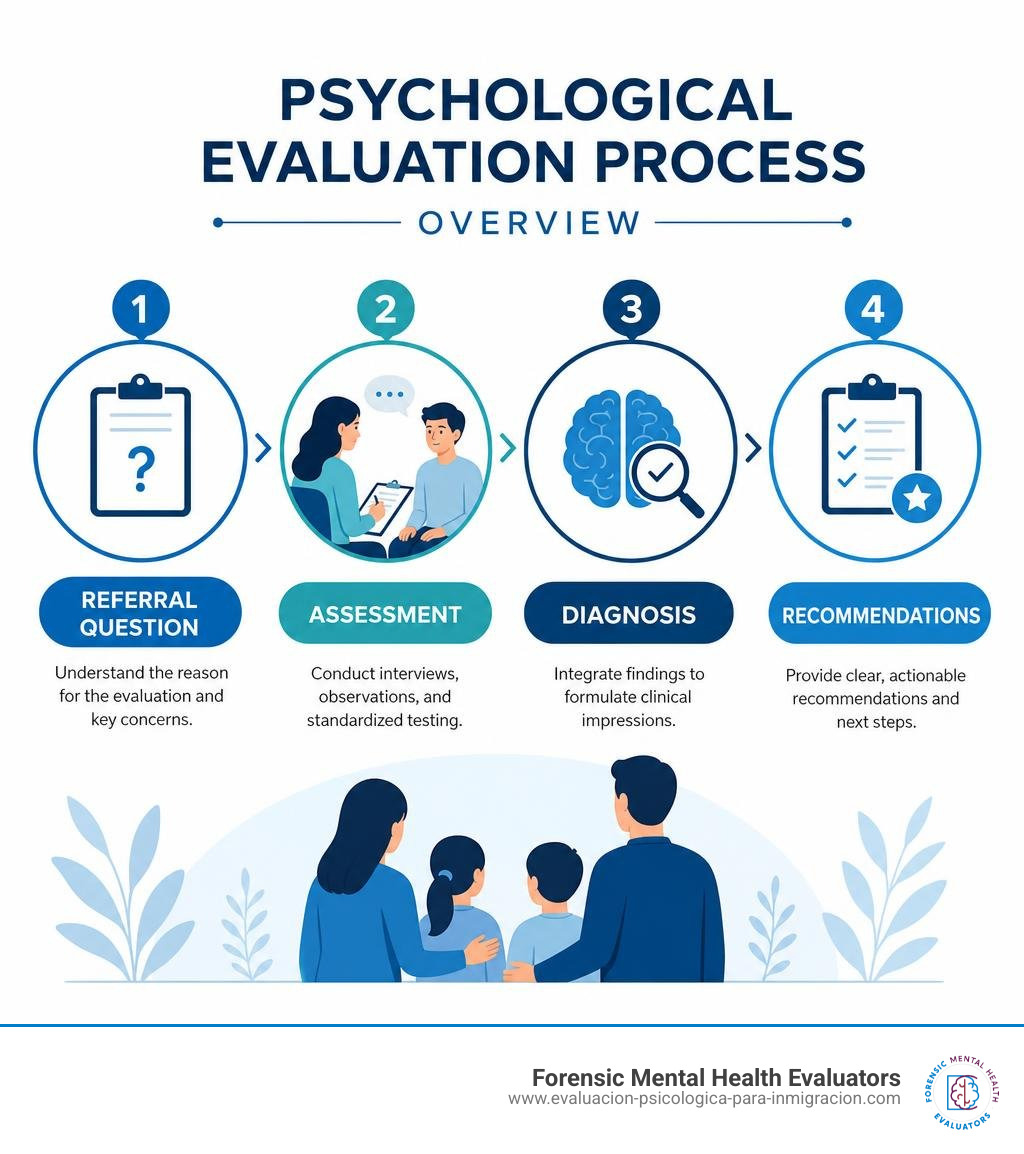
Here is what a psychological report typically includes:
- Referral question — the reason the evaluation was requested
- Background history — personal, medical, and family context
- Behavioral observations — how the person presented during the evaluation
- Assessment results — scores and findings from standardized tests
- Diagnostic impressions — clinical diagnoses based on the evidence
- Recommendations — specific, actionable next steps for treatment or legal purposes
For families facing deportation, this document is not just paperwork. It is often the most powerful piece of evidence an immigration attorney can submit to show the emotional and psychological harm that family separation would cause.
Courts, schools, employers, and immigration agencies all rely on psychological reports to make high-stakes decisions. As one clinical guideline puts it, these reports "shape diagnoses, inform treatment plans, influence school placements, and guide court decisions." That weight makes getting it right essential.
I'm Francisco Ortiz, Lead Forensic Mental Health Evaluator at District Counseling PLLC and a Certified Forensic Mental Health Evaluator (CFMHE), with specialized training in writing psychological reports for hardship waivers, asylum cases, and U-Visa and T-Visa applications. In this guide, I will walk you through everything you need to know — from structure and testing to ethics and legal use.
What is a Psychological Report and Why is it Crucial?
At its core, a psychological report is a highly structured, professional document that translates complex human behavior, cognitive processes, and emotional states into a clear, written narrative. Rather than relying on gut feelings or brief conversations, we build these reports on a foundation of evidence-based assessment methods. In fact, professional consensus dictates that all psychological report writing must derive its conclusions from empirically supported procedures rather than clinical intuition alone.
The primary purpose of a report is to provide diagnostic clarity, offer an objective look at an individual’s mental health, and map out a pathway for treatment planning. Whether a person is struggling with academic failure, coping with severe trauma, or navigating a complex legal proceeding, the report acts as official clinical documentation that details exactly what is happening and what should be done about it.
Furthermore, patients who feel that clinicians trust them are likely to reveal more details about themselves. These details are incredibly useful in the treatment process and should be documented as part of the report. A thorough report does not just list symptoms; it captures the whole person, providing a reliable baseline that other professionals can trust.
The Referral Question as the Compass of a Psychological Report
Every evaluation begins with a reason for testing, known as the referral question. This question acts as the compass for the entire report. It dictates which assessment tools we select, how we organize the findings, and where we focus our clinical analysis.
Referral questions can be explicit, such as: "Does this student meet the criteria for a specific learning disability?" or "Does this individual suffer from PTSD related to past trauma?" However, we must also tune in to the implicit needs of the client. For instance, a client referred for an Immigration Mental Health Evaluation may explicitly need a diagnosis, but implicitly requires a detailed explanation of how deporting a spouse would trigger severe, debilitating depressive episodes.
By keeping the referral question front and center, we ensure the evaluation scope remains relevant, avoiding unnecessary testing while thoroughly exploring the domains of functioning that matter most.
Determining the Length and Detail of the Document
How long should a psychological report be? The answer depends entirely on the context and complexity of the case.
- Standard Clinical Reports: For most routine clinical, educational, or ADHD screenings, reports are typically 5 to 7 pages long. This length is usually sufficient to present background history, test results, and clear recommendations.
- Complex or Forensic Evaluations: When we conduct comprehensive neuropsychological evaluations or forensic evaluations—such as those used in immigration court—the document can easily extend to 10 pages or more.
Report length should serve the content, not the other way around. Every paragraph must add value, eliminating redundant descriptions while providing enough detail to support our clinical conclusions.
Essential Structure and Common Assessments

A professional report must follow a logical, standardized framework to ensure that readers—whether they are doctors, school administrators, or immigration judges—can easily locate critical information.
Core Sections of a Comprehensive Psychological Report
To maintain rigorous clinical documentation standards, we structure our comprehensive reports into distinct, organized sections:
- Identifying Information: The basics, including the client's name, date of birth, dates of evaluation, and the evaluator's credentials.
- Referral Reason: A clear statement of who requested the evaluation and why.
- Relevant Background History: A bio-psychosocial overview, covering medical, educational, psychological, and family history.
- Behavioral Observations: Notes on the client's appearance, speech, affect, cooperation, and effort during testing.
- Assessment Procedures & Tests Administered: A complete list of all standardized instruments utilized.
- Results & Clinical Interpretation: The core analysis of cognitive, academic, and socioemotional findings.
- Diagnostic Impressions: Formal diagnoses aligned with the DSM-5-TR.
- Summary & Recommendations: A cohesive synthesis of the findings paired with actionable next steps.
For a real-world look at how these sections come together, you can explore a Bio-Psychosocial Assessment Report Sample.
Standardized Tests and Clinical Assessments
To gather objective, empirical data, we utilize a variety of standardized assessment tools depending on the referral question:
- Cognitive Testing (Intelligence): Tools like the Wechsler Adult Intelligence Scale (WAIS) or the Stanford-Binet help us map intellectual functioning. It is well-established that global IQ scores, such as the Full Scale IQ (FSIQ), are the most effective predictors of long-term educational attainment, school-based achievement, and vocational advancement.
- Academic Achievement: Tests like the Woodcock-Johnson (WJ) assess reading, math, and writing skills, helping us identify learning disorders.
- Personality and Socioemotional Inventories: Measures such as the Minnesota Multiphasic Personality Inventory (MMPI) or the 16PF Karson Clinical Report Sample allow us to evaluate stable personality traits and emotional coping styles.
- Executive Functioning: Assessments that measure attention, working memory, and impulse control, which are vital for understanding conditions like ADHD.
If you are looking for local testing services in Texas, consulting with qualified regional providers can help you find licensed professionals who specialize in comprehensive evaluations.
Integrating Client Feedback and Self-Reported Experiences
While standardized test scores provide an objective baseline, a truly excellent report behaves like a portrait of an individual rather than a cold template filled with numbers. To achieve this, we must actively integrate the client’s own perspective and self-reported experiences.
We do this by establishing a strong therapeutic alliance during our clinical interviews. By writing down the client's history in their own words, we capture their subjective well-being, unique cultural context, and lived struggles. Combining objective test data with the client's self-reported narrative creates a balanced, highly persuasive document.
Best Practices for Writing and Interpreting Results
Historically, reports have often been criticized for being neither accessible nor well-integrated. Many files end up stuffed with heavy jargon that leaves readers confused. To fix this, modern standards place a significant emphasis on formatting choices and the use of the active voice to dramatically improve readability.

Audience-Driven Writing and Minimizing Clinical Jargon
A professional evaluator always writes with the final reader in mind. If the report is for an immigration judge or a school teacher, overloading it with clinical jargon will only obscure your findings. We must strive to use plain language without sacrificing clinical precision.
When you write a Psychological Evaluation, translating clinical concepts into everyday terms makes the document far more powerful. Consider the difference:
| Clinical Jargon | Plain Language Alternative |
|---|---|
| "The client exhibits marked executive dysfunction, specifically regarding cognitive flexibility." | "The client struggles to adapt when plans change unexpectedly, often becoming highly anxious." |
| "Somatic presentation of severe affective distress." | "The client experiences physical symptoms, such as severe tension headaches, when overwhelmed by anxiety." |
| "Full Scale IQ of 62, placing them in the Mildly Delayed range." | "The client's overall learning and reasoning abilities are significantly below those of their peers, requiring hands-on support." |
Interpreting Test Results with Clarity and Accuracy
When presenting test results, we avoid simply listing raw scores, which mean very little to non-clinicians. Instead, we interpret scores using normative samples, percentiles, and standard scores (such as T-scores).
For example, if we are evaluating cognitive strengths, we explain that a T-score of 50 represents the exact average for the general population. If an individual scores in the 95th percentile on visual-spatial processing, we explain that this is a relative strength that can be leveraged in their daily life or career. Grounding our interpretations in empirical data ensures the report remains objective and legally defensible.
Formulating Actionable Recommendations and Avoiding Pitfalls
The "Summary and Recommendations" section is often the most read part of the entire document. To make it truly useful, we must write recommendations that are specific, realistic, and directly tied to our findings.
For instance, rather than writing a vague recommendation like "Client would benefit from academic support," we write: "Provide the student with 30-minute daily reading fluency interventions and allow 1.5x extended time on all written examinations."
We must also avoid common pitfalls, such as diagnostic overgeneralization (assuming a single low test score means a profound brain deficit) and ignoring environmental constraints. If a client does not have the financial means or local access to a highly specialized therapy, we must recommend feasible, accessible alternatives.
For those preparing reports for legal pathways, studying an Immigration Psychological Evaluation Sample can provide excellent guidance on how to draft court-ready recommendations.
Ethical Standards, Confidentiality, and Legal Regulations

Because a psychological report contains highly sensitive, deeply personal information, writing and sharing these documents comes with immense ethical and legal responsibility. Evaluators must maintain clear professional boundaries, obtain detailed informed consent before testing begins, and adhere strictly to state-specific record retention guidelines.
Navigating Privacy Laws and Section 5328
Confidentiality is the cornerstone of psychological practice. In states like California, strict confidentiality regulations—such as those outlined in Section 5328 of the Welfare and Institutions Code—govern the disclosure of mental health records. Under these rules, information cannot be shared without explicit, written disclosure authorization from the client or their legal guardian, except under very narrow legal exceptions.
Furthermore, we must comply with federal HIPAA regulations to ensure secure distribution and digital storage of all clinical records. Whether you are dealing with the Florida Board of Psychology or licensing boards in Texas, California, or New York, safeguarding client privacy is always our top priority.
Frequently Asked Questions about Psychological Reports
What is the difference between a therapy summary and a psychological report?
This is one of the most common points of confusion for clients.
- Therapy Summary: This is typically a brief, one-page letter written by an ongoing therapist. It outlines how long you have been in treatment, what you are working on, and your general progress. It is meant to document ongoing care.
- Psychological Report: This is an in-depth, multi-page diagnostic document resulting from a formal, structured evaluation process. It uses standardized testing, clinical interviews, and objective data to answer a specific referral question. It is a comprehensive diagnostic tool, not a summary of weekly sessions.
How long does a typical psychological evaluation take to complete?
The entire assessment process is thorough and takes time. It generally includes:
- Initial Clinical Interview: 1 to 2 hours of face-to-face discussion.
- Standardized Testing: 2 to 4 hours (or more, depending on complexity).
- Report Writing & Interpretation: The evaluator spends several hours analyzing scores and drafting the document.
- Feedback Session: A 30-to-60-minute meeting to discuss the final report.
In total, the turnaround time from your first appointment to receiving the final report typically spans 2 to 4 weeks.
Can a psychological report be used in immigration court?
Yes, absolutely. In fact, a specialized forensic report is often crucial evidence in legal proceedings. Whether you are dealing with extreme hardship waivers, political asylum, or U-Visa and T-Visa cases, a clinical evaluation provides objective proof of extreme psychological distress.
To understand how these documents are structured for legal success, read through our Immigration Psychological Evaluations Guide 2026 and our Immigration Evaluation Complete Guide.
Conclusion
A well-crafted psychological report is much more than a collection of scores—it is a powerful tool that can open doors to academic accommodations, guide life-saving clinical treatment, or protect a family from separation in court.
At District Counseling, we specialize in providing culturally sensitive, highly professional psychological evaluations for immigration cases (including U-VISA, asylum, and cancellation of removal). We proudly serve clients across Texas—including Houston, Katy, Cypress, Sugar Land, Austin, Dallas, and San Antonio—as well as clients in Florida, California, New York, Utah, Virginia, Idaho, and beyond.
Why families choose District Counseling:
- Bilingual Services: We conduct evaluations in Spanish and provide certified translations to English.
- Client Comfort: We prioritize a warm, safe, and welcoming environment to reduce stress.
- Post-Report Support: To ensure your family is cared for long after the evaluation, we offer 6 free therapy sessions after delivering your report.
If you or a loved one needs a professional evaluation, we are here to walk you through every step of the process. Explore our Immigration Psychological Evaluation Services today to schedule your consultation.