
How a Psychological Assessment Can Support Your Asylum Case
Why an Asylum Psychological Assessment Can Change the Outcome of Your Case

An asylum psychological assessment is one of the most powerful tools available to support your asylum claim — and the evidence backs this up.
Quick answer: What is an asylum psychological assessment?
- A formal evaluation conducted by a licensed forensic psychologist
- Documents trauma, PTSD, depression, and anxiety resulting from persecution
- Produces a medicolegal report submitted to USCIS or immigration court
- Directly addresses legal criteria including well-founded fear and credibility
- Can double or triple your chances of being granted asylum
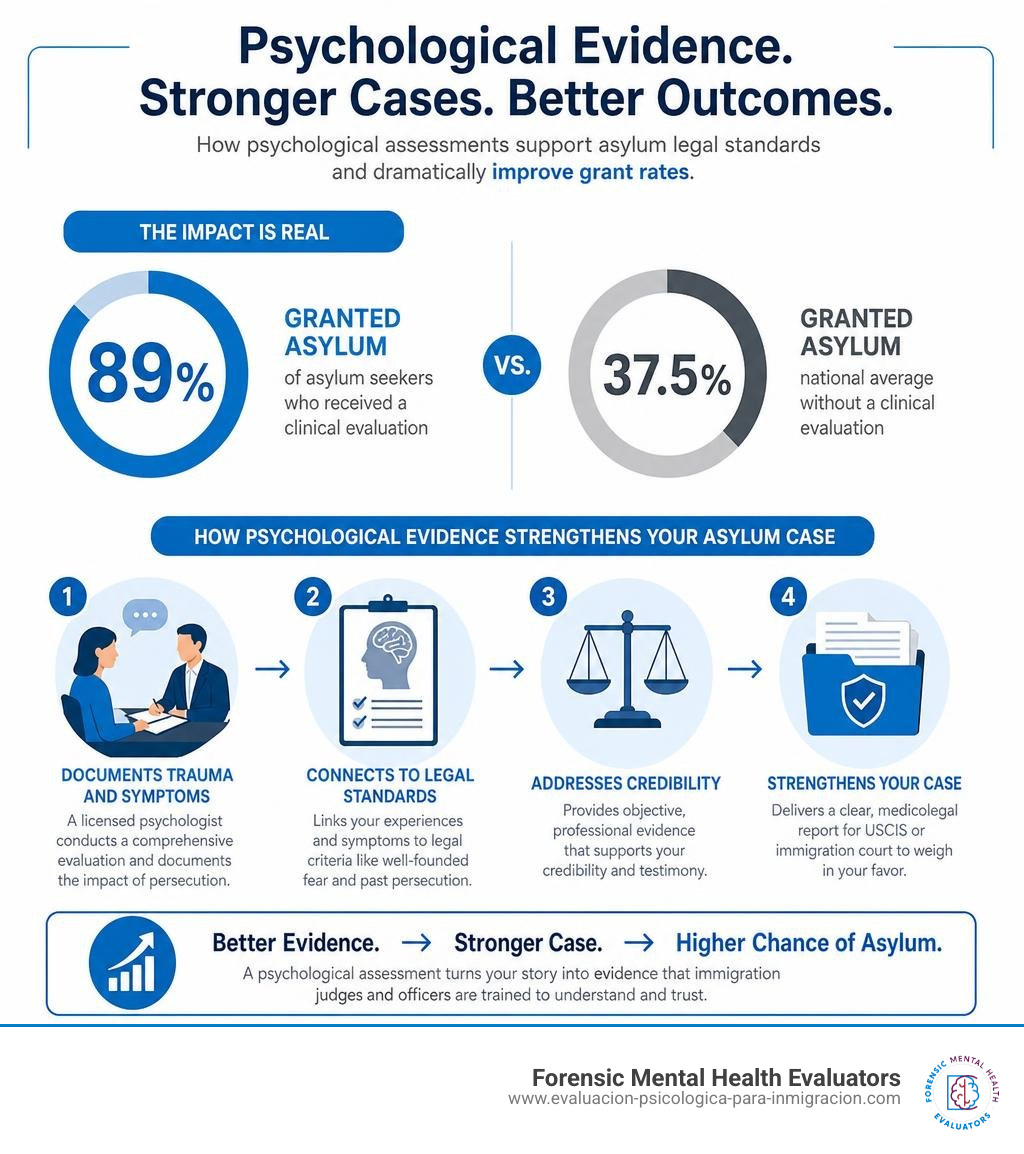
The numbers speak for themselves. Research shows that 89% of asylum seekers who received a clinical evaluation were granted asylum — compared to a national average of just 37.5%. That is not a small difference. That is a life-changing one.
Yet many applicants go through the asylum process without one.
The U.S. asylum system is under significant pressure right now. As of June 2026, USCIS has placed holds on affirmative asylum adjudications, expanded travel restrictions now affect 39 countries, and immigration courts face growing backlogs. In this environment, every piece of corroborating evidence matters more than ever.
A psychological evaluation does not just document your mental health. It tells your story in a language that immigration judges and USCIS officers are trained to weigh. It connects your trauma to the legal standards you must meet. And it addresses credibility questions that could otherwise work against you.
I'm Francisco Ortiz, Lead Forensic Mental Health Evaluator at Forensic Mental Health Evaluators, a Certified Forensic Mental Health Evaluator (CFMHE) with specialized training in asylum psychological assessment and extensive experience conducting high-stakes immigration evaluations across Texas, California, Florida, and beyond. In the sections below, I'll walk you through exactly how these evaluations work and what they can do for your case.
What is an Asylum Psychological Assessment?
An asylum psychological assessment is a highly specialized forensic evaluation designed specifically for immigration proceedings. It is not a standard therapy session, nor is it a casual conversation about your feelings. It is a structured, objective, medicolegal process that translates your lived experiences of trauma and fear into a formal document that meets the rigorous standards of U.S. immigration courts.
When we conduct a Texas Immigration Psych Evaluation, we align our methods with international human rights standards, specifically the Istanbul Protocol. This protocol provides the gold standard guidelines for documenting the physical and psychological consequences of torture and persecution. By utilizing these rigorous standards, we ensure that the resulting medicolegal report carries the maximum possible evidentiary weight before United States Citizenship and Immigration Services (USCIS) and Executive Office for Immigration Review (EOIR) judges.
The Scope of an Asylum Psychological Assessment
The primary scope of this evaluation is to establish a clear, documented link between the persecution you have suffered (or fear suffering) and your current psychological state. The evaluation looks closely at:
- Pre-migration trauma: The specific events, threats, or violence you experienced in your home country.
- The migration journey: The psychological impact of fleeing your homeland and traveling to the United States.
- Post-migration stressors: The ongoing anxiety, fear, and uncertainty of living in limbo while navigating the complex U.S. immigration system.
- Diagnostic impressions: Identifying and documenting specific conditions such as Post-Traumatic Stress Disorder (PTSD), Major Depressive Disorder (MDD), and generalized anxiety.
As highlighted in research on The role of mental health professionals in political asylum processing, evaluators serve a critical consultative role. We help the court understand how cultural factors and trauma-related symptoms affect your behavior, memory, and ability to tell your story. For a detailed breakdown of how this applies to your specific case, you can read more about a specialized Evaluación Psicológica para Caso de Asilo.
Clinical vs. Forensic Asylum Psychological Assessment
It is vital to understand that a forensic psychological evaluation is fundamentally different from standard clinical therapy. While both are conducted by licensed mental health professionals, their purposes, methods, and ethical boundaries diverge significantly.
| Feature | Clinical Therapy | Forensic Asylum Assessment |
|---|---|---|
| Primary Goal | Treatment, healing, and symptom reduction over time. | Objective documentation of psychological symptoms for legal evidence. |
| Relationship | Collaborative, therapeutic alliance where the therapist acts as an advocate. | Objective, neutral, and forensic evaluator-client relationship. |
| Timeframe | Ongoing sessions weekly or bi-weekly over months or years. | Typically 1 to 2 intensive sessions lasting 2 to 4 hours total. |
| Evidentiary Focus | Subjective self-reports focused on personal growth. | Multi-source data, standardized testing, and diagnostic probability. |
| Dual Relationships | Strictly avoided; a treating therapist should rarely act as a forensic expert due to bias. | Evaluator remains independent to preserve credibility in court. |
In clinical therapy, the therapist's job is to support you unconditionally. In a forensic Immigration Mental Health Evaluation, our job is to remain objective. This objectivity is actually what makes the report so valuable to an immigration judge. If a report reads like a clinical therapist simply "taking your side," the judge may dismiss it as biased. When it is written by an objective forensic expert who has rigorously tested and evaluated your symptoms, it becomes a formidable piece of legal evidence.
Meeting Legal Standards for Asylum with Psychological Evidence
To win asylum in the United States, you must prove that you meet the strict legal definition of a refugee. This means showing that you have suffered past persecution, or have a "well-founded fear" of future persecution, based on one of five protected grounds. Furthermore, you must establish a "nexus" (connection) between the harm and the protected ground, and show that the harm was inflicted either by the government or by forces the government is unable or unwilling to control.
This is a high legal bar, and the stakes are incredibly steep. Interestingly, modern machine learning analyses of immigration data show that asylum case outcomes can be predicted with approximately 80% accuracy based purely on judge and nationality factors. This highlights the reality of "refugee roulette"—the fact that outcomes vary wildly depending on the region, the judge, and the applicant's origin.
Because of these systemic variations, having an objective, scientific report from a Texas Immigration Psychological Expert can help level the playing field, providing hard clinical evidence that goes beyond subjective impressions.
Proving Persecution and Well-Founded Fear
Persecution does not only mean physical violence. U.S. courts have repeatedly ruled that psychological harm, severe threats, and intense emotional trauma can meet the legal threshold for persecution.
Statistics indicate that approximately 44% of asylum seekers in the United States are survivors of torture. For many, the scars are entirely psychological. When physical evidence is absent, a forensic psychologist can document the profound cognitive and emotional impact of the abuse.
This objective documentation is also critical in related proceedings, such as an Asylum Cancellation Psych Evaluation, where proving extreme and exceptional hardship to family members is the central legal requirement.
Establishing the Nexus to Protected Grounds
The "nexus" requirement is often the most heavily litigated part of an asylum case. You must prove that you were targeted because of your:
- Race
- Religion
- Nationality
- Political opinion
- Membership in a "Particular Social Group" (PSG)
A forensic evaluation can help establish this connection by documenting the specific psychological triggers associated with your protected identity. For example, if you are fleeing persecution based on sexual orientation, an evaluator can document the severe psychological distress caused by hiding your identity in a hostile environment.
However, it is important to note that ethical and legal boundaries exist regarding how these traits are assessed. For instance, European legal standards established that An asylum seeker may not be subjected to a psychological test in order to determine his sexual orientation. In the U.S., we similarly focus on documenting the trauma and psychological impact of persecution, rather than attempting to "prove" an applicant's inherent identity through pseudoscientific testing.
How Forensic Evaluators Document Trauma and Address Credibility

One of the most common reasons asylum applications are denied is a finding of "lack of credibility" by the immigration judge. If an applicant remembers a date incorrectly, changes a minor detail of their story, or seems "flat" or unemotional while testifying, an untrained adjudicator might assume they are lying. This is where an expert forensic report becomes invaluable.
When preparing an Immigration Psychological Evaluation Sample report for court, we systematically address these behavioral nuances, explaining the scientific, neurobiological reasons behind how trauma survivors present themselves.
Standardized Assessment Tools for Trauma
To maintain objectivity and satisfy the court's standards, we do not rely solely on clinical interviews. We utilize validated, scientifically sound psychometric testing instruments. As reviewed in the comprehensive paper Clinical and screening tools for psychic illness in asylum seekers and refugees: a narrative review, utilizing standardized tools is crucial for identifying genuine trauma-related psychopathology across diverse populations.
Some of the primary tools we use include:
- The Harvard Trauma Questionnaire (HTQ): Specifically designed to measure trauma symptoms and torture events in refugee populations.
- The Hopkins Symptom Checklist-25 (HSCL-25): A widely respected tool for measuring symptoms of anxiety and depression.
- The Miller Forensic Assessment of Symptoms Test (M-FAST): A brief, structured interview that helps detect malingering (feigning or exaggerating symptoms).
Addressing the possibility of malingering is a vital step in any forensic evaluation. In forensic settings, research suggests that up to 30% of individuals may show signs of symptom exaggeration or malingering. By proactively administering validity scales like the M-FAST, we can confidently state in our reports that the applicant’s symptoms are genuine, neutralizing a common line of attack by government attorneys.
Resolving Credibility and Memory Inconsistencies
Severe trauma does physical, biological damage to the brain—specifically to the hippocampus and the amygdala, which control memory storage and emotional processing. This often results in:
- Memory fragmentation: Remembering the core of a traumatic event (like a weapon or a scream) but completely forgetting peripheral details (like the date, the weather, or what street they were on).
- Avoidance behavior: A subconscious survival mechanism where the brain blocks out traumatic memories to protect itself from overwhelming distress.
- Late disclosure: An applicant may fail to mention a severe trauma (such as sexual assault) during their initial border interview because of intense shame, fear, or dissociation.
As detailed in the Journal of the American Academy of Psychiatry and the Law, understanding these clinical and legal considerations is essential when optimizing trauma narratives. A forensic evaluator can explain to the judge that the applicant's memory gaps or delayed disclosures are not evidence of fabrication, but are actually classic, textbook symptoms of severe PTSD.
Cultural and Linguistic Competency in Evaluations
Trauma does not look the same in every culture. In some cultures, psychological distress is expressed through physical symptoms (somatization), such as chronic headaches, stomach pain, or chest tightness, rather than verbal expressions of sadness.
Furthermore, shame-motivated avoidance is a powerful force. An applicant may find it culturally taboo to speak openly about physical abuse, domestic violence, or sexual trauma.
When we provide Texas Asylum Psychological Services, we prioritize cultural competency. We utilize professional, trained medical interpreters who understand the specific dialects and cultural nuances of the applicant's home country. This ensures that the applicant feels safe, understood, and respected, allowing them to share their experiences without fear of judgment or cultural misunderstanding.
The Practical Process: Timelines, Costs, and Telehealth
Embarking on an asylum psychological assessment can feel overwhelming, but understanding the step-by-step process can help ease your anxiety. If you are preparing for this step, our Immigration Evaluation Complete Guide offers a deep dive into what to expect from start to finish.
Telehealth vs. In-Person Evaluations
In recent years, telehealth has revolutionized the field of forensic psychology. Thanks to interstate compacts like PSYPACT, licensed psychologists can conduct highly secure, HIPAA-compliant telehealth evaluations across more than 40 states.
While remote assessments are highly convenient and widely accepted by immigration courts, they do have certain limitations. For example, as explored in UK-based research on Psychiatric evidence in UK immigration and asylum cases, evaluators conducting remote assessments must pay careful attention to verbal cues, speech patterns, and micro-expressions, since they cannot rely on the full range of physical, nonverbal behaviors visible during an in-person meeting.
At our practice, we are highly trained in both modalities, ensuring that whether your evaluation is conducted in-person at one of our Texas offices or via secure video, the evidentiary value of your report remains top-tier.
What to Expect: Timeline, Costs, and Documentation
To help you and your legal team prepare, here is a typical breakdown of the asylum evaluation timeline, average costs, and required preparation:
- What to Bring: You should prepare to share your Form I-589 (asylum application), your personal written declaration, any relevant medical records documenting physical injuries, and country condition reports.
- The Evaluation Session: The clinical interview typically takes between 2 to 4 hours. It can be broken up into multiple sessions if the emotional toll becomes too heavy.
- The Turnaround Time: A standard, comprehensive forensic report is typically drafted, reviewed, and delivered to your attorney within 14 to 21 days of the final interview.
- The Cost: Forensic evaluations generally range from $1,350 to $1,750, depending on case complexity. Expedited reports (delivered within 5 to 7 days) are often available for an additional fee to accommodate sudden court dates.
- Expert Testimony: If the immigration judge requires the psychologist to testify in court, this service is typically billed separately based on preparation and appearance time.
Frequently Asked Questions About Asylum Psychological Evaluations
How much does an asylum psychological evaluation cost?
On average, a comprehensive asylum psychological evaluation costs between $1,350 and $1,750. This fee covers the clinical interview, the administration and scoring of standardized psychological tests, and the preparation of a highly detailed, multi-page medicolegal report tailored for USCIS or immigration court. Expedited options are usually available for an additional fee if you have an imminent court deadline, and most forensic evaluators operate on a private-pay basis as health insurance rarely covers forensic legal services.
Can an asylum evaluation be conducted via telehealth?
Yes. Secure, HIPAA-compliant telehealth evaluations are highly effective, legally admissible, and widely accepted by immigration courts across the United States. Thanks to PSYPACT, our licensed doctoral-level evaluators can conduct video assessments for applicants residing in dozens of states. Telehealth is especially beneficial for applicants who face transportation barriers, live in remote areas, or feel more secure sharing their personal stories from the comfort of their own homes.
What qualifications should an asylum evaluator have?
An immigration psychological evaluator should be a licensed mental health professional—ideally a doctoral-level licensed psychologist or psychiatrist—with specific training in forensic assessment and the Istanbul Protocol. It is highly recommended to work with clinicians who have experience in trauma-informed care and a deep understanding of U.S. asylum law. Choosing an evaluator with these specialized credentials ensures your report is written to withstand intense cross-examination by government attorneys.
Conclusion
Navigating the U.S. asylum system can be an incredibly stressful, exhausting journey. The legal requirements are rigid, and the emotional weight of reliving your deepest traumas is a heavy burden to carry.
At District Counseling and Forensic Mental Health Evaluators, we are here to support you every step of the way. We specialize in providing culturally sensitive, highly professional psychological evaluations for immigration cases—including asylum, U-VISA, and cancellation of removal applications—across major Texas hubs like Houston, Austin, Dallas, and San Antonio, as well as our locations in Katy, Cypress, and Sugar Land.
To ensure you feel safe and supported, we offer:
- Fully bilingual evaluations in Spanish and English (with all reports translated and finalized in professional English for the court).
- An atmosphere focused entirely on your psychological comfort and emotional safety.
- Six free therapy sessions post-report to help you process your trauma and begin your journey toward healing after your legal evaluation is complete.
Your story deserves to be told with dignity, scientific accuracy, and deep compassion. If you are ready to strengthen your asylum case with a professional psychological evaluation, we invite you to take the first step today.