
The Mind Matters: Why You Need a Mental Health Assessment for Your U Visa
When Your Story Isn't Enough: The Case for a Mental Health Assessment for Your U Visa

A mental health assessment for a U visa is a formal clinical evaluation conducted by a licensed professional that documents the psychological harm you suffered as a result of a qualifying crime — and it may be the most important document in your entire immigration case.
Here is what you need to know right away:
- The U visa requires proof of "substantial physical or mental abuse" — your personal statement alone rarely meets this burden
- A forensic mental health assessment translates your trauma into objective, clinical language that USCIS adjudicators can evaluate
- The evaluation typically includes a 2-hour clinical interview, standardized psychological tests, and a 10–20 page written report
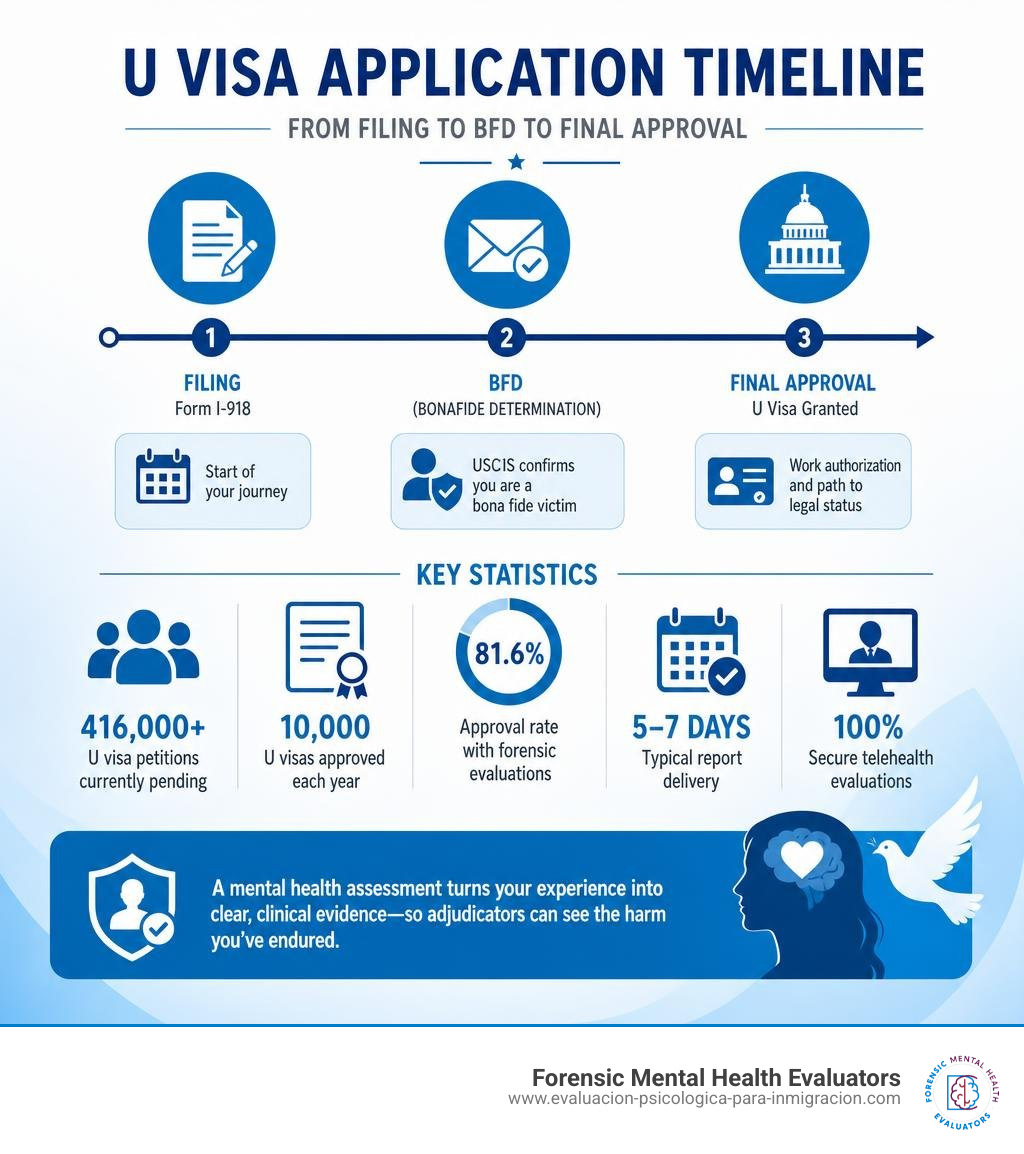
- Cases supported by forensic evaluations are approved at 81.6% — nearly double the rate of cases without one
- The report must establish a clear link between the qualifying crime and your diagnosed psychological harm
- Evaluations can be completed via secure telehealth, with reports delivered in as few as 5–7 days
The U visa was created by Congress in 2000 under the Victims of Trafficking and Violence Protection Act. It offers a path to legal status for victims of serious crimes — but only if you can prove the harm was real and severe. With more than 416,000 petitions currently pending and only 10,000 visas approved each year, weak evidence is not an option.
As one immigration professional put it simply: survivors often arrive carrying wounds that are not visible — and a forensic evaluation is how those invisible wounds become legally undeniable.
I'm Francisco Ortiz, Lead Forensic Mental Health Evaluator at District Counseling PLLC and a Certified Forensic Mental Health Evaluator (CFMHE) licensed in Texas, California, Florida, Virginia, Utah, and Idaho — and I have dedicated my practice to conducting the exact type of mental health assessment for U visa cases that gives survivors the clinical evidence they need. In this guide, I'll walk you through every step of the process so you know exactly what to expect.
Proving Substantial Harm: The Role of a Mental Health Assessment for Your U Visa
When you apply for a U visa, the burden of proof rests entirely on your shoulders. You must demonstrate to United States Citizenship and Immigration Services (USCIS) that you have suffered "substantial physical or mental abuse" as a direct result of being a victim of a qualifying crime.
While physical injuries are often documented by police reports, emergency room visits, or photographs, psychological wounds are invisible. This is where a clinical U Visa Psychological Assessment becomes indispensable.

A comprehensive clinical evaluation bridges the gap between your personal experience and the strict legal standards of immigration law. Without it, you are asking a USCIS adjudicator to simply take your word for the depth of your suffering.
While your personal statement is highly valuable, it lacks the scientific objectivity and diagnostic authority of a forensic psychological report. By translating your symptoms into recognized clinical diagnoses, we provide the objective proof needed to build an unassailable case.
Understanding the Five Regulatory Factors of Substantial Abuse
USCIS adjudicators do not simply guess whether your suffering was "substantial." Instead, they use a strict five-factor test established by federal regulations to evaluate the abuse. A high-quality psychological evaluation is structured to address each of these five regulatory factors directly:
- Nature of the injury inflicted or suffered: We detail the exact psychological symptoms you are experiencing, such as panic attacks, severe depression, flashbacks, hypervigilance, and insomnia.
- Severity of the perpetrator's conduct: We document the clinical impact of the perpetrator's actions, contextualizing how their specific behavior (such as threats of deportation, physical violence, or psychological manipulation) targeted your unique vulnerabilities.
- Severity of the harm suffered: We measure how deeply your daily functioning has been impaired. This includes your ability to work, maintain relationships, care for your children, and perform basic daily tasks.
- Duration of the infliction of the harm: We establish how long you have been suffering. Often, trauma from a crime that occurred years ago continues to impact a victim's mental health today.
- Extent of permanent or serious harm: We provide a clinical prognosis, detailing the long-term or permanent psychological consequences of the trauma if you do not receive specialized treatment.
By mapping your clinical symptoms directly to these five legal pillars, the evaluation speaks the exact language that USCIS adjudicators use to make their decisions.
Establishing a Clinical Nexus Between the Crime and Trauma
One of the most critical elements of a successful U visa application is establishing a clear "nexus"—or causal link—between the qualifying criminal activity and your current psychological harm. USCIS needs to know that your Post-Traumatic Stress Disorder (PTSD), anxiety, or depression was actually caused or significantly worsened by the crime you survived.
It is common for applicants to have experienced previous trauma, such as childhood abuse in their home country or a difficult migration journey. Some attorneys worry that pre-existing trauma will weaken a U visa claim. However, the opposite is true.
Immigration regulations explicitly account for the "aggravation of pre-existing conditions." A skilled evaluator will conduct an aggravation analysis, showing how the qualifying crime acted as a compounding trauma, shattering your fragile coping mechanisms and worsening your mental state. We explicitly document this clinical nexus to ensure the adjudicator understands the true weight of your psychological injuries.
Forensic Rigor: Standardized Testing and the Evaluation Process
A forensic Immigration Mental Health Evaluation is vastly different from a standard counseling intake session. It requires clinical objectivity, standardized psychometric tools, and specialized legal-psychological training to withstand the intense scrutiny of immigration officials.

Objective Psychometric Testing in a Mental Health Assessment for Your U Visa
According to a national study of over 200 immigration attorneys conducted by Fordham University, only 44% of immigration evaluation providers use validated testing instruments. The other 56% rely solely on subjective clinical interviews. This is a massive mistake.
To provide the highest level of objective clinical data, our mental health assessment for a U visa utilizes a robust battery of scientifically validated testing instruments, which may include:
- PCL-5 (PTSD Checklist for DSM-5): To measure the presence and severity of post-traumatic stress symptoms.
- PHQ-9 (Patient Health Questionnaire-9): To objectively assess the depth of clinical depression.
- GAD-7 (Generalized Anxiety Disorder-7): To quantify severity levels of generalized anxiety.
- BDI-II (Beck Depression Inventory-II): To provide a highly trusted, standardized measure of depressive symptoms.
- TSI-2 (Trauma Symptom Inventory-2): A comprehensive test that evaluates complex post-traumatic states and includes built-in validity scales.
These instruments do more than just document your pain; they provide numerical, standardized scores that compare your symptoms against clinical norms. Furthermore, using tests with built-in validity scales helps us rule out symptom exaggeration or malingering. This clinical rigor makes it incredibly difficult for USCIS to dismiss your diagnosed trauma, protecting your credibility as an applicant.
Why a Forensic Evaluation Outweighs a Standard Therapist Letter
Many applicants ask, "Can't I just get a letter from my regular counselor?" While a letter from your treating therapist is helpful, it carries significantly less weight with USCIS than an independent forensic evaluation.
The American Psychological Association (APA) warns against "dual relationships" because a treating therapist's primary ethical duty is to support and advocate for their patient's healing. Because of this therapeutic alliance, their reports are viewed by courts as naturally biased.
A forensic evaluator, however, acts as an independent expert witness. Our role is to provide a strictly objective, third-party assessment of your mental health. This independence is precisely what gives the report its legal authority. We do not write "cookie-cutter" templates; we craft highly individualized, legally defensible, 10-to-20-page forensic reports designed to meet the highest evidentiary standards.
Step-by-Step: What to Expect During Your Clinical Assessment
We understand that undergoing a psychological evaluation can feel intimidating, especially when you are already dealing with trauma. That is why we have structured our process to be as transparent, predictable, and supportive as possible.
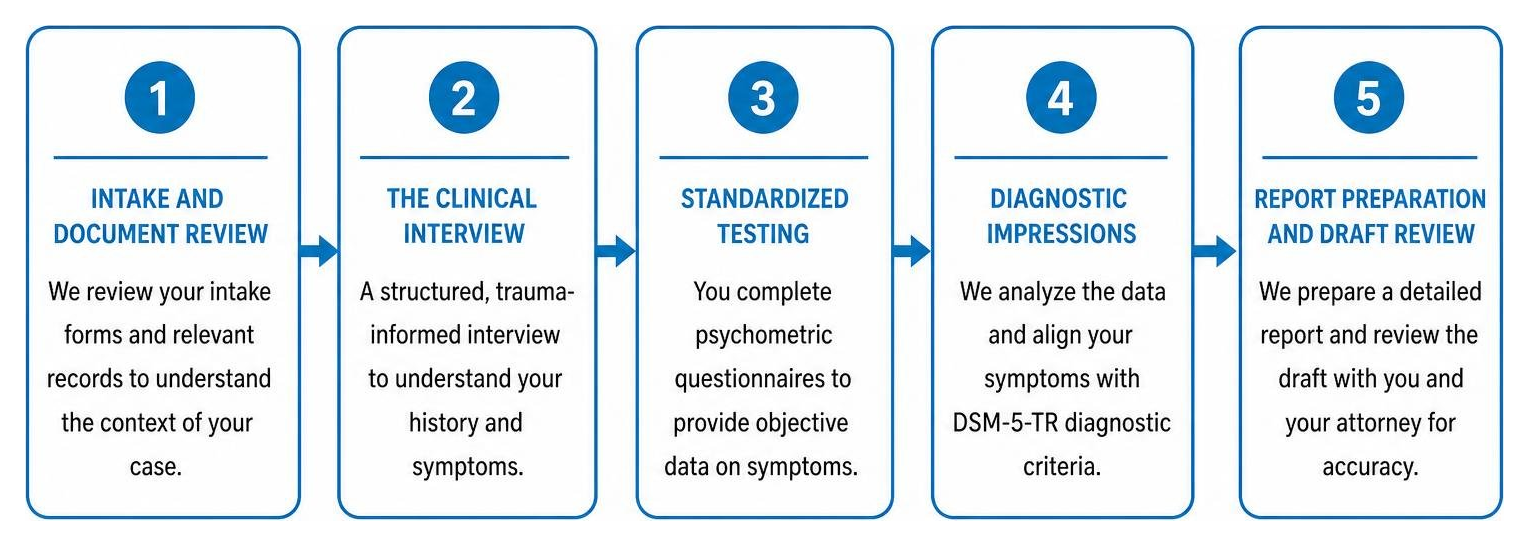
- Intake and Document Review: Before we meet, you will complete secure online intake forms. We will also carefully review your police reports, personal declarations, and any medical records to ensure we understand the legal context of your case.
- The Clinical Interview: We will meet for a structured clinical interview, which typically lasts about two hours. This session is conducted with deep cultural sensitivity and trauma-informed care. You do not have to retell every painful detail of the crime all at once; we pace the interview to ensure your comfort and safety.
- Standardized Testing: You will complete the relevant psychometric questionnaires to provide objective data regarding your symptoms.
- Diagnostic Impressions: We analyze the clinical data and align your symptoms with the strict diagnostic criteria of the DSM-5-TR (Diagnostic and Statistical Manual of Mental Disorders, Fifth Edition, Text Revision).
- Report Preparation and Draft Review: We write a comprehensive, detailed report. Before finalization, we review the draft with you and your attorney to ensure all factual details—such as names, dates, and spellings—are 100% accurate.
Navigating the USCIS Journey: Form I-918, Backlogs, and the BFD Process
Securing legal status through a U visa is a long-distance marathon. Understanding how your psychological report fits into the broader legal timeline can help you and your attorney make strategic decisions. For a comprehensive overview of this pathway, refer to our U Visa Complete Guide 2026.
For official eligibility information, USCIS provides guidance on its Victims of Criminal Activity: U Nonimmigrant Status page.
The Synergy Between Form I-918 Supplement B and Your Mental Health Assessment for Your U Visa
Your U visa journey cannot begin without the Law Enforcement Certification, also known as Form I-918, Supplement B. This form must be signed by an authorized certifying agency (such as a police department, prosecutor, or judge) confirming that you were a victim of a qualifying crime and have been, are being, or are likely to be helpful in the investigation or prosecution of the criminal activity.
It is crucial to remember that Form I-918, Supplement B is only valid for six months from the date it is signed. You must file your entire U visa petition with USCIS within this strict six-month window.
While the police certification proves your cooperation, your psychological evaluation proves your substantial harm. Together, these two documents form the twin pillars of a successful U visa application.
Accelerating the Bona Fide Determination (BFD) and Work Permit
In June 2021, USCIS implemented the Bona Fide Determination (BFD) process to address the massive backlog of cases. Under this policy, USCIS conducts an initial review of your application to determine if it is "bona fide" (made in good faith and complete). If approved for a BFD, you are granted deferred action and a temporary Employment Authorization Document (EAD)-commonly known as a work permit-while you wait for a visa to become available.
Front-loading your application by submitting your mental health assessment for a U visa at the very beginning of your filing is incredibly beneficial. It provides immediate, undeniable proof of substantial harm during the initial review, acting as a powerful positive discretionary factor. This proactive step can prevent costly Requests for Evidence (RFEs), helping you secure your work permit and deferred action status as quickly as possible.
Managing the 2026 USCIS Backlog and Processing Timelines
The U visa backlog is one of the most severe in the entire U.S. immigration system. Because Congress capped the number of principal U-1 visas at just 10,000 per year, applicants face extensive wait times.
- The Pending Backlog: As of early 2025, there were more than 416,000 pending U-visa petitions in the USCIS queue.
- Annual Demand: In FY2024 alone, USCIS received 41,556 principal U-visa petitions-more than four times the annual statutory limit.
- Wait Time to BFD: The average wait time from your initial filing to receiving a Bona Fide Determination (BFD) is currently 44.4 months.
- Wait Time from BFD to Visa: The average wait time from your BFD approval to final U-1 visa approval is 24.5 months.
- Total Estimated Wait: The entire journey from filing to final visa approval takes approximately 68.9 months (5.7 years).
Because of these extreme timelines, obtaining your psychological evaluation early is vital. It secures your place in the queue with a robust, complete application, ensuring that when your file is finally opened for review, there are zero delays.
Clinical Realities: Trauma, Memory, and Special Legal Pathways
Trauma does not just affect your emotions; it physically changes how your brain processes and stores memories. Understanding these clinical realities is essential for both your healing and the success of your legal case.
How Trauma Affects Memory Recall and Disclosure
When a person experiences a terrifying event, the brain's survival mechanisms take over, flooding the body with stress hormones. This response can impair the hippocampus—the part of the brain responsible for chronological memory. As a result, trauma survivors often experience:
- Fragmented Memories: Remembering intense sensory details (such as a smell, a sound, or a specific visual) while struggling to recall the exact chronological order of events.
- Delayed Disclosure: Being unable to speak about certain aspects of the abuse until months or years later, once a sense of physical and emotional safety has been established.
- Avoidance and Dissociation: Subconsciously blocking out memories or feeling completely detached from the event as a protective coping mechanism.
Unfortunately, untrained immigration adjudicators sometimes mistake these natural trauma responses for dishonesty or a lack of credibility, especially if there are minor inconsistencies between your initial police statement and your current affidavit.
In our evaluations, we provide a thorough clinical explanation of the neuroscience of trauma. By explaining why your memory may be fragmented or why you delayed disclosing certain details, we protect your credibility and resolve potential "A-File" inconsistencies before they can damage your case.
Comparing U Visa and VAWA Self-Petition Evaluations
Many survivors of domestic violence may qualify for both a U visa and a Violence Against Women Act (VAWA) self-petition. While both are humanitarian pathways, they have very different legal and clinical requirements:
| Feature / Requirement | U Visa (Form I-918) | VAWA Self-Petition (Form I-360) |
|---|---|---|
| Primary Legal Standard | Substantial physical or mental abuse | Extreme cruelty or battery |
| Perpetrator Requirement | Can be any individual (no legal status required) | Must be a U.S. Citizen or LPR spouse/parent |
| Law Enforcement Certification | Mandatory (Form I-918 Supplement B) | Not required |
| Hardship Standard | Not explicitly required for visa, but vital for waivers | Extreme hardship is a powerful discretionary factor |
| Inadmissibility Waiver | Highly broad waiver available under INA 212(d)(14) | Standard VAWA waivers apply |
If you qualify for both, your attorney may recommend a dual-filing strategy to maximize your chances of success. A comprehensive psychological evaluation can be tailored to support both petitions simultaneously, documenting the "substantial abuse" required for the U visa and the "extreme cruelty" required for VAWA.
Telehealth, Jurisdictional Rules, and Confidentiality Protections
Thanks to modern clinical standards and secure technology, we can conduct highly effective, trauma-informed evaluations remotely. Telehealth allows you to complete your assessment from the safety and comfort of your own home, eliminating the stress of travel and childcare.
We utilize fully HIPAA-compliant video platforms to guarantee absolute client confidentiality and privacy. Furthermore, because we participate in PSYPACT (the Interstate Medical Licensure Compact) and hold multi-state licensure, we are legally authorized to conduct telehealth evaluations for clients residing in Texas, California, Florida, Virginia, Utah, and Idaho. No matter where you are located in these states, you can access our specialized forensic services.
Frequently Asked Questions about U Visa Evaluations
What are the typical costs and turnaround times for a U visa evaluation?
Our evaluations are offered on a transparent, flat-fee basis, so you never have to worry about hidden hourly charges. The standard turnaround time to receive your finalized, court-ready report is 5 to 7 business days after your clinical interview is completed.
If you are facing a tight legal deadline or an impending RFE, we offer expedited 48-hour emergency turnaround options for an additional fee. Please note that because health insurance companies classify forensic immigration evaluations as "non-covered services," we operate on a private-pay basis to protect your clinical privacy.
What common mistakes weaken a psychological evaluation?
The most common mistake that weakens an evaluation is the use of "cookie-cutter" templates. If an adjudicator reads a three-page report that looks identical to five other reports from the same provider, they will give it very little weight.
Other critical mistakes include:
- Failing to use validated, standardized psychological testing instruments.
- Missing a clear, explicit clinical nexus linking the current symptoms to the specific qualifying crime.
- Failing to address the applicant's prior criminal history or survival-based arrests (which must be contextualized as reactive violence or trauma-coerced behavior).
At District Counseling, we avoid these pitfalls by conducting rigorous, highly individualized assessments that stand up to intense USCIS scrutiny.
What crimes qualify an applicant for a U visa?
There are over 28 statutory categories of qualifying criminal activities under U.S. immigration law. Some of the most common qualifying crimes include:
- Domestic violence and spousal abuse
- Sexual assault, rape, and abusive sexual contact
- Felonious assault and manslaughter
- Human trafficking (both labor and sex trafficking)
- Kidnapping, abduction, and false imprisonment
- Stalking, blackmail, and extortion
- Witness tampering and obstruction of justice
If you have survived any of these crimes and cooperated with law enforcement, you may be eligible for U nonimmigrant status.
Conclusion
Your mental health matters—not just for your physical and emotional recovery, but as the foundational evidence of your legal journey. A professional mental health assessment for a U visa is the key that unlocks the door to safety, stability, and healing.
At District Counseling, we serve clients across major Texas metropolitan areas—including Houston, Austin, Dallas, and San Antonio—as well as throughout Florida, California, New York, Utah, Virginia, and Idaho.
We are proud to offer a unique, client-centered experience built on comfort and professional excellence:
- Bilingual Capabilities: We conduct evaluations directly in Spanish, delivering certified English translations that preserve the authentic clinical depth of your story.
- Unmatched Post-Report Support: Because we believe your evaluation is just the first step on your path to healing, we provide 6 free therapy sessions to help you process your trauma and rebuild your life after your report is delivered.
If you are ready to take the next step toward safety and legal status, we invite you to explore our Evaluación Forense de Inmigración services. Contact us today to schedule your consultation and let us help you prove the strength of your survival.