
Understanding the Difference Between Suspension of Deportation and Cancellation of Removal
What Is the Difference Between Suspension of Deportation and Cancellation of Removal?
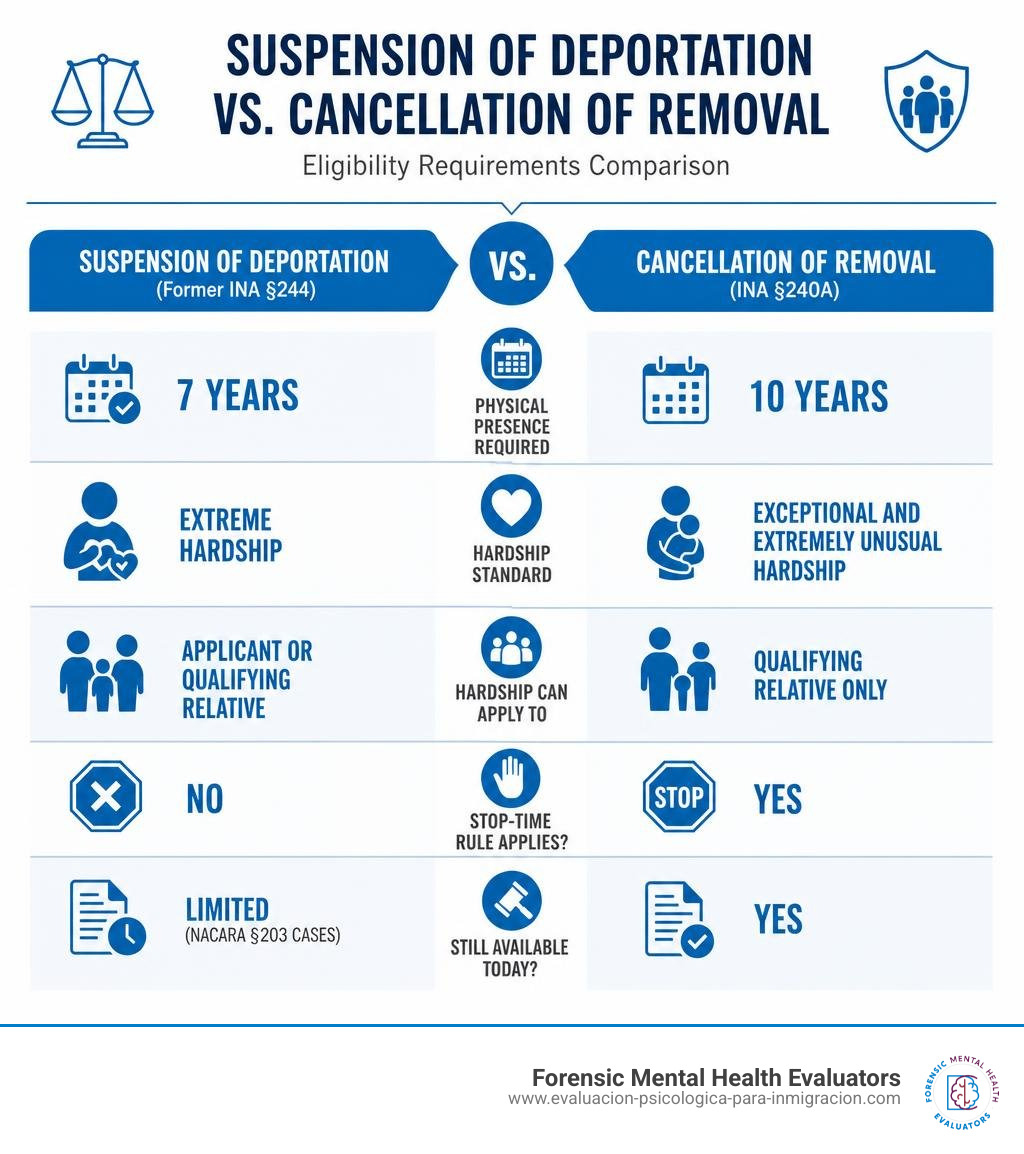
Suspension of deportation and cancellation of removal are two forms of legal relief that can stop a deportation and lead to a green card — but they have very different rules, standards, and histories.
Here is a quick comparison to answer the most common questions:
| Feature | Suspension of Deportation | Cancellation of Removal (Non-LPR) |
|---|---|---|
| Governing law | Former INA §244 (pre-1997) | INA §240A (post-1996) |
| Physical presence required | 7 years | 10 years |
| Hardship standard | Extreme hardship | Exceptional and extremely unusual hardship |
| Hardship can apply to | Applicant or qualifying relative | Qualifying relative only |
| Stop-time rule applies? | No (pre-IIRIRA cases) | Yes |
| Still available today? | Limited (NACARA §203 cases) | Yes |
The key difference is this: suspension of deportation was the older, more forgiving standard. Cancellation of removal replaced it in 1996 and made relief significantly harder to win.
If you are a non-permanent resident facing deportation today, you most likely need to pursue cancellation of removal — unless you qualify for special relief under NACARA §203, which still uses the older suspension of deportation rules for certain Salvadoran, Guatemalan, and Eastern European nationals.
Both forms of relief require proving extreme hardship to a qualifying family member, and that is where a professional psychological evaluation can make a critical difference in your case.
I'm Francisco Ortiz, Lead Forensic Mental Health Evaluator at District Counseling PLLC, and I specialize in providing evidence-based psychological evaluations for immigration proceedings including suspension of deportation and cancellation of removal cases across Texas, California, Florida, and beyond. In this guide, I'll walk you through exactly how these two forms of relief work, who qualifies, and what evidence you need to build the strongest possible case.
Historical Context: Suspension of Deportation and Cancellation of Removal
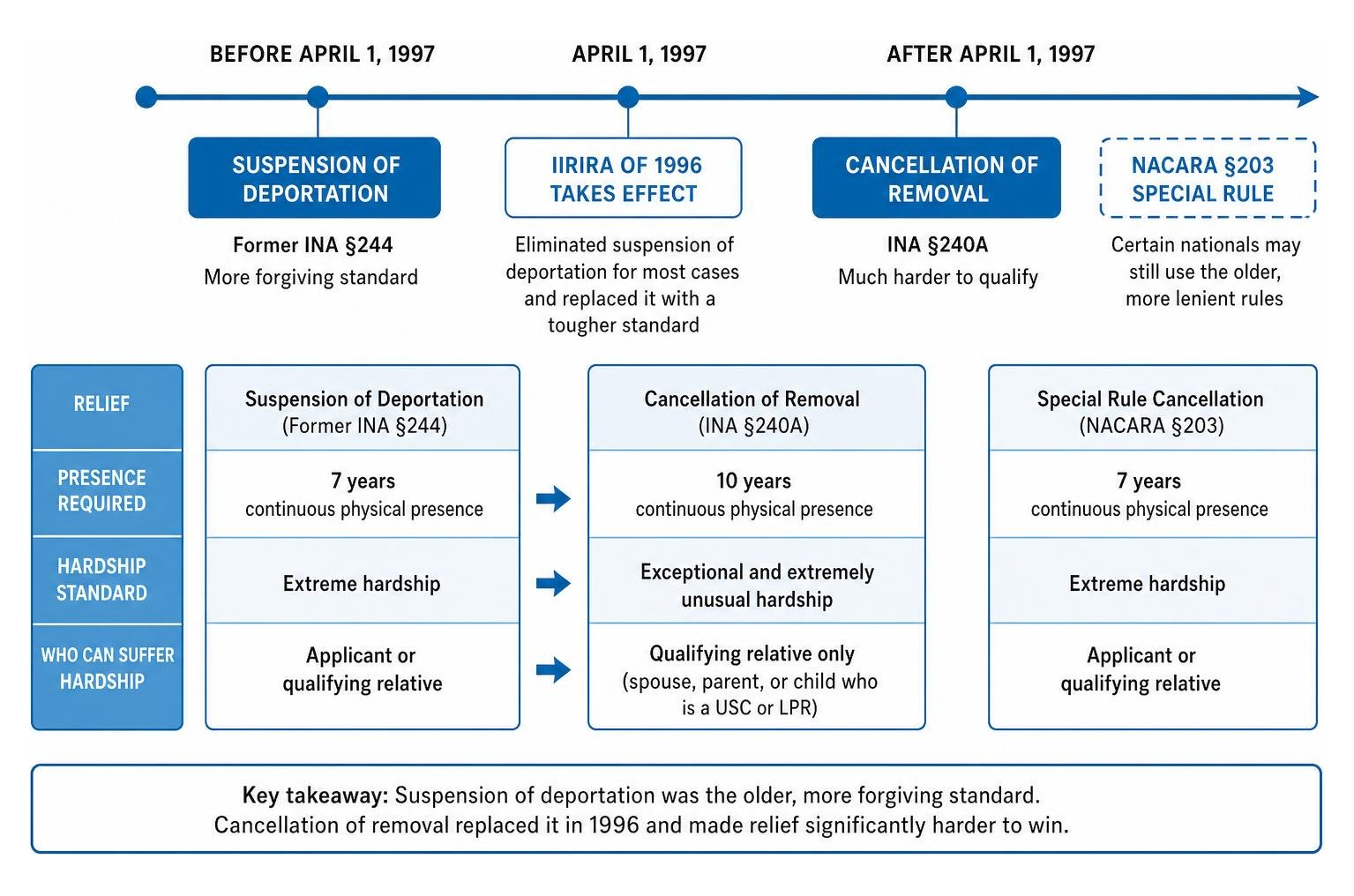
To understand where we are in July 2026, we have to look back at how the legal landscape shifted. Before April 1, 1997, individuals facing deportation could apply for a relief known as "Suspension of Deportation" under former Section 244 of the Immigration and Nationality Act (INA). It was a highly sought-after remedy because it only required seven years of continuous physical presence and a showing of "extreme hardship" to either the applicant themselves or their qualifying U.S. citizen (USC) or lawful permanent resident (LPR) relatives.
However, Congress fundamentally changed the rules when it passed the Illegal Immigration Reform and Immigrant Responsibility Act (IIRIRA) of 1996. This sweeping legislation eliminated suspension of deportation for almost all new cases and replaced it with a much tougher standard: Cancellation of Removal under INA Section 240A.
To learn more about the legislative history and the tightening of these laws, you can read the Congressional Research Service report: Suspension of Deportation: Tighter Standards for Canceling Removal .
Under the post-1996 rules, standard non-LPR applicants must show ten years of continuous physical presence, and the hardship standard was elevated to "exceptional and extremely unusual hardship." Crucially, the law also eliminated hardship to the alien applicant as a qualifying factor, meaning the hardship must be suffered solely by a qualifying USC or LPR spouse, parent, or child.
If you want to understand how these historical changes affect current deportation defense strategies, check out our guide on Cancellation of Deportation.
Special Rule Cancellation of Removal Under NACARA §203
While IIRIRA made things much harder for most people, Congress carved out an exception when it passed the Nicaraguan Adjustment and Central American Relief Act (NACARA) in 1997. Section 203 of NACARA allows certain individuals to apply for "Special Rule Cancellation of Removal" or suspension of deportation under the older, more lenient pre-IIRIRA standards.
This means that if you qualify under NACARA §203, you only need to show seven years of continuous physical presence and meet the lower extreme hardship standard (which can include hardship to yourself, not just your relatives).
To download the official application form for this relief, you can access the Application for Suspension of Deportation or Special Rule Cancellation of Removal .
Eligibility Criteria for Suspension of Deportation and Cancellation of Removal Under NACARA
To benefit from the relaxed rules of NACARA §203, you must belong to one of the specific classes of individuals designated by the law. The primary eligibility groups include:
- Guatemalan Nationals: Must have entered the United States on or before October 1, 1990, and registered for ABC benefits (under the American Baptist Churches v. Thornburgh settlement) on or before December 31, 1991, or filed an application for asylum on or before January 3, 1990.
- Salvadoran Nationals: Must have entered the United States on or before September 19, 1990, and registered for ABC benefits or Temporary Protected Status (TPS) on or before October 31, 1991, or filed an application for asylum on or before Lilian/February 16, 1996.
- Former Soviet Bloc Nationals: Individuals who entered the United States on or before December 31, 1990, and filed an application for asylum on or before December 31, 1991. This includes nationals of countries such as Poland, El Salvador, Guatemala, and various former Soviet republics.
- Qualified Derivatives: Spouses and unmarried children of a primary NACARA beneficiary can also apply, provided the relationship existed at the time the primary applicant's case was approved.
To dive deeper into the differences between these pathways, read our Cancellation of Removal Complete Guide.
The Presumption of Extreme Hardship for ABC Class Members
One of the greatest advantages of NACARA §203 for Salvadoran and Guatemalan ABC class members is the rebuttable presumption of extreme hardship.
Unlike standard applicants who carry the heavy burden of proving hardship, the law presumes that these specific Central American applicants will experience extreme hardship if deported. The burden of proof actually shifts to the Department of Homeland Security (DHS) to rebut this presumption. To do so, DHS must show that it is "more likely than not" that neither the applicant nor their qualifying relatives would suffer extreme hardship upon removal.
Even with this presumption, it is highly recommended to submit a comprehensive psychological evaluation. If the government attempts to rebut the presumption by pointing to improved conditions in your home country, having a professional clinical report that details your deep-seated trauma, anxiety, or family ties can completely shut down the government's rebuttal.
For a detailed breakdown of how hardship is analyzed clinically, see our resource on Extreme Hardship.
Standard 10-Year Cancellation of Removal for Non-Permanent Residents
For individuals who do not qualify under NACARA, the standard pathway to avoid deportation is the 10-Year Cancellation of Removal (often filed using Form EOIR-42B). This is a defensive application filed exclusively in Immigration Court.
To succeed in a standard 10-year cancellation case, you must meet four incredibly strict requirements:
- 10 Years of Continuous Physical Presence: You must have lived in the U.S. continuously for at least ten years prior to the service of a Notice to Appear (NTA).
- Good Moral Character: You must show you have been a person of good moral character during the entire ten-year period.
- No Disqualifying Criminal Convictions: Certain crimes, particularly aggravated felonies, will automatically bar you from relief.
- Exceptional and Extremely Unusual Hardship: You must prove that your deportation would cause "exceptional and extremely unusual hardship" to a qualifying relative who is a U.S. citizen or LPR spouse, parent, or child.
This hardship standard is exceptionally high. It is not enough to show that your family will miss you or that your children will have to adjust to a new school. You must show that the hardship is substantially beyond what would normally be expected from deportation—such as a relative with a severe, chronic medical condition or profound developmental delays who relies entirely on you.
To learn more about how to navigate this high bar, read the official guide: A Guide to 10-Year Cancellation of Removal .
You can also read our clinical perspective on what constitutes Extreme and Exceptionally Unusual Hardship.
The Stop-Time Rule in Suspension of Deportation and Cancellation of Removal
One of the trickiest legal concepts in deportation defense is the stop-time rule. Under standard 10-year cancellation of removal, the continuous physical presence clock stops ticking the moment the government serves you with a Notice to Appear (NTA) or when you commit certain criminal offenses. If you have been in the U.S. for nine years and nine months when you receive an NTA, you can never reach the ten-year mark required for relief.
However, the stop-time rule is applied differently to NACARA §203 applicants. For NACARA cases, the service of an NTA or an Order to Show Cause does not stop the continuous physical presence clock. This allows applicants to continue accruing their required seven years of physical presence even while their immigration court proceedings are actively pending.
For more information on the specific forms used in court, read about the EOIR 42B Form.
The Application Process: Form I-881 vs. Form EOIR-40
Depending on your legal status and how your case is initiated, you will use different forms and file with different agencies:
- Form I-881: This form is used specifically for suspension of deportation or special rule cancellation of removal under NACARA §203.
- Form EOIR-40: This is a legacy form used for standard suspension of deportation cases that were initiated before April 1, 1997.
Affirmative vs. Defensive Filing
If you are a NACARA-eligible individual and you do not currently face active deportation proceedings, you can file your Form I-881 affirmatively with U.S. Citizenship and Immigration Services (USCIS). This is a non-adversarial process where you are interviewed by an asylum officer in a relatively low-stress environment.
If you are already in deportation or removal proceedings, you must file your application defensively before an Immigration Judge in Immigration Court (EOIR).
For the legacy EOIR-40 form, you must file defensively in court and pay the required fees electronically. To understand the court fee structures, see our guide on EOIR Fees Immigration Court.
To review the official instructions for the legacy form, you can download the EOIR-40 - Application for Suspension of Deportation .
Frequently Asked Questions About Deportation Relief
What are the main bars to eligibility for cancellation of removal?
There are several strict bars that will immediately disqualify you from receiving cancellation of removal, regardless of how much hardship your family faces. These include:
- Aggravated Felonies: Conviction of any crime classified as an aggravated felony under immigration law is an absolute bar.
- Certain Criminal Grounds: Crimes involving moral turpitude, drug offenses, or domestic violence convictions often act as statutory bars.
- Security and Security-Related Grounds: Involvement in terrorist activities, persecution of others, or espionage.
- Previous Grants: If you have previously been granted suspension of deportation or cancellation of removal, you cannot receive it again.
To understand how a clinical evaluation can address past trauma and help present your character in court, read about a Cancellation of Removal Psych Eval.
How does domestic violence affect the physical presence requirement?
Under special provisions of the Violence Against Women Act (VAWA), the continuous physical presence requirement is reduced from ten years to three years for battered spouses or children of U.S. citizens or LPRs. Furthermore, the hardship standard is lowered back to "extreme hardship" (as opposed to exceptional and extremely unusual hardship), and the hardship can apply directly to the abused applicant themselves.
At District Counseling, we provide specialized, sensitive evaluations for domestic abuse survivors. Learn more about our Evaluación Psicológica para Caso de VAWA.
Can Deferred Enforced Departure (DED) lead to permanent residency?
No. Deferred Enforced Departure (DED) is a temporary administrative stay of removal authorized directly by the President of the United States under their constitutional foreign relations powers. While it provides temporary work authorization and protection from deportation, it does not grant formal immigration status or provide a direct pathway to a green card.
For the latest updates on DED guidelines and eligibility, visit Deferred Enforced Departure | USCIS .
You can also review the recent Policy Alert regarding USCIS prosecutorial discretion and deferred action policies.
Conclusion
Navigating the complexities of suspension of deportation and cancellation of removal can feel overwhelming, but you do not have to walk this path alone. Whether you are applying affirmatively under NACARA §203 or defending your life in Immigration Court, proving extreme or exceptional hardship is the single most important element of your case.
At District Counseling, we provide expert, culturally sensitive psychological evaluations designed to clearly document the emotional, psychological, and mental health impacts of deportation on you and your loved ones. We serve clients across Texas (including Houston, Katy, Cypress, Sugar Land, Austin, Dallas, and San Antonio), as well as Florida, California, Utah, Idaho, and Virginia.
Our unique services include:
- Bilingual, Spanish-language clinical evaluations.
- Certified English translations included with every report.
- A warm, welcoming, and non-judgmental environment.
- 6 free therapy sessions post-report to help support your mental health journey during this stressful time.
Let us help you build the strongest possible case. Contact us today to schedule your Evaluación Psicológica para Caso de una Cancelación de Deportación.