
How to Apply for a U Visa Fast
What Is a U Visa and How Can It Help You?

The U visa is a form of temporary immigration relief for non-citizens who have been victims of certain serious crimes in the United States — and who have helped, or are willing to help, law enforcement investigate or prosecute that crime.
If you are searching for a quick answer, here is what you need to know:
| Question | Quick Answer |
|---|---|
| Who qualifies? | Victims of qualifying crimes who suffered abuse and cooperated with law enforcement |
| What does it give you? | 4 years of legal status, work authorization, protection from deportation |
| Is there a cap? | Yes — 10,000 per year for principal applicants |
| Can family members be included? | Yes — spouse, children, parents, and siblings (depending on your age) |
| Can it lead to a green card? | Yes — after 3 years of continuous presence in the U.S. |
| How long does it take? | Work authorization in 3–7 months via Bona Fide Determination; full approval can take years |
This visa was created in 2000 through the Victims of Trafficking and Violence Protection Act. Congress recognized that immigrant victims — especially those without legal status — are often afraid to report crimes. The U visa was designed to change that by offering real protection in exchange for cooperation with law enforcement.
The process is not simple. The annual cap is quickly reached every year, the waiting list currently holds hundreds of thousands of petitions, and gathering the right evidence takes time and strategy. But there are ways to move faster and protect yourself while you wait.
I'm Francisco Ortiz, Lead Forensic Mental Health Evaluator at District Counseling PLLC, and I have conducted hundreds of psychological evaluations specifically for U visa cases, helping crime victims document the mental and emotional impact of their trauma as part of their immigration petition. In this guide, I'll walk you through exactly how to apply — and what you can do to strengthen your case from day one.
Understanding the U Visa and Eligibility Requirements
To qualify for a U visa, you must meet several strict legal criteria. USCIS does not hand these out easily, which is why understanding the foundational rules is so important.
According to the official guidelines on Victims of Criminal Activity: U Nonimmigrant Status | USCIS, there are four primary requirements you must fulfill:
- You must be the victim of a qualifying criminal activity that occurred in the United States or violated U.S. laws.
- You must have suffered substantial physical or mental abuse as a result of this crime.
- You must possess credible, reliable information about the details of the crime.
- You must be helpful, have been helpful, or be likely to be helpful to law enforcement, prosecutors, judges, or other government authorities investigating or prosecuting the criminal activity.
Additionally, you must be admissible to the United States. If you entered without inspection, have certain immigration violations, or have a criminal history, you are considered "inadmissible." However, do not lose hope! You can file a Form I-192 waiver to ask USCIS to forgive these issues, which is very common in immigration U visa cases.
As of our current year, June 2026, USCIS continues to process massive backlogs. This makes submitting a legally airtight, thoroughly documented application absolutely vital. Any mistake or missing piece of evidence can delay your case by years.
Qualifying Criminal Activities for a U Visa
Not every crime qualifies you for a U visa. The law specifies a list of over 28 qualifying criminal activities. Many of these involve violence, coercion, or severe exploitation.
The most common qualifying crimes include:
- Domestic violence and stalking
- Sexual assault, rape, and abusive sexual contact
- Human trafficking and involuntary servitude
- Felonious assault (assault with a deadly weapon or assault resulting in severe injury)
- Kidnapping, abduction, and unlawful criminal restraint
- Blackmail and extortion
- Manslaughter and murder
- Obstruction of justice and witness tampering
It is also important to know that "similar activity" can qualify if the elements of the crime are substantially similar to those listed above. Furthermore, attempt, conspiracy, or solicitation to commit any of these crimes also qualifies.
The Role of Law Enforcement and Form I-918 Supplement B
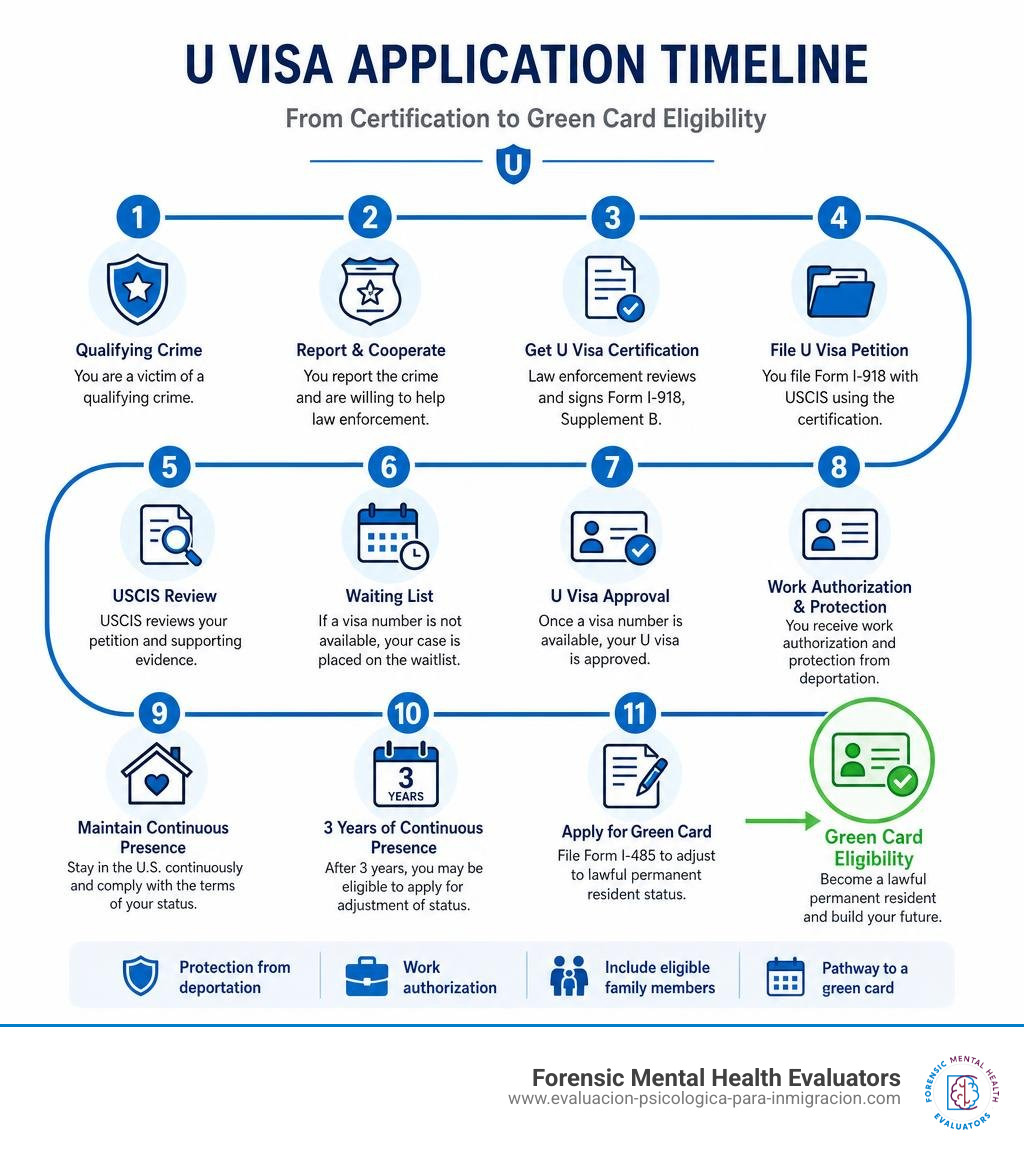
You cannot simply self-certify that you were helpful to the police. You must prove it using a specific government document: Form I-918 Supplement B (U Nonimmigrant Status Certification).
This form must be signed by an authorized official from a certifying agency. This includes:
- Federal, state, and local law enforcement agencies (like local police departments or sheriff offices)
- Prosecutors and district attorneys
- Federal and state judges
- Child Protective Services (CPS)
- Government agencies like the Equal Employment Opportunity Commission (EEOC) or the Department of Labor (DOL)
The certifying official must state that you were a victim of a qualifying crime and that you have been, are currently, or are likely to be helpful in the detection, investigation, or prosecution of that crime.
Signing this form is entirely at the discretion of the agency. There is no law that forces a police department or a judge to sign it. However, without a signed Supplement B, USCIS will automatically deny your U visa petition. The certification can be signed at any stage of the case—even after the investigation is closed or the case has ended.
Step-by-Step Guide to Applying Fast
Applying for a U visa is a multi-step journey that requires patience, organization, and a mountain of paperwork. To give your petition the best chance of a swift review, you must follow the correct filing order.

- Step 1: Obtain the signed Form I-918 Supplement B. Reach out to the law enforcement agency that handled your case. This is often the hardest step, so working with an immigration attorney is highly recommended.
- Step 2: Draft your personal statement. This is a written declaration in your own words describing the details of the crime, the help you provided to the police, and the physical or emotional trauma you suffered.
- Step 3: Gather supporting evidence. This includes police reports, court records, medical files, witness statements, and psychological evaluations.
- Step 4: Complete Form I-918 (the main petition). Make sure every question is answered completely.
- Step 5: File Form I-192 (if needed). If you have any inadmissibility issues (such as entering the country illegally), you must submit this waiver request.
- Step 6: Mail the package to the USCIS Vermont Service Center. All U visa petitions are centralized there for specialized review.
Fortunately, there are fee exemptions built into the process. There is no filing fee for Form I-918 itself, and you can request a fee waiver (Form I-912) for associated forms like the Form I-192 waiver. Once USCIS receives your application, they will schedule a biometrics appointment for background and security checks.
Accelerating Your Case with a U Visa Psychological Assessment
One of the most critical requirements of the U visa is proving you suffered "substantial physical or mental abuse." While physical scars eventually heal, the mental scars of trauma often linger for years.
This is where a U visa psychological assessment becomes a game-changer.
A professional clinical evaluation provides objective, scientific evidence of your mental trauma. During an evaluation, a licensed mental health professional will assess you for conditions like:
- Post-Traumatic Stress Disorder (PTSD)
- Severe anxiety and panic attacks
- Major depressive disorders
- Chronic fear, insomnia, and hypervigilance
By documenting these symptoms in a detailed, forensic psychological report, you present USCIS with clear, professional evidence of the "substantial abuse" required by law. This takes the guesswork out of your application and can prevent USCIS from sending a dreaded Request for Evidence (RFE), which can delay your case by many months.
Filing for Derivative Family Members
The U visa is not just a lifeline for you; it can also protect your loved ones. You can petition for qualifying family members using Form I-918 Supplement A.
The family members you can include depend on your age:
- If you are under 21 years old: You can petition for your spouse, children (unmarried and under 21), parents, and unmarried siblings under the age of 18.
- If you are 21 years of age or older: You can petition for your spouse and your unmarried children under 21.
Filing for your family members at the same time as your main petition ensures that they are processed together, keeping your family safe from separation.
Benefits and Limitations of U Nonimmigrant Status
While the U visa is an incredibly powerful tool for immigration relief, it has distinct boundaries. It is important to weigh both sides of the coin.
| Benefits of the U Visa | Limitations of the U Visa |
|---|---|
| Work Authorization: Automatic Employment Authorization Document (EAD) for principal applicants. | Strict Annual Cap: Only 10,000 principal visas are issued each fiscal year, creating massive backlogs. |
| Deportation Protection: Grants deferred action, protecting you from being removed from the U.S. | Travel Restrictions: You cannot travel outside the U.S. without advanced parole, or you risk losing your status. |
| Path to Green Card: Eligible to apply for lawful permanent residency after 3 years. | No Federal Public Benefits: Holders are generally excluded from federal safety-net programs like Medicaid or FAFSA. |
| Family Protection: Allows you to secure legal status for close relatives. | Temporary Duration: The visa is only valid for 4 years (though extensions are possible in specific cases). |
The Bona Fide Determination Process and Waiting List
Because of the 10,000 annual cap, the waiting list for a final U visa approval is incredibly long. However, USCIS introduced a crucial policy to protect applicants while they wait: the Bona Fide Determination (BFD) process.
Under USCIS U visa policies, when you file your petition, USCIS will perform an initial review to see if your application is complete and "bona fide" (made in good faith). This review checks that you submitted a signed Supplement B, a personal statement, and passed your background security clearances.
If your case receives a Bona Fide Determination:
- You are granted deferred action (protection from deportation).
- You receive an Employment Authorization Document (EAD) valid for 4 years, which can be renewed.
This interim relief is a massive benefit, allowing you to live and work legally in the U.S. in just a matter of months (typically 3 to 7 months from filing) while your actual visa sits in the long queue.
Transitioning to Lawful Permanent Residency
The ultimate goal for most U visa holders is to secure a permanent future in the United States. The good news is that the U visa provides a direct path to a Green Card.
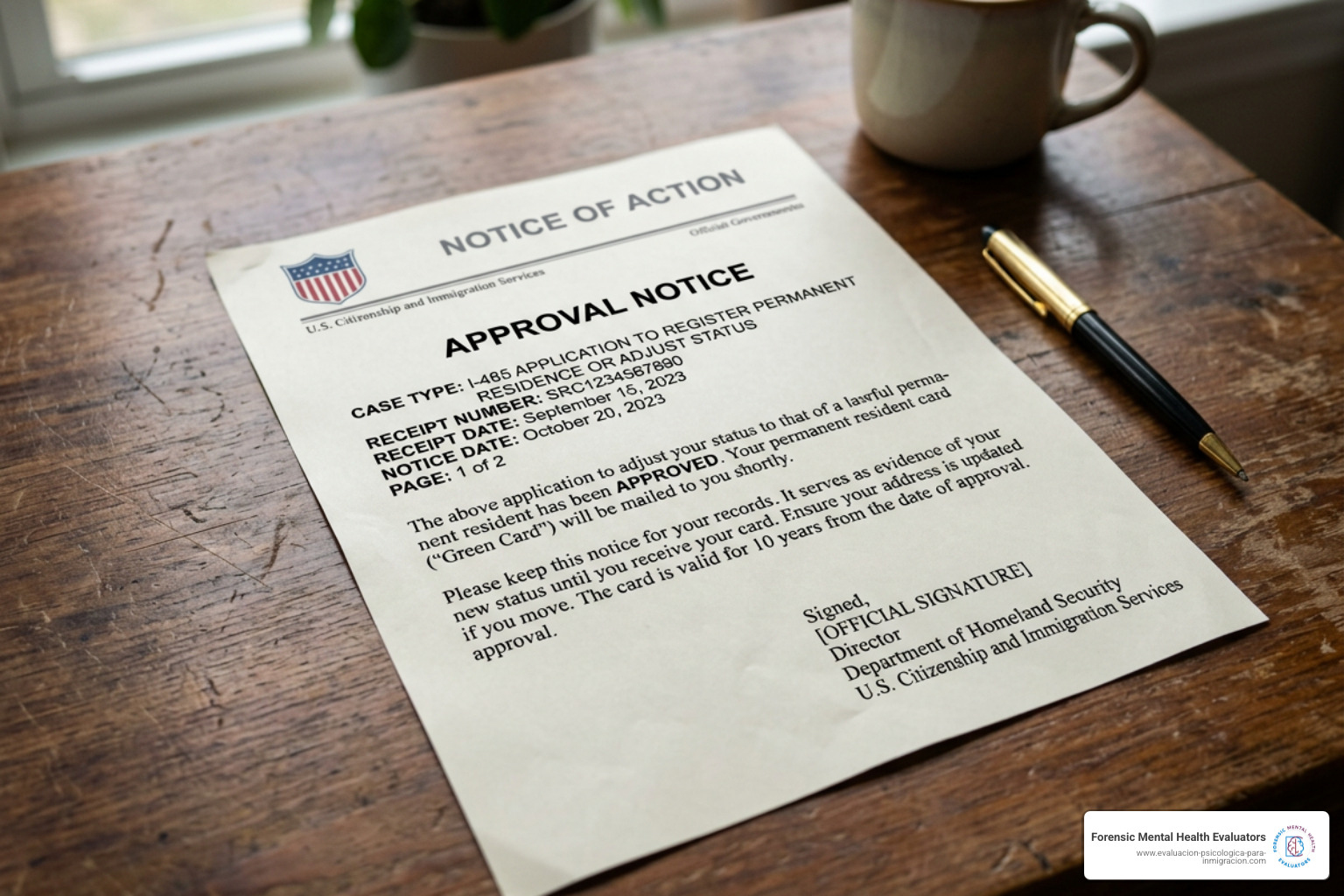
Once you have been approved for a U visa, you can begin planning your transition to lawful permanent residency. You will do this by filing Form I-485 (Application to Register Permanent Residence or Adjust Status).
According to the rules detailed on U visa to green card transition, to qualify for adjustment of status, you must meet the following criteria:
- You must have been physically present in the United States for a continuous period of at least 3 years since the date you were admitted as a U nonimmigrant.
- You must not have unreasonably refused to provide assistance to law enforcement since receiving your U visa.
- Your continued presence in the United States must be justified on humanitarian grounds, to ensure family unity, or to serve the public interest.
Processing Times for Adjustment of Status
While the path is clear, you must prepare for processing delays. The timeline for converting your status to a permanent resident can take several months or even years due to the ongoing USCIS backlog.
As of June 2026, the processing times for Form I-485 adjustment of status applications are continuously updated on the USCIS website. To avoid any gaps in your legal status, it is critical to consult with an immigration attorney and track your continuous physical presence carefully. You can read more about current expectations on U visa to green card processing times.
Frequently Asked Questions
Can I apply if I am outside the United States?
Yes, you can. You do not have to be physically inside the U.S. to file. The petition (Form I-918 and Supplement B) is still filed with USCIS in the United States. Once approved, you will go through consular processing at a U.S. Embassy or Consulate in your home country. This involves submitting Form DS-160, attending a visa interview, and obtaining a visa stamp to enter the country legally. If you have inadmissibility issues, you must also secure an approved Form I-192 waiver before you can enter. You can find official details on Visas for Victims of Criminal Activity.
What happens if the police refuse to sign my certification?
If the primary police department refuses to sign your Form I-918 Supplement B, do not give up. You can seek certification from alternative agencies that had authority over or were involved in your case. This includes the county prosecutor's office, family court judges, the Department of Labor, or the Equal Employment Opportunity Commission (EEOC) if the crime occurred in a workplace.
Does the crime need to be recently reported to qualify?
No. There is no statutory deadline or expiration date on when the crime occurred or when it was reported. As long as you can secure a signed Form I-918 Supplement B from a certifying agency, the crime could have happened years ago. If police records are sparse due to the passage of time, you can support your case using medical records, witness statements, and therapist notes.
Conclusion
Navigating the U visa process can feel overwhelming, but you do not have to walk this path alone. Securing professional, compassionate support is the key to protecting your future.
At District Counseling, we specialize in providing professional U Visa Psychological Evaluation services. Our mission is to document your mental and emotional trauma with the highest level of clinical care, giving your immigration petition the solid, objective evidence it needs to succeed.
We proudly serve clients across major Texas cities, including Houston, Austin, Dallas, and San Antonio.
Why choose District Counseling?
- Bilingual Evaluations: We conduct evaluations in Spanish and provide certified English translations.
- Client Comfort: We create a warm, safe, and trauma-informed environment where you can share your story without judgment.
- Ongoing Support: To help you heal, we offer 6 free therapy sessions after your psychological report is finalized.
If you are ready to take the next step in your immigration journey and heal from the past, contact us today to schedule your evaluation. We are here to support you every step of the way.