
Everything You Need to Know About Eligibility for a Hardship Waiver
What a Hardship Waiver Actually Is (And Why It Matters for Your Family)

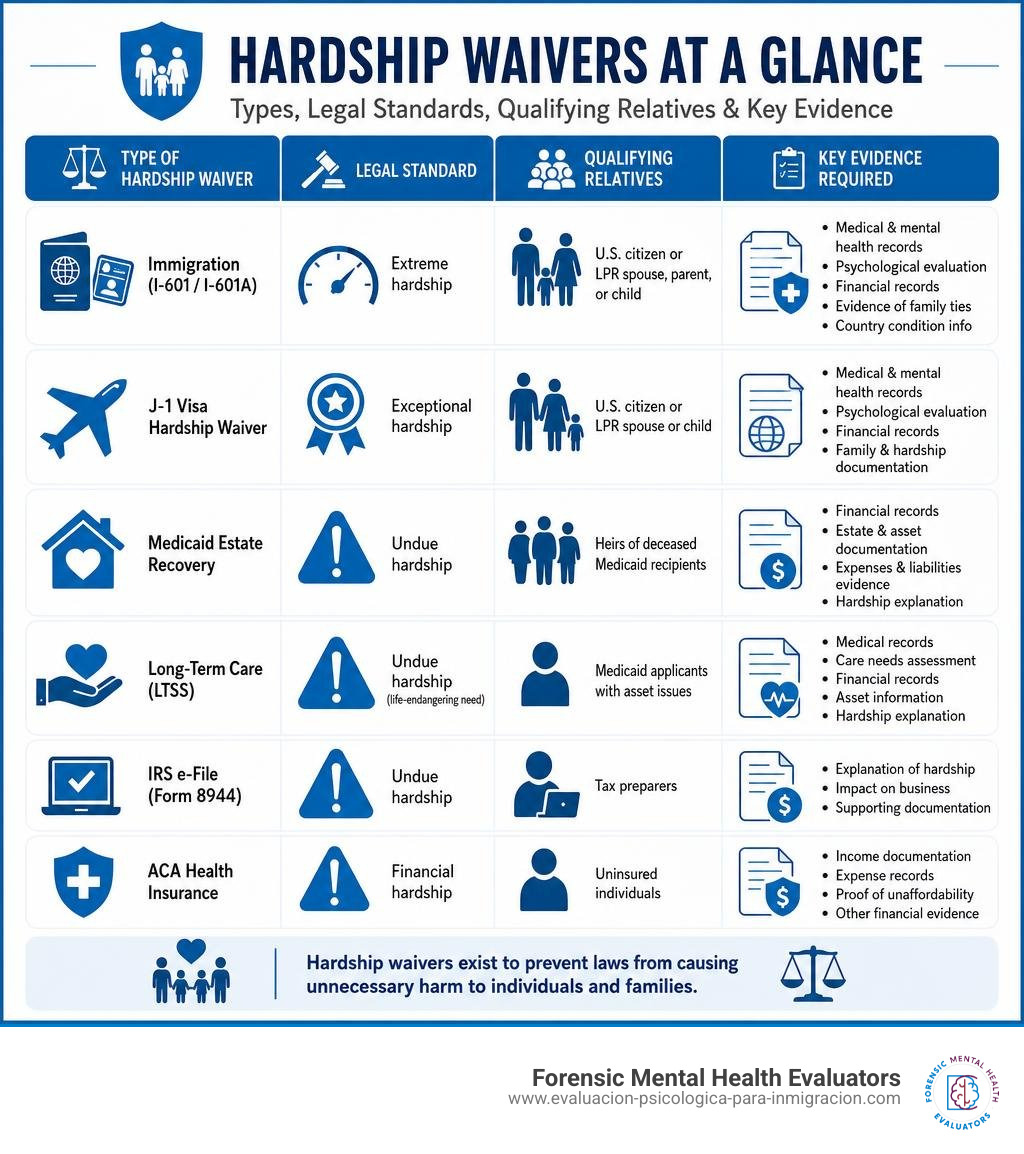
A hardship waiver is a legal request that allows a person to avoid a penalty, bar, or requirement by proving that enforcing it would cause serious harm to themselves or their family members. Here is a quick breakdown of the most common types:
| Type | Who It's For | Key Standard |
|---|---|---|
| Immigration (I-601 / I-601A) | Immigrants facing inadmissibility | Extreme hardship to a U.S. citizen or LPR relative |
| J-1 Visa Hardship Waiver | Exchange visitors | Exceptional hardship to a U.S. citizen or LPR spouse or child |
| Medicaid Estate Recovery | Heirs of deceased Medicaid recipients | Undue hardship to the heir |
| Long-Term Care (LTSS) | Medicaid applicants with asset issues | Undue hardship (life-endangering need) |
| IRS e-File (Form 8944) | Tax preparers | Undue hardship from electronic filing mandate |
| ACA Health Insurance | Uninsured individuals | Financial hardship preventing coverage |
If you are a non-U.S. citizen in Texas facing deportation, the immigration hardship waiver is almost certainly the one that applies to you. To get it approved, you must prove that your U.S. citizen or permanent resident spouse, parent, or child would suffer extreme hardship if you were removed or barred from the country.
This is not easy to prove on your own. The standard goes well beyond the normal pain of family separation. You need hard evidence — and in most cases, a professional psychological evaluation makes the difference between approval and denial.
I'm Francisco Ortiz, Lead Forensic Mental Health Evaluator at Forensic Mental Health Evaluators, a Certified Forensic Mental Health Evaluator (CFMHE) licensed in six states, with specialized training in conducting hardship waiver evaluations for immigration legal proceedings. I've built this guide to walk you through everything — eligibility, evidence, legal standards, and what to expect at every step.
What is a Hardship Waiver and Where is it Used?
At its core, a hardship waiver acts as a legal safety valve. Laws are designed to be uniform, but uniform application can sometimes lead to devastating, unintended consequences for innocent people. In these situations, administrative agencies and courts use hardship waivers to look at the human side of a case and grant relief.
While we primarily focus on helping families navigate the high-stakes world of immigration law, hardship waivers exist across several distinct legal and administrative landscapes.
Immigration Hardship Waiver Applications (Form I-601 and I-601A)
In the immigration system, a waiver is essentially a "pardon" for a specific ground of inadmissibility. If you are deemed inadmissible to the United States due to unlawful presence, fraud, misrepresentation, or certain criminal history, you cannot obtain a green card or visa unless USCIS approves a waiver.
The most common pathways are:
- Form I-601 (Application for Waiver of Grounds of Inadmissibility): Used by individuals who are currently outside the U.S. or applying for adjustment of status within the country.
- Form I-601A (Application for Provisional Unlawful Presence Waiver): Designed specifically for individuals who are physically present in the U.S. but must depart for their consular interview abroad. It allows them to apply for the waiver before leaving, drastically reducing the risk of being stranded outside the country.
To win either of these, you must meet the rigid statutory requirements of an Immigration Extreme Hardship Waiver.
Medicaid Estate Recovery and Long-Term Care Exemptions
Outside of immigration, hardship waivers protect low-income families from losing their homes or vital services. When a Medicaid recipient passes away, state agencies are legally mandated to attempt to recover the cost of long-term care from the deceased person's estate.
However, heirs can apply for an undue hardship waiver to stop this recovery if it would deprive them of their primary residence or source of income.
- California (Medi-Cal): Heirs can submit a Hardship Waiver Application - DHCS - CA.gov to protect their proportionate share of the estate.
- Texas: Texas administrative rules also protect heirs under strict guidelines outlined in 1 Tex. Admin. Code § 373.209 - Undue Hardship Waivers, ensuring family-owned businesses or farms producing the heir's primary livelihood are not seized.
- Other States: While Washington State has its own structure detailed in the Washington State Health Care Authority Hardship Rules, our focus remains on serving clients within our core service areas like Texas, California, and Florida.
Tax Preparer and Healthcare Insurance Hardship Exemptions
Even professionals and everyday consumers rely on these legal tools:
- IRS Form 8944: Tax return preparers use this form to request an undue hardship waiver from the federal mandate requiring them to e-file. If a preparer lacks reliable internet access in a rural area or faces an unexpected technology disaster, they can request a temporary paper-filing exemption.
- Affordable Care Act (ACA) Exemptions: For the 2026 plan year and beyond, the Centers for Medicare & Medicaid Services (CMS) has expanded and streamlined pathways to catastrophic health coverage. Under the CMS 2026 Hardship Exemption Guidance, individuals who are ineligible for premium tax credits due to their household income can secure a "Hardship 14" exemption, allowing them to purchase more affordable catastrophic health insurance.
Key Legal Standards: Extreme, Exceptional, and Undue Hardship
Not all "hardships" are created equal in the eyes of the law. Depending on the waiver you are applying for, you will have to meet one of three distinct legal thresholds.
| Legal Standard | Context | Definition |
|---|---|---|
| Extreme Hardship | USCIS (I-601 / I-601A) | Suffering that is "greater than that which would normally be expected" from deportation or separation. |
| Exceptional Hardship | J-1 Visas (Form I-612) | A standard slightly lower than "extreme" but still requiring proof of severe disruption in both separation and relocation scenarios. |
| Undue Hardship | Medicaid / IRS / NY OATH | Severe financial or physical deprivation, such as being forced onto public assistance or losing basic shelter. |
Proving Extreme Hardship for a Hardship Waiver
If you are applying for an immigration waiver, you must meet the standard of Extreme Hardship. The law assumes that any family separation causes emotional pain, financial stress, and sadness. Therefore, "normal" hardship is not enough to win your case.
To establish extreme hardship, you must demonstrate that your qualifying relative would experience a level of suffering that is significantly more severe than the average family going through deportation. USCIS adjudicators evaluate this using a "totality of the circumstances" approach. This means that even if no single factor in your case is "extreme" on its own, the cumulative effect of multiple smaller hardships can aggregate to meet the legal threshold.
Exceptional Hardship vs. Undue Hardship
If you are a J-1 exchange visitor subject to the two-year home residency requirement, you must file Form I-612 under the "exceptional hardship" standard. According to Chapter 4 - Waiver of the Foreign Residence Requirement | USCIS, exceptional hardship is legally defined as more than normal disruption, but it is technically considered a slightly less stringent threshold than the "extreme" standard. Crucially, J-1 applicants must prove this exceptional hardship would occur under both scenarios: if the qualifying relative remains in the U.S. without you, and if they relocate to your home country with you.
"Undue hardship," on the other hand, is the standard used in financial, tax, and healthcare matters. For example, in New York, individuals facing heavy municipal fines can submit a Financial Hardship Online Form - OATH to reduce their penalties. In Florida, drivers facing license suspensions can seek a hardship license to travel to work, as detailed by the Other Common Suspensions and Revocations - Florida Department of ... . In all these cases, "undue" means the penalty would actively prevent you from meeting basic life necessities like food, shelter, or employment.
Who Qualifies for a Hardship Waiver?
You cannot apply for a hardship waiver simply because you want to stay in the United States or keep your assets. The law dictates exactly whose hardship the government is allowed to care about.
Qualifying Relatives in Immigration Law
For the vast majority of immigration waivers, the applicant's own hardship is legally irrelevant. Instead, the focus is entirely on the Qualifying Relative.
- For Form I-601A (Unlawful Presence): The qualifying relative must be a U.S. citizen (USC) or Lawful Permanent Resident (LPR) spouse or parent. (Note: U.S. citizen children do not count as qualifying relatives for unlawful presence waivers).
- For Form I-601 (Fraud/Misrepresentation): The qualifying relative must be a USC or LPR spouse or parent.
- For Form I-601 (Criminal Grounds under 212(h)): The qualifying relative can be a USC or LPR spouse, parent, or child.
- VAWA Self-Petitioners: Under the Violence Against Women Act, victims of domestic abuse are an exception to the rule. They are permitted to demonstrate extreme hardship to themselves to waive certain inadmissibility grounds.
While a child's hardship cannot be counted directly on an I-601A, we can frame their suffering through the psychological impact it would have on the qualifying parent. For example, if a U.S. citizen spouse is left to raise a child with special needs alone, the immense psychological and financial toll on that spouse is highly relevant.
Eligible Heirs and Legatees in Estate Recovery
In probate and Medicaid estate recovery law, the rules of eligibility are entirely different. To apply for an undue hardship waiver in California or Texas, the applicant must be an heir or legatee explicitly named in the deceased person's Will or entitled to inherit under state intestacy laws.
The waiver is designed to protect low-income heirs from losing their family home or primary source of livelihood. If the estate property has been the site of a family business for at least 12 months and provides more than 50% of your household's livelihood, you may qualify for a complete or partial waiver of the state's recovery claim.
Essential Evidence and Factors to Prove Your Case
Winning a hardship waiver requires moving past simple emotional pleas. You must build an objective, structured, and heavily documented evidence file.
The Critical Role of Psychological Evaluations
When an immigration officer reviews your file, they expect to see a professional Psychological Evaluation. A clinical mental health assessment from a licensed professional bridges the gap between your personal feelings and the legal standard of extreme hardship.
At District Counseling, we specialize in conducting these evaluations across Texas (including Houston, Katy, Cypress, and Sugar Land). Our clinical reports provide an objective mental health diagnosis — such as Major Depressive Disorder, Generalized Anxiety Disorder, or Post-Traumatic Stress Disorder (PTSD) — and explain exactly how the deportation of a loved one would exacerbate these conditions.
According to our Immigration Psychological Evaluations Guide 2026, a thorough evaluation must answer two critical questions:
- What would be the psychological impact on the qualifying relative if they remained in the U.S. separated from the applicant?
- What would be the psychological impact on the qualifying relative if they were forced to relocate to the applicant's home country?
Our evaluations are fully bilingual (conducted in Spanish and translated into English) to ensure our clients feel completely comfortable sharing their stories.
Financial, Medical, and Country Condition Evidence
While mental health is a massive component of your application, USCIS evaluates extreme hardship across five core categories. You should back up your personal statement — which you can learn how to write using this Sample Hardship Letter for Immigration (2026 Guide) — with the following documentation:
- Medical Factors: Signed letters from physicians detailing chronic health conditions, ongoing treatments, and proof that comparable medical care is unavailable or unaffordable in the applicant's home country. As noted in Chapter 6 - Extreme Hardship Determinations | USCIS , USCIS officers cannot substitute their own medical opinions for those of a reputable professional.
- Financial Factors: Tax transcripts, mortgage statements, rental agreements, utility bills, and bank records. You must show how losing the applicant's income would cause severe financial default or force the family onto public assistance.
- Country Conditions: Official State Department travel advisories, human rights reports, and news articles showing high rates of violence, political instability, or lack of economic opportunity in the relocation country.
- Local Support: Proof of deep community ties, such as letters of support from church groups, local employers, or community organizations like Cypress Assistance Ministries or civic programs in Sugar Land, TX - Official Website | Official Website.
Procedural Steps, Deadlines, and Appeals
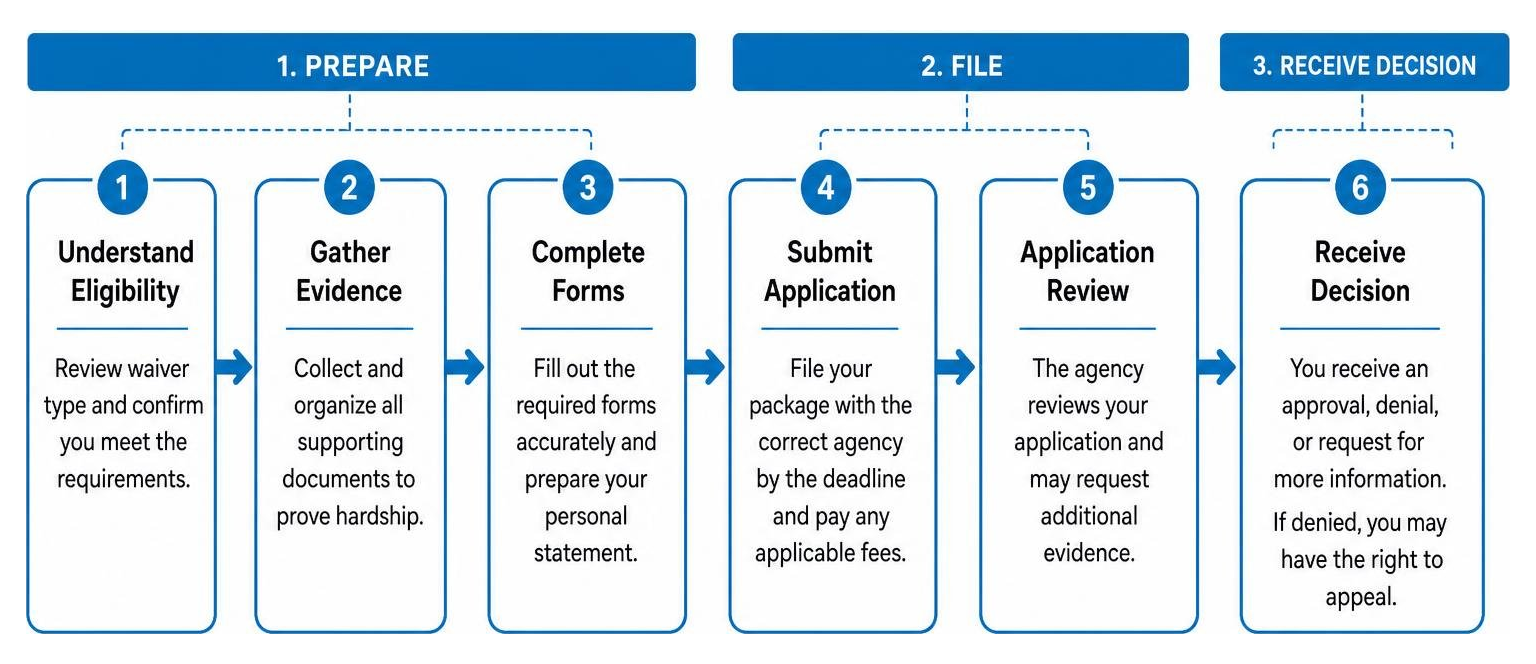
Filing a hardship waiver is a highly structured, time-sensitive process. Missing a single deadline or submitting an incomplete form can result in immediate rejection.
Filing Timelines and Agency Procedures
The procedural rules vary dramatically depending on the type of waiver you are filing:
- Medicaid Estate Recovery (California / Texas): You must submit your completed hardship waiver application within 60 calendar days from the date printed on the state's Estate Recovery claim letter. If the state requests additional documentation, you must return it within 45 calendar days to avoid an automatic denial.
- Immigration (I-601 / I-601A):
- Form I-601A: As of 2026, the current filing fee is $795, and processing times average 28 to 32 months.
- Form I-601: The current filing fee is $1,050.
- Adjudication: USCIS officers follow a strict 5-step process outlined in Chapter 3 - Adjudicating Extreme Hardship Claims | USCIS to verify eligibility, evaluate hardships individually, aggregate them, and ultimately decide whether the applicant merits a favorable exercise of discretion.
What Happens If Your Waiver Is Denied?
A denial is not necessarily the end of the road, but your options depend heavily on the specific agency involved.
- Immigration Denied (I-601): You can file an appeal with the Administrative Appeals Office (AAO) or file a Motion to Reopen/Reconsider using Form I-290B.
- J-1 Waiver Denied (I-612): If USCIS denies the waiver before referring it to the Department of State (DOS), you can appeal to the AAO. However, if the denial is based on a negative recommendation from the DOS Waiver Review Division, there is no right to appeal or administrative review.
- Medicaid Estate Recovery Denied: In California, you have 60 calendar days from the date of the denial letter to submit a written request for an administrative hearing to challenge the decision.
Frequently Asked Questions About Hardship Waivers
Who is considered a qualifying relative for an immigration waiver?
For an I-601A provisional unlawful presence waiver, only a U.S. citizen or Lawful Permanent Resident (LPR) spouse or parent is considered a qualifying relative. For an I-601 waiver (which covers fraud or certain criminal grounds), a U.S. citizen or LPR child may also qualify depending on the specific section of the law under which you are applying.
How long does it take to process an I-601A provisional waiver in 2026?
Currently, in 2026, most Form I-601A applications take approximately 28 to 32 months for USCIS to process. Because of these long backlogs, it is absolutely vital to submit a complete, error-free application backed by strong psychological and financial evidence to avoid a Request for Evidence (RFE), which can delay your case by several additional months.
Can I appeal a denied J-1 visa hardship waiver?
If your J-1 waiver application (Form I-612) is denied by USCIS before being sent to the Department of State, you can file an appeal with the Administrative Appeals Office (AAO). However, if the Department of State’s Waiver Review Division issues a negative recommendation, USCIS is legally required to deny the waiver, and you have no right to appeal that decision.
Conclusion
Navigating a hardship waiver application can feel overwhelming, especially when your family’s future in the United States is on the line. The legal standards are incredibly high, the wait times are long, and the paperwork must be flawless.
At District Counseling, we are dedicated to helping families throughout Texas — including Houston, Austin, Dallas, and San Antonio — build the strongest possible cases. We conduct thorough, compassionate psychological evaluations in both Spanish and English, and we translate our reports into clear, professional English for USCIS.
To help your family navigate the emotional stress of the immigration process, we also provide six free therapy sessions to our clients after their evaluation report is completed.
Don't leave your family's future to chance. Schedule a Psychological Evaluation for Your Hardship Waiver with our licensed clinical team today, and let us help you take the next step toward security and peace of mind.