
Texas Immigration Psychological Evaluation: What to Expect and How to Prepare
What Is an Immigration Psychological Evaluation in Texas — and Do You Need One?

If you are facing deportation or an immigration case, an immigration psychological evaluation in Texas could be one of the most important steps you take to protect your family.
Here is a quick overview of what you need to know:
- What it is: A formal mental health assessment prepared by a licensed professional that documents your psychological state, trauma history, and the emotional impact of your immigration situation.
- Who needs it: Non-permanent residents facing removal, individuals applying for hardship waivers, asylum seekers, and victims of crime or abuse applying for U-Visa, T-Visa, or VAWA petitions.
- What it does: It gives USCIS or an immigration court objective, clinical evidence to support your case — in your own words, backed by professional documentation.
- Success rates: Immigration cases that include a psychological evaluation have an 89% success rate, compared to just 37.5% for cases without one.
- How long it takes: Most evaluations involve a 60–120 minute clinical interview, with reports delivered within a few business days to two weeks depending on the provider.
- Cost range: Fees typically range from $650 to $1,500 depending on the provider and complexity of the case.
Facing a deportation order or a denial of your visa petition is terrifying — especially when your children or spouse depend on you being here. The fear of family separation, the stress of legal uncertainty, and the emotional weight of your journey all matter. And a psychological evaluation is exactly how you can show that to the people making decisions about your future.
The evidence is clear: a well-prepared clinical report can be the difference between staying with your family and being forced to leave.
I'm Francisco Ortiz, Lead Forensic Mental Health Evaluator at District Counseling PLLC, and I have completed advanced specialized training in hardship waiver evaluations, asylum cases, and U-Visa and T-Visa assessments — making immigration psychological evaluations in Texas a core part of my forensic practice. In the sections below, I'll walk you through everything you need to know to prepare for your evaluation and understand how it works.
Understanding the Role of an Immigration Psychological Evaluation Texas

When navigating the complex United States immigration system, legal arguments and immigration forms are only half the battle. To build an unshakeable case, you must humanize your experience. This is where a clinical assessment from a licensed mental health professional becomes invaluable.
An immigration psychological evaluation in Texas serves as objective, scientific evidence. While your attorney argues the legal merits of your case, we provide the clinical documentation that details the human cost. We translate your emotional distress, trauma history, and mental health struggles into a comprehensive, professional report that immigration judges and USCIS officers can easily interpret.
Many people ask us, "Can't I just tell the judge how stressed I am?" While your personal testimony is crucial, a self-report carries significantly less weight than an independent forensic evaluation. A licensed clinician uses standardized psychological instruments, diagnostic criteria, and specialized clinical interviews to substantiate your claims. This objective documentation provides the depth and credibility required to back up your story. In fact, peer-reviewed data highlights that cases utilizing a professional Texas Immigration Psych Evaluation see a massive jump in success rates compared to those that rely solely on legal petitions.
Key Immigration Cases That Benefit from Mental Health Assessments

Every immigration journey is unique, and federal immigration laws provide several pathways where mental health assessments play a deciding role. Whether you are seeking to remain with your family or escaping dangerous conditions in your home country, a professional evaluation can help secure a favorable outcome. For those undergoing these legal processes, receiving Texas Asylum Psychological Services or specialized assessments can make a life-changing difference.
Extreme Hardship Waivers (I-601 and I-601A)
Extreme Hardship Waivers require the applicant to prove that their deportation would cause "extreme and unusual hardship" to a qualifying relative who is a U.S. citizen or Lawful Permanent Resident (LPR). This relative could be a spouse, parent, or child.
During our evaluations, we look far beyond simple sadness or temporary anxiety. We document the profound, long-term psychological and physical impacts of separation. Our assessments explore:
- Financial Impact: How the loss of the primary breadwinner will lead to severe economic hardship, housing instability, or the inability to afford medical care.
- Health Concerns: How a relative's pre-existing chronic physical or mental health conditions would deteriorate without the applicant's daily support.
- Educational Opportunities: The disruption to children's education and developmental milestones if they are forced to relocate to a country they do not know.
- Family Separation: The deep-seated emotional trauma, severe depressive disorders, and generalized anxiety that occur when families are torn apart.
Asylum, VAWA, U-Visa, and T-Visa Petitions
For humanitarian-based petitions, a psychological evaluation acts as a voice for those who have survived unimaginable suffering.
- Asylum (Form I-589): Seeking asylum requires proving past persecution or a well-founded fear of future persecution based on race, religion, nationality, political opinion, or membership in a particular social group. We document the severe trauma, post-traumatic stress disorder (PTSD), and psychological scars left by past torture or mistreatment. This is especially vital for cases where trauma has caused memory gaps or delayed filing past the standard one-year deadline.
- VAWA (Violence Against Women Act - Form I-360): This self-petition allows abused spouses, children, or parents of U.S. citizens or LPRs to apply for legal status independently. We carefully document the psychological impact of domestic violence, emotional abuse, coercive control, and extreme cruelty.
- U-Visa (Form I-918): For victims of qualifying crimes (such as domestic violence, sexual assault, or felonious assault) who have assisted law enforcement, we evaluate and document the severe mental or physical abuse suffered as a result of the crime.
- T-Visa (Form I-914): For survivors of severe forms of human trafficking (sex or labor trafficking), we assess the psychological impact of the trafficking and the extreme hardship the survivor would face if removed from the United States.
The Evaluation Process: What to Expect During Your Appointment
We understand that speaking about your past trauma, family worries, and personal history can feel incredibly intimidating. That is why we design our process to be as gentle, comfortable, and transparent as possible. When you undergo an Immigration Mental Health Evaluation, you are stepping into a safe, non-judgmental space.
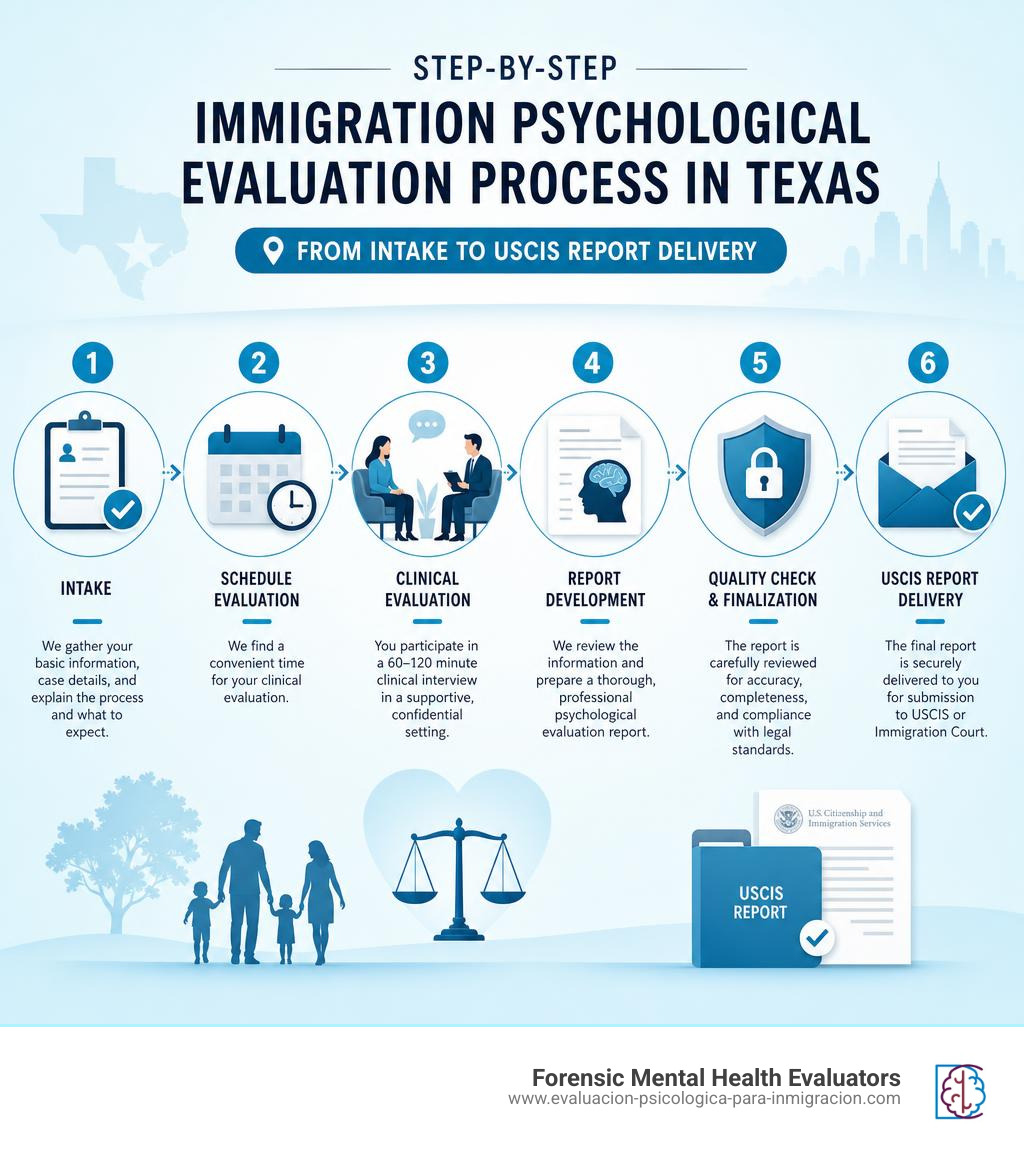
An evaluation is not an interrogation. It is a structured conversation guided by a compassionate professional. The standard process involves:
- Initial Consultation: A brief discussion to understand your specific immigration case and coordinate with your attorney.
- Intake & Questionnaires: Completing essential background forms and clinical questionnaires.
- The Clinical Interview: A detailed conversation lasting between 1.5 to 4 hours (which can be split into shorter sessions to prevent emotional exhaustion).
- Collateral & Document Review: Reviewing any existing medical records, police reports, or school records.
- Report Preparation: Writing a highly detailed, 12-to-20-page clinical report tailored to your specific USCIS petition.
How to Prepare for Your Immigration Psychological Evaluation Texas
You do not need to "study" or worry about giving the "right" answers for your evaluation. The best way to prepare is simply to be honest and open. However, here are a few practical steps you can take to make the process smoother:
- Gather Your Documents: Have your attorney's contact information, relevant medical or mental health records, and any legal documents (like police reports for U-Visas) ready.
- Complete Your Intake Forms Early: Filling out your background questionnaire beforehand allows us to spend more time focusing on you during the clinical interview.
- Get Plenty of Rest: Discussing personal history and emotional symptoms like coping mechanisms, anxiety, or trauma can be draining. Give yourself space to rest before and after the session.
- Coordinate with Your Attorney: We routinely collaborate directly with immigration lawyers to ensure our clinical findings align with the specific legal standards of your case.
Telehealth vs. In-Person Assessments in Texas
We are proud to offer both in-person appointments at our comfortable offices and secure, fully encrypted virtual appointments via Zoom.
Our virtual telehealth services provide complete statewide access. Whether you live in Houston, Katy, Cypress, Sugarland, or anywhere else across Texas, you can complete your evaluation from the comfort and privacy of your own home.
Telehealth evaluations meet all federal and state regulations, ensuring the exact same level of clinical depth, security, and court admissibility as an in-person visit. For our Spanish-speaking clients, we provide seamless Austin Spanish Immigration Evaluation services virtually, ensuring language is never a barrier to receiving expert care.
Costs, Timelines, and Report Credibility for USCIS and Court Cases
When choosing a clinical evaluator, transparency regarding costs, timelines, and report formatting is essential. To help you plan, we have outlined the typical industry standards for professional evaluations below:
| Evaluation Metric | Standard Service | Expedited / Rush Options |
|---|---|---|
| Average Cost | $650 - $1,500 (Flat Fee) | Additional rush fees apply |
| Turnaround Time | 7 to 14 business days | 24 to 48 hours available |
| Clinical Interview Duration | 1.5 to 4 hours total | Completed in single session |
| Average Report Length | 8 to 20 pages | Fully detailed clinical analysis |
| Court Testimony | Available if requested | Hourly preparation rates apply |
To ensure your report is highly credible before USCIS and immigration courts, we provide comprehensive, multi-page assessments that strictly adhere to forensic standards. We also coordinate closely with your legal team to ensure deadlines are met without compromising clinical quality. If your case requires expedited processing, we offer rapid turnaround options to deliver your report when you need it most.
Who Can Perform an Immigration Psychological Evaluation Texas?
Only licensed mental health professionals who are legally authorized to practice in the state of Texas can conduct these assessments and write admissible forensic reports. This includes:
- Licensed Psychologists (PhD/PsyD)
- Licensed Clinical Social Workers (LCSW)
- Licensed Professional Counselors (LPC)
- Licensed Marriage and Family Therapists (LMFT)
It is crucial to work with a professional who has specialized post-graduate training in forensic mental health assessments and a deep understanding of USCIS legal criteria. Choosing a Texas Immigration Psychological Expert ensures your evaluator knows how to write a report that stands up to intense legal scrutiny.
Selecting a Qualified Evaluator for Your Case
When searching for the right professional, look for an evaluator who demonstrates:
- A Trauma-Informed Approach: The evaluation must prioritize your emotional safety, especially if you are discussing severe abuse or persecution.
- Cultural Sensitivity: An understanding of how mental health is viewed across different cultures and backgrounds.
- Bilingual Capabilities: The ability to conduct the evaluation directly in your native language (such as Spanish) without relying on external, untrained translators.
- Strong Attorney Referrals: Trusted legal professionals routinely refer their clients to evaluators with proven track records of credibility in court.
Whether you need a Dallas Psychological Immigration Assessment or an Austin Spanish Immigration Evaluation, selecting a credentialed expert is key to the integrity of your case.
Frequently Asked Questions About Texas Immigration Evaluations
What mental health conditions qualify for an immigration evaluation?
There is no single "required" mental health condition or diagnosis needed to qualify for an immigration evaluation. The assessment focuses entirely on your unique life circumstances, history, and functioning. We evaluate for a wide range of clinical findings, including post-traumatic stress disorder (PTSD), major depressive disorder, generalized anxiety disorder, and acute stress. We also document the absence of conditions when demonstrating resilience, as well as the severe emotional distress and functional impairment that would result from deportation or family separation.
Can the evaluation be completed entirely online via telehealth?
Yes, absolutely! Thanks to secure, HIPAA-compliant video conferencing platforms, you can complete your entire evaluation online. As long as you are physically located in Texas (or any of our other licensed states like Florida, California, New York, Utah, Virginia, or Idaho) at the time of the appointment, a virtual evaluation is fully valid, highly convenient, and accepted by USCIS and immigration courts.
How long is the final report, and is it accepted by USCIS?
Our final written reports are highly comprehensive, typically ranging from 12 to 20 pages in length. They are written to meet the highest forensic and government standards, ensuring maximum credibility. Yes, our reports are fully accepted by USCIS and Executive Office for Immigration Review (EOIR) immigration courts. We also provide your immigration attorney with a draft copy for review before finalization to ensure all administrative details are perfectly aligned.
Conclusion
At Forensic Mental Health Evaluators (District Counseling), we believe your story deserves to be heard, understood, and documented with the utmost care. We offer professional, trauma-informed immigration psychological evaluations across our physical locations in Houston, Katy, Cypress, and Sugarland, as well as virtually across Texas, Florida, California, New York, Utah, Virginia, and Idaho.
We are fully committed to your comfort and success. We provide seamless Spanish-language evaluations translated into English so you can speak your truth in the language you feel most comfortable using. Furthermore, because we care about your long-term well-being beyond just your legal case, we proudly offer six free therapy sessions to our clients after their report is completed.
Whether you are preparing a hardship waiver and need an expert Evaluación Psicológica para Caso de un Perdón, applying for asylum, or seeking a U-Visa, we are here to walk alongside you. Reach out to us today to schedule your evaluation and take a vital step toward securing your family's future.