
What to Expect During Houston Immigration Evaluations
What Houston Immigration Evaluations Are — and Why They Matter

Houston immigration evaluations are specialized psychological assessments used as legal evidence in immigration cases before USCIS and immigration courts.
Here is a quick overview of what to expect:
- What they are: A clinical interview and written report documenting trauma, hardship, or psychological impact
- Who needs them: Immigrants applying for hardship waivers, asylum, VAWA, U-Visa, T-Visa, or fighting cancellation of removal
- Who conducts them: Licensed mental health professionals trained in forensic immigration assessment
- How long they take: Typically 2–3 hours for the interview; reports delivered within a few days to a few weeks
- What they cost: Roughly $650 to $3,000 depending on complexity and provider
- Key benefit: Evaluations can significantly strengthen your case by providing objective clinical evidence a judge or USCIS officer can rely on
If you or a family member is facing deportation, the stakes could not be higher. The thought of being separated from your children or spouse — your entire life built here in Texas — is an overwhelming burden to carry. A psychological evaluation gives your attorney a powerful, credible document to show exactly what that separation would mean for your family.
One striking data point drives this home: between 2000 and 2004, asylum seekers who received professional evaluations through Physicians for Human Rights won their cases at an 89% rate — compared to a national average of just 37.5% for those without one.
I'm Francisco Ortiz, Lead Forensic Mental Health Evaluator at District Counseling PLLC, a Certified Forensic Mental Health Evaluator (CFMHE) licensed in Texas and five other states, with specialized training in hardship waiver evaluations, asylum cases, and U-Visa and T-Visa assessments — the exact case types most common in houston immigration evaluations. In this guide, I'll walk you through every step of the process so you know exactly what to expect.
Understanding the Role of Houston Immigration Evaluations in Legal Cases
When you are navigating the U.S. immigration system, your personal story is the heart of your application. However, explaining the deep emotional pain, fear, or trauma you have experienced to a government official can be incredibly difficult. This is where houston immigration evaluations play a vital role.

A forensic mental health evaluation is not a standard therapy session. Instead, it is a highly specialized legal and clinical tool. We use these evaluations to document your mental health, emotional state, and personal history in a structured format that meets the strict standards of U.S. Citizenship and Immigration Services (USCIS) and the Executive Office for Immigration Review (EOIR).
By conducting a thorough Immigration Mental Health Evaluation, we gather a complete biopsychosocial history. This includes looking at your childhood, family relationships, medical history, and current emotional symptoms.
For many applicants, the biggest hurdle in court is overcoming "credibility challenges." If a person has experienced severe trauma, their memory can be fragmented, making it hard to tell their story consistently to an immigration officer. Our job is to provide objective clinical context. We explain how trauma affects memory and behavior, helping the court understand your experience through a professional, scientific lens. For deeper insight into this process, you can explore our guide on Houston Forensic Mental Health Evaluations.
Why Attorneys Recommend Houston Immigration Evaluations
Immigration attorneys are legal experts, but they are not mental health experts. They know that a judge or USCIS officer is far more likely to approve a petition when the legal arguments are backed by objective clinical data.
When your lawyer recommends that you get an evaluation, it is a strategic decision. We work closely with legal teams to ensure our reports address the specific legal criteria of your case. Whether your attorney needs to prove "extreme hardship" for a spouse or document the psychological impact of domestic violence for a self-petition, our reports provide the professional weight required to support their legal briefs. To learn more about how these reports fit into broader legal strategies, read our Immigration Psychological Evaluations Guide 2026.
The Difference Between Clinical Diagnosis and Forensic Assessment
It is common to feel nervous before your first appointment. Many clients ask us, "Does needing an evaluation mean I am crazy?" The answer is absolutely not.
There is a major difference between a regular clinical session and a forensic Psychological Evaluation.
- Clinical Therapy: Focuses on ongoing treatment, healing, and coping strategies. The goal is to help you feel better over time.
- Forensic Assessment: Focuses on documenting the truth of your psychological state for a legal third party (like a judge). We use standardized tools to assess for conditions like Post-Traumatic Stress Disorder (PTSD), depression, or anxiety, but our primary goal is to answer a legal question: What is the psychological impact of this situation on the applicant or their family?
We do not "coach" you on what to say. In fact, doing so would ruin the credibility of the report. Instead, we create a safe, warm, and non-judgmental space where you can share your authentic experiences.
Key Immigration Cases That Benefit from Psychological Assessments
Different immigration pathways have completely different legal requirements. A high-quality evaluation must be tailored to the exact case type you are filing.

Below is a detailed breakdown of the most common cases we evaluate in our Houston, Katy, and Cypress offices, and how we approach them:
| Case Type | Relevant Form | Primary Legal Focus | Psychological Focus Area |
|---|---|---|---|
| Extreme Hardship Waiver | Form I-601 / I-601A | The impact of deportation or relocation on a qualifying U.S. citizen or LPR relative. | Documenting severe emotional, financial, medical, and educational hardship on the family left behind. |
| VAWA Self-Petition | Form I-360 | Abuse suffered by a non-citizen spouse, parent, or child of a U.S. citizen or LPR. | Documenting the psychological impact, severity, and cycle of physical, emotional, or financial abuse. |
| U-Visa | Form I-918 | Victimization by a qualifying crime within the U.S. and cooperation with law enforcement. | Documenting the mental or physical abuse, trauma, and ongoing fear resulting from the crime. |
| T-Visa | Form I-914 | Victimization by severe human trafficking (labor or sex trafficking). | Documenting the psychological trauma of exploitation and the extreme hardship if returned to the home country. |
| Asylum | Form I-589 | Persecution or well-founded fear of persecution based on protected grounds. | Documenting PTSD, trauma symptoms, and how past torture or persecution affects current mental health. |
| Cancellation of Removal | Form EOIR-42B | Deportation defense for non-permanent residents with qualifying relatives. | Proving "exceptional and extremely unusual hardship" to U.S. citizen or LPR children, spouses, or parents. |
For a comprehensive look at how these case types are handled clinically, you can refer to our Immigration Evaluation Complete Guide.
How Houston Immigration Evaluations Document Extreme Hardship
In extreme hardship cases (such as I-601 or I-601A waivers), the focus of the evaluation is actually not on the applicant. Instead, we evaluate the qualifying relative — who is typically a U.S. citizen or Lawful Permanent Resident (LPR) spouse or parent.
The law requires proving that this qualifying relative would experience "extreme hardship" under two scenarios:
- If the relative is separated from the applicant (who is deported).
- If the relative is forced to relocate to the applicant's home country to stay together.
During our sessions, we look at multiple life areas:
- Health concerns: Does the relative have chronic medical conditions that require the applicant's care?
- Financial impact: Will the family face financial ruin without the applicant's income?
- Educational needs: Are there school-aged children who would suffer academically or emotionally?
- Family separation: How will the sudden loss of a spouse or parent trigger severe depression or anxiety?
We tie all of these pieces together into a cohesive clinical report. If you are in Fort Bend County or the wider Houston area, you can learn more about this by reading our specialized resource on the Texas Immigration Psych Evaluation.
Documenting Trauma in Asylum, VAWA, and Visa Petitions
For humanitarian cases like asylum, VAWA, U-Visas, and T-Visas, the evaluation focus shifts back to the applicant. These cases require a deep, trauma-informed approach.
Many survivors of domestic violence or human trafficking suffer in silence. They may feel shame, guilt, or fear of retaliation. Our evaluators are trained to spot the subtle, clinical signs of trauma, such as hypervigilance, avoidance, emotional numbing, and memory gaps.
For asylum seekers, documenting a "credible fear" of returning to their country of origin is crucial. If an applicant was tortured or severely persecuted, they often carry deep psychological scars. By documenting these symptoms professionally, we provide the court with physical and psychological proof that matches their testimony. To read more about how forensic evaluations support trauma-affected individuals, see our resource on Evaluacion Forense De Inmigracion.
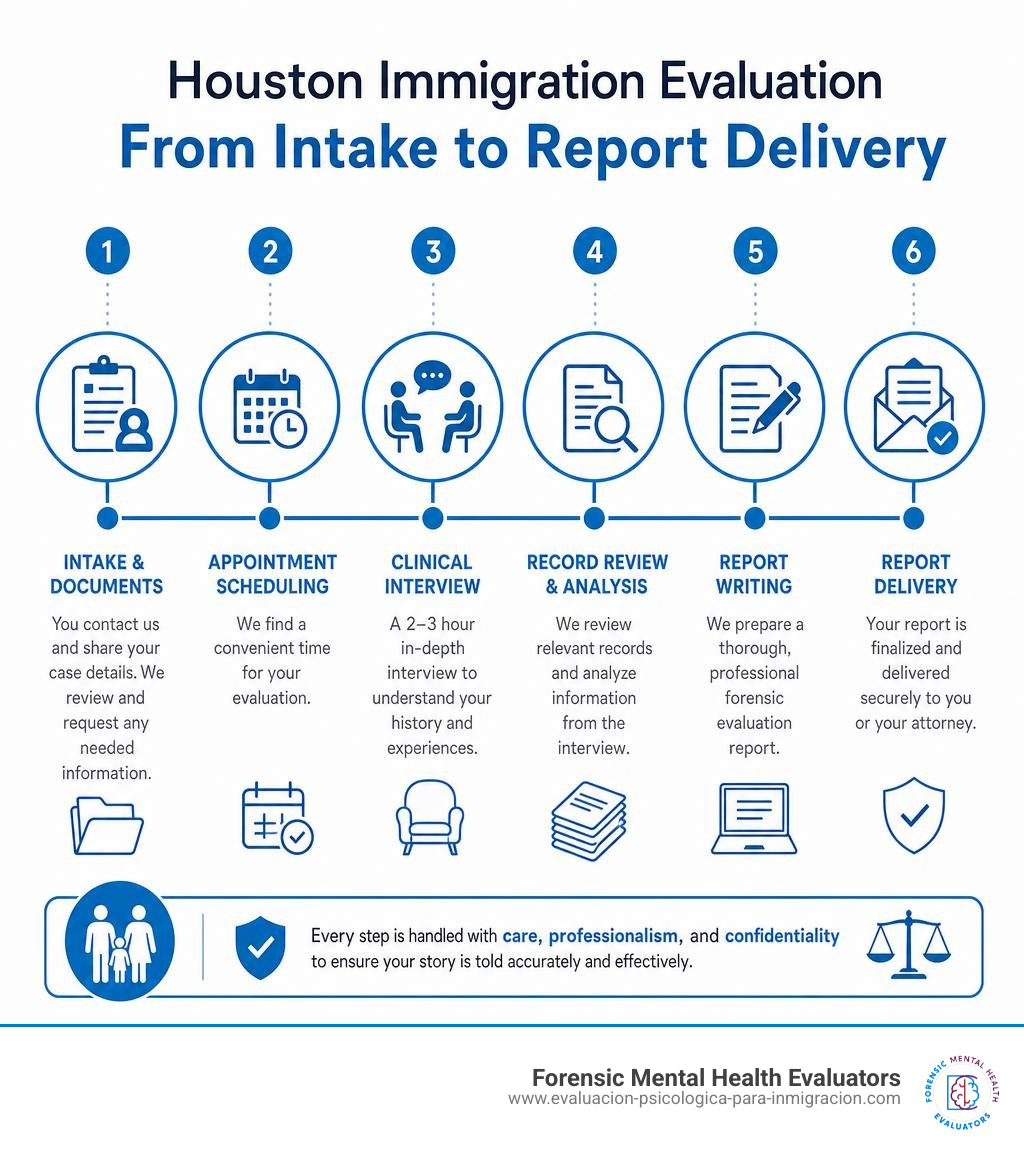
Step-by-Step: The Clinical Evaluation Process
We want your experience to be as stress-free as possible. Here is exactly what happens when you work with us:
- Initial Consultation & Intake: You or your attorney contacts us to schedule an appointment. We gather basic information about your case, and you complete your intake forms securely online.
- The Clinical Interview: We meet for an in-depth clinical interview. This can be done in person at one of our local offices (such as Houston, Katy, or Cypress) or online via our secure telehealth platform.
- Psychological Testing: We administer standardized, evidence-based questionnaires to screen for symptoms of trauma, depression, anxiety, and stress.
- Report Preparation: We carefully analyze the interview data and test results to draft a comprehensive, multi-page forensic report that directly addresses USCIS legal standards.
- Attorney Collaboration: With your written permission, we share the draft with your immigration attorney to ensure all legal questions are answered before we finalize and sign the document.
This structured approach ensures that every report is legally sound and clinically accurate. For a detailed roadmap of this process, please review our Immigration Evaluation Guide 2026.
What To Expect During the Clinical Interview
The clinical interview is the core of the evaluation. It typically lasts about two hours.
We will talk about your life story. We will cover your childhood, your family history, your educational background, and your employment. Then, we will discuss the specific events that led to your immigration case — whether that is the hardship of family separation, past abuse, or the fear of returning to your home country.
We understand that talking about these topics can be painful. You are welcome to take breaks, cry, or step out of the room whenever you need to. Our goal is to support you, not to interrogate you. Everything you share with us is kept strictly confidential, within the limits of the law and the requirements of your legal case.
Timeline, Costs, and Expedited Services in Texas
Time is often of the essence in immigration proceedings. A missed court deadline can have devastating consequences.
- Standard Timeline: Our standard turnaround time to complete a written report is 2 to 3 weeks after the final interview.
- Expedited Services: For urgent cases, we offer expedited services. We can deliver your completed report within 48 hours or 4 to 5 days for an additional rush fee.
- Typical Cost Range: Complete, professional evaluations across the industry generally range from $1,500 to $3,000 depending on the complexity of the case. However, some basic evaluations can start as low as $650 for straightforward, English-language assessments. We believe in transparency, which is why we offer flexible payment plans and accept HSA/FSA cards to make these services accessible.
Whether you prefer to meet in person or via video, we provide convenient Texas Immigration Psychological Expert services designed to fit your schedule.
Frequently Asked Questions about Houston Psychological Assessments
Will my evaluation be accepted by USCIS?
Yes. Our evaluators are fully licensed mental health professionals with specialized, advanced training in forensic assessments. Our reports are written to meet the rigorous clinical and legal standards required by USCIS, immigration courts, and the Board of Immigration Appeals (BIA). While no clinician can legally guarantee a specific outcome for your case, our reports are designed to provide the highest quality of clinical evidence possible.
Are evaluations available in Spanish?
Absolutely. We understand that you can express your deepest feelings and memories best in your native language. We offer bilingual evaluations conducted directly in Spanish.
At District Counseling, we translate all Spanish evaluations into professional, USCIS-compliant English reports. To support your long-term healing, we also offer a unique benefit: 6 free therapy sessions after your report is delivered, helping you process the emotions that the evaluation process might bring up.
Can I complete my evaluation via telehealth?
Yes, as long as you are physically located in Texas (or one of our other licensed states: Florida, California, New York, Utah, Virginia, or Idaho) at the time of your appointment. We use a secure, HIPAA-compliant video platform. Telehealth is highly convenient, saving you from driving through Houston traffic, and is just as legally valid and accepted by USCIS as an in-person visit.
Take the Next Step in Your Immigration Journey
A professional psychological evaluation is more than just a piece of paper — it is a powerful voice for your family's future. It turns your private worries, fears, and hopes into credible, clinical evidence that judges and immigration officers can understand and respect.
At District Counseling, we are dedicated to providing a warm, comfortable, and deeply respectful environment for every client. With our bilingual Spanish-English services, rigorous forensic standards, and our unique offer of 6 free post-evaluation therapy sessions, we are here to support both your legal case and your mental well-being.
Do not navigate this complex process alone. Talk to your attorney, and Schedule your evaluation today to take a vital step forward in your immigration journey.