
Working Legally in the US with T Visa Status
Overview of the T Visa Work Permit and Eligibility

You can obtain a T visa work permit in two main ways: through an early bona fide determination, which grants deferred action and an Employment Authorization Document under category (c)(14) while your petition is pending, or automatically upon final approval of T-1 nonimmigrant status, which provides work authorization under category (a)(16). The T nonimmigrant status was created under the Victims of Trafficking and Violence Protection Act (TVPA) to provide vital humanitarian relief and legal protection to individuals who have survived human trafficking. Understanding this relief begins with a comprehensive overview of T nonimmigrant status, which shields survivors from deportation, enables family reunification, and grants the right to work lawfully in the United States.
To qualify for T nonimmigrant status (T-1) and obtain an associated employment authorization document, you must meet specific statutory requirements outlined in the USCIS T Nonimmigrant Status Guidelines:
- Severe Form of Trafficking: You must be a victim of either sex trafficking (induced by force, fraud, or coercion, or involving an individual under 18) or labor trafficking (involving involuntary servitude, peonage, debt bondage, or slavery through force, fraud, or coercion).
- Physical Presence: You must be physically present in the United States, American Samoa, the Commonwealth of the Northern Mariana Islands, or at a port of entry on account of trafficking.
- Law Enforcement Cooperation: You must comply with any reasonable request for assistance from law enforcement agencies in the investigation or prosecution of human trafficking. However, statutory exemptions apply if you were under 18 years of age at the time of the victimization or if you are unable to cooperate due to physical or psychological trauma.
- Extreme Hardship: You must establish that you would suffer extreme hardship involving unusual and severe harm if removed from the United States.
- Admissibility: You must be admissible to the United States or obtain a waiver of inadmissibility (using Form I-192) for any applicable immigration violations or criminal grounds linked to your trafficking.
Congress established a statutory cap of 5,000 principal T visas per fiscal year. In practice, this annual cap has never been reached, meaning backlogs are driven by processing times rather than visa availability. Additionally, Congress and USCIS have eliminated the filing fees for Form I-914, Form I-765, associated biometrics, and waiver requests, removing significant financial barriers for survivors seeking legal status and work authorization.
Obtaining Employment Authorization: Bona Fide Determination vs. Final Approval
Securing employment authorization is one of the most critical milestones for survivors rebuilding their lives. Historically, applicants had to wait years for final adjudication before legally working. Under the policy updates published in late 2024, USCIS established a modified bona fide determination (BFD) process for pending applications. This update allows eligible applicants to receive deferred action and an employment authorization document while their full petition undergoes final review.
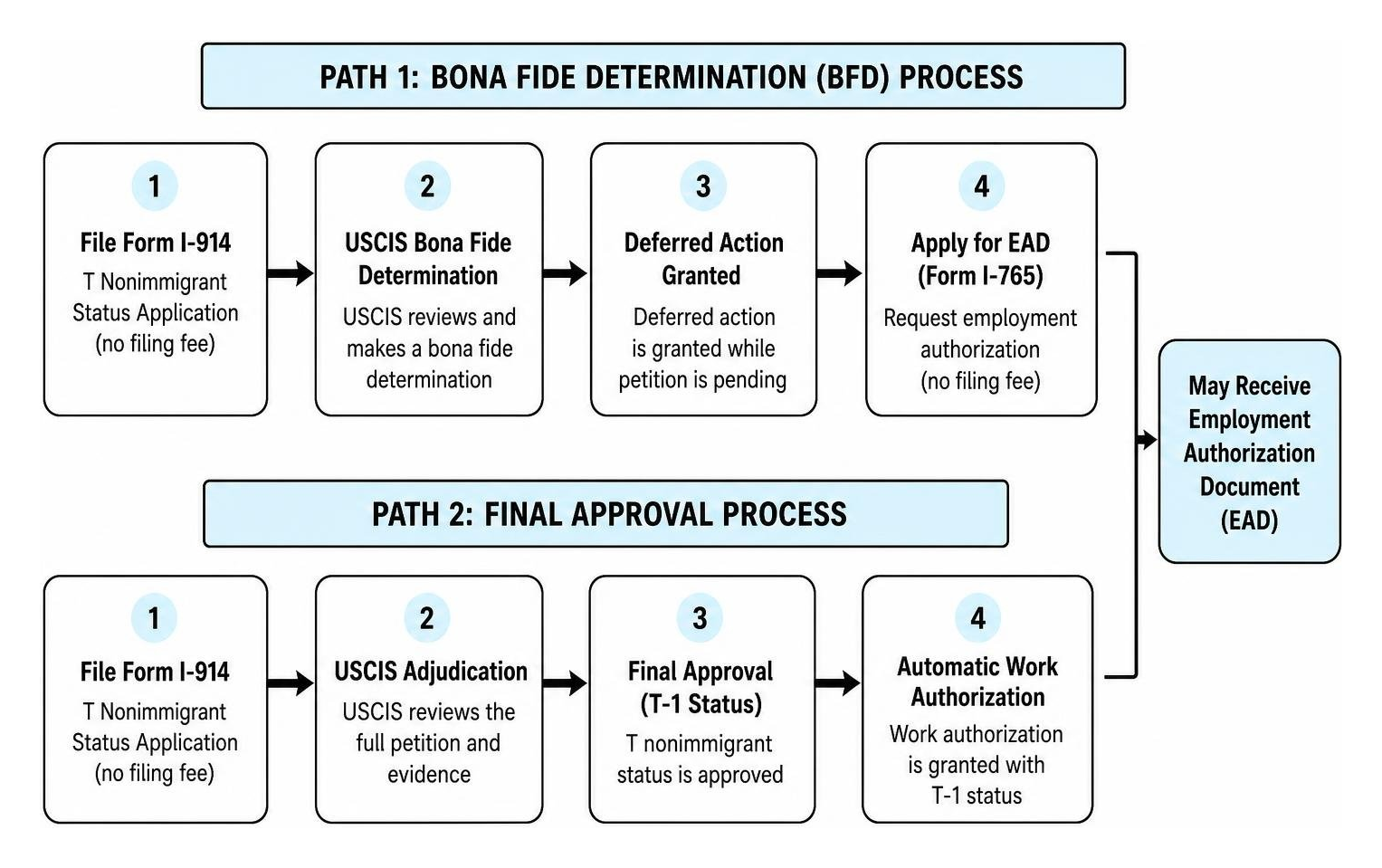
The following table outlines the key differences between obtaining an EAD via the bona fide determination process and receiving automatic work authorization upon final approval of T-1 nonimmigrant status:
| Criterion | Bona Fide Determination (BFD) EAD | Final Approval (T-1 Status) EAD |
|---|---|---|
| Statutory Basis | Discretionary grant under Deferred Action | Status-based work authorization |
| Form I-765 Eligibility Category | Category (c)(14) | Category (a)(16) |
| Issuance Mechanism | Requires Form I-765 adjudication | Generated automatically upon Form I-914 approval |
| Standard Validity Period | Up to 4 years (tied to deferred action) | 4 years (matching T-1 validity period) |
| Public Benefits Access | Limited state/local relief; case-by-case | Full federal refugee-equivalent benefits via ORR |
| Deportation Protection | Temporary administrative deferred action | Full lawful nonimmigrant status |
These regulatory protections ensure that applicants who present credible claims are safeguarded from removal while waiting for full adjudication, reflecting the humanitarian principles detailed in the USCIS T Visa Policy Updates.
Qualifying for a T Visa Work Permit Through Bona Fide Determination
A bona fide determination represents an initial finding by USCIS that your Form I-914 is complete, properly filed, and presents credible evidence supporting each eligibility requirement. During this initial review, USCIS verifies that:
- The application includes all mandatory sections, signatures, and primary personal statements.
- Background checks and biometrics have been completed without revealing disqualifying national security or public safety concerns.
- The submitted record establishes prima facie eligibility for severe trafficking, physical presence, law enforcement cooperation (or an exception), and extreme hardship.
Once USCIS issues a bona fide determination notice and grants deferred action, they adjudicate the concurrently filed Form I-765 under category (c)(14), issuing an EAD card that allows you to work legally throughout the extended adjudication window.
Automatic Work Authorization After Final T-1 Status Approval
When USCIS grants final approval of Form I-914, your legal classification changes to T-1 nonimmigrant status. Work authorization for a T-1 principal applicant is incident to status, meaning you are legally permitted to work automatically as a matter of law.
Upon approval, USCIS issues an approval notice along with Form I-94 showing T-1 status under employment authorization category (a)(16). The agency automatically generates an EAD card valid for the standard four-year duration of T nonimmigrant status. With this card, you can obtain an unrestricted Social Security number, secure standard driver's licenses, and access comprehensive federally funded support services, including refugee-equivalent resettlement benefits administered through the Office of Refugee Resettlement (ORR).
How to Apply for an EAD with Form I-914 and Form I-765
Applying for work authorization involves submitting a comprehensive petition package to USCIS. Because safety is paramount for trafficking survivors, federal law (8 U.S.C. § 1367) mandates strict confidentiality protections. USCIS cannot disclose your application details to third parties or use information provided solely by traffickers to make adverse immigration decisions. Applicants can also list a designated safe mailing address on all forms to ensure correspondence arrives securely without alerting unauthorized parties.

Step-by-Step Filing Procedures for a T Visa Work Permit
To request early work authorization via a bona fide determination while preserving automatic issuance upon approval, submit your paperwork following these core steps:
- Complete Form I-914: Fill out the Application for T Nonimmigrant Status thoroughly, detailing personal biographic data, trafficking history, and hardship elements.
- Complete Form I-765: File Form I-765 concurrently with Form I-914. Principal applicants seeking pre-approval authorization under a bona fide determination should select category (c)(14).
- Submit to the Direct Filing Center: Mail the complete package to the designated USCIS service center handling humanitarian petitions (primarily the Vermont Service Center).
- Receive Receipt Notices: USCIS will issue Form I-797C receipt notices confirming delivery and case tracking numbers for both forms.
- Complete Biometrics: Attend the mandatory biometrics appointment at your local Application Support Center (ASC) for fingerprinting and background checks.
Fee Exemptions and Required Supporting Documentation
Trafficking survivors are completely exempt from paying filing fees for Form I-914, Form I-765, and Form I-192. You do not need to file a separate fee waiver request (Form I-912) because the entire filing category is fee-exempt.
Your application must include robust corroborating documentation:
- Detailed Personal Declaration: A comprehensive statement describing your trafficking victimization, the means of force, fraud, or coercion used, your escape, and why returning to your home country would result in severe hardship.
- Law Enforcement Declaration: Form I-914 Supplement B, Declaration of Law Enforcement Officer for Victim of Trafficking in Persons, completed by a federal, state, or local investigative agency (or proof of reasonable cooperation/trauma exceptions).
- Mental Health and Medical Evaluations: Extensive psychological assessments demonstrating trauma, PTSD, depression, anxiety, and extreme hardship. For deeper insights on how clinical evidence substantiates these claims, read about evaluating trauma and extreme hardship with a T-visa psychological report.
- Secondary Corroboration: Medical records, police incident reports, shelter letters, wage receipts, text messages, and third-party witness affidavits.
Securing Work Permits for Derivative Family Members
Principal T-1 applicants can include eligible family members in their petition by submitting Form I-914, Supplement A. Derivative categories depend on the principal applicant's age:
- Principal Applicant Under 21: May petition for spouses (T-2), unmarried children under 21 (T-3), parents (T-4), and unmarried siblings under 18 (T-5).
- Principal Applicant 21 or Older: May petition for spouses (T-2) and unmarried children under 21 (T-3).
- Adult or Minor Facing Retaliation: Certain adult or minor children of qualifying derivatives (T-6) may also qualify if facing severe danger of retaliation from the traffickers.
Unlike principal applicants, derivative family members do not receive automatic work authorization incident to status. To obtain an EAD, derivatives residing in the United States must file Form I-765 under category (c)(25). If derivatives are abroad, they must complete consular processing through the Department of State, enter the United States on their derivative T visa, and subsequently file Form I-765 to receive their employment authorization card.
Processing Timelines, EAD Validity, and Pathways to Permanent Residency
The overall processing timeline for a T visa petition spans several phases. Initial intake, receipt issuance, and biometrics processing typically take between 1 to 3 months. Following biometrics, USCIS conducts the bona fide determination review to assess eligibility for deferred action and a category (c)(14) work permit. Full statutory adjudication of the Form I-914 often takes between 12 to 24 months or more depending on service center caseloads.
T nonimmigrant status is granted for an initial duration of 4 years. If an applicant requires additional time due to law enforcement needs, exceptional circumstances, or delays in adjusting status, they can apply for an extension using Form I-539.
After maintaining continuous physical presence in the United States for at least 3 years in lawful T-1 status—or upon the official completion of the trafficking investigation or prosecution—the survivor becomes eligible to adjust status to lawful permanent residence (obtain a Green Card) by filing Form I-485.
To satisfy the requirements detailed in the USCIS Green Card Requirements for T Nonimmigrants, applicants must maintain continuous residence (absences cannot exceed 90 single days or 180 cumulative days unless justified by law enforcement needs), demonstrate good moral character, and establish continued compliance with reasonable requests or hardship exceptions. Establishing continuous hardship and ongoing psychological impact during the transition to permanent residence is supported by comprehensive immigration psychological evaluation protocols, ensuring the full clinical record is documented for USCIS adjudicators.
Frequently Asked Questions About T Visa Work Permits
What happens to my work permit if my T visa application is denied?
If USCIS denies your Form I-914, any temporary work authorization and deferred action granted under a bona fide determination are automatically terminated. However, denial does not immediately lead to removal proceedings unless there are serious criminal issues or national security grounds. Applicants have the legal right to file an administrative appeal or a motion to reopen/reconsider using Form I-290B within 33 calendar days of the denial notice.
Do I have to pay USCIS filing fees for my work authorization document?
No. Under federal regulations, all initial and renewal applications for Form I-765 filed by T nonimmigrant status applicants (whether under bona fide deferred action category (c)(14) or derivative category (c)(25)) are 100% exempt from USCIS filing fees. Associated biometrics and Form I-192 inadmissibility waivers are also completely fee-exempt.
Can I renew or extend my work permit while waiting for green card approval?
Yes. If your Form I-485 adjustment of status application is pending and your underlying four-year T-1 status is nearing expiration, you can maintain continuous work authorization. You can either apply for an extension of your T nonimmigrant status using Form I-539 or file Form I-765 under category (c)(9) based on your pending adjustment of status application. USCIS policy provides for automatic extensions of employment authorization while an adjustment-based EAD renewal is pending.
Conclusion
Securing a T visa work permit offers vital financial stability, legal protection, and a foundation for long-term recovery after enduring the trauma of human trafficking. Because establishing severe harm, fear of removal, and trauma-based exemptions requires compelling clinical evidence, having an objective mental health evaluation can strengthen your legal petition.
At District Counseling, we specialize in conducting thorough, trauma-informed psychological evaluations for immigration cases across Texas, including Houston, Austin, Dallas, and San Antonio, as well as serving clients across our practice locations in Florida, California, New York, Utah, Virginia, and Idaho. Our clinicians provide seamless Spanish-language evaluations that are translated into English, ensuring our clients feel understood and supported throughout every step of their journey. To support long-term healing, we also provide six complimentary therapy sessions following the completion of your evaluation report.
When you are ready to document your case and move toward legal security, schedule an evaluation for your T visa case with our experienced clinical team.