
Understanding Your Immigration Psychological Assessment Step by Step
What Is an Immigration Psychological Assessment and How Does It Work?

Navigating the United States legal immigration system involves meeting stringent evidentiary standards, where personal testimony alone is often insufficient. An immigration psychological evaluation serves as an objective, scientific bridge between your personal lived experience and the complex legal standards enforced by United States Citizenship and Immigration Services (USCIS) and the Executive Office for Immigration Review (EOIR).
Unlike ordinary therapy records, a forensic psychological report is tailored to answer specific psycholegal questions posed by immigration law. Adjudicators—whether an asylum officer, a USCIS field examiner, or an immigration judge—rely on these comprehensive documents to evaluate clinical claims, establish credibility, and understand the functional impact of trauma, persecution, or family separation. To withstand judicial scrutiny, evaluators must adhere to strict psychological evaluation standards and established professional guidelines for immigration assessments.
| Feature | Standard Clinical Assessment (Therapy) | Forensic Immigration Psychological Assessment |
|---|---|---|
| Primary Purpose | Diagnose mental health conditions to formulate a treatment plan and facilitate personal healing. | Answer specific legal questions (e.g., hardship, persecution sequelae) for immigration adjudicators. |
| Role of Evaluator | Supportive advocate, counselor, and therapeutic ally. | Neutral, objective forensic evaluator; maintains clinical neutrality. |
| Confidentiality | Highly protected; shared only with client consent or under strict safety mandates. | Limited; findings are compiled into a formal legal report submitted to attorneys, USCIS, or immigration courts. |
| Data Sources | Primarily client self-report during counseling sessions. | Multi-method: clinical interviews, psychometric tests, symptom validity checks, and extensive collateral records. |
| Evidentiary Focus | Symptom reduction, personal growth, and emotional support. | Psycholegal nexus, functional impairment, objective consistency, and diagnostic credibility. |
Clinical Diagnostics vs. Forensic Psycholegal Evaluation
In standard therapy, the relationship between the provider and client is built on unconditional positive regard and therapeutic advocacy. In a forensic setting, however, clinical neutrality is essential. The evaluator does not act as your legal attorney or your personal cheerleader; instead, our responsibility is to provide an unbiased, scientifically sound evaluation of your mental health.
A forensic evaluation establishes a psycholegal nexus—the causal link between your psychological symptoms and the legal standard required for immigration relief. For instance, rather than merely stating that an individual experiences depression, a forensic report details how that clinical depression directly stems from specific past persecution or how the deportation of a parent will cause severe psychological decompensation in a qualifying child.
Primary Case Types: Asylum, Waivers, VAWA, and U-Visas
Different immigration pathways require distinct clinical assessments tailored to statutory requirements:
- Asylum Claims: Governed by international and domestic protection laws, asylum evaluation protocols document the psychological aftermath of past persecution or substantiate a well-founded fear of future persecution based on race, religion, nationality, membership in a particular social group, or political opinion.
- Violence Against Women Act (VAWA): In self-petitions filed by abused spouses, children, or parents of U.S. citizens or lawful permanent residents, structured VAWA evaluation processes document battery or "extreme cruelty," highlighting coercive control, psychological abuse, and post-traumatic stress.
- U-Visas and T-Visas: For victims of qualifying crimes (such as domestic violence, felonious assault, or human trafficking) who assist law enforcement, U Visa psychological assessment criteria substantiate that the applicant suffered "substantial physical or mental abuse."
- Extreme Hardship Waivers (I-601 / I-601A): These assessments evaluate the profound emotional, developmental, and psychological harm a qualifying U.S. citizen or permanent resident relative would endure if their family member were removed, applying established extreme hardship standards.
Step-by-Step Stages of the Clinical Forensic Process
A thorough forensic assessment involves structured clinical steps to ensure findings are defensible in court. Following a clear immigration psychological evaluation guide helps alleviate stress by ensuring you understand what will happen during each phase.
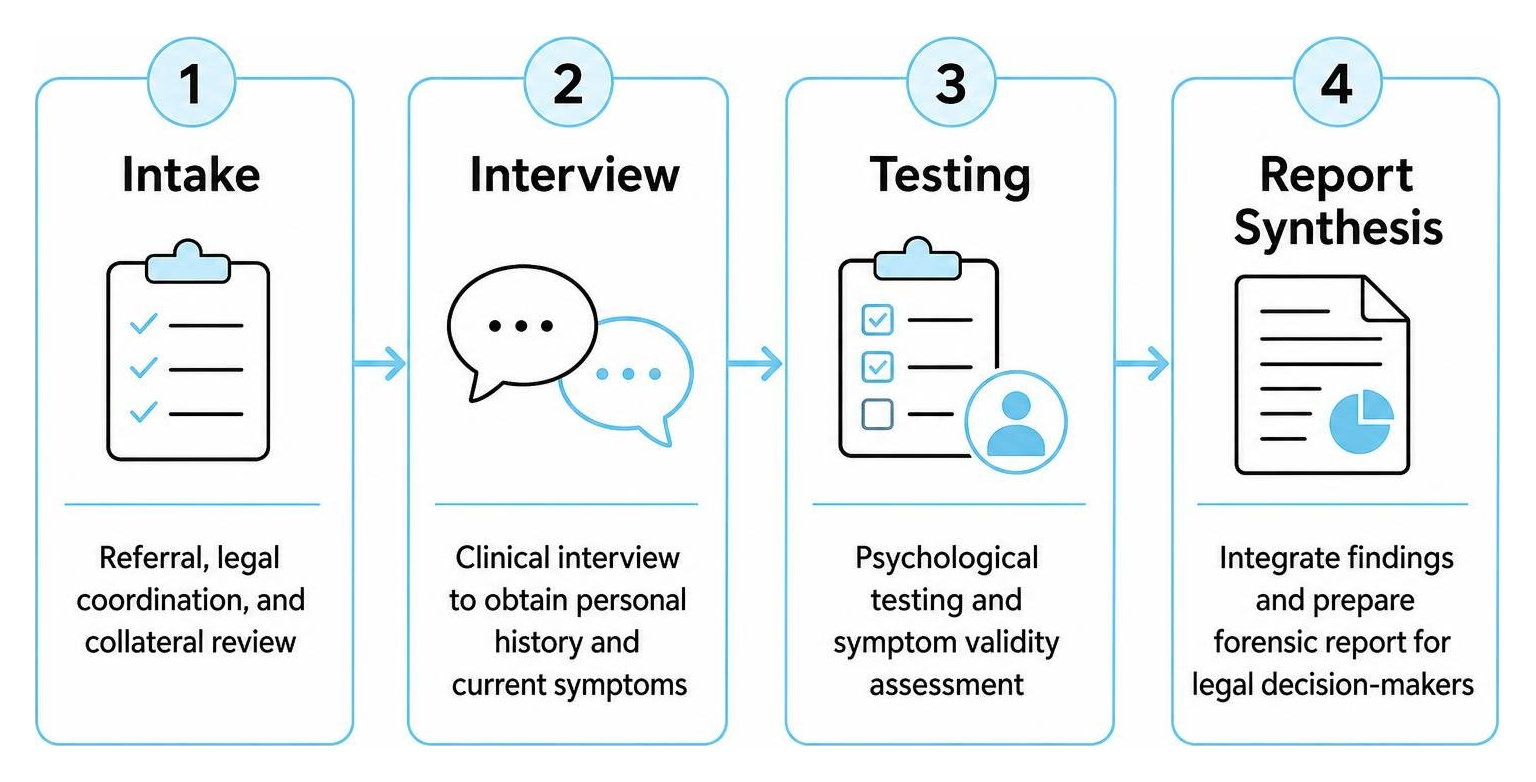
Step 1: Referral, Legal Coordination, and Collateral Review
The process begins when your immigration attorney contacts us with a specific referral question. Before conducting your interview, we review your background legal and personal documents. These collateral records can include:
- Attorney declarations and legal briefs
- Police reports, protective orders, and incident summaries
- Prior medical and psychiatric records
- School reports, Individualized Education Programs (IEPs), and academic progress records for children
- Country conditions reports documenting human rights violations
Collateral records offer crucial verification, anchoring your personal narrative to objective, verifiable facts.
Step 2: Clinical Forensic Interviews and Trauma History
The interview phase typically spans multiple hours across one or more clinical sessions. We explore developmental background, family dynamics, medical history, migration journeys, and direct exposure to traumatic events.
To maintain cultural accuracy and comfort, we ensure bilingual immigration evaluation standards are respected. Communicating in your primary language removes intermediate translation barriers, allowing nuanced emotional distress to be captured accurately. Evaluators utilize trauma-informed interviewing techniques, providing structured breaks and grounding exercises to prevent retraumatization while collecting necessary historical details.
Step 3: Psychometric Testing and Objective Scoring
Self-reported symptoms are evaluated using standardized, cross-culturally validated psychological instruments. These psychometric tools provide objective data that corroborate clinical interview findings. Common instruments include:
- PTSD Checklist for DSM-5 (PCL-5): Measures the presence and severity of post-traumatic stress symptoms.
- Beck Depression Inventory-II (BDI-II) / PHQ-9: Quantifies depressive severity and cognitive-affective distress.
- Beck Anxiety Inventory (BAI) / GAD-7: Evaluates physiological and emotional anxiety markers.
- Minnesota Multiphasic Personality Inventory (MMPI-3): Provides a comprehensive profile of personality functioning and psychological distress, complete with embedded validity scales.
Incorporating symptom and performance validity indicators is essential in forensic evaluations to demonstrate that responses are genuine, reliable, and not exaggerated.
Step 4: Report Synthesis and Legal Formulation
Following the interview and test administration, we synthesize all clinical data, collateral documents, and test scores into a detailed forensic psychological report.
The final document outlines:
- Professional Credentials and Legal Scope: Establishing the evaluator's qualifications.
- Psycholegal Formulation: Clear diagnostic impressions aligned with the Diagnostic and Statistical Manual of Mental Disorders (DSM-5-TR).
- Causal Connections: Linking identified trauma, abuse, or hardship directly to legal criteria.
- Prognosis and Recommendations: Detailing the psychological risks of removal, required clinical interventions, and long-term prognosis.
Scientific Methodology, Credibility, and Trauma Science
Immigration adjudications often hinge on a single central factor: credibility. However, a significant gap exists between traditional legal expectations of credibility and the scientific reality of how human memory processes extreme trauma. An empirical study on adjudicating credibility reveals that while courts often look for a linear, chronological story, the neuroscience of trauma shows that traumatic memories are naturally fragmented and disjointed.
In fact, research shows that 65.62% of immigration lawyers cite addressing credibility concerns—such as internal inconsistencies in a client’s statements—as a primary reason for seeking an assessment, while 93.75% seek assessments to validate past harm, cruelty, or hardship claims.
How an Immigration Psychological Assessment Bridges Trauma and Credibility
Neurobiological research confirms that severe distress floods the brain with neurochemicals (such as cortisol and adrenaline) that impair the hippocampus—the area responsible for encoding linear, time-stamped autobiographical memories. As a result, trauma survivors frequently recall central sensory fragments vividly while experiencing gaps in peripheral details, dates, or sequences.
When an immigration judge or asylum officer perceives these normal memory gaps as deceit, a forensic evaluation provides objective clinical clarification. In our reports, we explain how symptoms like avoidance, emotional numbing, dissociation, and memory fragmentation directly account for apparent narrative discrepancies, bringing scientific clarity to legal proceedings, as noted in studies on psychiatric evidence in immigration cases.
The Istanbul Protocol and International Forensic Guidelines
The Manual on the Effective Investigation and Documentation of Torture and Other Cruel, Inhuman or Degrading Treatment or Punishment (known worldwide as the Istanbul Protocol) serves as the international gold standard for documenting torture and ill-treatment.
The Istanbul Protocol emphasizes evaluating:
- The consistency between an individual’s trauma account and their observed psychological sequelae.
- The physical and mental symptoms that develop over time following torture or persecution.
- The plausibility of symptoms given the cultural and political context of the applicant’s home country.
Despite its importance, studies indicate that 69.23% of mental health professionals report being unfamiliar with the Istanbul Protocol. Qualified forensic evaluators should integrate Istanbul Protocol principles to ensure psychological findings meet international evidentiary standards.
Malingering vs. Credibility: Dismantling Common Misconceptions
A persistent hurdle in immigration proceedings is the confusion between clinical malingering and perceived credibility:
- Malingering: The intentional production of false or grossly exaggerated physical or psychological symptoms, motivated by external incentives (such as avoiding deportation).
- Credibility: A legal determination made by an adjudicator regarding the overall believability of a witness’s testimony.
Survey data reveals that 45.65% of surveyed mental health professionals were unsure whether there was a difference between malingering and credibility, and 15.22% incorrectly stated there was no difference.
Forensic evaluators do not make final legal credibility judgments—that remains the exclusive domain of the judge. Instead, we use standardized symptom validity tests (such as the SIMS, TOMM, or embedded MMPI-3 validity indicators) to verify that an applicant is responding truthfully. When psychometric validity scales show no evidence of feigning or exaggeration, that objective clinical finding strengthens the credibility of the entire application.
Evidentiary Value in Removal Proceedings and Hardship Cases
The inclusion of an objective psychological assessment has a statistically verifiable impact on immigration case outcomes. Landmark research underscores the transformative value of forensic documentation:
- Applicants who submitted forensic evaluations from Physicians for Human Rights (PHR) achieved an 81.6% grant rate, compared to a national asylum grant rate of 42.4%.
- A broader study evaluating 746 asylum cases demonstrated an 89% grant rate for cases supported by forensic medical/psychological evaluations, compared to just 37.5% for cases lacking forensic evaluation support.
These statistics highlight why mental health evaluations carry substantial evidentiary weight: they provide independent, objective clinical evidence that substantiates subjective claims of fear, suffering, and emotional trauma.
Psychological Evaluations for Cancellation of Removal and Hardship
For Non-LPR Cancellation of Removal (Form EOIR-42B) and I-601/I-601A provisional unlawful presence waivers, applicants must demonstrate that their deportation would result in "exceptional and extremely unusual hardship" or "extreme hardship" to a qualifying relative who is a U.S. citizen or lawful permanent resident. Meeting cancellation of removal psych eval requirements requires a thorough look at how separation or relocation affects a qualifying family member's well-being.
Our evaluations assess:
- Developmental Disruptions: The psychological and educational impact on children, especially those receiving special education services or therapy.
- Decompensation Risk: The risk that a qualifying spouse or parent will experience acute depressive or anxious decompensation if separated from their primary emotional and caregiving support.
- Medical Comorbidities: The compounded psychological distress of managing chronic illnesses in an environment lacking adequate care or financial stability.
Today, clients in Texas and other permitted states (such as Florida, California, Utah, and Idaho) can access these evaluations through secure, compliant evaluaciones psicológicas por telehealth, ensuring comprehensive forensic access regardless of geographical distance.
Preparing for Your Immigration Psychological Assessment
Proper preparation ensures a smooth and productive clinical assessment. When you attend your evaluation, having organized documentation helps your evaluator establish a thorough historical record.
Checklist of Helpful Documentation for Your Assessment:
- Identification (Passport, consular ID, driver’s license, or state ID)
- Current immigration case records (Notice to Appear, prior declarations, legal filings)
- Police reports, protective orders, or official incident records (especially for U-Visa, T-Visa, or VAWA cases)
- Medical records detailing chronic illnesses, physical injuries, or past surgeries
- Existing mental health records, therapy notes, or psychiatric prescriptions
- Academic records, IEP files, and developmental assessments for qualifying children
- Letters from family members, community organizations, or employers corroborating your role in the household
Frequently Asked Questions About Immigration Evaluations
How long does an immigration psychological assessment take from start to finish?
The clinical assessment process typically involves 2 to 4 hours of direct interview and testing time, which may be scheduled in one or two appointments. After the interviews and psychometric scoring are complete, drafting and finalizing the 10-to-15-page forensic report usually takes 2 to 3 weeks. Expedited evaluations can often be arranged when court submission deadlines require faster turnaround.
Will an immigration psychological evaluation guarantee my case approval?
No clinical evaluation can guarantee approval. Immigration relief is granted at the discretion of USCIS adjudicators and immigration judges. However, research demonstrates that objective evaluations substantially improve grant rates—increasing relief rates up to 81.6% to 89% in documented studies—by providing the court with concrete clinical evidence that verifies hardship, abuse, or past trauma.
Can an immigration psychological assessment be completed via telehealth?
Yes. USCIS and immigration courts accept psychological evaluations conducted via secure, HIPAA-compliant telehealth platforms. Research confirms that remote clinical assessments yield diagnostic accuracy and psychometric reliability comparable to in-person interviews, provided the evaluator is properly licensed in the state where the client is physically located during the appointment.
Conclusion
An immigration psychological assessment is an objective forensic tool that helps bridge personal trauma and legal standards. By applying validated psychometric instruments, trauma-informed interview methods, and established forensic standards, our reports provide clear, independent clinical findings for immigration courts and USCIS.
At District Counseling, we provide thorough psychological evaluations for asylum, U-Visas, VAWA, hardship waivers, and deportation proceedings across Texas—including Houston, Katy, Cypress, Sugar Land, Austin, Dallas, and San Antonio—as well as clients in Florida, California, New York, Utah, Virginia, and Idaho. We conduct direct evaluations in Spanish and provide certified English translations for legal submission. Because we recognize that recounting trauma is emotionally challenging, we also offer our clients six complimentary therapy sessions following the completion of their forensic report to support their ongoing well-being.
If you are navigating removal proceedings or preparing an affirmative petition, contact a qualified forensic evaluator to discuss an evaluación psicológica para un caso de cancelación de deportación and ensure your case is supported by sound clinical evidence.