
Medical and Mental Health Asylum Evaluations Explained
How an Asylum Evaluation Can Strengthen Your Immigration Case

An asylum evaluation is a forensic medical or mental health assessment that documents how persecution, violence, torture, or other serious harm has affected you. A licensed clinician interviews you, reviews relevant records, may use mental health screening tools, and prepares an objective report for your attorney to submit as evidence to USCIS or immigration court.
For many applicants, this report can help explain PTSD, depression, anxiety, memory gaps, sleep problems, or physical injuries that may otherwise be misunderstood as inconsistency or a lack of credibility. It does not replace your testimony or prove every legal part of an asylum claim, but it can provide important clinical support for what you experienced.
If you are considering an evaluation, take these steps early:
- Ask your immigration attorney whether a forensic psychological or medical report would support your case.
- Work with a qualified, trauma-informed evaluator who understands immigration legal standards.
- Share relevant records and prepare to discuss your history at a pace that protects your well-being.
- Allow time for the written affidavit to be completed and filed before your interview or court deadline.
I am Francisco Ortiz, a Certified Forensic Mental Health Evaluator and licensed clinician who conducts trauma-informed asylum evaluation services and other immigration-focused psychological assessments. My work includes asylum, hardship waiver, U-Visa, T-Visa, and immigration-court competency evaluations, with bilingual support for Spanish-speaking clients.
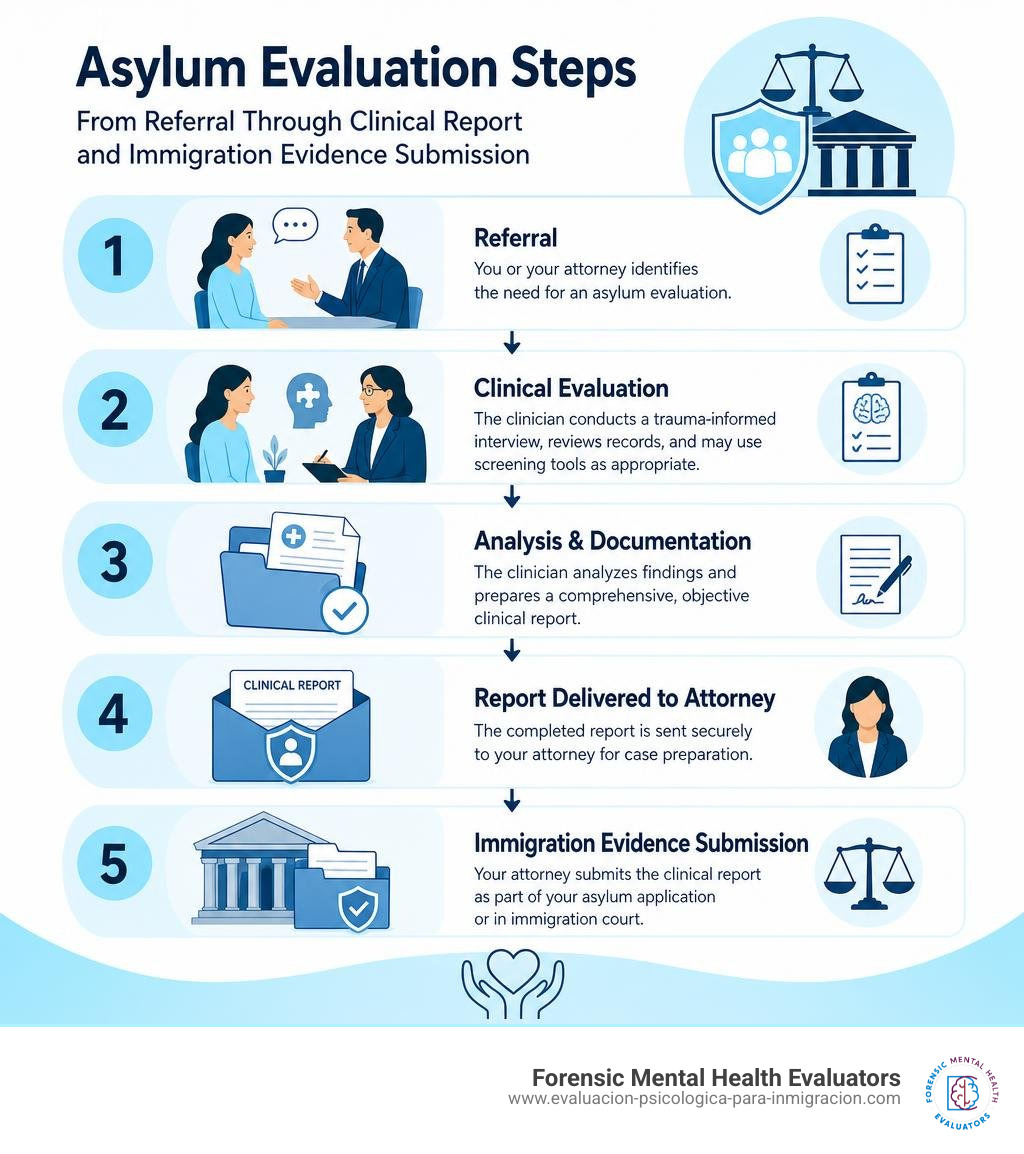
The Role and Purpose of an Asylum Evaluation in Immigration Cases
Seeking refuge in the United States requires navigating an intricate legal landscape. Whether someone applies affirmatively through United States Citizenship and Immigration Services (USCIS) or defends their claim before an Executive Office for Immigration Review (EOIR) immigration judge, the evidentiary burden rests firmly on the applicant. Under federal immigration statutes, an applicant must demonstrate that they have suffered past persecution or hold a well-founded fear of future persecution based on five protected grounds: race, religion, nationality, membership in a particular social group (PSG), or political opinion.
A thorough Immigration Psychological Evaluations Guide 2026 highlights how expert clinical assessments serve as objective corroboration in these proceedings. Medical and mental health evaluations do not simply restate a personal narrative; they independently document psychological trauma, evaluate physical sequelae of torture, and establish the clinical nexus connecting severe harm to protected legal grounds.
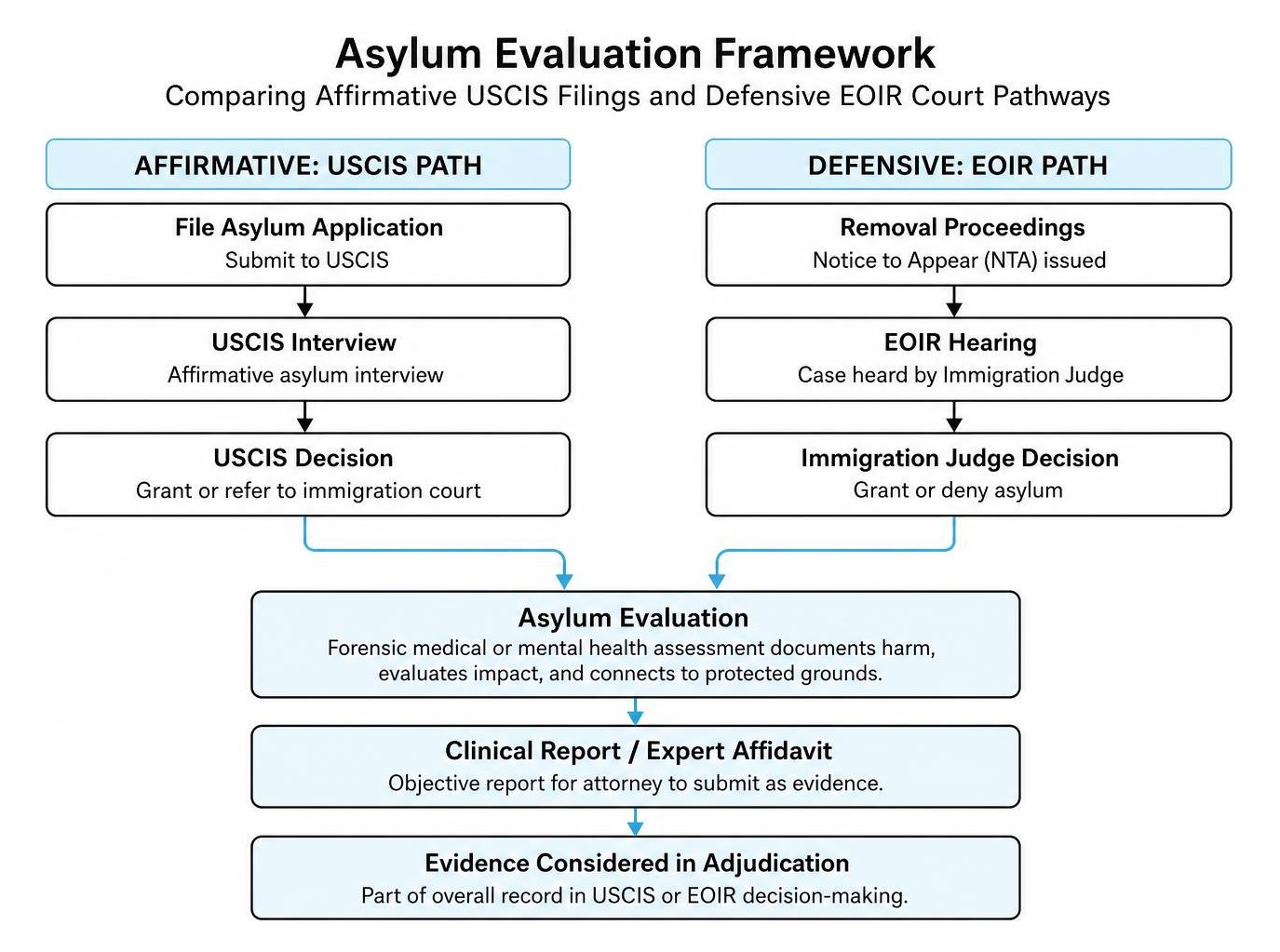
Clinical vs. Forensic Asylum Evaluation: Key Distinctions
Many people ask how a forensic evaluation differs from everyday clinical therapy. In ongoing therapy, the primary objective is treatment, emotional support, and symptomatic recovery within a confidential therapeutic alliance. In contrast, an asylum evaluation is a forensic assessment designed to answer specific medicolegal questions for adjudicators.
Forensic evaluators maintain strict professional objectivity, evaluating diagnostic validity through structured psychometric instruments, clinical interviews, and behavioral observations. Because the written report serves as legal evidence, the clinician does not act as a legal advocate, but rather as an independent expert witness. For an in-depth breakdown of clinical assessments across humanitarian relief categories, our Immigration Mental Health Evaluation resource details how standard diagnostic thresholds are applied in legal contexts.
| Feature | Clinical Therapy | Forensic Asylum Evaluation |
|---|---|---|
| Primary Purpose | Symptom management, emotional support, and healing | Objective documentation of trauma and legal evidence creation |
| Role of Clinician | Therapeutic ally and ongoing care provider | Neutral, independent forensic expert |
| Confidentiality | Strict therapist-client privilege | Limited; findings are detailed in a report for USCIS/EOIR |
| Standard Output | Progress notes and treatment plans | Comprehensive medicolegal affidavit adhering to international guidelines |
| Scope of Inquiry | Client-led personal growth and coping strategies | Psychosocial history, trauma exposure, and diagnostic testing |
Evidentiary Weight and Impact on Asylum Grant Rates
The impact of submitting an objective forensic evaluation is substantial. Historically, immigration judges denied close to 74% of asylum cases in fiscal year 2020. However, research demonstrates that clinical documentation alters these outcomes significantly. A study co-sponsored by Physicians for Human Rights showed that immigrants who obtained forensic evaluations were granted protection at nearly twice the national asylum grant rate. In fact, peer-reviewed clinical studies have found that up to 89% of asylum seekers who underwent a clinical evaluation were granted relief, compared to a national grant average of just 37.5% during the same reference timeframe.
When individuals undergo Credible Fear Screenings | USCIS after arriving at ports of entry, establishing a significant possibility of persecution is essential. A comprehensive psychological affidavit provides adjudicators with clear evidence corroborating subjective testimony, bridging the gap between clinical distress and legal credibility.
Clinical Methodology and Trauma-Informed Interviewing Standards
Conducting an asylum assessment requires specialized clinical methodologies that prioritize client safety while systematically documenting complex trauma. At District Counseling, we serve clients across our offices in Houston, Katy, Cypress, and Sugarland, Texas, as well as throughout Florida, California, New York, Utah, Virginia, and Idaho. Because talking about past violence can be difficult, we ensure Spanish evaluations are smoothly translated to English, maintain client comfort throughout every meeting, and provide 6 free therapy sessions post-report to ensure ongoing emotional support.
For Spanish-speaking individuals seeking clarity on this process, our Evaluación Psicológica para Caso de Asilo resource outlines our culturally sensitive intake and diagnostic procedures.
Step-by-Step Process of a Mental Health Asylum Evaluation
Completing a rigorous evaluation involves several structured phases, typically requiring 10 to 20 hours of total clinician time:
- Intake and Psychosocial History: Reviewing developmental background, family history, educational attainment, and baseline functioning prior to persecution.
- Standardized Diagnostic Testing: Administering psychometric instruments such as the Post-Traumatic Stress Disorder Checklist (PCL-5) and Patient Health Questionnaire-9 (PHQ-9) to measure trauma severity, depression, and functional impairment.
- Detailed Trauma Narrative: Gathering chronological accounts of threats, physical abuse, detention, or state-sponsored violence in a non-adversarial environment.
- Collateral Document Review: Analyzing police reports, medical records, witness statements, and country condition reports to corroborate clinical findings.
- Report Drafting and Legal Synthesis: Writing a formal affidavit connecting clinical diagnoses directly to the asylum legal claim.
For an extensive walkthrough of clinical testing standards, see our Asylum Psychological Assessment Complete Guide.
Trauma-Informed Techniques, Memory Distortion, and Unaccompanied Minors
Trauma directly alters neural pathways involved in memory consolidation and recall. Severe chronic stress, attachment disruptions, and acute threats impair the hippocampus and prefrontal cortex, often causing fragmented, non-linear memories. In immigration hearings, memory lapses can be mistaken for dishonesty if the evaluator does not place them in proper clinical context.
Official guidance such as Assessing credibility and refugee status post 28 June 2022 confirms that decision-makers must consider how psychological distress shapes recall. When assessing unaccompanied minors, evaluators must adapt interviews using child-friendly language, collateral caretaker interviews, and explicit assent protocols to prevent retraumatization.
Medicolegal Affidavits, Istanbul Protocol, and Court Requirements
A forensic psychological affidavit is a legal document submitted under penalty of perjury. To withstand cross-examination by government attorneys, the evaluation must follow internationally recognized medicolegal standards. If your case involves concurrent removal defense strategies, our Asylum Cancellation Psych Evaluation overview explains how clinical documentation supports diverse avenues of immigration relief.
Istanbul Protocol Consistency Ratings and Diagnostic Formats
The Manual on the Effective Investigation and Documentation of Torture and Other Cruel, Inhuman or Degrading Treatment or Punishment (the Istanbul Protocol) defines specific clinical guidelines for rating physical and psychological trauma. Forensic reports categorize clinical findings using five standardized degrees of consistency:
- Not Consistent: The symptom or physical lesion could not have been caused by the reported trauma.
- Consistent With: The finding could have been caused by the trauma, but is non-specific and common across various causes.
- Highly Consistent: The finding is typical of the reported trauma, with few other plausible explanations.
- Typical Of: The finding is a characteristic presentation of the trauma, with very few other potential causes.
- Diagnostic Of: The symptom or lesion could not have been caused in any other way than the reported event.

Adjudication Deadlines, USCIS Procedures, and 8 CFR § 1208.13 Standards
Federal regulations under 8 CFR 1208.13 | Establishing asylum eligibility. | eCFR.io establish that an applicant's credible testimony may sustain the burden of proof, but corroborating evidence is vital. Under these rules, establishing past persecution creates a legal presumption of future fear, shifting the burden to the government to prove changed circumstances or reasonable internal relocation.
Procedural rules mandate strict compliance with evidence deadlines. Under the Affirmative Asylum Procedures, affirmative applicants must submit all supporting psychological affidavits at least 14 calendar days prior to their scheduled asylum interview to avoid rescheduling or delays on their 180-day employment authorization (EAD) clock. Additionally, Chapter 5 - Adjudication Procedures | USCIS details subsequent adjustment of status procedures, where initial forensic evidence remains part of the permanent record.
Professional Competencies, Ethical Guidelines, and Workforce Expansion
The demand for qualified forensic evaluators remains urgent. As of August 2026, immigration court backlogs continue to affect wait times nationwide, with cases taking years to reach final hearings. Expanding the clinical workforce requires specialized training in cross-cultural competence, medicolegal drafting, and trauma-informed interviewing.
To understand how language access affects clinical evaluations, read our Bilingual Immigration Evaluation Guide 2026. If you are looking for local support in Texas, our Texas Asylum Psychological Services page outlines regional resources across major metropolitan areas.
Clinician Qualifications and the Federal Rules of Evidence
Under the Federal Rules of Evidence, an expert witness must demonstrate specialized knowledge, skill, experience, training, or education. Qualified evaluators include licensed psychologists, licensed clinical social workers (LCSWs), licensed professional counselors (LPCs), licensed marriage and family therapists (LMFTs), and psychiatrists.
Clinicians must attach a current curriculum vitae (CV) to every affidavit, demonstrating their clinical licensure, assessment credentials, and relevant experience. For more on what credentials qualify an expert, review our guide to a Psychological Evaluation.
Ethical Dilemmas, Vicarious Trauma, and Mitigating Harm
Forensic evaluators face distinct ethical considerations:
- Secondary and Vicarious Trauma: Regularly reviewing accounts of torture, violence, and extreme persecution can lead to compassion fatigue and burnout, requiring active clinical peer supervision.
- Academic Clinic Training Risks: While training new clinicians is important, having multiple observers present during an evaluation can overwhelm an applicant. Interviews should remain as non-intrusive as possible.
- Data Security: Evaluators must safeguard clinical files, ensuring electronic records are fully encrypted and shared exclusively through secure legal channels.
Frequently Asked Questions About Asylum Evaluations
How does a psychological evaluation help an asylum case?
A psychological evaluation provides objective, third-party clinical corroboration of the trauma and persecution you experienced. It documents formal diagnoses (such as PTSD, Major Depressive Disorder, or Generalized Anxiety Disorder) and explains how trauma affects your daily functioning and memory recall, significantly increasing the statistical likelihood of relief.
How many hours does an asylum evaluation take to complete?
A comprehensive evaluation generally involves 3 to 5 hours of direct clinical interviews and psychometric testing, followed by records review and report drafting. In total, a clinician typically dedicates 10 to 20 hours to finalize a comprehensive medicolegal affidavit.
What qualifications must a clinician have to conduct an asylum evaluation?
Evaluators must be fully licensed mental health professionals (such as Licensed Psychologists, LCSWs, LPCs, LMFTs, or Psychiatrists) with clinical training in trauma assessment, diagnostic testing, cross-cultural competencies, and the Istanbul Protocol standards for medicolegal reporting.
Conclusion
An objective, professionally drafted asylum evaluation provides critical evidentiary support for individuals fleeing persecution and torture. By documenting trauma, validating symptom severity, and offering trauma-informed explanations for memory fragmentation, clinical reports help immigration judges and asylum officers fully understand the human reality behind each legal claim.
At District Counseling, we are committed to providing trauma-informed forensic evaluations across Texas, Florida, California, New York, Utah, Virginia, and Idaho. With Spanish evaluations smoothly translated to English, warm and respectful assessments, and 6 free therapy sessions post-report to support your well-being, we stand ready to assist you and your legal team. Contact our Forensic Mental Health Evaluators today to schedule an evaluation and take the next step in your immigration journey.