
The Mind and the Wallet: Are Psych Evaluations Covered by Insurance?
The Real Cost of a Psych Evaluation — and What Insurance Actually Pays

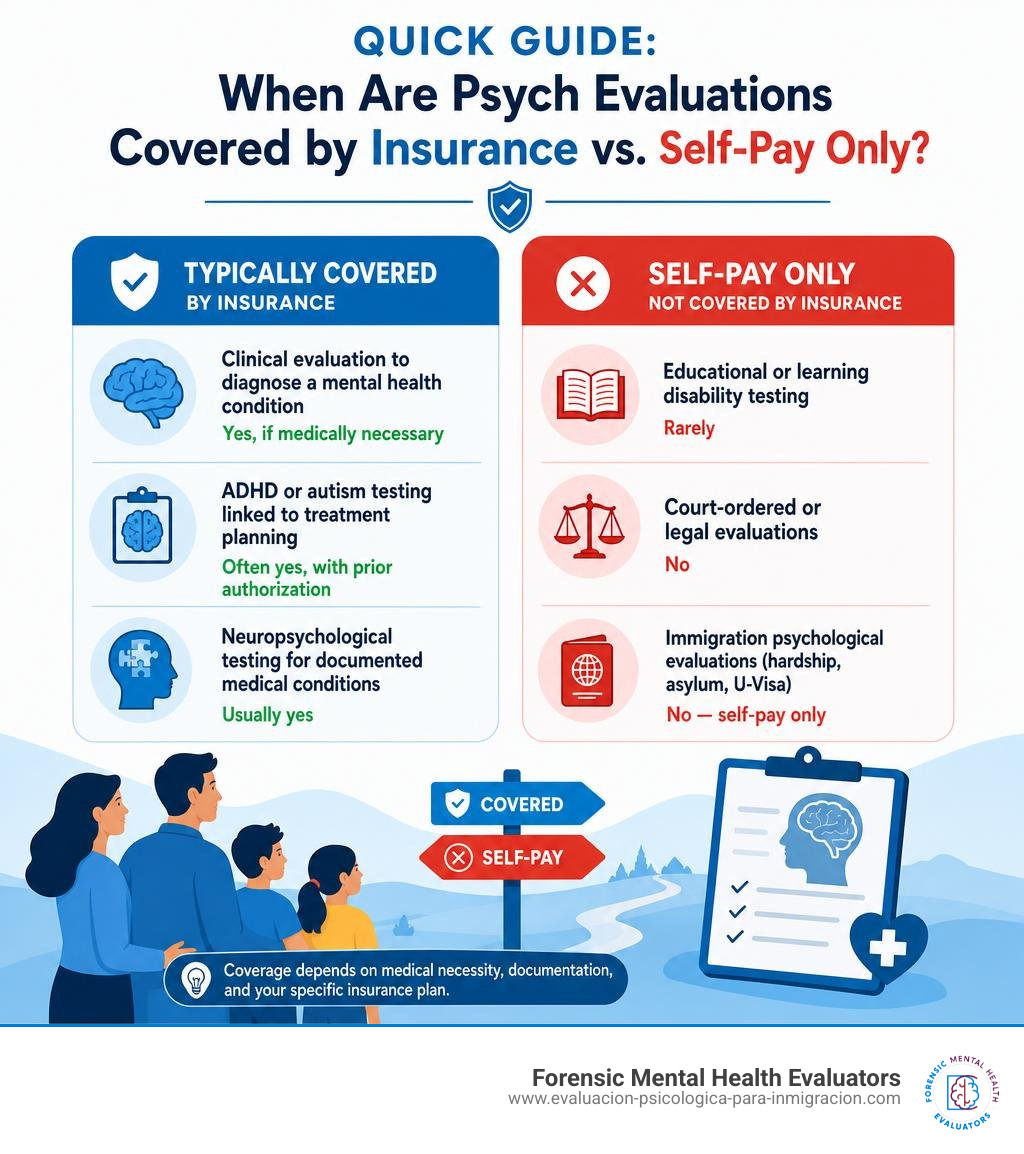
Are psych evaluations covered by insurance? Yes — but only under specific conditions, and many of the evaluations that immigrants and families need most are not covered at all.
Here is the short answer:
| Situation | Typically Covered? |
|---|---|
| Clinical evaluation to diagnose a mental health condition | Yes, if medically necessary |
| ADHD or autism testing linked to treatment planning | Often yes, with prior authorization |
| Neuropsychological testing for documented medical conditions | Usually yes |
| Educational or learning disability testing | Rarely |
| Court-ordered or legal evaluations | No |
| Immigration psychological evaluations (hardship, asylum, U-Visa) | No — self-pay only |
Nearly 1 in 5 U.S. adults live with a mental illness, and cost is the most commonly cited reason people never get help. A full psychological evaluation can run anywhere from $2,200 to $3,700 — even with insurance, if you haven't met your deductible yet.
For Hispanic immigrant families already navigating legal uncertainty, that number can feel impossible.
This guide breaks down exactly how insurance coverage works for psych evaluations, what gets excluded, and what your real options are when insurance won't pay.
I'm Francisco Ortiz, Lead Forensic Mental Health Evaluator at District Counseling PLLC and a Certified Forensic Mental Health Evaluator licensed in Texas, California, Florida, and three other states — and a significant part of my work involves the types of immigration psychological evaluations where are psych evaluations covered by insurance is the first question families ask. In the sections ahead, I'll walk you through everything you need to know to protect both your health and your wallet.
Are Psych Evaluations Covered by Insurance? The Core Rules of Coverage
Navigating health insurance can feel like trying to read a map written in a language you only half-understand. When it comes to mental health, those maps get even more complicated.

The foundational framework for mental health coverage in the United States rests on two major federal laws: the Mental Health Parity and Addiction Equity Act (MHPAEA) of 2008 and the Affordable Care Act (ACA) of 2010.
Under the ACA, mental and behavioral health services are classified as one of the ten "essential health benefits." This means that any ACA-compliant plan (including most employer-sponsored and marketplace plans) must offer mental health coverage.
Furthermore, the Mental Health Parity Guide explains that insurance companies are legally prohibited from putting stricter limits on mental health care than they do on physical health care. In other words, if your plan does not limit the number of visits you can make to a cardiologist, it cannot arbitrarily cap your visits to a psychiatrist or psychologist. The financial requirements (like copays and deductibles) and treatment limitations must be equal.
In September 2024, the federal government significantly strengthened these parity laws. New rules issued by the U.S. Departments of Health and Human Services, Labor, and the Treasury forced insurance companies to evaluate their provider networks and actively eliminate barriers that make it harder to access mental health services.
However, there is a catch. Parity laws do not mean that every test or evaluation is covered. The ultimate gatekeeper for whether your plan will pay for a psychological evaluation is a concept known as medical necessity.
The Definition of Medical Necessity in Mental Health
In the insurance world, "medical necessity" is the golden ticket. If a service is deemed medically necessary, your insurance is legally obligated to cover it (subject to your plan's deductibles and copays). If it is not, you will be left holding the bill.
But what does medical necessity actually mean for a psychological evaluation?
To meet the criteria for medical necessity, a psychological evaluation must be:
- Recommended by a licensed provider: A referral from a primary care doctor, pediatrician, or licensed therapist is often required to prove that a professional believes the testing is clinically indicated.
- Aimed at diagnostic clarification: The testing must be designed to answer a specific diagnostic question that cannot be resolved through a standard, 60-minute clinical interview. For example, if a therapist cannot tell whether a patient’s struggles are caused by severe ADHD, a learning disability, or trauma, a comprehensive evaluation becomes medically necessary to clarify the diagnosis.
- Directly tied to treatment planning: The results of the evaluation must have a direct, logical impact on the patient’s future medical or psychological treatment. If the test results will not change the treatment plan, the insurance company will argue that the test was not necessary.
If we are conducting an assessment simply to satisfy curiosity, or because a school suggested it without a formal referral, the insurer may deny the claim, stating that a standard clinical interview would have been sufficient.
Step-by-Step Guide: How to Verify If Are Psych Evaluations Covered by Insurance Under Your Plan
Before you book an appointment for a psychological evaluation, you must do your homework. Do not rely on a clinic's front desk to tell you what your insurance covers; they can give you estimates, but only your insurance company has the final say.
Follow this step-by-step process to verify your benefits:
- Log Into Your Member Portal: Go to your insurance provider’s website and locate your Summary of Benefits and Coverage (SBC). Look specifically for the "Outpatient Mental/Behavioral Health" section.
- Locate the Customer Service Number: Find the member services phone number on the back of your insurance card. There is often a dedicated number for "Behavioral Health" or "Mental Health."
- Call and Ask Specific Questions: When you speak to a representative, make sure to take detailed notes. Write down the date, the time, the name of the representative you spoke with, and a reference number for the call. Use this Guide to Mental Health Coverage to prepare your questions, which should include:
- Does my specific plan cover outpatient psychological testing (CPT codes 96130 and 96131)?
- Do I need prior authorization or a formal referral from my primary care physician before scheduling?
- Have I met my annual deductible? If not, how much do I need to pay out-of-pocket before coverage kicks in?
- What is my copay or coinsurance rate for these services once the deductible is met?
- Are there any specific exclusions, such as testing for learning disabilities or developmental delays?
Covered vs. Excluded Testing Types: What to Expect
Not all psychological evaluations are created equal. Insurance policies draw a very sharp line between clinical testing (which is designed to treat an illness) and educational, vocational, or legal testing (which is designed to help you succeed in school, get a job, or win a court case).
| Evaluation Category | Purpose | Typically Covered by Insurance? |
|---|---|---|
| Clinical Evaluations | Diagnosing depression, bipolar disorder, PTSD, schizophrenia, or personality disorders to guide therapy or medication. | Yes (Subject to medical necessity) |
| Neuropsychological Testing | Evaluating cognitive decline, memory issues, or brain function after a stroke, traumatic brain injury (TBI), or medical event. | Yes (Usually filed under medical insurance rather than behavioral health) |
| Developmental Testing | Assessing children for Autism Spectrum Disorder (ASD) or developmental delays. | Yes (Many states, including Texas, Florida, and California, have specific mandates requiring coverage) |
| Educational Testing | Identifying dyslexia, dyscalculia, giftedness, or general learning styles. | No (Insurers argue this is the legal responsibility of the public school system) |
| Vocational Testing | Career counseling, job placement assessments, or fitness-for-duty evaluations. | No |
| Forensic & Legal Testing | Court-ordered evaluations, custody disputes, or immigration psychological evaluations. | No |
ADHD, Autism, and Neuropsychological Testing Coverage
Testing for neurodevelopmental conditions like ADHD and Autism Spectrum Disorder (ASD) occupies a complex middle ground.
For Autism, coverage is generally robust. Because early intervention is so critical, most major insurance plans cover comprehensive autism assessments, including gold-standard tools like the Autism Diagnostic Observation Schedule (ADOS). In states like Texas, Florida, and California, state laws mandate that insurance providers cover autism-related services, including the initial diagnostic Psychological Evaluation.
ADHD testing, however, is frequently scrutinized. Many insurance companies argue that a formal, multi-hour psychological testing battery is "not medically necessary" to diagnose ADHD. They claim that a skilled psychiatrist or pediatrician can diagnose ADHD using standard clinical interviews and parent/teacher rating scales (which are much cheaper). To get ADHD testing covered, your psychologist must document why your case is complex — for example, if they need to rule out co-occurring learning disorders, anxiety, or trauma.
Neuropsychological testing, which measures brain function and cognitive abilities, is highly likely to be covered if there is a documented physical or medical cause. If you have suffered a concussion, a stroke, or are showing early signs of dementia, these evaluations are usually approved because they directly impact your neurological and medical care.
Forensic, Educational, and Legal Exclusions: When Are Psych Evaluations Covered by Insurance and When Are They Not?
This is where many families face painful surprises. If you need a psychological evaluation for any reason other than direct medical or mental health treatment, your insurance company will almost certainly deny coverage.
Common exclusions include:
- Educational Evaluations: If your child is struggling to read, you might want a private neuropsychological evaluation to check for dyslexia. However, insurance companies will deny this, stating that under the Individuals with Disabilities Education Act (IDEA), your local public school district is legally obligated to perform these assessments for free. Even if a comprehensive evaluation includes both clinical and educational components, the insurer will typically strip out the educational testing portion, forcing you to pay for that segment out-of-pocket.
- Court-Ordered & Custody Evaluations: If a judge orders you to undergo a psychological evaluation as part of a custody dispute, divorce, or criminal proceeding, this is considered a legal expense, not a medical one. Insurance will not pay for it.
- Immigration Evaluations: For those navigating the immigration system, an Immigration Mental Health Evaluation Guide is an invaluable tool. These evaluations document the extreme hardship, trauma, or abuse suffered by immigrants applying for U-Visas, asylum, VAWA, or cancellation of removal. Because these evaluations are conducted for legal and administrative purposes — rather than to design a medical treatment plan — they do not meet the definition of medical necessity. Consequently, health insurance will not cover them. They must be paid for out-of-pocket.
Navigating CPT Codes, Prior Authorizations, and Referrals
Understanding the administrative side of billing is the best way to prevent unexpected medical debt. Doctors and insurance companies communicate using a highly structured language of numbers called Current Procedural Terminology (CPT) codes.
Common CPT Billing Codes for Psychological Testing
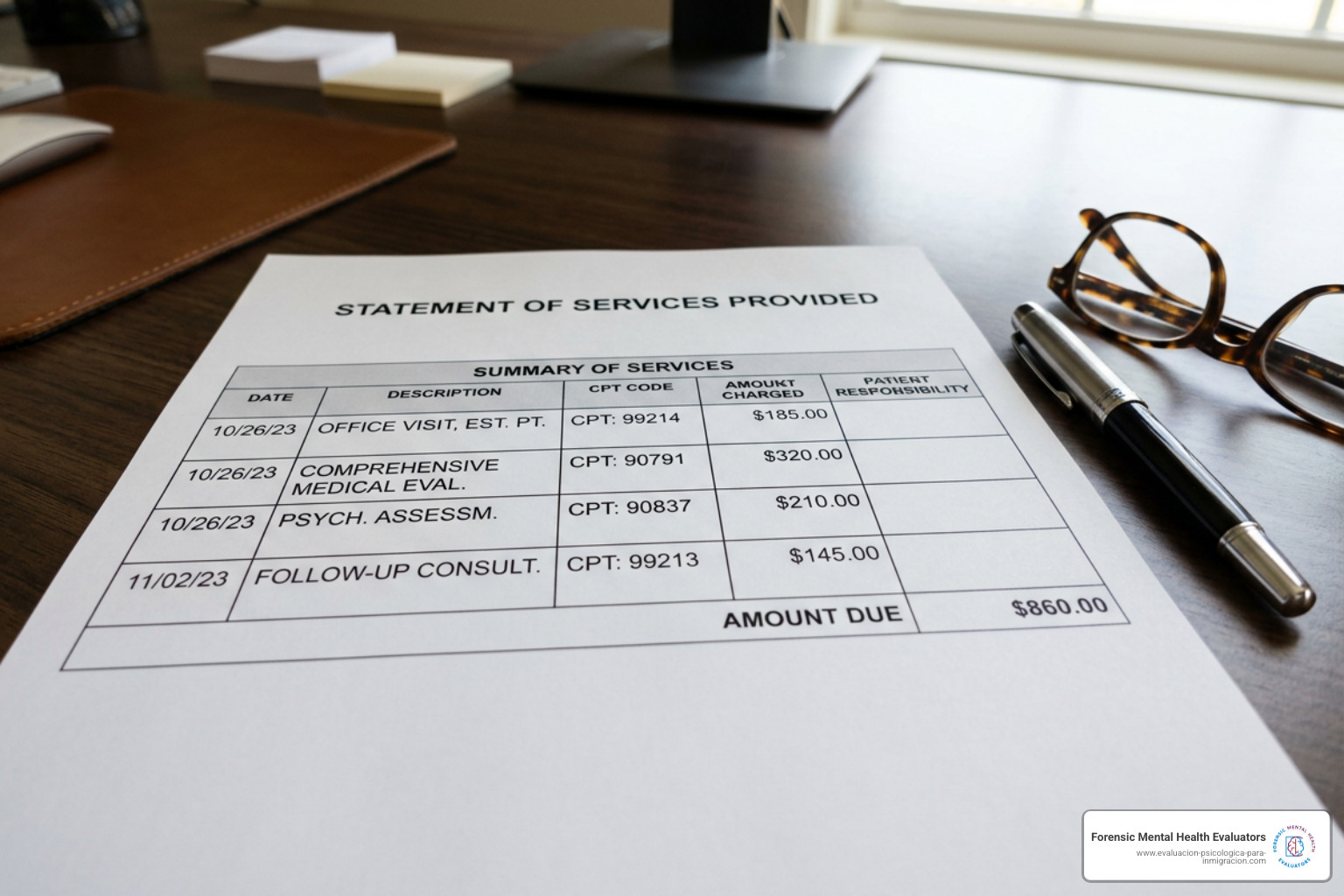
When a psychologist bills your insurance for an evaluation, they do not just send a single bill for "testing." They break the process down into specific tasks, billing for each hour of work required to complete your assessment.
The standard CPT codes used for psychological and neuropsychological evaluations include:
- CPT 90791 (Psychiatric Diagnostic Evaluation): This is the code used for your initial intake appointment. It covers the clinical interview where the psychologist gathers your history and determines if testing is necessary.
- CPT 96130 (Psychological Testing Evaluation Services; First Hour): This code is billed for the first hour the psychologist spends selecting tests, interpreting the data, integrating clinical history, and writing the final report.
- CPT 96131 (Psychological Testing Evaluation Services; Each Additional Hour): This is an "add-on" code billed for every subsequent hour the psychologist spends on interpretation and report writing.
- CPT 96136 (Test Administration and Scoring; First 30 Minutes): This covers the actual face-to-face time spent administering the tests to you, whether by the psychologist or a trained technician.
- CPT 96137 (Test Administration and Scoring; Each Additional 30 Minutes): This is the add-on code for additional administration and scoring time.
- CPT 90837 (Psychotherapy, 60 Minutes): This code is frequently used for the final "feedback session," where the psychologist sits down with you to explain the results and recommendations.
Why do these codes matter to you? Because when you call your insurance company to verify benefits, you should ask specifically about these codes. An insurer might say they cover "psychological testing," but when the bill arrives, you realize they only cover the administration (96136) and not the complex interpretation and report writing (96130/96131).
The Role of Referrals and Prior Authorizations
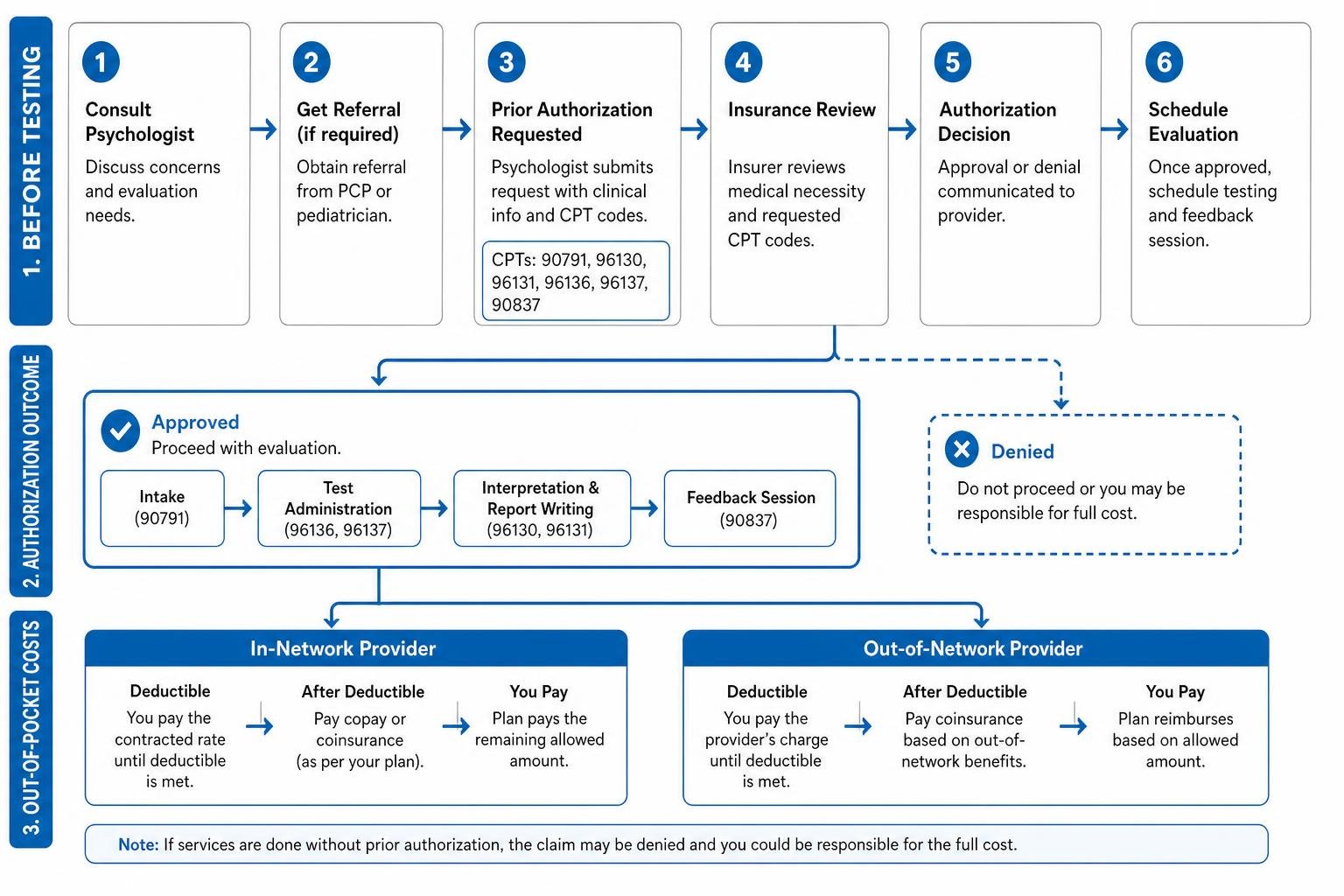
Even if your plan covers the CPT codes listed above, you cannot simply walk into a psychologist's office and demand a battery of tests. Most insurance plans require two administrative hurdles to be cleared first:
- A Referral: Many HMO and POS plans require a formal referral from your primary care physician (PCP) or pediatrician. This referral acts as a medical stamp of approval, proving to the insurer that a medical doctor believes the evaluation is necessary.
- Prior Authorization: This is a process where your psychologist must submit a detailed request to your insurance company before the testing begins. The psychologist must outline the patient's symptoms, explain why standard therapy/clinical interviews aren't enough, and list the exact CPT codes and estimated hours they plan to bill.
If you proceed with testing before the prior authorization is officially approved, the insurance company has the right to deny the entire claim, leaving you responsible for thousands of dollars.
Out-of-Pocket Costs, Network Status, and Denials
Even when are psych evaluations covered by insurance is answered with a reassuring "yes," you should still prepare for out-of-pocket expenses. Unless you have a premium plan with no deductible, you will likely have to pay a portion of the cost.
If you have a high-deductible health plan (HDHP), you must pay the "contracted rate" for the testing services out-of-pocket until you meet your annual deductible. Because a comprehensive evaluation takes hours of professional time, the contracted rate for a full testing battery typically ranges from $2,200 to $3,700.
Once your deductible is met, you will still be responsible for either a flat copay (usually $15 to $30 per session) or coinsurance (where you pay a percentage, typically 20%, of the total cost).
To visualize how these costs flow, consider this process:
In-Network vs. Out-of-Network Benefits and Superbills
Your out-of-pocket costs will depend heavily on whether your psychologist is in-network or out-of-network with your insurance plan.
- In-Network Providers: These professionals have signed a contract with your insurance company. They agree to accept a pre-negotiated, discounted rate for their services, and they cannot bill you for the difference between their retail rate and the insurance company’s allowed amount.
- Out-of-Network Providers: These psychologists do not have a contract with your insurer. If your plan has out-of-network benefits (typical of PPO plans), you can still see them, but your insurance will cover a much lower percentage of the cost.
If you choose an out-of-network provider, you will usually have to pay the full fee upfront. Afterward, you can request a superbill from the psychologist. A superbill is a highly detailed receipt that includes the provider’s tax ID, NPI number, your formal DSM-5 diagnostic codes, and the specific CPT codes billed.
You can submit this superbill directly to your insurance company to seek partial reimbursement, which will count toward your out-of-network deductible. For more details on what should be included in these documents, read our Psychological Report Guide.
What to Do If Your Claim Is Denied
If your insurance company denies coverage for a psychological evaluation, do not panic. Denials are common, but they are not always the final word.
If you receive a denial letter, take the following steps:
- Read the Explanation of Benefits (EOB): The EOB will list a specific reason code for the denial (e.g., "not medically necessary," "requires prior authorization," or "non-covered benefit").
- Contact Your Psychologist: Share the denial with your provider. They can often write a letter of medical necessity, submit additional clinical notes, or participate in a "peer-to-peer review" (a phone call where your psychologist speaks directly to a medical director at the insurance company to explain why the testing is needed).
- File a Formal Appeal: You have the legal right to appeal the decision. Submit a packet containing your doctor's referral, your psychologist's clinical notes, and any school or medical records that support your case. The Vox Guide to Using Mental Health Benefits provides excellent strategies on how to draft an appeal and hold insurance companies accountable under federal parity laws.
Frequently Asked Questions about Psychological Testing Coverage
Is it legal or ethical for a psychologist to assign a "cushion" diagnosis to secure insurance coverage?
Absolutely not. Assigning a fake, exaggerated, or "cushion" diagnosis (such as diagnosing a child with ADHD or Major Depressive Disorder when they only have mild behavioral issues) solely to force an insurance company to pay for testing is legally classified as insurance fraud and medical record fraud.
Ethical psychologists will never fabricate symptoms. Doing so can result in heavy fines, imprisonment, and the permanent loss of their clinical license.
Instead, if a clear diagnosis is not yet obvious, ethical clinicians will use "provisional" or "rule-out" diagnoses (e.g., "Adjustment Disorder, rule out Major Depressive Disorder") on billing forms. This honestly communicates to the insurer that a diagnostic question exists, which justifies the medical necessity of the evaluation without resorting to deception.
How much does a psychological evaluation cost out-of-pocket if I am uninsured?
If you do not have health insurance, or if you need an excluded service like an immigration evaluation, the out-of-pocket cost can range from $1,500 to $4,000, depending on the complexity of the assessment and the psychologist's location.
If you cannot afford these fees, you have several options:
- Sliding-Scale Fees: Many private practices offer a limited number of slots for low-income clients, adjusting their fees based on your household income.
- University Clinics: If you live near a university with a graduate program in clinical psychology, their training clinics often provide comprehensive assessments conducted by supervised doctoral students at a fraction of the cost of private practice.
- Community Mental Health Centers: These county- or state-funded clinics often provide low-cost mental health evaluations for residents who are uninsured or underinsured.
How long does it take for insurance to process a reimbursement claim?
If you pay for an evaluation upfront and submit a superbill to your insurance company for out-of-network reimbursement, the standard processing time is 4 to 6 weeks.
Once processed, you will receive an Explanation of Benefits (EOB) detailing how much of the cost was applied to your deductible and a check for any reimbursed amount.
Conclusion
Understanding how insurance handles psychological evaluations is essential to avoiding unexpected bills. While clinical testing for conditions like depression, anxiety, or autism is often covered under strict medical necessity guidelines, evaluations for educational, legal, or immigration purposes are universally excluded.
At District Counseling, we specialize in providing highly professional, culturally sensitive immigration psychological evaluations across Texas, Florida, California, and several other states. We serve families in major metropolitan areas, including Houston, Austin, Dallas, and San Antonio.
We understand the unique stressors faced by immigrant communities. To make the process as supportive and seamless as possible, we offer:
- Bilingual Evaluations: Assessments conducted entirely in Spanish and professionally translated into English.
- Client Comfort: A warm, compassionate environment where your story is heard without judgment.
- Post-Report Support: We provide 6 free therapy sessions to our clients after their evaluation report is completed, helping you process trauma and begin your healing journey.
Because these evaluations are forensic and legal in nature, they cannot be covered by health insurance. However, we offer clear, transparent cash-pricing and flexible scheduling to ensure you get the vital legal documentation you need.
If you are ready to take the next step in your immigration journey, Schedule an Immigration Psychological Evaluation with us today. Let us help you protect your family's future.