
Legal Hardship Definition: Everything You Need to Know About
What Legal Hardship Means and Why Evidence Matters

Legal hardship is a legal standard used to ask a court, government agency, employer, or plan administrator for an exception or relief from a rule. It is more than everyday stress, inconvenience, or a tight budget. To succeed, a person must meet the exact standard that applies to their case and support each key fact with credible evidence.
For an immigration waiver, this often means proving that a U.S. citizen or lawful permanent resident spouse or parent would face extreme hardship if separated from the immigrant or forced to relocate abroad. USCIS looks at the full picture: health needs, mental health, caregiving, finances, family ties, and conditions in the other country.
The standard changes by area of law. Student loan bankruptcy uses an undue hardship test. A 401(k) withdrawal may require an immediate and heavy financial need. Tax relief focuses on whether paying would prevent someone from covering necessary living costs. The right documents - such as medical records, financial statements, therapist or physician letters, and country-condition reports - can make the difference.
For immigration cases, a detailed psychological evaluation may help show how family separation or relocation affects a qualifying relative's mental health and daily functioning. It should connect clinical findings to the specific hardship claimed, rather than relying on broad statements of worry or sadness.
I am Francisco Ortiz, a Certified Forensic Mental Health Evaluator who conducts immigration psychological evaluations for hardship waivers and other high-stakes immigration matters. My work focuses on documenting the real psychological effects behind a legal hardship claim in a clear, evidence-based format for legal proceedings.
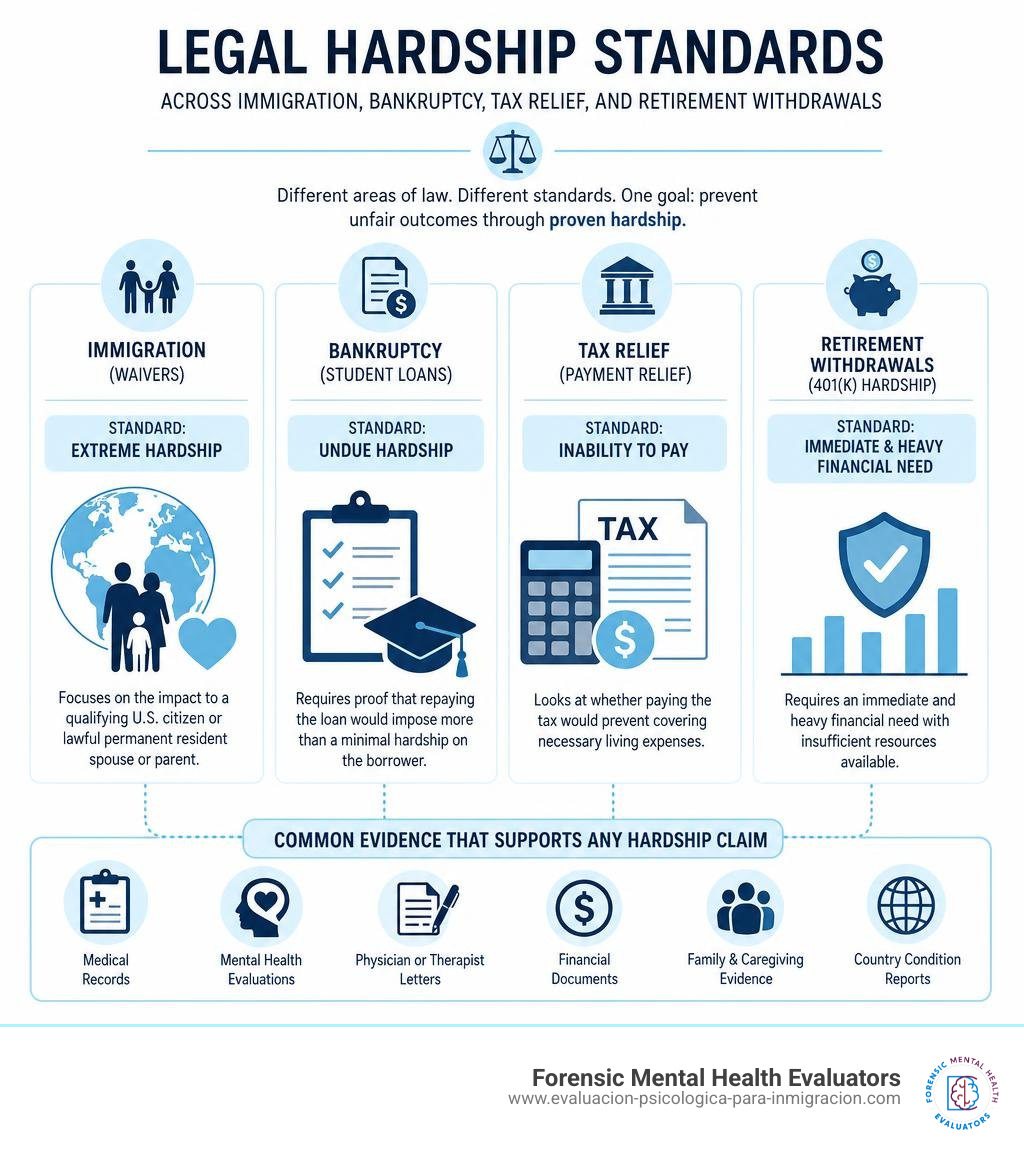
Understanding the Legal Hardship Standards Across Different Areas of Law
When people first hear the word "hardship," they usually think of tough times—a bad month with bills, emotional strain after a divorce, or a stressful job transition. However, within the legal system, hardship is an exacting evidentiary concept rather than an emotional state. The LSD.Law Definition of Hardship outlines how this term operates across legal sectors to grant exceptions, prevent absurd outcomes, and offer equity where strict adherence to rules would cause catastrophic disruption.
Hardship functions as an essential safety valve in American jurisprudence. Whether you are dealing with administrative agencies, federal bankruptcy courts, or state municipal dockets, the core question is consistent: Does enforcing the standard rule create an unacceptable, disproportionate burden that justifies an exception?
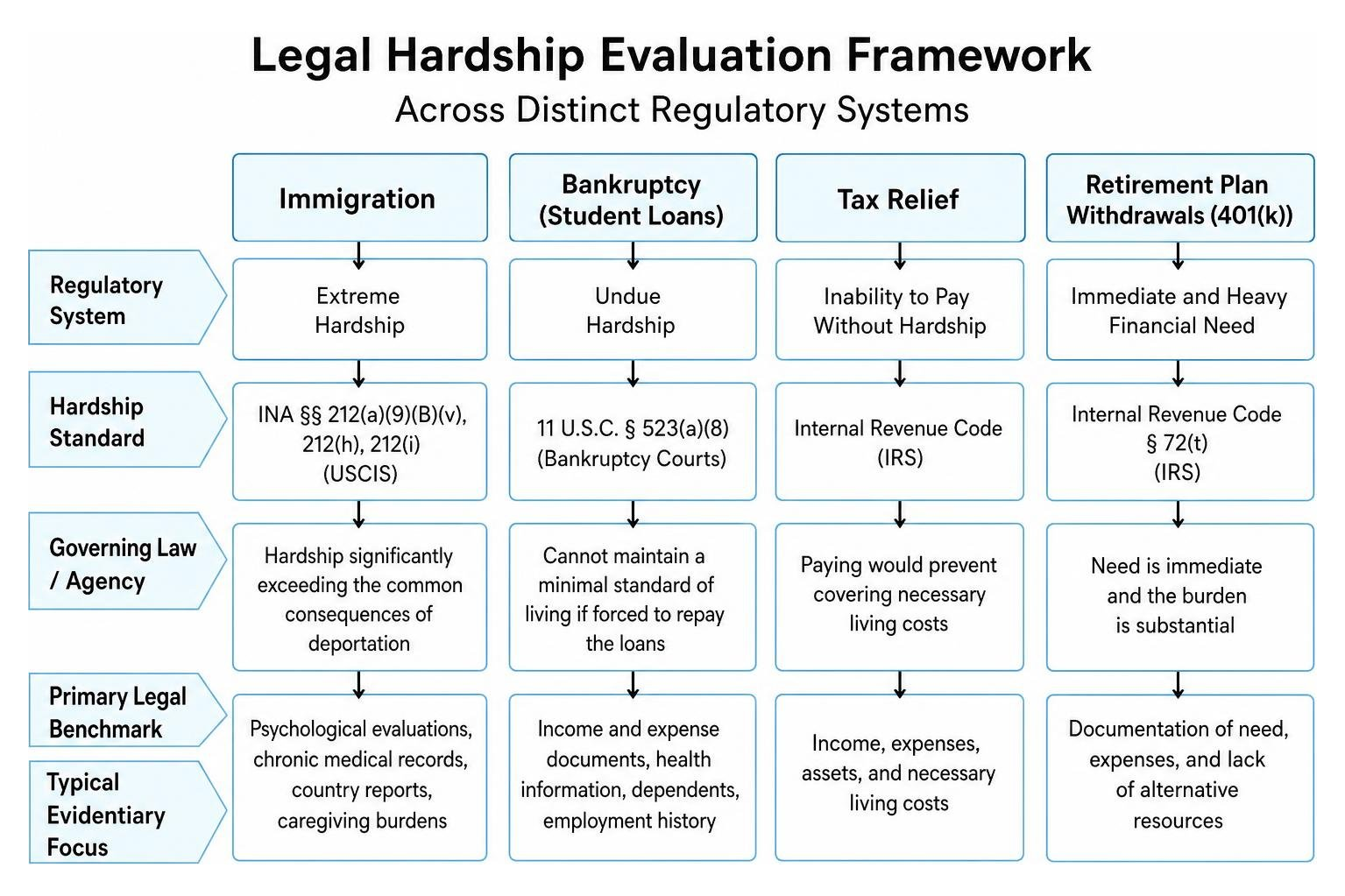
Because legal systems define this threshold differently, qualifying for relief in one agency does not guarantee approval in another. Consider how key standards compare:
| Hardship Standard | Governing Law / Agency | Primary Legal Benchmark | Typical Evidentiary Focus |
|---|---|---|---|
| Extreme Hardship | Immigration (INA §§ 212(a)(9)(B)(v), 212(h), 212(i)) | Hardship significantly exceeding the common consequences of deportation | Psychological evaluations, chronic medical records, country reports, caregiving burdens |
| Exceptional & Extremely Unusual Hardship | Immigration Court (EOIR-42B Cancellation of Removal) | Hardship substantially beyond the ordinary, ranking among the top tier of severe cases | Severe child disabilities, life-threatening medical conditions lacking foreign care, extreme economic collapse |
| Undue Hardship | Federal Bankruptcy (11 U.S.C. § 523(a)(8)) | Certainty of hopelessness; inability to maintain a minimal standard of living | Multi-year tax transcripts, permanent disability proof, exhaustive job search logs |
| Immediate & Heavy Financial Need | IRS / ERISA (401(k) Safe Harbor Rules) | Specific urgent financial obligations that cannot be met through other liquid assets | Foreclosure notices, primary residence repair invoices, postsecondary tuition bills |
| Inability to Pay / Financial Burden | Municipal & State Courts (e.g., California, Florida, Texas) | Income below state poverty lines; basic living costs exceed income | Pay stubs, public benefit verification, formal ability-to-pay filings |
Defining Legal Hardship vs. Financial Inconvenience
Under federal regulations such as 31 CFR § 29.524, the law makes a strict distinction between genuine financial hardship and mere financial inconvenience. Financial hardship exists only when an individual requires substantially all current and anticipated income and liquid assets simply to meet basic, ordinary, and necessary living expenses.
If paying a debt or fine causes a lifestyle adjustment, forces someone to cut discretionary spending, or creates budget tightness, administrative bodies view that as an inconvenience, not a legal hardship. Understanding this hardship legal definition is critical because decision-makers will systematically audit income, household assets, and non-essential expenses to confirm that an applicant's financial distress is both severe and involuntary.
Distinct Legal Hardship Thresholds in Federal and State Law
Outside of bankruptcy and immigration, legal hardship standards appear across various state and federal frameworks:
- Zoning Variances: Land-use boards evaluate "unnecessary hardship" when a landowner requests a variance from local building codes. The hardship must stem directly from the physical characteristics of the land (such as an irregular lot shape, steep slope, or bedrock) rather than the personal or economic situation of the owner.
- Workplace Accommodations Under the ADA: Under the Americans with Disabilities Act, the term flips. Employers must provide reasonable accommodations to disabled employees unless doing so creates an "undue hardship"—defined as significant difficulty or expense relative to the employer's overall operating budget and workforce size.
- Commercial Impracticability: In contract law under UCC § 2-615, a business may be excused from fulfilling a commercial contract if unforeseen events (such as sudden foreign embargoes or severe natural disasters) make performance practically impossible, rather than merely more expensive.
- Municipal Court Fee Reductions: Municipal and traffic courts frequently evaluate hardship through ability-to-pay requests. In California traffic courts, for instance, drivers demonstrating poverty can secure fine reductions or cap installment payment plans at no more than $25 per month under Form TR-320 filings.
- State Legal Aid and CLE Waivers: Administrative bodies and professional associations establish income tiers to support individuals in need. Organizations like Lone Star Legal Aid help low-income families verify their qualifying for legal aid status, while institutions like Albany Law School provide 50% to 75% tuition discounts for attorneys facing professional income constraints.
Proving Hardship in Immigration: Waivers and Removal Defense
Immigration law contains some of the most rigorous hardship standards in the legal system. When a foreign national is deemed inadmissible due to unlawful presence, prior immigration violations, or specific criminal grounds, their entire future often hinges on an administrative waiver.
Under the USCIS Extreme Hardship Considerations and Factors outlined in the USCIS Policy Manual, adjudicators do not examine the immigrant’s hardship alone. Instead, the focus is squarely on the qualifying relative—a U.S. citizen or lawful permanent resident (LPR) spouse or parent. For comprehensive legal strategies, our extreme hardship waiver guide 2026 explains how these elements are balanced during administrative review.
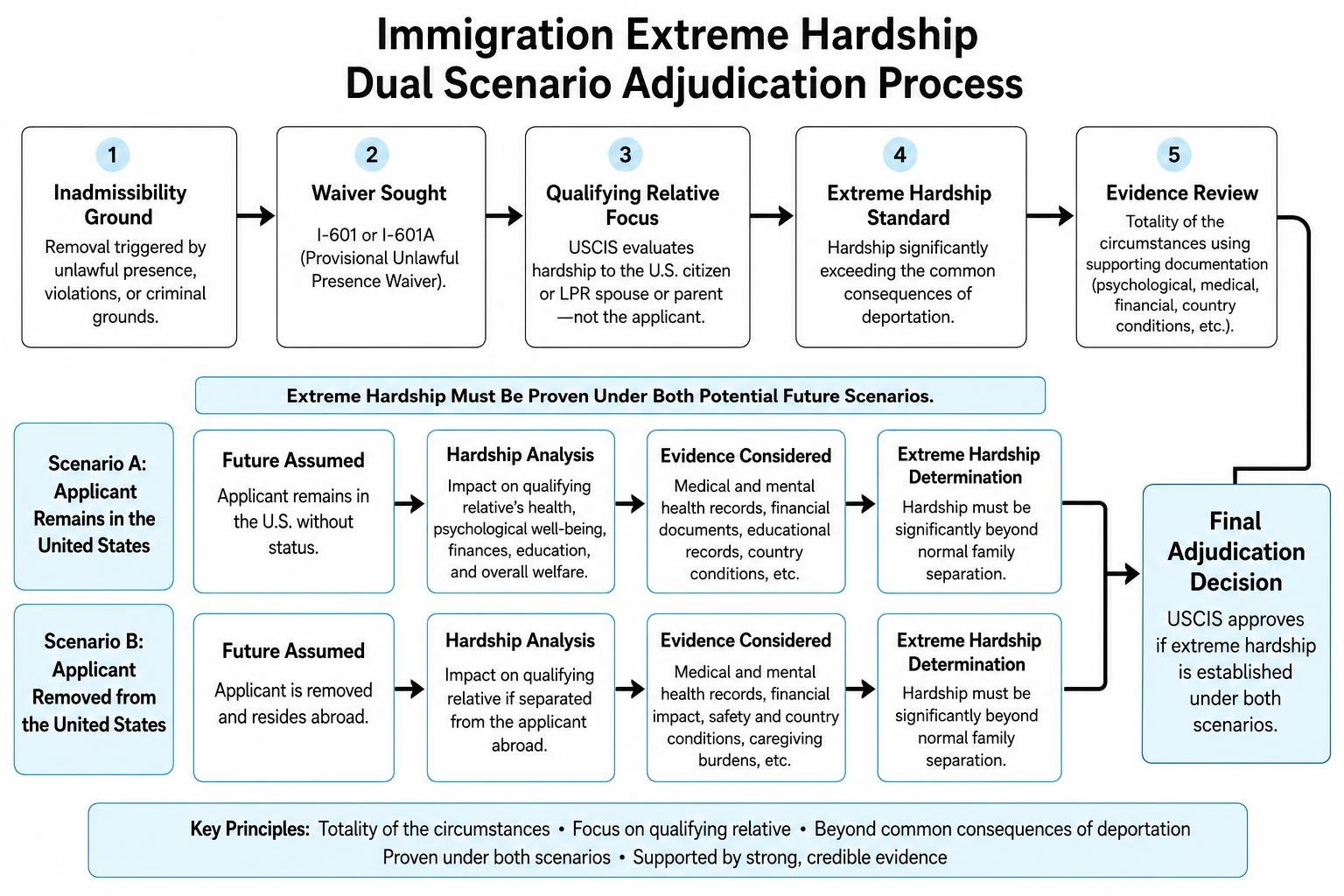
Extreme Hardship for I-601 and I-601A Waivers
To succeed on Form I-601 or Form I-601A (Provisional Unlawful Presence Waiver), an applicant must demonstrate that their qualifying relative would suffer hardship that goes far beyond the normal distress of family separation. In the landmark precedent Matter of Cervantes-Gonzalez, the Board of Immigration Appeals (BIA) confirmed that standard emotional upset, economic readjustment, and foreign language barriers are "common consequences" of removal.
To rise to the level of extreme hardship, an applicant must present a combination of factors evaluated under the totality of the circumstances. Furthermore, USCIS requires applicants to prove this extreme burden under both potential future scenarios:
- The Separation Scenario: The severe psychological, physical, medical, and financial harm the qualifying relative will suffer if they remain in the United States while the immigrant is barred abroad.
- The Relocation Scenario: The severe disruptions, health risks, economic ruin, language hurdles, and safety threats the qualifying relative would face if they left their home in the U.S. to live in the foreign country.
With Form I-601A filing fees set at $795 and Form I-601 fees at $1,050, alongside wait times averaging 28 to 32 months for initial adjudication, filing a complete, well-documented initial submission is essential. Reviewing how to show extreme hardship for a waiver provides detailed steps for organizing this dual-scenario evidence.
Exceptional and Extremely Unusual Hardship in Cancellation of Removal
When an undocumented individual without lawful status is placed in deportation proceedings before an immigration judge, they may apply for Non-LPR Cancellation of Removal under Form EOIR-42B.
This pathway requires meeting a much higher legal standard: extreme and exceptionally unusual hardship. Unlike standard I-601 waivers, qualifying relatives for cancellation of removal include U.S. citizen or LPR children, spouses, or parents. However, the applicant must demonstrate that the deportation would cause suffering that ranks in the top tier of all deportation cases.
For example, showing that a child will experience lower living standards or attend an underfunded foreign school does not meet this standard. The court looks for severe factors, such as a child with a serious neurodevelopmental disorder, advanced autism, or a rare medical condition requiring specialized therapies that are completely unavailable in the parent's country of origin.
The Critical Role of Comprehensive Psychological Evaluations
Personal statements from qualifying relatives are a standard component of hardship waivers, but on their own, they often fall short of proving severe clinical distress. Immigration officers and judges review hundreds of letters describing deep sadness, anxiety, and sleeplessness. To distinguish typical emotional distress from clinical, disabling conditions, a comprehensive hardship evaluation is critical.

At District Counseling, our forensic evaluations go beyond informal clinical impressions:
- We conduct structured clinical interviews, developmental histories, and validated psychometric testing (e.g., BAI, BDI-II, PCL-5, TSI-2) to identify DSM-5 diagnoses such as Major Depressive Disorder, Generalized Anxiety Disorder, or Post-Traumatic Stress Disorder.
- We assess how the qualifying relative's mental health will deteriorate under both separation and relocation scenarios.
- We offer complete clinical interviews in Spanish and provide fully translated certified reports in English, ensuring accessibility for families across our offices in Houston TX, Katy TX, Cypress TX, Sugarland TX, as well as our clients in Florida, California, New York, Utah, Virginia, and Idaho.
- Following the completion of the forensic evaluation, we support families through their legal journey by providing six free post-report therapy sessions to address their acute psychological stress.
Attorneys frequently reference an immigration psychological evaluation sample to ensure clinical reports integrate proper psychometric assessments, diagnostic criteria, and clear functional limitation analyses.
Proving Undue and Financial Hardship in Bankruptcy, Taxes, and Debts
Outside of immigration, proving legal hardship often involves demonstrating complete financial insolvency or showing that strict enforcement of financial obligations would deprive an individual or family of basic human necessities.
Student Loan Undue Hardship and the Brunner Test
Under 11 U.S.C. § 523(a)(8) of the U.S. Bankruptcy Code, federal and private student loans are generally non-dischargeable unless the debtor proves that repaying the debt imposes an "undue hardship." Across most federal circuits, bankruptcy courts apply the three-pronged Brunner Test established in Brunner v. New York State Higher Education Services Corp.:
Historically, proving this "certainty of hopelessness" was exceptionally difficult. However, under updated Department of Justice (DOJ) and Department of Education guidance, debtors can now complete a formal Attestation Form during adversary proceedings. This allows government attorneys to review expense-to-income ratios and recommend a full or partial discharge without forcing borrowers through contentious trial depositions.
Chapter 13 Bankruptcy Hardship Discharges
When an individual enters a Chapter 13 bankruptcy repayment plan, they commit to paying their disposable income to a bankruptcy trustee over a 3-to-5-year period. However, unexpected life events—such as a catastrophic medical diagnosis, a permanent disabling injury, or an uninsured natural disaster—can make completing the plan impossible.
Under 11 U.S.C. § 1328(b), debtors can petition the court for a Chapter 13 Hardship Discharge. To qualify, the debtor must satisfy three statutory requirements:
- Circumstances Beyond Control: The inability to complete the plan must stem from an involuntary, permanent change (such as an incapacitating stroke rather than voluntary job changes).
- Best-Interests-of-Creditors Test: The total dollar amount already paid to unsecured creditors must equal or exceed what those creditors would have received in a hypothetical Chapter 7 liquidation.
- Impossibility of Modification: The debtor's financial disruption is so severe that modifying the Chapter 13 plan to lower payments is not feasible.
IRS Tax Relief and Retirement Plan Hardship Distributions
When back taxes or urgent cash needs arise, taxpayers often turn to federal hardship remedies with distinct legal definitions:
- IRS Currently Not Collectible (CNC) Status: If paying tax debt prevents a taxpayer from paying for basic housing, food, and utilities, the IRS can designate the account as CNC. While interest continues to accrue, active collection actions (such as wage garnishments and bank levies) are paused.
- Offer in Compromise (OIC): Taxpayers can settle tax liabilities for less than the full balance under the "Effective Tax Administration" category by demonstrating that full collection would create serious financial hardship due to chronic health issues or fixed retirement incomes.
- 401(k) Hardship Withdrawals: Under IRS safe harbor regulations, employees can access their retirement funds early if they demonstrate an "immediate and heavy financial need." Qualifying expenses include emergency medical care, primary residence eviction/foreclosure prevention, postsecondary tuition for the next 12 months, or funeral costs.
- The Early Withdrawal Tax Impact: Many individuals do not anticipate the tax consequences of early 401(k) withdrawals. Unless a specific statutory exemption applies, distributions taken before age 59½ face ordinary federal and state income taxes plus an immediate 10% early withdrawal tax penalty. As a result, a $10,000 hardship withdrawal can easily shrink to between $6,500 and $7,000 in net cash.
- SECURE 2.0 Emergency Relief: Under the SECURE 2.0 Act, participants can take one self-certified, penalty-free emergency withdrawal of up to $1,000 per calendar year for unforeseeable personal or family emergency expenses, with the option to repay the amount within three years.
Essential Evidence and Common Mistakes in Legal Hardship Claims
Whether you are petitioning an immigration officer, a bankruptcy judge, or a retirement plan administrator, a valid legal hardship with poor documentation will almost always be denied. Decisions turn on concrete, verified evidence rather than emotional declarations alone.

Building a Solid Evidentiary Record
Every hardship claim must be built on a well-indexed, documented collection of third-party evidence. Consider this evidentiary roadmap:
- Comprehensive Personal Declarations: Detailed, first-person sworn affidavits explaining the timeline of hardship events, daily functional challenges, and specific financial or medical consequences.
- Formal Psychological Evaluations: Detailed clinical reports from licensed mental health evaluators documenting objective psychometric test results, trauma histories, DSM-5 diagnoses, and functional limitations.
- Medical Documentation: Attending physician letters, diagnostic summaries, prescription lists, hospital records, and projected future treatment costs. This is particularly critical in elder care contexts, where paid home care can run upwards of $5,800 a month—an expense that quickly overwhelms an average $2,400 monthly Social Security income.
- Financial and Tax Records: Certified IRS tax transcripts from the past three to five years, recent pay stubs, household balance sheets, bank records, and official debt collection or foreclosure notices.
- Country Condition Reports & Travel Advisories: Official U.S. Department of State Country Reports, human rights assessments, and Level 3 or Level 4 Travel Advisories detailing violence, lack of infrastructure, or poor medical systems in the applicant's home country.
Avoiding Pitfalls That Cause Hardship Claim Denials
Legal claims often face denials, delays, or costly Requests for Evidence (RFEs) due to several recurring mistakes:
Frequently Asked Questions About Legal Hardship
What is the difference between ordinary difficulty and legal hardship?
Ordinary difficulty includes the common, expected consequences of life disruptions—such as short-term budget strain, moving to a smaller apartment, or sadness associated with life transitions.
In contrast, legal hardship requires showing that strict enforcement of the law creates a severe, disruptive burden that makes normal compliance virtually impossible. In immigration, this means showing harm far beyond the normal pain of separation. In bankruptcy, it requires demonstrating an inability to sustain a basic standard of living.
Who qualifies as a qualifying relative for an immigration hardship waiver?
For Form I-601 and Form I-601A extreme hardship waivers, qualifying relatives are strictly limited to U.S. citizen or lawful permanent resident (LPR) spouses and parents.
Children are not qualifying relatives under these specific waiver forms. However, if a child suffers from a severe medical or developmental condition, that child’s challenges can be presented as hardship to the qualifying parent, who must shoulder the emotional, logistical, and financial burden of their care.
How do recent policy changes in 2026 impact hardship determinations?
Hardship claims are subject to structured administrative review processes:
- Immigration Adjudications: USCIS applies close scrutiny to subjective hardship letters, making objective evidence—such as forensic psychological assessments and medical records—essential to substantiate claims.
- Student Loan Bankruptcies: The Department of Justice's streamlined administrative attestation framework provides a clear pathway to negotiate student loan discharges for debtors experiencing chronic, long-term poverty.
- Emergency Retirement Access: The SECURE 2.0 Act offers a streamlined path to access up to $1,000 for immediate emergency expenses without early withdrawal penalties.
Conclusion
Navigating a legal hardship claim can feel overwhelming. Whether you are dealing with immigration waivers, bankruptcy proceedings, tax relief, or unexpected debt, success comes down to a clear strategy: understanding the exact standard that applies to your case, gathering objective third-party evidence, and presenting a well-supported narrative.
When an immigration waiver hinges on proving extreme hardship, clinical mental health documentation can be central to your filing. At District Counseling, we provide thorough forensic evaluations tailored to immigration courts and USCIS adjudications. We document psychological trauma, chronic stress, and functional limitations across our locations in Houston TX, Katy TX, Cypress TX, Sugarland TX, as well as our service areas in Florida, California, New York, Utah, Virginia, and Idaho.
To support your family beyond the evaluation, our services include six free post-report therapy sessions to help qualifying relatives manage stress while their case is pending. If you are preparing an immigration waiver and need a clinical evaluation to document your hardship, schedule your consultation for an evaluación psicológica para caso de un perdón today.