
Detailed Guide to Extreme Hardship Waiver Requirements
What an Extreme Hardship Waiver Means for Your Family

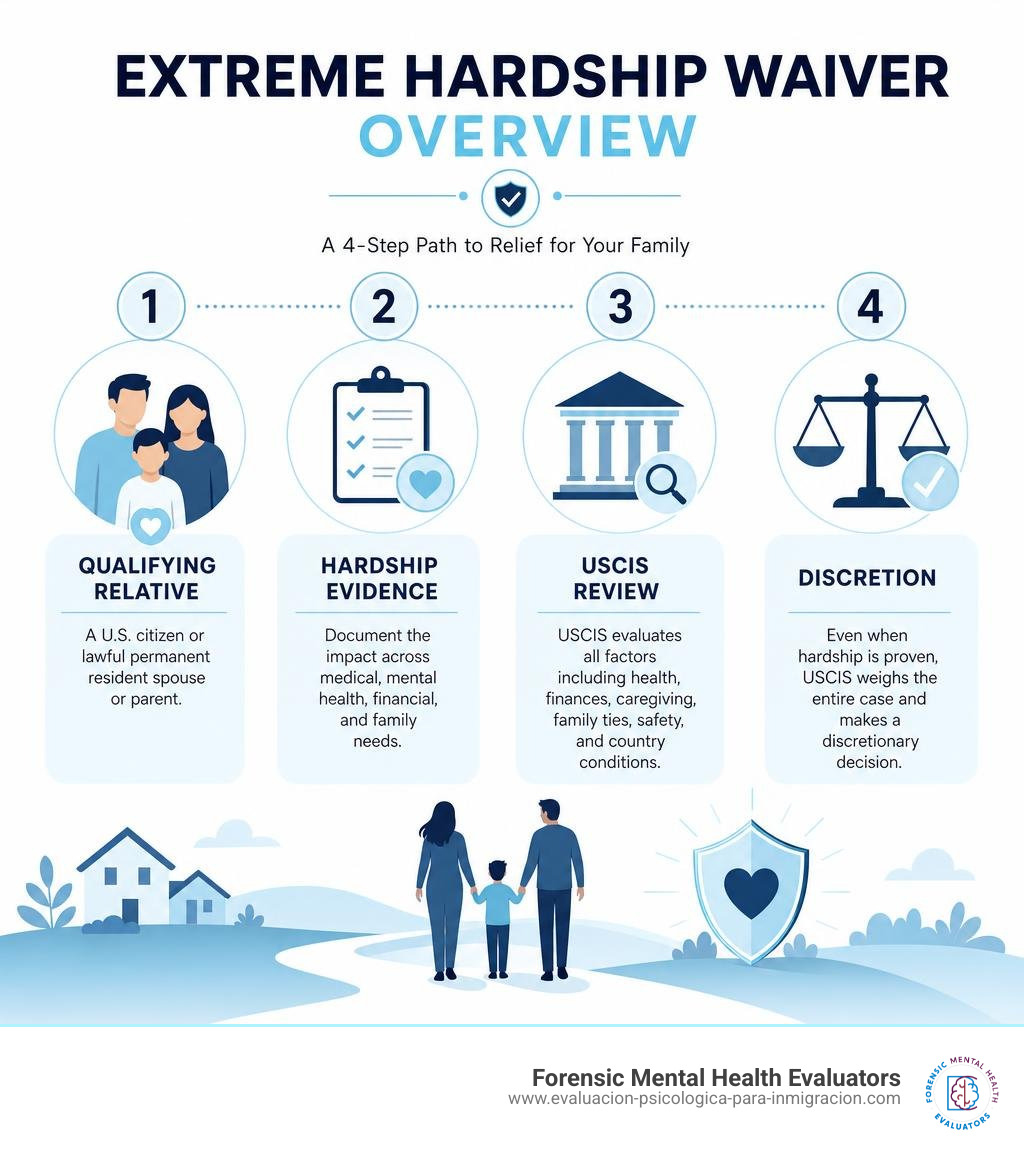
An extreme hardship waiver is an immigration waiver that may forgive certain grounds of inadmissibility when denying admission would cause hardship beyond the normal effects of separation or relocation to a qualifying U.S. citizen or lawful permanent resident family member.
In simple terms, USCIS does not approve a waiver just because a family will be separated or lose income. The applicant must show, with credible evidence, that the impact on the qualifying relative would be more serious than what is normally expected when a loved one cannot stay in or return to the United States.
| Quick answer | What it means |
|---|---|
| Who may qualify? | It depends on the immigration ground. For many waivers, including unlawful presence and fraud waivers, the qualifying relative is a U.S. citizen or permanent resident spouse or parent. |
| What must be proven? | That the qualifying relative would more likely than not face extreme hardship if the applicant is denied admission. |
| What does USCIS review? | Medical needs, mental health, finances, caregiving, family ties, safety, and conditions in the country of relocation. |
| Is family separation enough? | Usually not by itself. USCIS considers all hardships together. |
| Is approval automatic once hardship is proven? | No. The waiver is discretionary, so USCIS also weighs the full facts of the case. |
For many Texas families, the most difficult part is not knowing whether a spouse or parent will remain in the United States, relocate abroad, or face long-term separation. A strong case explains the real-life impact of both possible outcomes, especially when a U.S. citizen family member has serious medical, financial, caregiving, or psychological needs.
I am Francisco Ortiz, a Certified Forensic Mental Health Evaluator who conducts evidence-based psychological evaluations for immigration cases, including extreme hardship waiver applications. My work focuses on documenting the mental-health effects of family separation, migration stress, trauma, and caregiving disruption in a clear format that can support the legal record.
Understanding the Extreme Hardship Waiver Eligibility Standards
To secure an extreme hardship waiver, an applicant must navigate complex statutory grounds set forth in the Immigration and Nationality Act (INA). The legal eligibility criteria vary depending on why the noncitizen is considered inadmissible in the first place. At Forensic Mental Health Evaluators, we frequently assist families across Texas—including Houston, Katy, Cypress, and Sugarland—as well as clients in Florida, California, New York, Utah, Virginia, and Idaho, who are applying for relief under one of three main statutory provisions:
- Unlawful Presence Waiver (INA § 212(a)(9)(B)(v)): Noncitizens who accrue more than 180 days or one year of unlawful presence in the United States trigger 3-year or 10-year statutory bars upon departure. A waiver can forgive this inadmissibility if refusal of admission would result in extreme hardship to a qualifying relative.
- Criminal Grounds Waiver (INA § 212(h)): This provision provides relief for certain criminal convictions, such as crimes involving moral turpitude or a single offense of simple possession of 30 grams or less of marijuana (INA § 212(h)(1)(B)). It requires establishing extreme hardship to a qualifying relative.
- Fraud or Misrepresentation Waiver (INA § 212(i)): Individuals who made a material misrepresentation or committed fraud to obtain an immigration benefit may seek a waiver by demonstrating extreme hardship to a qualifying relative.

When applying, individuals typically submit Form I-601 (Application for Waiver of Grounds of Inadmissibility) or Form I-601A (Application for Provisional Unlawful Presence Waiver). The Form I-601A provisional waiver allows eligible spouses and children of U.S. citizens or lawful permanent residents to apply for an unlawful presence waiver while still inside the United States before departing for their consular interview abroad. Conducting a clinical Hardship Evaluation is a critical step in building the evidentiary basis for both Form I-601 and Form I-601A packets.
Qualifying Relatives and Who Suffers Hardship
A crucial distinction in immigration law is who must experience the extreme hardship. The statute strictly defines who counts as a "qualifying relative," and this definition changes depending on the specific waiver provision:
- For Unlawful Presence Waivers (INA § 212(a)(9)(B)(v)) and Fraud Waivers (INA § 212(i)): The qualifying relative must be a U.S. citizen (USC) or Lawful Permanent Resident (LPR) spouse or parent. U.S. citizen or LPR children are not statutory qualifying relatives under these specific provisions.
- For Criminal Waivers (INA § 212(h)): The qualifying relative can be a USC or LPR spouse, parent, son, or daughter.
While hardship to non-qualifying family members (such as U.S. citizen children under an unlawful presence waiver) cannot be cited directly as primary statutory hardship, their distress is far from irrelevant. Harm suffered by children—such as severe educational disruption, developmental regression, or behavioral crises—creates substantial indirect emotional and financial hardship for the qualifying relative parent. For instance, if a qualifying U.S. citizen mother develops severe Major Depressive Disorder because she cannot support or care for her special-needs child without her husband, her child's suffering directly elevates the mother's statutory hardship. Understanding these legal nuances is crucial when filing an Immigration Extreme Hardship Waiver.
Legal Standards: Extreme Hardship vs. Exceptional and Extremely Unusual Hardship
Applicants often confuse the standard for an extreme hardship waiver with other forms of immigration relief. However, U.S. immigration statutes establish distinct tiers of hardship, each with a different legal threshold:
- Extreme Hardship Standard: Applied in waiver cases under INA § 212(a)(9)(B)(v), § 212(h), and § 212(i). The hardship must exceed that which is usual, expected, or ordinary upon deportation, but it does not require showing that the family's situation would be catastrophically unmanageable.
- Exceptional and Extremely Unusual Hardship Standard: Applied in Non-LPR Cancellation of Removal cases under INA § 240A(b)(1)(D). This standard is significantly higher and more burdensome. The applicant must prove that the hardship to a qualifying relative would be substantially beyond the normal hardships of deportation, placing the case in the top tier of severe hardship cases (such as a qualifying relative having a life-threatening medical illness or profound disability).
The official guidance in Chapter 3 - Adjudicating Extreme Hardship Claims | USCIS makes it clear that officers must not improperly import the higher cancellation of removal standard into standard extreme hardship waiver adjudications.
| Comparison Feature | Extreme Hardship Waiver | Exceptional and Extremely Unusual Hardship |
|---|---|---|
| Primary Statutory Grounds | INA § 212(a)(9)(B)(v), § 212(h), § 212(i) | INA § 240A(b)(1)(D) (Cancellation of Removal) |
| Qualifying Relatives | USC/LPR Spouse or Parent (varies by section) | USC/LPR Spouse, Parent, or Child |
| Legal Severity Threshold | Exceeds ordinary deportation hardship | Substantially beyond ordinary hardship; exceptionally severe |
| Application Forms | Form I-601 or Form I-601A | Form EOIR-42B (In Immigration Court) |
| Relative Weight of Common Factors | Moderate factors combined cumulatively can meet threshold | Common factors alone rarely meet threshold without severe aggravation |
Key USCIS Evaluation Factors and Common Consequences
When USCIS adjudicates an extreme hardship waiver, officers evaluate the totality of the circumstances. No single factor is viewed in isolation. Instead, the adjudicator aggregates all emotional, economic, physical, and social impacts to see if their cumulative weight rises to the level of extreme hardship.
Common Consequences vs. Aggravated Hardship
The Board of Immigration Appeals (BIA) and official USCIS policy maintain that "common consequences" of deportation—those routine hardships that naturally accompany family separation or relocation—do not, by themselves, warrant finding extreme hardship. Common consequences include:
- General financial strain and decreased standard of living
- Normal emotional sadness, grief, and stress caused by family separation
- Difficulty readjusting to life, culture, or employment in a foreign country
- Lower quality of foreign educational systems or medical facilities
- Inability to pursue a preferred career path abroad
However, USCIS guidance in Chapter 5 - Extreme Hardship Considerations and Factors | USCIS emphasizes that common consequences must be evaluated cumulatively. When multiple common consequences interact—such as a spouse experiencing moderate job loss while managing mild chronic depression and caring for an elderly parent—their combined aggregate weight can cross the legal line into extreme hardship. Learning How to Show Extreme Hardship for a Waiver involves effectively connecting these individual stressors into a coherent, evidence-backed narrative.
Particularly Significant Factors in an Extreme Hardship Waiver Case

USCIS policy highlights five "Particularly Significant Factors" that carry extra weight in hardship adjudications. While these factors do not create an automatic approval, their presence strongly supports a finding of extreme hardship when documented with clear evidence:
- Qualifying Relative Previously Granted Humanitarian Status: The qualifying relative was previously granted Iraqi or Afghan Special Immigrant Status, T Nonimmigrant Status, or Refugee/Asylum status, where returning to the home country poses known safety risks.
- Disability of Qualifying Relative or Dependent: A formal disability determination (such as Social Security Disability, medical board finding, or clinical evaluation) for the qualifying relative or a family member dependent on them for care.
- Active Military Service: The qualifying relative is a member of the U.S. Armed Forces (Active Duty, Reserves, or National Guard).
- U.S. Department of State Travel Warnings: Official DOS Travel Warnings advisory levels (Level 3: Reconsider Travel, or Level 4: Do Not Travel) covering the target relocation region or country.
- Substantial Displacement of Care for Children: The applicant’s departure creates a severe caregiving gap for minor children, forcing the qualifying relative to hire outside care, abandon employment, or suffer catastrophic personal disruption.
Evaluating Separation vs. Relocation Scenarios

A fundamental principle of waiver adjudication is that extreme hardship must be established under both possible outcome scenarios, or the applicant must demonstrate that one of the scenarios is reasonably foreseeable and would cause extreme hardship:
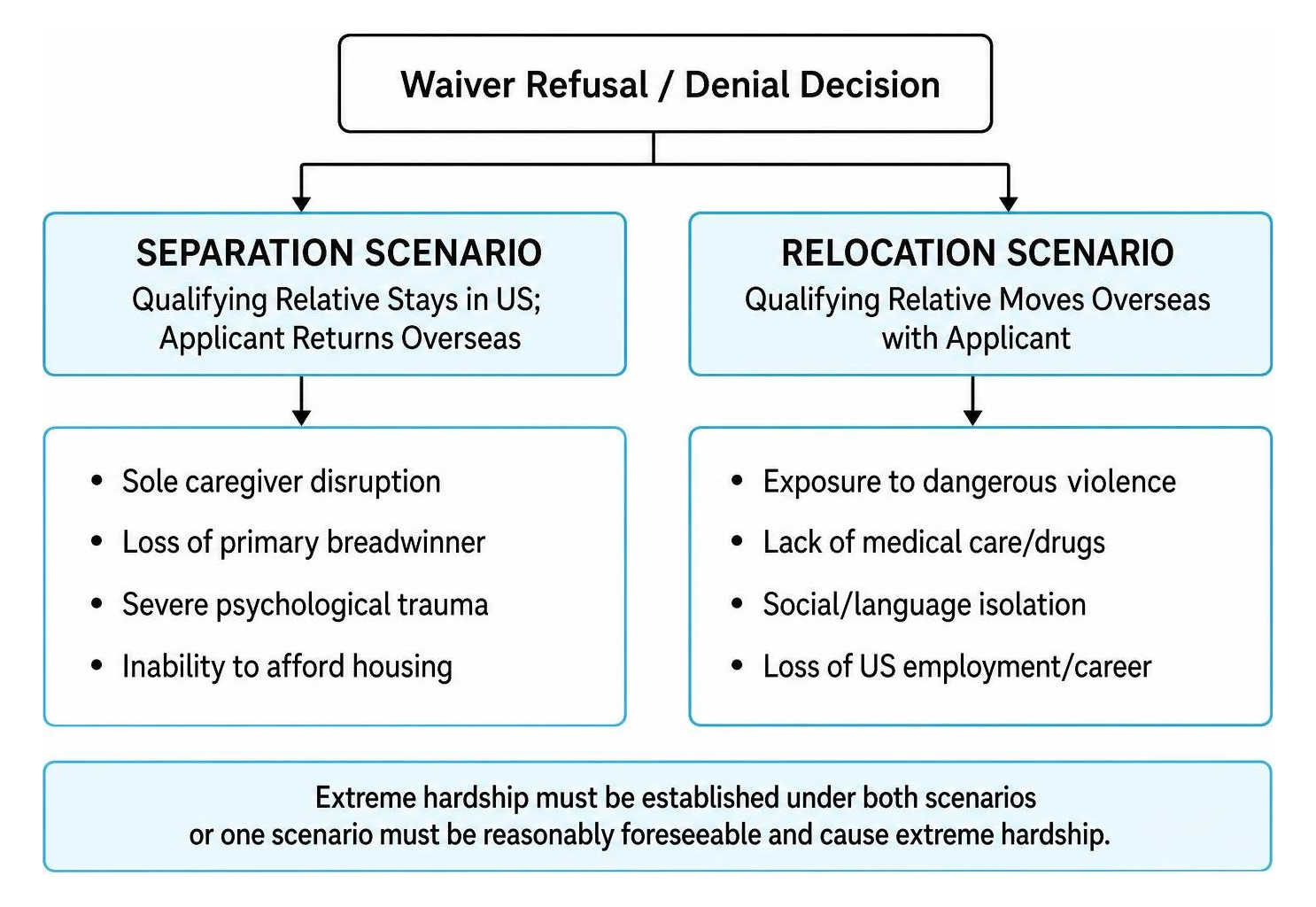
- Separation Scenario: The qualifying relative remains in the United States while the applicant is denied admission and lives abroad.
- Relocation Scenario: The qualifying relative leaves the United States and moves abroad to live with the applicant in their home country.
USCIS officers conduct a predictive analysis rather than a normative one. They are instructed not to impose personal moral views on whether a family should stay together or separate. Instead, they evaluate the actual physical, emotional, and economic consequences that would occur under both pathways.
Financial, Medical, and Psychological Impact Across Both Outcomes
When we evaluate cases at Forensic Mental Health Evaluators, we assess how hardships manifest in both scenarios:
- Financial Impact: In a separation scenario, the U.S. household often loses its primary breadwinner, leading to immediate housing instability, foreclosure, or reliance on public assistance. In a relocation scenario, the qualifying relative may face total loss of U.S. employment, inability to secure professional licensure overseas, and permanent depletion of retirement savings.
- Medical Impact: In a separation scenario, an ill or disabled qualifying relative loses their primary hands-on caregiver, making them dependent on costly institutional care. In a relocation scenario, the relative may face severe health deterioration due to lack of specialized medical equipment, unavailable prescription drugs, or substandard health facilities in the destination country.
- Psychological Impact: Family separation frequently triggers Major Depressive Disorder, Generalized Anxiety Disorder, or Post-Traumatic Stress Disorder (PTSD) in the qualifying relative. Relocation to an unfamiliar, high-crime, or politically unstable region creates intense psychological trauma, social isolation, and safety-related fear.
Evidentiary Burden, Standard of Proof, and Discretionary Decisions
The legal burden of proof rests entirely on the applicant pursuant to INA § 291. To succeed, the applicant must demonstrate eligibility by a preponderance of the evidence.
As detailed in Chapter 6 - Extreme Hardship Determinations | USCIS, "preponderance of the evidence" means showing that the claimed facts are more likely true than not (greater than a 50% probability). The applicant does not need to prove extreme hardship beyond a reasonable doubt or by clear and convincing evidence.
Even if an applicant successfully proves extreme hardship, approval of an extreme hardship waiver is not automatic. The waiver remains a discretionary benefit. Adjudication involves a two-step framework:
- Statutory Eligibility Step: Has the applicant established that refusal of admission would result in extreme hardship to a qualifying relative?
- Discretionary Analysis Step: Does the applicant warrant a favorable exercise of discretion based on the totality of positive and negative factors?
When weighing discretion, USCIS officers balance negative discretionary factors (such as prior immigration violations, unauthorized employment, or criminal history) against positive equities (such as long-time residence in the U.S., family ties, community service, employment stability, payment of taxes, and good moral character). Proactively addressing any negative background factors with documented evidence of rehabilitation is vital.
Preparing Evidence for an Extreme Hardship Waiver Application
Submitting a strong evidence package is essential for meeting the preponderance of the evidence standard. A successful application relies on objective primary and secondary evidence, including:
- Comprehensive Psychological Evaluations: A formal clinical assessment conducted by a licensed forensic evaluator. The report details diagnostic findings (using DSM-5-TR criteria), clinical test results, psychological vulnerability factors, and precise projections of how separation or relocation will impact the qualifying relative's mental health.
- Medical Records and Physician Letters: Detailed medical charts, diagnostic reports, treatment plans, and sworn letters from treating physicians outlining chronic health conditions, required medications, and the availability of care abroad.
- Financial Documentation: Joint tax returns, W-2s, bank statements, mortgage or rent statements, pay stubs, debt obligations, and budget breakdowns demonstrating financial interdependence and potential insolvency.
- Country Condition Reports: Official U.S. Department of State Human Rights Reports, travel advisories, and expert declarations documenting safety threats, economic instability, and medical shortages in the country of return.
- Sworn Affidavits: Detailed, signed declarations from qualifying relatives, family members, employers, and community members explaining daily caregiving responsibilities and emotional dependency.
At Forensic Mental Health Evaluators, our clinical evaluations provide objective mental health documentation that directly connects diagnostic findings to statutory hardship factors. For a comprehensive overview of how psychological evaluations support immigration cases, review our Immigration Psychological Evaluations Guide 2026.
Frequently Asked Questions About Extreme Hardship Waivers
Who qualifies as a qualifying relative for a waiver?
A qualifying relative is a U.S. citizen or lawful permanent resident family member who meets the statutory definition under the specific immigration provision being waived:
- For unlawful presence waivers (INA § 212(a)(9)(B)(v)) and fraud waivers (INA § 212(i)), qualifying relatives are limited to U.S. citizen or permanent resident spouses or parents.
- For criminal waivers under INA § 212(h), qualifying relatives include U.S. citizen or permanent resident spouses, parents, sons, or daughters.
Hardship experienced solely by non-qualifying family members (such as U.S. citizen children in an unlawful presence waiver case) does not fulfill statutory requirements on its own, but it can be used to demonstrate indirect emotional and financial hardship on the qualifying relative parent.
What is the difference between Form I-601 and Form I-601A?
Form I-601 and Form I-601A serve distinct procedural functions:
- Form I-601 (Application for Waiver of Grounds of Inadmissibility): Used to waive multiple grounds of inadmissibility, including unlawful presence, fraud, misrepresentation, and certain criminal records. It is generally filed after a formal finding of inadmissibility has been made during an immigrant visa interview abroad or during adjustment of status proceedings inside the United States.
- Form I-601A (Application for Provisional Unlawful Presence Waiver): Strictly limited to waiving the 3-year or 10-year unlawful presence bars for eligible individuals who are physically present in the United States. It allows applicants to receive provisional approval before leaving the U.S. for their consular visa interview abroad, substantially shortening the time spent separated from their families.
Does proving extreme hardship guarantee approval of the waiver?
No. Proving extreme hardship satisfies the statutory requirement for the waiver, but it does not guarantee approval. Because an extreme hardship waiver is discretionary, USCIS must also determine that the applicant merits a favorable exercise of discretion. The adjudicator will weigh positive factors (such as clean criminal record, strong family bonds, tax compliance, and community involvement) against adverse factors (such as past immigration infractions or criminal history).
Conclusion
Navigating an extreme hardship waiver requires a strategic approach that combines legal analysis with persuasive, objective documentation. From establishing statutory eligibility to presenting a compelling discretionary case, every component of the application must demonstrate that denying admission would inflict hardship beyond the ordinary consequences of family separation or relocation.
At Forensic Mental Health Evaluators, led by Francisco Ortiz, we conduct clinical evaluations for families across Texas—including Houston, Katy, Cypress, and Sugarland—as well as clients in Florida, California, New York, Utah, Virginia, and Idaho. Our forensic psychological assessments provide objective clinical documentation of depression, anxiety, trauma, and caregiver burnout, helping families present clear, evidence-backed claims to USCIS.
If your family is preparing an immigration waiver application and requires a professional, evidence-based mental health assessment, visit our page on Evaluacion Psicologica para Caso de un Perdon to schedule a consultation with our clinical team.