
What to Do When Facing a Cancellation of Deportation Order
What Cancellation Removal Proceedings Actually Mean for You

Cancellation of removal proceedings is a legal defense that allows certain immigrants — both documented and undocumented — to ask an immigration judge to cancel their deportation order and grant them the right to stay in the United States.
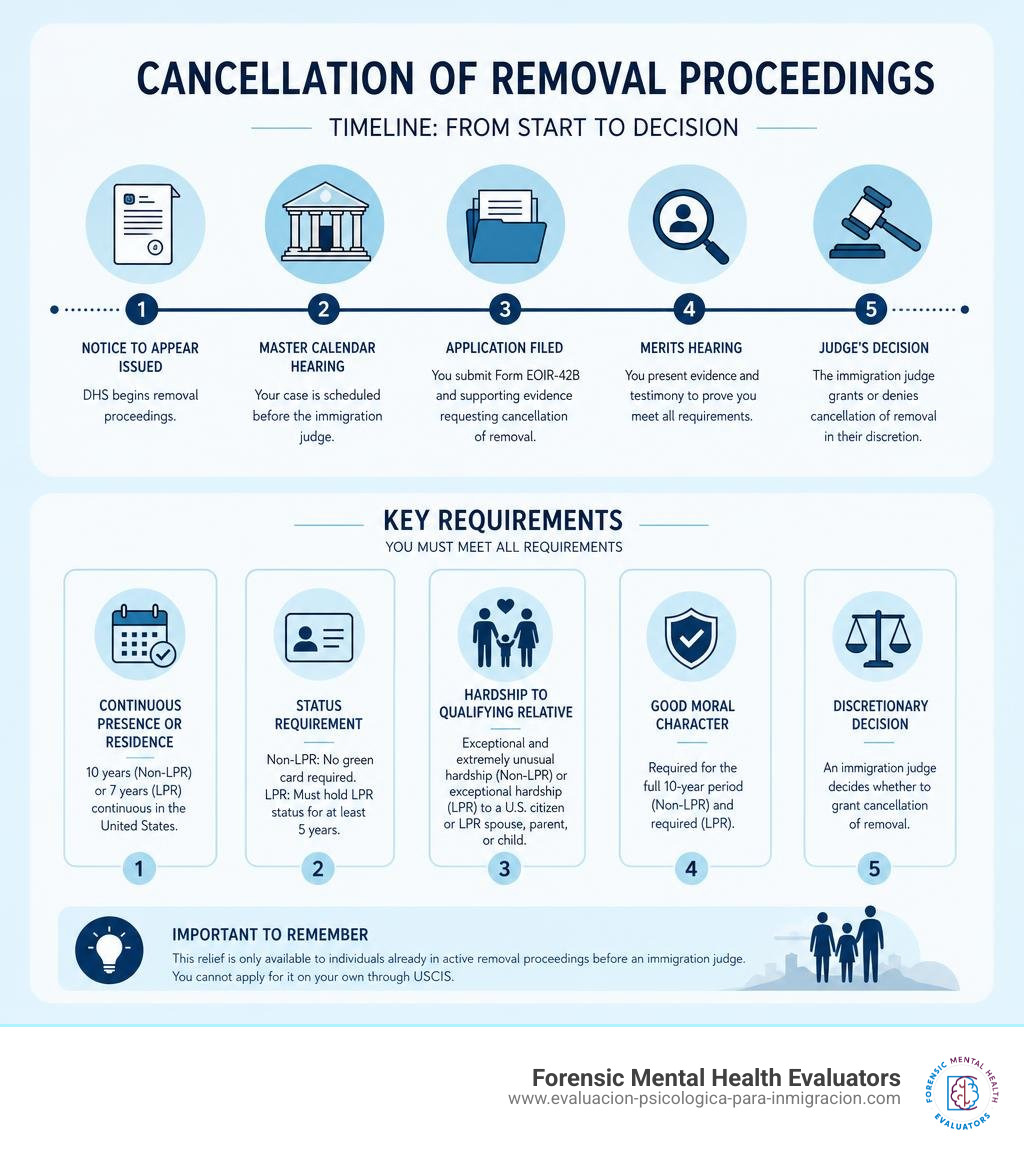
Here is a quick overview of who qualifies and what is required:
| Non-LPR (Undocumented) | LPR (Green Card Holder) | |
|---|---|---|
| Minimum U.S. presence | 10 years continuous physical presence | 7 years continuous residence |
| Status requirement | No green card required | Must hold LPR status for at least 5 years |
| Hardship standard | Exceptional and extremely unusual hardship to a U.S. citizen or LPR spouse, parent, or child | Exceptional hardship to a qualifying relative |
| Good moral character | Required for the full 10-year period | Required |
| Who decides | Immigration judge (discretionary) | Immigration judge (discretionary) |
This relief is only available to people already in active removal proceedings before an immigration judge. You cannot apply for it on your own through USCIS.
If you are a non-permanent resident in Texas facing deportation, the stakes could not be higher. As of June 2025, ICE was holding more than 59,000 people in detention — the highest number ever recorded — and immigration judges were issuing removal orders in over 50% of cases that reached the merits hearing stage. The pressure is real, and the legal bar is high.
The most common reason cancellation cases fail is not eligibility — it is lack of evidence. Many families struggle to prove the level of hardship required by law, especially when it involves the emotional and psychological toll on U.S. citizen children or spouses.
I'm Francisco Ortiz, Lead Forensic Mental Health Evaluator at Forensic Mental Health Evaluators, licensed in six states including Texas, and I specialize in providing the kind of rigorous, evidence-based psychological evaluations that cancellation of removal proceedings require to meet the high hardship standard. In this guide, I will walk you through every step of the process — from eligibility to application to what happens if your case is denied.
Understanding Cancellation Removal Proceedings and Eligibility
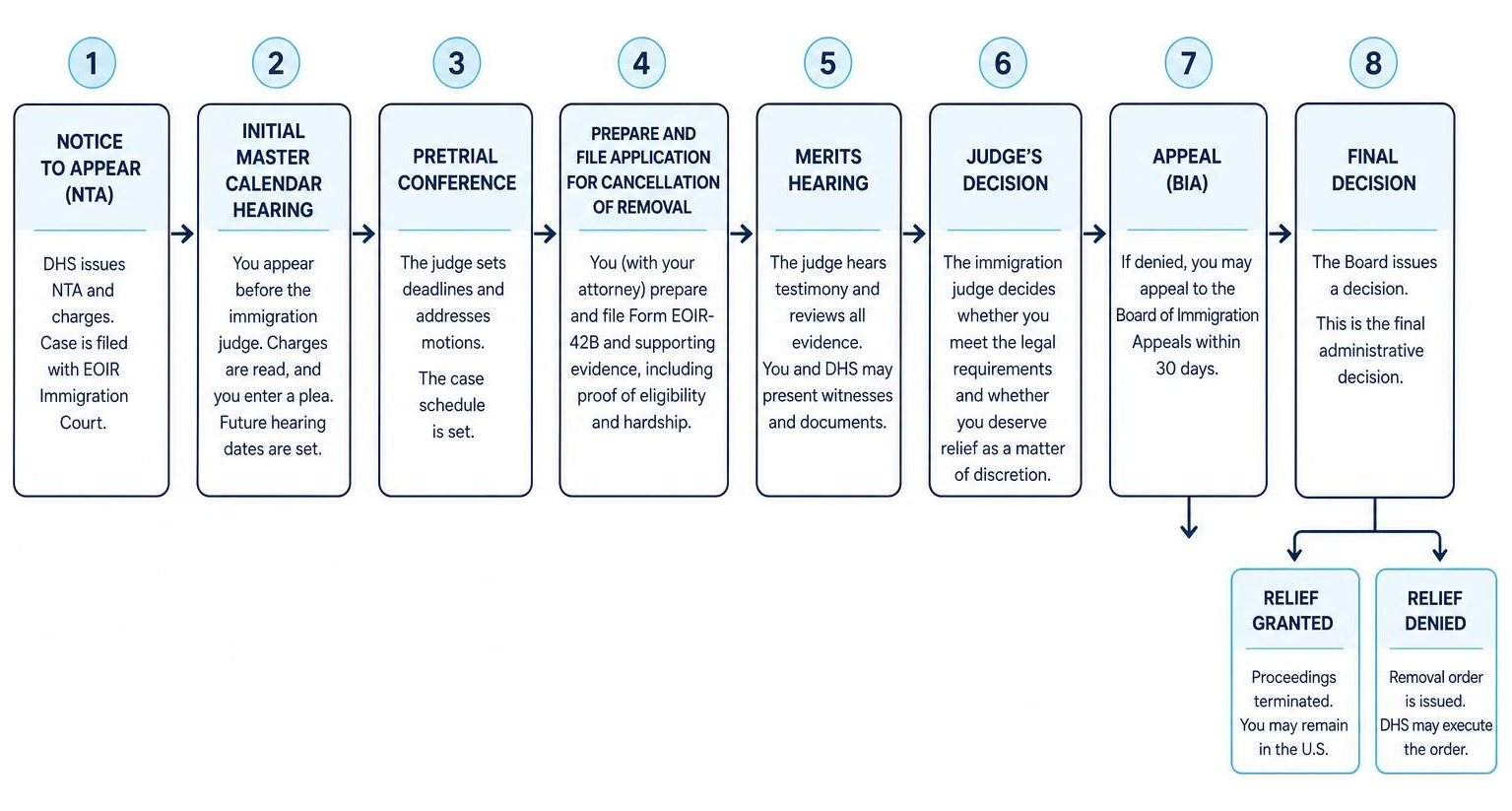
When the Department of Homeland Security (DHS) decides to initiate deportation, they issue a document called a Notice to Appear (NTA). This is the official starting gun for your case in front of the Executive Office for Immigration Review (EOIR), which is the agency that runs the immigration courts.
Once you are in this system, you cannot simply ask USCIS for a green card or a waiver. Instead, your defense must be presented directly to an immigration judge. One of the most powerful shields available to stop this process is applying for a cancellation of removal.
To explore this path in-depth, you can read our Cancellation of Removal Complete Guide. Under federal regulations, specifically PART 1240—PROCEEDINGS TO DETERMINE REMOVABILITY OF ALIENS IN THE UNITED STATES, the judge has the discretionary authority to approve or deny your application. This means that even if you meet every single technical requirement, the judge must still believe you deserve to stay in the United States.
Eligibility for LPRs in Cancellation Removal Proceedings
For individuals who already hold lawful permanent resident (LPR) status — commonly known as having a green card — the requirements are slightly different. Sometimes, a past mistake or a criminal conviction can land a permanent resident in deportation proceedings. To qualify for LPR cancellation under INA § 240A(a), you must prove that you:
- Have been a lawful permanent resident for at least 5 years.
- Have resided in the United States continuously for at least 7 years after being admitted in any status.
- Have not been convicted of an "aggravated felony" (a specific category of serious crimes in immigration law).
LPR status is a major shield, but it is not bulletproof. If you are a permanent resident facing these charges, you must still convince the judge that the positive factors in your life (like family ties, rehabilitation, and employment history) outweigh the negative factors (like your criminal record).
Eligibility for Non-LPRs in Cancellation Removal Proceedings
For non-LPRs — undocumented immigrants, those with overstayed visas, or individuals with temporary statuses like TPS — the legal hurdle is significantly higher. To qualify for non-LPR cancellation under INA § 240A(b)(1), you must meet four strict statutory criteria:
- 10 Years of Continuous Physical Presence: You must have been physically present in the U.S. for at least 10 years before the "clock" was stopped (more on this below).
- Good Moral Character: You must show you have been a person of good moral character during those 10 years.
- No Disqualifying Criminal Convictions: You cannot have certain criminal marks on your record.
- Exceptional and Extremely Unusual Hardship: You must prove that your deportation would cause "exceptional and extremely unusual hardship" to a qualifying relative who is a U.S. citizen or LPR.
Navigating these requirements is incredibly complex. For a deeper breakdown of how these rules apply to undocumented individuals, take a look at our Cancellation Removal Psych Evaluation Guide 2026.
Proving Exceptional and Extremely Unusual Hardship

The most difficult element of a non-LPR cancellation case is proving "exceptional and extremely unusual hardship." This is not just a fancy legal phrase; it is a very specific, incredibly high legal standard.
To qualify, the hardship cannot be suffered by you, the applicant. Instead, it must be suffered by your qualifying relatives, who must be your U.S. citizen or LPR spouse, parent, or child under the age of 21. If your sick relative is also undocumented, the law does not allow their hardship to be counted toward your application.
You can read more about this exact standard in our guide on Extreme and Exceptionally Unusual Hardship.
The Difference Between Ordinary and Exceptional Hardship
When a family member is deported, every family suffers. There is always financial strain, emotional sadness, and the stress of adjusting to a new life or being separated. In the eyes of the law, however, this is considered "ordinary" or "standard" hardship.
To win a 10-year cancellation case, you must show that your qualifying relative's suffering would go significantly above and beyond the normal hardships of deportation. Examples of exceptional hardship include:
- A U.S. citizen child with a severe, chronic medical condition (like cancer, severe asthma, or autoimmune diseases) that requires specialized medical care unavailable or unaffordable in your home country.
- A child with severe special educational needs (such as autism spectrum disorder or severe developmental delays) who relies on specialized U.S. school programs that do not exist in the country of relocation.
- A qualifying relative who is completely financially and physically dependent on you due to advanced age, disability, or severe illness, where your deportation would leave them with no support system.
The Role of Psychological Evaluations in Hardship Claims
How do you prove that a child's anxiety or a spouse's depression rises to the level of "exceptional and extremely unusual"? You cannot simply tell the judge that your family will be sad. You need objective, clinical, and professional evidence.
This is where a professional psychological evaluation becomes the cornerstone of your defense. At District Counseling, we conduct comprehensive clinical evaluations specifically designed for immigration court. We analyze the family's psychosocial history, perform diagnostic mental health testing, and draft a detailed forensic report that clearly explains the deep psychological impact of separation or forced relocation.
Our evaluations are fully bilingual (conducted in Spanish and translated into English), ensuring that you and your family can speak comfortably in your native language. Best of all, we stand by our clients long after the report is written by offering 6 free therapy sessions to help your family cope with the intense stress of active court proceedings. This objective clinical evidence is often the deciding factor that helps an immigration judge understand the true depth of your family's suffering.
Disqualifying Factors and the Stop-Time Rule
Even if you have lived in the United States for 15 years and have a child who needs your support, certain legal technicalities can instantly disqualify you from seeking cancellation of removal. Two of the biggest hurdles are criminal history and the "stop-time rule."
For a detailed analysis of how these rules are interpreted by legal advocates, refer to the practice advisory Strategies and Considerations in the Wake of Niz-Chavez v. Garland.
How Criminal Records Bar Relief
Your criminal history is heavily scrutinized in immigration court. Certain offenses act as automatic statutory bars, meaning the judge is legally forbidden from granting you cancellation, no matter how sympathetic your family's situation is. These disqualifying factors include:
- Aggravated Felonies: For LPRs, any conviction classified as an aggravated felony is an absolute bar.
- Crimes Involving Moral Turpitude (CIMTs): This includes offenses involving theft, fraud, or intentional violence.
- Drug Offenses: Almost any drug-related conviction (with a very narrow exception for a single offense of simple possession of 30 grams or less of marijuana) will disqualify you.
- Domestic Violence: Convictions related to domestic abuse, stalking, or child abuse are major red flags.
Even minor issues, like traffic tickets or dismissed charges, must be disclosed on your application. Failing to list them can make the judge believe you are hiding information, which instantly destroys your "good moral character" claim.
Understanding the Stop-Time Rule and Defective NTAs
To apply for non-LPR cancellation, you must prove 10 years of continuous physical presence. However, under the "stop-time rule," your continuous presence clock stops ticking the moment the government serves you with a valid Notice to Appear (NTA).
For years, the government issued NTAs that did not include the actual date, time, or location of the court hearing, leaving that information as "to be determined." In the landmark Supreme Court case Niz-Chavez v. Garland, the court ruled that an NTA must contain all statutorily required information — including the specific time and place of the hearing — in a single, comprehensive document to trigger the stop-time rule.
If you received a defective NTA that lacked these details, your continuous physical presence clock may have kept ticking, allowing you to reach the 10-year threshold even after your court case began! Challenging a defective NTA is a highly technical legal strategy that requires the help of an experienced attorney.
The Step-by-Step Process of Applying for Relief

Applying for cancellation of removal is a marathon, not a sprint. It requires meticulous organization, extensive documentation, and careful preparation.
To begin the process, you must file the correct application form. For non-LPRs, this is the Form EOIR-42B. You can read our detailed guide on how to navigate this document here: EOIR 42B Form.
Preparing Your Application and Gathering Evidence
Your application packet is essentially a biography of your life in the United States. You must gather and organize concrete evidence to prove every single element of your eligibility. This includes:
- Proof of 10-Year Presence: Tax transcripts, rent receipts, utility bills, school records, employment stubs, and medical records covering every single year of your residency.
- Relationship Documents: Birth certificates of your U.S. citizen children, marriage certificates, and proof of your relatives' legal status (green cards or passports).
- Hardship Evidence: Detailed medical files, letters from special education teachers, financial statements, and a professional psychological evaluation report.
- Good Moral Character: Affidavits from community members, proof of volunteer work, and police clearances.
Every document that is not in English must be accompanied by a certified translation, stating that the translator is competent and that the translation is accurate.
Navigating Master Calendar and Individual Merits Hearings
Your case will involve at least two different types of hearings:
- Master Calendar Hearing (MCH): This is a short, preliminary hearing where the judge reviews the charges against you, schedules deadlines for filing your applications, and sets a date for your final trial.
- Individual Merits Hearing: This is your actual trial. You, your attorney, and your witnesses will testify under oath. The ICE government counsel will cross-examine you, and the immigration judge will make a final decision on your case.
Attending every single hearing is vital. Over the past three years, only 8% of individuals in removal proceedings received in absentia (in their absence) removal orders because they missed court. For those represented by counsel, that number drops to a mere 3%. Having a team in your corner makes a massive difference.
The Impact of Recent Policy Changes and Detention Trends
The landscape of immigration enforcement is constantly shifting. As of late 2025 and heading into 2026, the implementation of the One Big Beautiful Bill Act (OBBA) has poured an additional $45 billion into expanding ICE's detention capacity, targeting a massive increase to at least 116,000 beds nationwide.
With this expanded capacity and strict enforcement directives, more individuals are being held in mandatory detention without the immediate option for a bond hearing. Fighting a deportation case from inside a detention facility is incredibly difficult, as cases are placed on an expedited docket that moves in a matter of weeks rather than years.
Restoring Judicial Discretion to Terminate Cases
Despite these aggressive enforcement trends, there is also good news for respondents. A critical legal precedent, Matter of CORONADO ACEVEDO, 28 I&N Dec. 648 (A.G. 2022), officially restored the authority of immigration judges and the Board of Immigration Appeals (BIA) to terminate or dismiss removal proceedings in specific circumstances.
This means that if you are in removal proceedings but have another viable pathway to legal status — such as an approved immediate relative petition (Form I-130) that would allow you to adjust status through USCIS — your attorney can ask the judge to dismiss your court case entirely. This provides a vital "off-ramp" from the deportation system, allowing you to pursue your green card safely and peacefully without the threat of an active removal order hanging over your head.
Frequently Asked Questions about Cancellation of Deportation
What happens if my cancellation of removal application is denied?
If the immigration judge denies your application, they will issue a formal removal order. You generally have 30 days to appeal this decision to the Board of Immigration Appeals (BIA). If you choose not to appeal, or if your appeal is denied, the removal order becomes final, and you face deportation. A final removal order typically carries a 10-year bar to re-entry, making it illegal for you to return to the U.S. without special permission. In some cases, your attorney may be able to request "voluntary departure" instead of a removal order, which avoids some of the harshest legal penalties of deportation.
Can I apply for cancellation of removal if I am not currently in deportation proceedings?
No. Cancellation of removal is strictly a defensive form of relief. It is only available to individuals who are actively facing deportation in immigration court. You cannot proactively mail an EOIR-42B application to USCIS if you are not in proceedings; they do not have the legal jurisdiction to hear or approve it.
How long does the cancellation of removal process take in 2026?
The timeline varies wildly depending on whether you are on the detained or non-detained docket. If you are detained, your case is expedited and may be resolved in a few weeks or months. However, if you are on the non-detained docket, severe court backlogs mean it can take several years (sometimes three to five years) to reach your final Individual Merits Hearing.
Conclusion
Facing a deportation order is one of the most frightening experiences a family can go through. The legal requirements are strict, the government's resources are vast, and the emotional toll is heavy. But remember: you do have rights, and you do have options.
A successful defense relies on preparation, a strong legal strategy, and undeniable evidence. At District Counseling, we are dedicated to helping families in Texas (including Houston, Katy, Cypress, and Sugar Land) and across our licensed states (including Florida, California, New York, Utah, Virginia, and Idaho) build the strongest case possible.
Through our professional, bilingual psychological evaluations, we give a voice to your family's silent struggles, providing the objective clinical evidence that immigration judges need to see. And because we care about your long-term well-being, we support you through the journey by offering 6 free therapy sessions after your evaluation report is completed.
Do not leave your family's future to chance. To learn more about how we can support your case, explore our resources on Evaluacion Psicologica para Caso de una Cancelacion de Deportacion or contact us today to schedule your consultation. We are here to stand with you.