
Facing Removal? What an Immigration Lawyer for Deportation Does
What an Immigration Lawyer for Deportation Can Do

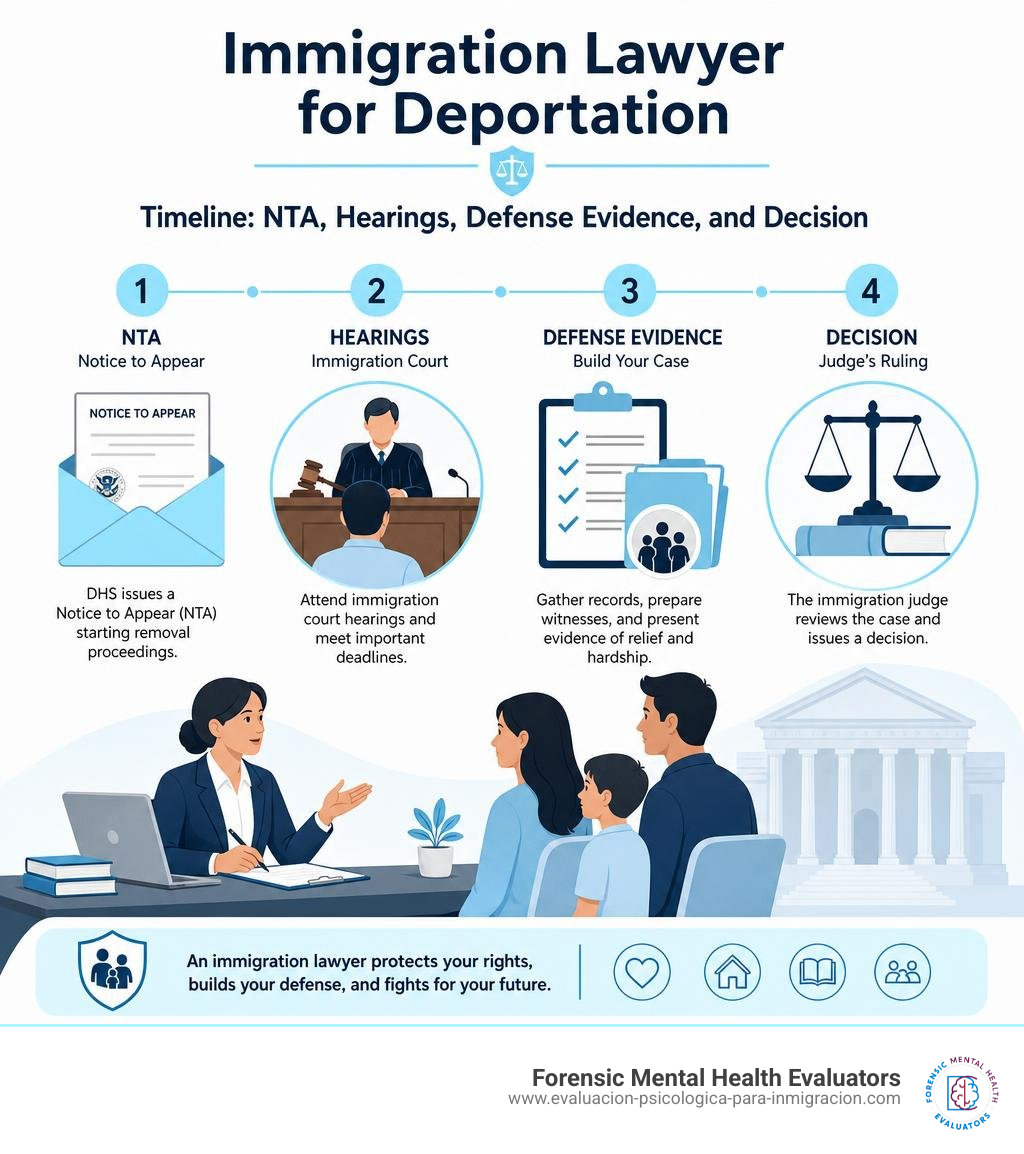
An immigration lawyer for deportation helps a person facing removal understand the government's allegations, protect their rights in immigration court, and pursue any relief for which they may qualify. Removal cases can affect your ability to remain with your children, spouse, job, and community, so acting quickly after receiving a Notice to Appear is important.
In simple terms, a deportation defense lawyer can:
- Review the Notice to Appear and the legal reason DHS says you can be removed.
- Represent you at immigration court hearings and meet filing deadlines.
- Identify possible defenses, such as asylum, cancellation of removal, adjustment of status, VAWA relief, a U visa, or other protections.
- Gather records, prepare witnesses, and challenge weak or incorrect government claims.
- Help document the impact that removal would have on qualifying U.S. citizen or lawful permanent resident family members.
Immigration court is a civil process, not a criminal trial. Still, the consequences can be life-changing. You may have the right to hire a lawyer and receive a court interpreter, but the government generally does not appoint a free attorney for adults who cannot afford one. Legal representation can make a major difference in whether a person can present a complete defense.
For families seeking cancellation of removal, evidence of a child's medical, educational, or mental health needs may be central to showing the required level of hardship. A careful psychological evaluation can help explain the real human impact of separation in a clear, evidence-based way.
I am Francisco Ortiz, a Certified Forensic Mental Health Evaluator who conducts immigration psychological evaluations for hardship, asylum, U visa, T visa, and immigration court competency matters. My work often supports the evidence an immigration lawyer for deportation may use to show how removal could affect a U.S. citizen spouse, child, or other qualifying family member.
How Removal Proceedings Begin and Common Deportation Grounds
Deportation—officially called "removal" under current federal law—is the legal process through which the U.S. government seeks to deport a noncitizen from the country. Understanding how this administrative machine starts is the first step toward stopping it.
Removal proceedings are governed by the Executive Office for Immigration Review (EOIR), a branch of the U.S. Department of Justice that runs the nation's immigration courts. On the other side of the courtroom sits an attorney representing the Department of Homeland Security (DHS), usually through Immigration and Customs Enforcement (ICE). DHS acts as the prosecutor, alleging that you lack lawful status or have committed an act that makes you removable.
The process unfolds across two primary types of court hearings:
- Master Calendar Hearing: This is your initial procedural court date. It is usually short, lasting anywhere from five minutes to half an hour. During this hearing, you (or your immigration lawyer for deportation) will respond to the administrative charges on your charging document, indicate what forms of legal relief you plan to seek, and establish strict submission deadlines for evidence and petitions.
- Individual Merits Hearing: This is your full trial. Unlike the quick master calendar session, a merits hearing can last several hours. It is where you testify under oath, present documentary evidence, bring forward expert or character witnesses, and face cross-examination from the government’s ICE trial attorney before the Immigration Judge renders a final decision.
What to Do Upon Receiving a Notice to Appear (NTA)
The administrative mechanism of deportation begins with a single document: the Notice to Appear (NTA) (Form I-862). Served by DHS, the NTA outlines the statutory grounds under which the government believes you are subject to removal. It lists factual statements regarding your citizenship, date and manner of entry, and the specific legal provisions you are alleged to have violated.
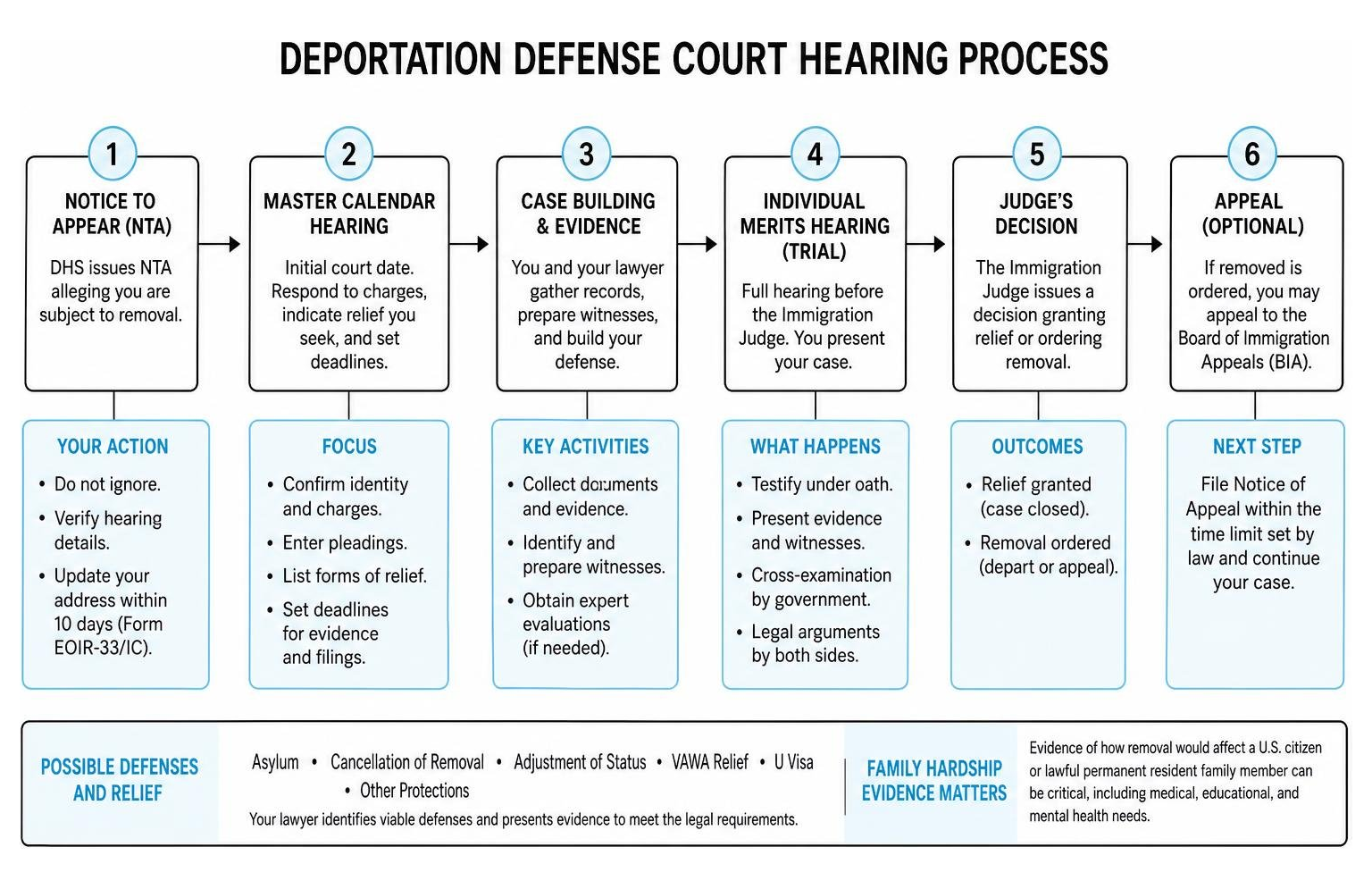
If you receive an NTA, taking immediate structured steps is essential:
- Do Not Ignore the NTA: Ignoring a court notice is the single fastest way to lose your right to remain in the United States.
- Verify the Hearing Details: Check whether your NTA contains a valid court date, time, and specific immigration court address. Under federal case law developments, defective NTAs missing crucial court details may be subject to procedural legal challenges by an attorney.
- Update Your Address within 10 Days: If you move at any point during your proceedings, federal law strictly mandates that you update your mailing address with the court using Form EOIR-33/IC within 10 days of moving. If the court sends a hearing notice to your old address because you failed to file Form EOIR-33, you risk being ordered deported in your absence.
- Consult an Immigration Attorney Immediately: Bring your NTA to a legal consultation right away so your attorney can evaluate the charges, identify pleading strategies, and prepare initial affirmative applications.
Deportation Risks for Green Card Holders and Criminal Convictions
A common myth among immigrants is that obtaining Lawful Permanent Resident (LPR) status—a green card—makes someone completely immune to deportation. In reality, lawful permanent residence is a privilege subject to rules under the Immigration and Nationality Act (INA). LPRs can be placed in removal proceedings if they commit specific criminal offenses or immigration violations.
The statutory grounds that most frequently put green card holders at risk include:
- Aggravated Felonies: Defined under INA § 101(a)(43), this statutory category includes serious violent crimes, murder, rape, sexual abuse of a minor, drug trafficking, firearm trafficking, and theft or fraud offenses resulting in a sentence of imprisonment of at least one year. An aggravated felony conviction creates severe statutory bars against almost all forms of discretionary deportation relief.
- Crimes Involving Moral Turpitude (CIMT): A CIMT generally involves conduct that is inherently base, vile, or depraved, contrary to accepted moral standards (such as fraud, theft, domestic violence, or intentional bodily harm). Committing a CIMT within five years of admission into the U.S. (where the offense carries a potential sentence of one year or more) or committing two independent CIMTs at any time can trigger deportability.
- Controlled Substance Violations: Convictions related to controlled substances—federal or state—render noncitizens deportable, with a narrow exception for a single offense involving simple possession of 30 grams or less of marijuana for personal use.
- Domestic Violence and Stalking Offenses: Convictions for domestic violence, child abuse, child neglect, stalking, or violating a protective order are independent statutory grounds for removal under U.S. immigration law.
Consequences of Failing to Appear in Court
Missing a scheduled immigration court date carries catastrophic administrative consequences. If you fail to show up for either a Master Calendar Hearing or an Individual Merits Hearing without an extraordinary excuse, the Immigration Judge will issue an in absentia removal order.
An in absentia order means you are ordered deported in your absence without having had the opportunity to present evidence or request relief. Once an in absentia order is issued:
- You are subject to immediate detention and physical removal by ICE.
- You become ineligible for most forms of discretionary immigration relief for a period of ten years.
To undo an in absentia deportation order, your immigration lawyer for deportation must file a formal Motion to Reopen with the immigration court. Under federal regulations, an in absentia order can generally only be reopened under two primary conditions:
- Lack of Proper Notice: Demonstrating that DHS or the court failed to properly serve you with the hearing notice or NTA in accordance with statutory notice requirements.
- Exceptional Circumstances (Filed Within 180 Days): Proving that your failure to appear was caused by exceptional circumstances beyond your control, such as a severe, unexpected personal illness, severe battery, or the death of an immediate family member (spouse, child, or parent). Unintentional logistical mistakes or work conflicts rarely meet this high legal threshold.
Types of Relief and the Role of an Immigration Lawyer for Deportation

Being placed in removal proceedings does not mean automatic deportation. The law provides multiple statutory avenues of relief that allow noncitizens to stop deportation and, in many cases, obtain or keep their lawful permanent residence.
A knowledgeable immigration lawyer for deportation analyzes your personal history, employment records, family connections, and country conditions to construct a customized defense strategy. Relief options are broadly categorized into defensive claims made in court before an Immigration Judge and concurrent affirmative applications processed before United States Citizenship and Immigration Services (USCIS). In some scenarios, attorneys can also negotiate with ICE trial counsel to seek prosecutorial discretion, such as joint motions to dismiss or administratively close proceedings for low-priority individuals.
How an Immigration Lawyer for Deportation Defends Your Case
When you face removal, a defense attorney serves as your strategic advocate. Immigration court rules, evidence standards, and procedure guidelines are rigorous; navigations without formal legal training leave immigrants vulnerable to procedural default.
Your deportation attorney takes on critical responsibilities throughout the process:
- Evidence Collection & Formatting: Gathering primary documents, certified police disposals, tax returns, medical charts, expert evaluations, and affidavits, ensuring all items comply with the strict EOIR Practice Manual rules.
- Witness Preparation: Preparing you and your character or family witnesses to provide clear testimony under stress during direct examination and cross-examination.
- Enforcing Court Rights: Protecting your legal rights, including securing your right to a free court interpreter in your native primary language so you fully understand every detail of the proceeding.
- Cross-Examining Government Evidence: Questioning government witnesses and challenging DHS documents that fail to meet legal standards of authenticity or admissibility.
- Drafting Comprehensive Legal Briefs: Writing complex legal arguments that synthesize federal circuit case law and statutory codes to persuade the Immigration Judge.
Asylum, Withholding of Removal, and Protection Under CAT
For individuals fearing persecution, harm, or torture if returned to their home country, humanitarian protections provide a crucial shield against deportation.
- Asylum: To qualify for asylum, an applicant must demonstrate a "well-founded fear" of persecution in their native country based on at least one of five statutory protected grounds: race, religion, nationality, political opinion, or membership in a particular social group. Asylum is discretionary, must generally be applied for within one year of arrival in the U.S. (unless extraordinary circumstances or changed country conditions apply), and offers a direct pathway to green card status after one year.
- Withholding of Removal: This is a mandatory form of protection under INA § 241(b)(3). The legal standard of proof is higher than asylum: the applicant must prove a "clear probability" (more than a 50% chance) that their life or freedom would be threatened on account of one of the five protected grounds. While withholding of removal stops physical deportation to that specific country, it does not provide a path to permanent residency and can be barred by certain criminal convictions.
- Protection Under the Convention Against Torture (CAT): Derived from international treaty obligations, CAT protection requires demonstrating that it is "more likely than not" (greater than 50% probability) that the applicant would be subjected to severe pain or physical torture inflicted by—or with the consent or acquiescence of—a public official or person acting in an official capacity. CAT protection carries no statutory bars regarding prior criminal convictions.
Voluntary Departure vs. Formal Deportation
When no viable statutory relief is available or when a client prefers to leave the country cleanly to avoid the harsh legal consequences of a removal order, an immigration lawyer for deportation may negotiate for Voluntary Departure.
Voluntary departure allows an individual to depart the United States voluntarily at their own expense within a designated time window granted by the judge.
| Feature | Voluntary Departure | Formal Deportation / Removal Order |
|---|---|---|
| Legal Status Impact | Avoids formal administrative deportation order | Results in a formal civil order of removal on your record |
| Reentry Bar | No automatic 5, 10, or 20-year statutory bar to reentry | Imposes a strict 10-year (or 20-year/permanent) bar to lawful reentry |
| Future Visa Eligibility | Preserves future eligibility for consular visas or family petitions | Requires special permission (Form I-212 waiver) to apply for future visas |
| Financial Cost | Respondent pays for their own return transportation | Government pays for travel; respondent subject to immediate ICE custody |
| Failure to Depart Penalty | Civil fines and automatic conversion to formal removal order | Immediate execution of deportation and potential criminal re-entry charges |
Cancellation of Removal and Proving Exceptional Hardship
One of the most frequently utilized forms of defense for long-term undocumented residents is Cancellation of Removal for Non-Permanent Residents under INA § 240A(b). If granted by an Immigration Judge, cancellation halts deportation, terminates proceedings, and converts the respondent directly into a Lawful Permanent Resident.
Because this form of relief permanently grants lawful status, Congress created very high eligibility thresholds. To learn more about the complete process, explore our comprehensive Cancellation of Removal Complete Guide.
Eligibility Rules for Non-LPR Cancellation
To qualify for non-permanent resident cancellation of removal, an applicant must fulfill four statutory requirements:
- Continuous Physical Presence: The applicant must demonstrate continuous physical presence in the U.S. for at least 10 years immediately preceding the service of the Notice to Appear (which halts the physical presence clock under the "stop-time rule"). A single absence exceeding 90 days or aggregate absences exceeding 180 days breaks continuous presence.
- Good Moral Character: The applicant must prove good moral character during the entire 10-year period. Certain criminal convictions, drug violations, false testimony under oath, or incarceration exceeding 180 days automatically defeat good moral character.
- No Disqualifying Criminal Convictions: The applicant must not have been convicted of an aggravated felony, crimes involving moral turpitude, controlled substance violations, or domestic violence offenses.
- Exceptional and Extremely Unusual Hardship: The applicant must prove that their removal would result in exceptional and extremely unusual hardship to a qualifying relative who is a U.S. citizen (USC) or Lawful Permanent Resident (LPR) spouse, parent, or child.
Proving Exceptional and Extremely Unusual Hardship
The single most challenging hurdle in cancellation cases is satisfying the "exceptional and extremely unusual hardship" standard. Established Board of Immigration Appeals (BIA) precedent (such as Matter of Monreal, Matter of Recinas, and Matter of Andazola) dictates that standard financial loss, emotional distress, or lower living standards in a native country do not meet this standard.
The hardship must be substantially beyond the ordinary suffering that naturally occurs when a family member is deported.
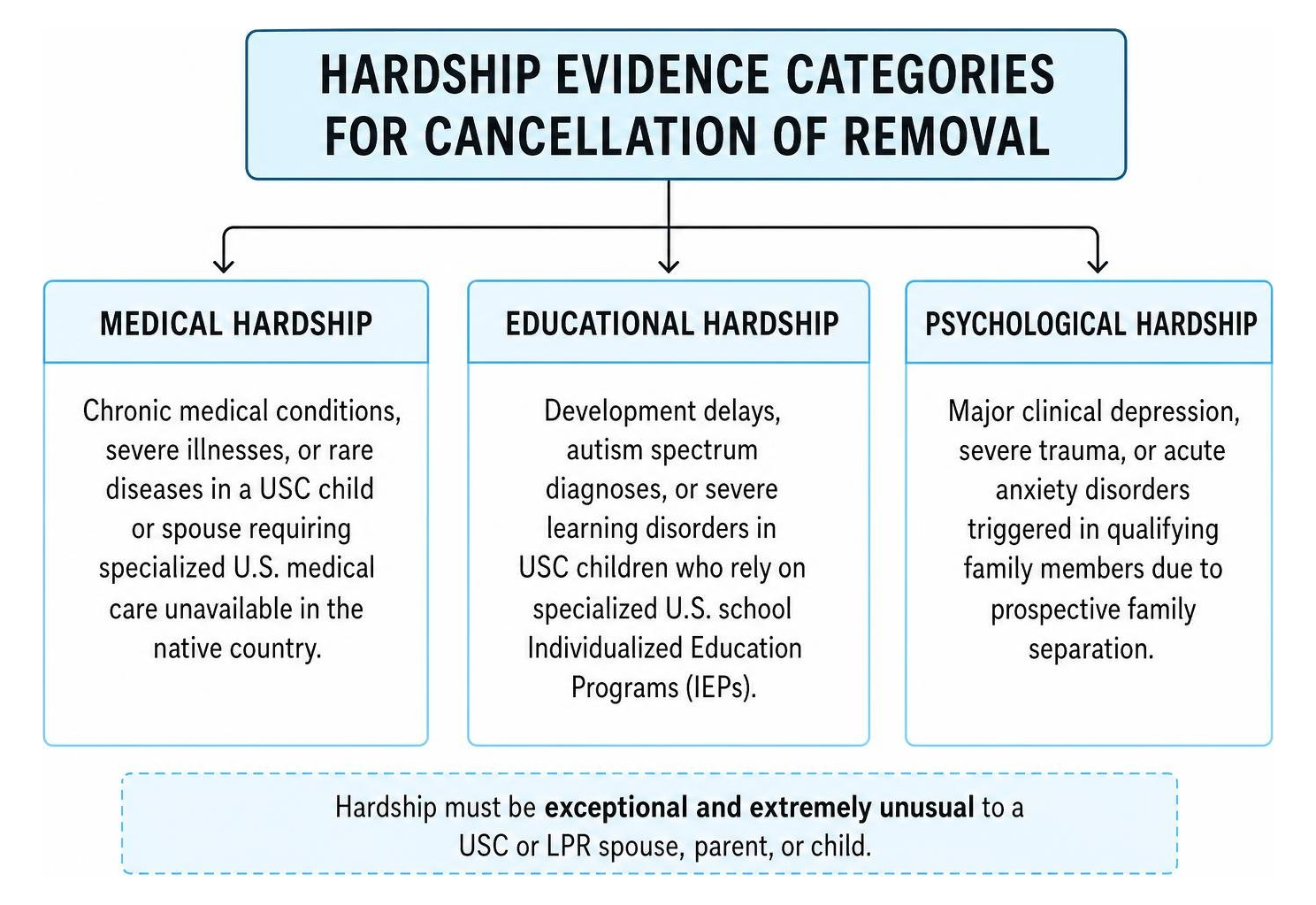
Proving this legal threshold requires assembling multi-layered evidence, specifically focusing on severe hardship factors:
- Chronic Medical Conditions: Severe physical disabilities, chronic illnesses, or rare diseases in a USC child or spouse requiring specialized U.S. medical care unavailable in the native country.
- Special Educational Needs: Development delays, autism spectrum diagnoses, or severe learning disorders in USC children who rely on specialized U.S. school Individualized Education Programs (IEPs).
- Severe Psychological and Mental Health Impact: Major clinical depression, severe trauma, or acute anxiety disorders triggered in qualifying family members due to prospective family separation.
In establishing these psychological impacts, clinical evidence is often vital. Our practice regularly conducts thorough clinical assessments that detail emotional functioning and mental health diagnoses. For a deeper breakdown of how clinical documentation is utilized in court, refer to our guide on Extreme and Exceptionally Unusual Hardship and review the Cancellation Removal Psych Evaluation Guide 2026.
How to Choose an Immigration Lawyer for Deportation, Appeals, and Resources
Selecting legal representation when facing deportation is one of the most critical decisions an immigrant will ever make. Statistical studies consistently confirm that noncitizens with dedicated legal representation in immigration court are significantly more likely to win their cases or obtain relief compared to unrepresented individuals.

Selecting the Right Immigration Lawyer for Deportation
Not all immigration attorneys handle courtroom litigation. Many practitioners specialize primarily in routine affirmative applications, such as marriage-based green cards or naturalization. Removal defense requires an experienced litigator familiar with trial procedure, rules of evidence, and administrative court dynamics.
When selecting an immigration lawyer for deportation, evaluate these practical criteria:
- Courtroom Litigation Experience: Ask specifically how many removal defense trials and individual merits hearings the attorney has conducted before EOIR immigration courts.
- Familiarity with Local Courts: Choose an attorney who regularly practices before the local immigration courts in your state—such as courts in Texas (Houston, Dallas, San Antonio), California, Florida, New York, Virginia, Utah, or Idaho—as local court procedures and judicial expectations vary.
- Transparent Fee Structures: Ensure the legal fee agreement clearly defines what is covered (e.g., representation at Master Calendar Hearings, Individual Merits Hearings, Bond Motions, or Appeals) and whether billing is flat-rate or hourly.
- Clear and Honest Communication: Be wary of any attorney who guarantees a specific outcome in immigration court. Ethical removal defense lawyers provide honest assessments based on existing statutory laws and evidence.
Appealing a Removal Order and Low-Income Legal Resources
If an Immigration Judge renders an adverse decision ordering deportation, the fight is not automatically over. Noncitizens have the right to challenge legal errors by appealing the decision to the Board of Immigration Appeals (BIA), located in Falls Church, Virginia.
- The 30-Day Appeal Window: To preserve your right to appeal, your attorney must file Form EOIR-26 (Notice of Appeal) so that it is physically received by the BIA within 30 calendar days of the judge's oral or written decision. Missing this 30-day deadline renders the deportation order final.
- Automatic Stay of Removal: Filing a timely Form EOIR-26 triggers an automatic stay of deportation, meaning ICE cannot physically remove you from the U.S. while your BIA appeal is pending review.
- Filing Fees and Waivers: Filing a BIA appeal requires paying a fee or submitting a fee waiver request if you cannot afford it. To understand how fee waivers function, read our complete guide on the BIA Appeal Fee Waiver.
For individuals and families facing deportation who cannot afford a private defense attorney, pro bono resources and low-cost legal assistance may be available:
- EOIR List of Pro Bono Legal Service Providers: The Executive Office for Immigration Review maintains an officially updated state-by-state list of accredited legal organizations and non-profits that offer free or low-cost assistance in removal cases across states like Texas, California, Florida, New York, Virginia, Utah, and Idaho.
- Legal Aid Societies and Legal Clinics: Law schools and local legal aid societies frequently run specialized immigration defense clinics that assist low-income respondents facing removal.
Frequently Asked Questions About Removal Defense
Can a lawful permanent resident be deported?
Yes. While green card holders have permanent residency status, that status can be revoked if they commit certain disqualifying acts listed under INA § 237. Key grounds include convictions for aggravated felonies, crimes involving moral turpitude, domestic violence offenses, firearm convictions, or controlled substance violations. However, qualifying LPRs facing removal may apply for relief under LPR Cancellation of Removal (INA § 240A(a)) if they have been a green card holder for at least 5 years, continuously resided in the U.S. for 7 years after admission, and have no aggravated felony convictions.
What is the difference between voluntary departure and formal deportation?
Formal deportation (a removal order) results in a mandatory legal bar precluding reentry to the U.S. for 10 years (or longer for repeated violations) and requires filing an I-212 waiver for future permission to enter. Voluntary departure allows an individual to leave the U.S. voluntarily within a designated court frame at their own expense without a formal deportation order, preserving future eligibility to apply for U.S. visas or family petitions through standard legal channels.
Can I appeal if an immigration judge orders my deportation?
Yes. You have the right to appeal an Immigration Judge's deportation order to the Board of Immigration Appeals (BIA). The Form EOIR-26 Notice of Appeal must be received by the BIA within 30 days of the judge's decision. A timely filed BIA appeal creates an automatic stay of deportation, keeping you in the country while the appellate body reviews written briefs for legal or factual errors made during the trial.
Conclusion
Facing deportation is undoubtedly one of the most stressful experiences a person or family can navigate. From the moment a Notice to Appear is served, time becomes a critical factor. Working alongside an experienced immigration lawyer for deportation ensures that your statutory rights are guarded, deadlines are preserved, and every possible defense strategy—whether asylum, cancellation of removal, or waivers—is brought forward.
Building a compelling removal defense often requires demonstrating the deep psychological impact that separation or return would cause. At District Counseling, we provide forensic psychological evaluations in Texas (including Houston, Austin, Dallas, and San Antonio) as well as across Florida, California, New York, Utah, Virginia, and Idaho. We offer Spanish-language evaluations translated into English, direct client care, and six complimentary therapy sessions post-report to support families through stressful legal proceedings.
If you are preparing a cancellation of removal defense or hardship claim with your deportation attorney, explore our comprehensive guidance on Evaluación Psicológica para Caso de una Cancelación de Deportación or contact us today to learn how our clinical evaluations can strengthen your case.