
Step-by-Step Guide on How to Show Extreme Hardship for a Waiver
What It Really Takes to Show Extreme Hardship for a Waiver
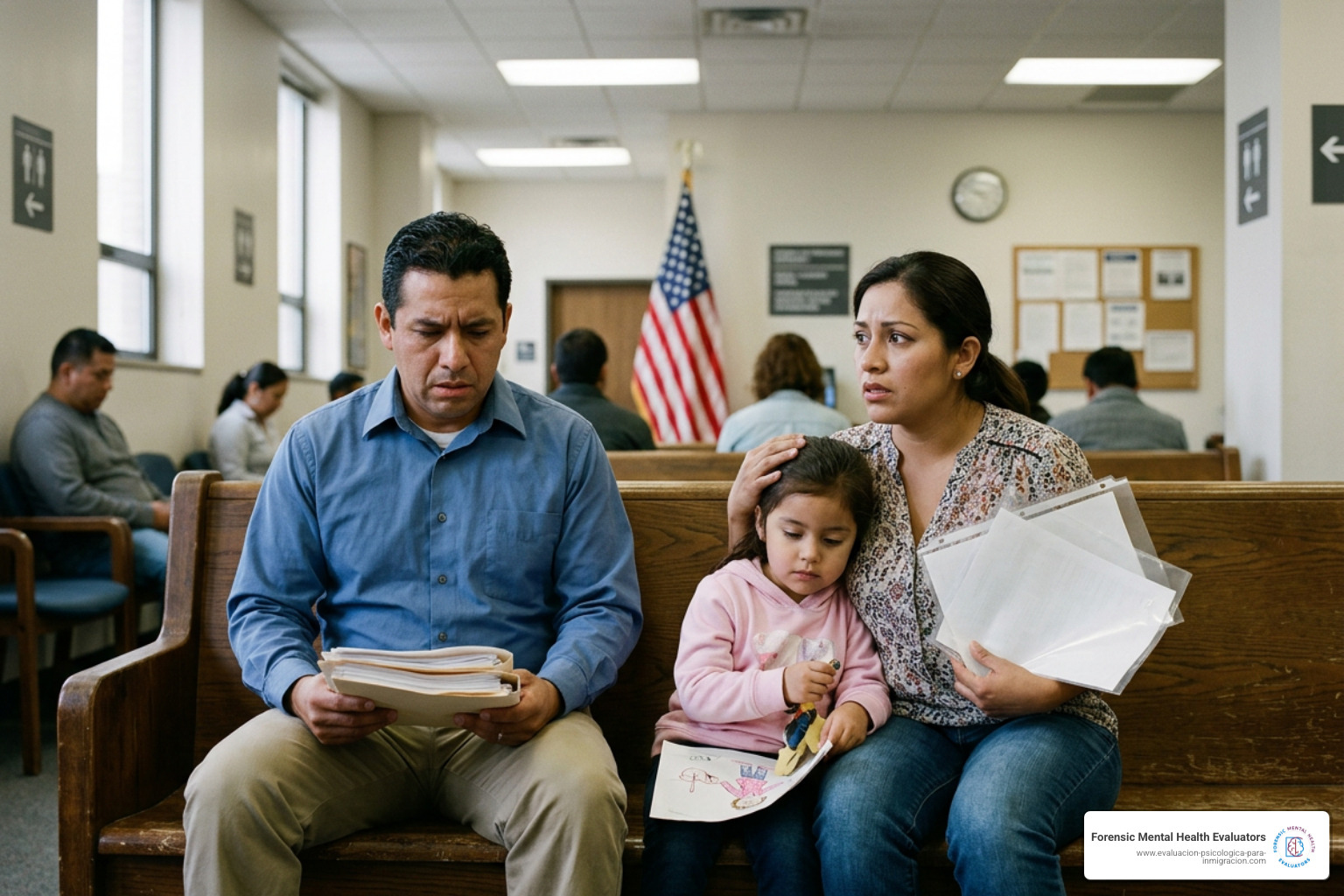
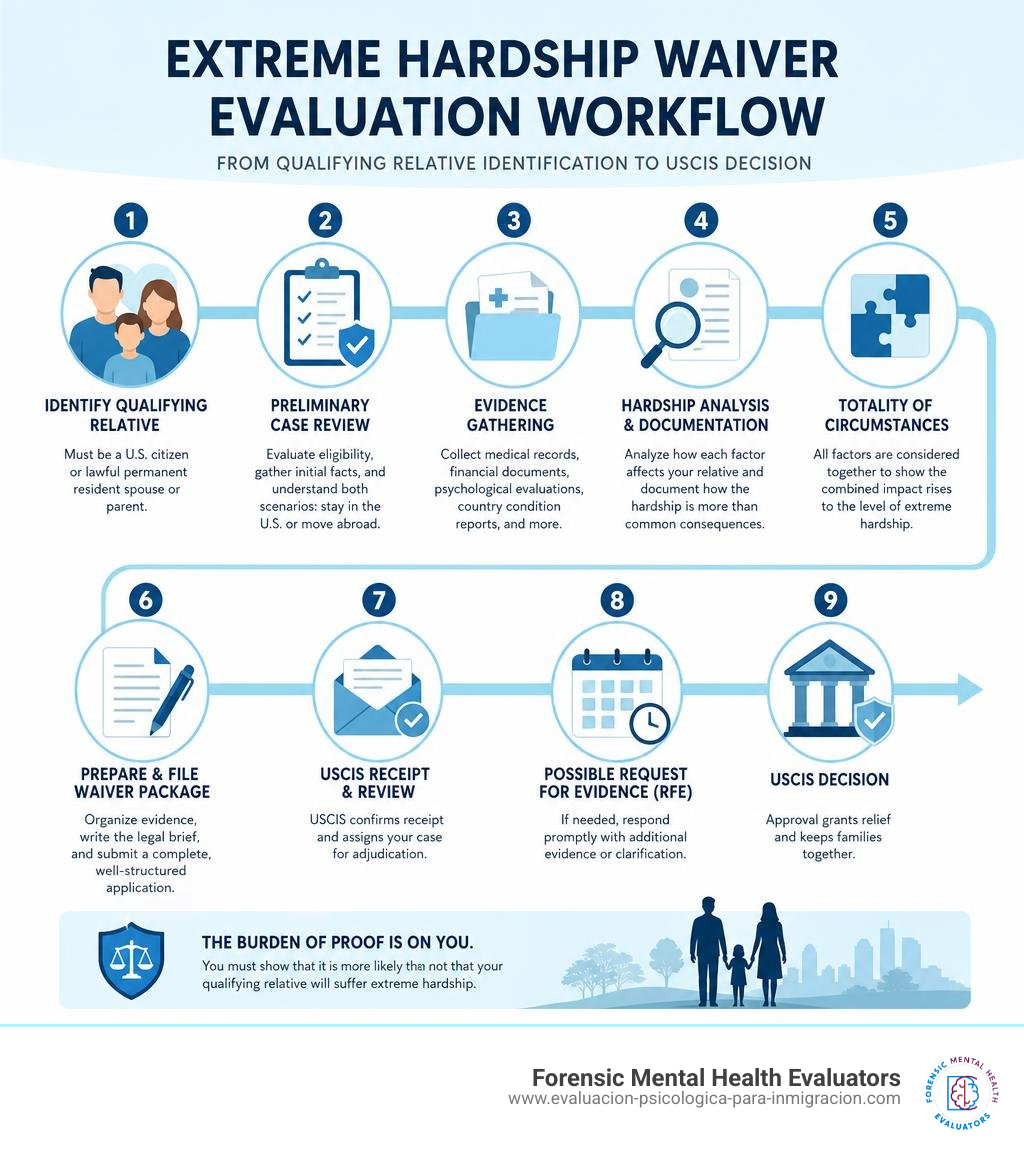
Knowing how to show extreme hardship for a waiver can mean the difference between your family staying together and being separated for years. Here is a quick overview of what USCIS needs to see:
- Identify your qualifying relative - This must be a U.S. citizen or lawful permanent resident (LPR) spouse or parent (not a child, for most waivers).
- Go beyond common consequences - Family separation and general sadness are expected. You must show hardship that is significantly worse than what most families experience.
- Cover both scenarios - Explain what happens if your relative stays in the U.S. without you and if they move abroad with you.
- Document every claim - Medical records, tax transcripts, psychological evaluations, and country condition reports all carry weight.
- Stack your factors - No single factor wins a case. USCIS adds everything up together under a "totality of the circumstances" standard.
The burden of proof is on you, the applicant, to show it is more likely than not that your qualifying relative will suffer extreme hardship.
Facing a potential deportation is one of the most stressful experiences a family can go through. The legal process is complex, the paperwork is overwhelming, and the emotional toll on your U.S. citizen spouse or children can be devastating — but that emotional toll must be proven, not just described.
USCIS does not grant waivers based on sympathy alone. According to official USCIS policy guidance, common consequences of family separation — like sadness, financial strain, or the difficulty of starting over in another country — do not automatically qualify as extreme hardship. The standard requires something more specific, more documented, and more severe than what the average family would experience.
That is exactly where many waiver applications fall apart. Strong cases get denied not because the hardship does not exist, but because it is not properly connected to the legal standard or backed by the right evidence.
I'm Francisco Ortiz, Lead Forensic Mental Health Evaluator at District Counseling PLLC, and I have conducted hundreds of expert clinical evaluations specifically designed to document how to show extreme hardship for a waiver in a way that meets USCIS adjudication standards. In this guide, I'll walk you through every step of the process — from understanding the legal definition to building a complete, well-organized waiver package.
Legal Definition: Extreme Hardship vs. Common Consequences
To win an immigration waiver (such as Form I-601 or Form I-601A provisional unlawful presence waiver), an applicant must demonstrate that their denial of admission will cause "extreme hardship" to a qualifying family member. But what does the law actually mean by "extreme"?
In immigration jurisprudence, "extreme hardship" is a legal term of art. It is not defined explicitly by statute, but through case law (such as Matter of Cervantes-Gonzalez and Matter of Hwang) and official USCIS policy guidance. Adjudicators evaluate cases under a totality of the circumstances standard.
USCIS strictly distinguishes between common consequences of family separation and extreme hardship:
- Common Consequences: Ordinary sadness, emotional distress, normal financial strain from maintaining two households, or routine difficulty adjusting to life in a foreign country. USCIS assumes these burdens occur in virtually every deportation or denial of admission. Therefore, common consequences alone do not meet the legal standard.
- Extreme Hardship: Exceptional emotional, physical, financial, or development-related suffering that exceeds the ordinary distress expected during separation or relocation.
It is vital to recognize that the standard for extreme hardship under section 212 of the Immigration and Nationality Act (INA) is distinct from—and lower than—the "exceptional and extremely unusual hardship" standard applied in cancellation of removal cases under INA § 240A(b). You do not need to prove near-total disaster, but you do need to prove that the aggregate impact on your relative goes well past routine difficulties.
The burden of proof rests entirely on you, the applicant, under the preponderance of the evidence standard. This means you must prove it is "more likely than not" (greater than a 50% probability) that your qualifying relative will experience extreme hardship if you are denied admission. For more on this legal baseline, review Chapter 5 - Extreme Hardship Considerations and Factors and our detailed legal breakdown of Extreme Hardship.
How to Show Extreme Hardship for a Waiver Through Qualifying Relatives
One of the most critical steps in learning how to show extreme hardship for a waiver is knowing whose hardship actually counts under the law. Hardship suffered by the immigrant applicant is generally irrelevant to USCIS adjudicators. The law focuses almost exclusively on the hardship experienced by the Qualifying Relative (QR).
The statutory definition of a qualifying relative depends on the specific ground of inadmissibility you are waiving:
- Unlawful Presence Waiver (INA § 212(a)(9)(B)(v) / Form I-601 or I-601A): Qualifying relatives are limited strictly to a U.S. citizen (USC) or Lawful Permanent Resident (LPR) spouse or parent. Children are not statutory qualifying relatives for this waiver ground.
- Fraud or Misrepresentation Waiver (INA § 212(i)): Qualifying relatives are also limited strictly to a USC or LPR spouse or parent.
- Certain Criminal Grounds Waiver (INA § 212(h)): Qualifying relatives include a USC or LPR spouse, parent, son, or daughter.
What happens if you have a U.S. citizen child with severe medical or educational needs, but you are applying for an I-601A unlawful presence waiver where children do not qualify directly?
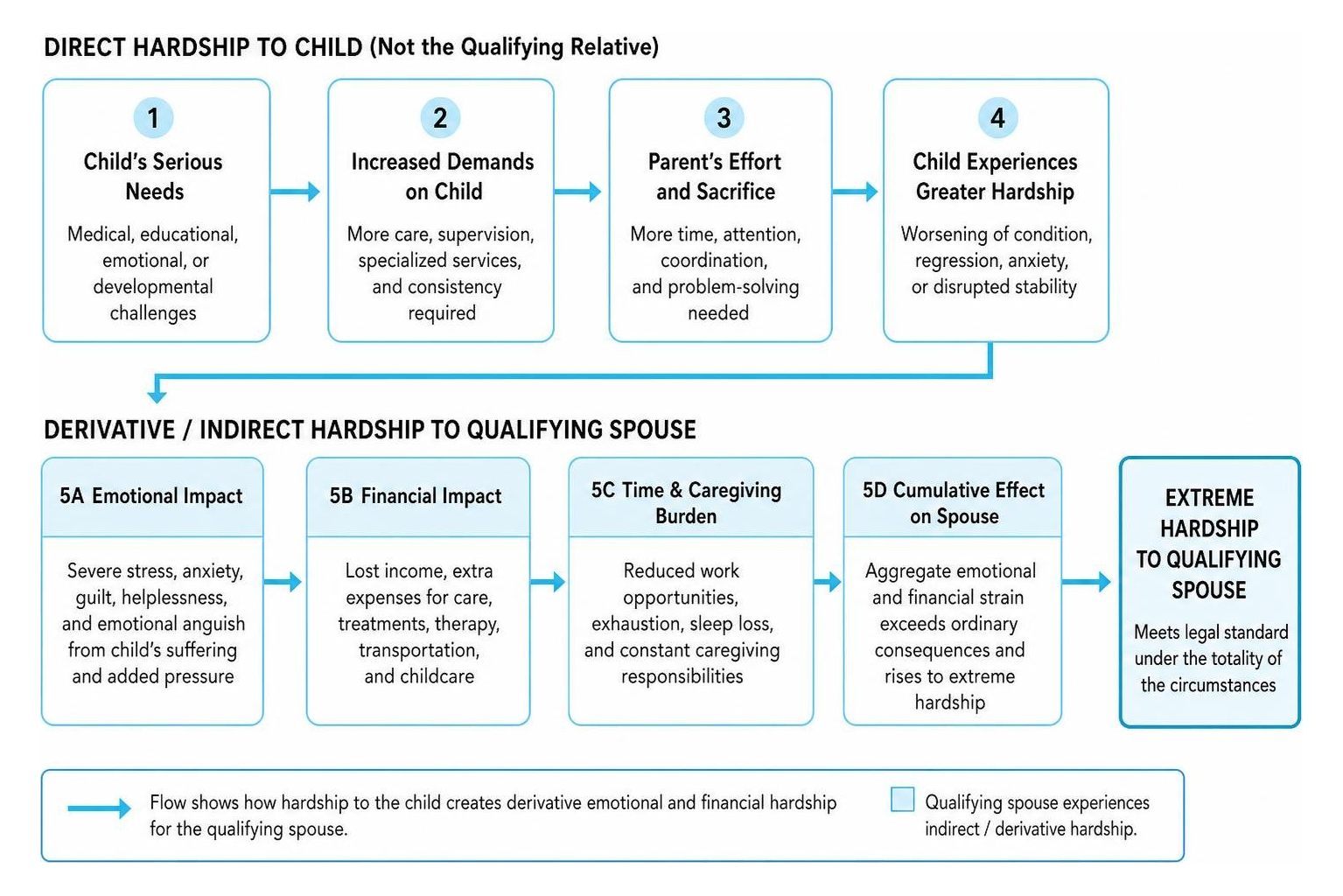
We use a legal technique known as bootstrapping hardship (or establishing derivative / indirect hardship). While the child is not the qualifying relative, severe hardship to the child directly causes psychological, emotional, and financial anguish to the qualifying parent (your spouse).
For instance, if a citizen child suffers from severe autism and relies on specialized educational plans, removing the father forces the qualifying mother to take on sole caregiving, work extra shifts, and witness her child regress. The child's detriment creates an extreme emotional and financial burden directly on the qualifying spouse.
The Five Core Factors and USCIS Particularly Significant Factors
When USCIS evaluates an application, officers do not examine hardship factors in isolation. They evaluate five core broad categories of hardship, weighing them cumulatively. A combination of several moderate hardship factors can add up to meet the legal standard, even if no single factor is "extreme" on its own.
- Health Conditions and Medical Care: Chronic physical illnesses, mental health conditions, need for specialized treatments, ongoing caregiving dependencies, or unavailability of suitable medical care in the applicant's home country.
- Financial Impact: Loss of primary household income, responsibility for debts or mortgages, cost of maintaining two households, or inability of the qualifying relative to earn a living abroad due to age, language barriers, or physical limitations.
- Country Conditions: High levels of crime, civil unrest, Department of State Travel Advisories, poor environmental infrastructure, or economic instability in the country of relocation.
- Social and Cultural Ties: Length of U.S. residence, family ties in the United States versus the country of origin, community involvement, language barriers, or fear of social ostracization abroad.
- Educational / Impact on Family Members: Disruption to a relative's higher education, special education needs for minor children, or loss of career progression opportunities.
To understand how USCIS differentiates standard consequences from extreme hardship across these pillars, review the comparison table below:
| Hardship Pillar | Common Consequence (Usually Denied) | Extreme Hardship Factor (Strong Case) |
|---|---|---|
| Medical / Health | General stress or mild sadness about separation. | Diagnosed major depressive disorder requiring therapy or severe chronic disease (e.g., autoimmune illness) needing specialized U.S. care. |
| Financial | Needing to tighten the family budget or general loss of secondary income. | Total economic collapse, inability to pay mortgage, or sole caregiver becoming unable to work due to child needs. |
| Country Conditions | Lower standard of living or general economic hardship in foreign country. | State Department Level 3/4 travel advisory, danger pay designation, active civil warfare, or severe targeted violence. |
| Family / Social Ties | Missing family events or adjusting to a new language and culture. | Complete disruption of care for disabled dependent, elderly parent requiring full daily living support, or total social isolation. |
To delve deeper into how adjudicators score these individual elements, refer to Chapter 6 - Extreme Hardship Determinations.
Identifying USCIS Particularly Significant Factors
In its updated Policy Manual guidance, USCIS explicitly identified five Particularly Significant Factors. When properly documented, these factors carry substantial weight in favor of a finding of extreme hardship:
- Qualifying Relative’s Disability: Formal disability ratings or determinations by federal/state agencies (such as Social Security Disability Insurance) for the qualifying relative or a dependent child.
- Active Military Service: The qualifying relative is an active-duty member of the U.S. Armed Forces or serves in the Selected Reserve.
- Department of State Travel Warnings: Relocation to a country or region subject to a State Department Travel Advisory recommending against travel (Level 3: Reconsider Travel, or Level 4: Do Not Travel).
- Substantial Displacement of Child Care: Denial of admission would cause substantial disruption or displacement of the care of the applicant's minor children, shifting heavy caretaking duties onto the qualifying relative.
- Refugee or Asylum Status: The qualifying relative was previously granted asylum, refugee status, or T/U nonimmigrant status from the applicant’s foreign country.
Step-by-Step Process on How to Show Extreme Hardship for a Waiver
To present a convincing argument to USCIS, applicants must follow a precise step-by-step framework. Adjudicators expect waiver applications to strictly analyze what is known as the Two-Scenario Rule.

You must demonstrate extreme hardship under both potential scenarios that the qualifying relative faces:
Scenario 1: Separation (Qualifying Relative Stays in the U.S.)
In this scenario, the applicant is forced to leave the country, while the qualifying relative remains in the United States. You must show the concrete severe consequences of this separation:
- Who covers the rent or mortgage when the main breadwinner leaves?
- How will the qualifying relative cope emotionally while living alone or managing children as a single parent?
- How does losing daily caregiving support impact the relative's health?
Scenario 2: Relocation (Qualifying Relative Moves Abroad)
In this scenario, the qualifying relative leaves their home, job, and life in the U.S. to move to the applicant's native country. You must prove why relocation is unreasonable or impossible:
- Does the foreign country lack adequate treatment for the relative's medical condition?
- Will the relative face language barriers, safety threats, or unemployment?
- Will they be cut off from their entire lifelong U.S. support network?
While current USCIS policy permits applicants to establish hardship under either separation or relocation, standard legal practice strongly advises arguing both scenarios thoroughly. If you only argue separation, an adjudicator might conclude, "If separation is so hard, why doesn't your spouse simply move abroad with you?"
Addressing both scenarios eliminates gaps in your argument. Learn more about organizing these dual claims in our comprehensive guide to Hardship Evaluation.
How to Show Extreme Hardship for a Waiver in Psychological Evaluations
While financial records and country reports are vital, the emotional and psychological toll on the qualifying relative is frequently the emotional engine of a successful waiver case. However, simply saying "my spouse is very sad and anxious" will almost guarantee a denial.
A formal clinical psychological evaluation conducted by a licensed mental health professional translates subjective distress into objective, recognized diagnostic data.
When we conduct a clinical psychological evaluation at District Counseling, we do not simply take personal statements at face value. We utilize standardized, scientifically validated clinical assessment tools (such as the PHQ-9 for depression, GAD-7 for anxiety, and PCL-5 for PTSD) combined with in-depth clinical interviews to determine whether the qualifying relative meets the diagnostic criteria under the DSM-5-TR.
A robust mental health report documents:
- Pre-existing Vulnerabilities: Trauma history, prior mental health challenges, or medical issues that make the relative uniquely vulnerable to stress.
- Specific Clinical Diagnoses: Formal diagnoses such as Major Depressive Disorder, Generalized Anxiety Disorder, Panic Disorder, or Adjustment Disorder with Mixed Anxiety and Depressed Mood.
- Daily Functional Impairment: How the distress specifically impacts the relative's ability to work, drive, parent, or maintain daily self-care.
- Prognosis Without the Applicant: Clinical opinion explaining how forced separation or relocation will lead to further psychological deterioration.
USCIS officers are administrative adjudicators, not doctors. Under official USCIS guidelines, officers are explicitly instructed that they cannot substitute their own medical judgment for that of a licensed medical or mental health expert. A comprehensive clinical report carries immense evidentiary weight.
At District Counseling, we provide specialized evaluations across our practice locations—including Houston TX, Katy TX, Cypress TX, Sugarland TX, as well as serving clients across Texas, Florida, California, New York, Utah, Virginia, and Idaho. To ensure complete accessibility, our Spanish-language evaluations are fully translated into certified English reports, and we include 6 free therapy sessions post-report to support family mental health during long processing delays.
To explore what goes into a formal mental health assessment, read our guide on Psychological Evaluation.
Building a Winning Waiver Package and Avoiding Pitfalls

Proving extreme hardship requires far more than telling a narrative. A successful submission is structured like a legal trial brief: every single assertion of fact in the qualifying relative’s declaration must refer directly to an attached, labeled exhibit.
To ensure your waiver package is complete, utilize this essential evidence checklist:
- Cover Letter and Detailed Table of Contents: A roadmap guiding the adjudicator through every legal argument and exhibit.
- Sworn Declarations / Affidavits: Written statements signed under penalty of perjury by the qualifying relative and applicant detailing daily routines, emotional reliance, and specific fears.
- Medical Records: Official diagnostic letters, treatment histories, physician statements, and prescription records.
- Financial Proof: IRS tax transcripts, pay stubs, bank statements, monthly expense budgets, lease agreements, and debt liabilities.
- Psychological Evaluation: Comprehensive clinical evaluation report from a licensed mental health professional.
- Country Condition Evidence: U.S. Department of State Country Reports on Human Rights Practices, Travel Advisories, and reputable news articles.
- Third-Party Support Letters: Affidavits from employers, teachers, community leaders, or family members confirming the family's situation.
For additional guidance on putting together your filing materials, check out our guide on the Immigration Extreme Hardship Waiver.
Common Drafting Errors and How to Prevent Them
Even cases with genuine hardship can be denied due to preventable mistakes. Here are the top errors we see applicants make when trying to show extreme hardship:
- Focusing on the Applicant's Hardship: The single most frequent mistake is writing a letter about how hard life will be for the immigrant applicant in their home country. Unless that hardship directly impacts the qualifying relative, USCIS will ignore it.
- Using Generic Template Language: Copying hardship statements directly off the internet is a major red flag. USCIS officers easily identify template language and will discount unoriginal assertions.
- Failing to Provide Objective Evidence: Stating that your spouse suffers from severe back pain or asthma without attaching doctor letters, medical bills, or prescription lists renders the claim unproven.
- Contradictory Scenario Arguments: Making arguments in Scenario A (Separation) that directly contradict Scenario B (Relocation). For example, arguing under separation that the spouse is completely financially independent, but arguing under relocation that they cannot afford to travel.
- Ignoring Long Processing Timelines: As of 2026, Form I-601A provisional waivers take between 28 and 32 months (and in some consulate processing tracks, up to 43 months). Failing to explain how long-term family separation deepens financial and mental health deterioration over years is a missed opportunity.
Frequently Asked Questions About Extreme Hardship Waivers
Can a U.S. citizen child be the qualifying relative for an I-601A waiver?
No. For Form I-601A provisional unlawful presence waivers and standard INA § 212(a)(9)(B)(v) unlawful presence waivers, Congress strictly limited qualifying relatives to a U.S. citizen or LPR spouse or parent. Children do not qualify directly.
However, as discussed earlier, hardship to a citizen child can be used as derivative hardship. If your child has medical, developmental, or emotional needs, the distress and extra caregiving burden placed on your qualifying spouse directly deepens the spouse's extreme hardship.
What is the standard of proof required by USCIS for an extreme hardship waiver?
The standard of proof is the preponderance of the evidence. This means the applicant must convince the USCIS officer that their claims are "more likely than not" true (greater than 50% likelihood).
Unlike criminal court cases that require proof "beyond a reasonable doubt," or non-LPR cancellation of removal which requires "exceptional and extremely unusual hardship," an extreme hardship waiver simply requires showing that the cumulative hardship clearly outweighs ordinary common consequences.
How do State Department travel advisories affect relocation hardship arguments?
Department of State (DOS) Travel Advisories carry significant weight in USCIS adjudications. Under official policy guidance, if a qualifying relative would be forced to relocate to a country or region subject to a Level 3 (Reconsider Travel) or Level 4 (Do Not Travel) advisory, USCIS treats this as a Particularly Significant Factor.
Adjudicators recognize that forcing a U.S. citizen or permanent resident to move into an officially dangerous region presents severe safety and security risks that strongly favor granting a waiver.
Conclusion
Understanding how to show extreme hardship for a waiver requires a systematic approach. You cannot rely on sympathy or vague claims of sadness. Success comes from connecting your family's daily reality directly to legal hardship standards, arguing both separation and relocation scenarios, and backing every single claim with objective documentation.
By combining financial records, country condition reports, detailed affidavits, and a professional clinical psychological evaluation, you transform a personal story into an undeniable legal case.
At District Counseling, we specialize in providing compassionate, scientifically grounded, and legally sound immigration evaluations for clients in Houston, Katy, Cypress, Sugarland, and across Texas, Florida, California, New York, Utah, Virginia, and Idaho. Our team is dedicated to giving your family the strongest possible voice before USCIS.
If you are preparing an immigration waiver application and need a professional psychological evaluation to document your qualifying relative's hardship, contact us today to schedule your consultation. For Spanish language guidance, visit our Evaluacion psicologica para caso de un perdon resource page.
To schedule your clinical evaluation or explore our services, visit our core portal at https://www.evaluacion-psicologica-para-inmigracion.com/evaluacion-psicologica-para-caso-de-un-perdon.