
A Guide on How to Stop ICE Deportation and Defend Rights
How to Stop ICE Deportation: Start With Rights, Legal Help, and a Plan

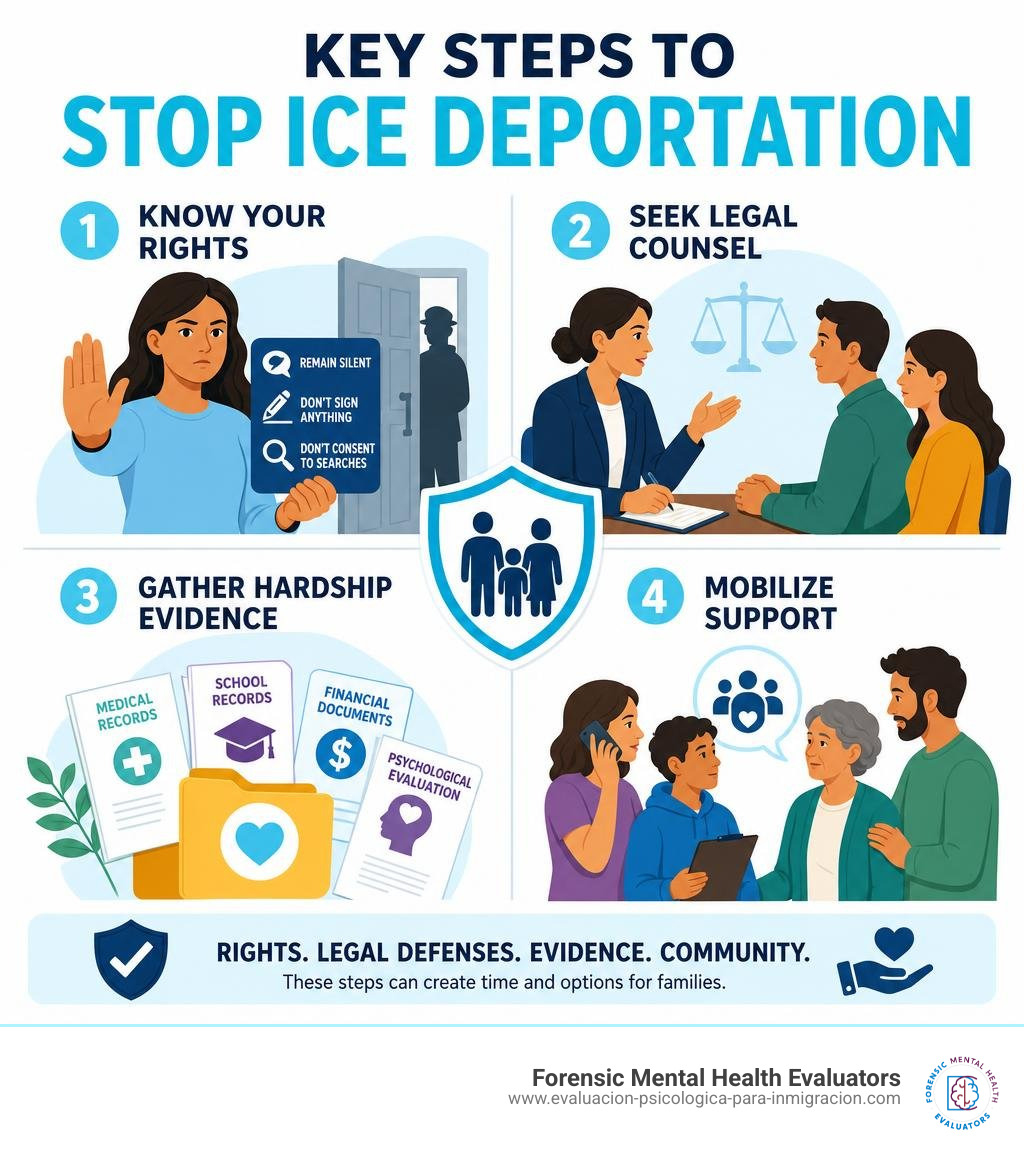
How to stop ICE deportation often begins with acting quickly: do not sign papers without legal advice, use your right to remain silent, find a qualified immigration lawyer, and build evidence for any relief you may qualify for.
- Protect your rights during an ICE encounter. Do not open your home door without a judicial warrant signed by a judge. Do not consent to a search, and do not sign documents you do not understand.
- Get immigration legal help fast. An attorney can assess options such as asylum, cancellation of removal, a U-visa, or a stay of removal.
- Prepare family and hardship evidence. Medical records, school records, financial documents, and a psychological evaluation may help show the serious harm deportation would cause a U.S. citizen or lawful permanent resident spouse, child, or parent.
- Use community support. Rapid-response networks, legal observers, and trusted family members can help document an arrest, locate a detained person, and connect the family with counsel.
In January 2026, ICE detention reached a reported record of about 73,000 people. That scale can make the system feel overwhelming, but deportation is not automatic in every case. Rights, legal defenses, careful evidence, and community support can create time and options for families facing separation.
I am Francisco Ortiz, a Certified Forensic Mental Health Evaluator who conducts immigration psychological evaluations for hardship waivers, asylum matters, U-visa and T-visa cases, and immigration-court competency concerns. My work on how to stop ICE deportation focuses on documenting trauma, mental-health effects, and the likely hardship a family could face if a loved one is removed.
Knowing Your Constitutional Rights During ICE Encounters
Everyone living in the United States—regardless of immigration status—is protected by the U.S. Constitution. Understanding how these constitutional guarantees apply during an immigration enforcement encounter is the first line of defense.
Under the Fourth Amendment, you have the right to be free from unreasonable searches and seizures. Under the Fifth Amendment, you have the right to remain silent and refuse to answer questions about your birthplace, citizenship, or legal status.
A critical distinction to understand is the difference between an administrative warrant (Forms I-200 or I-205) and a judicial warrant:
- Administrative Warrant: Signed by an ICE agent or immigration officer. It does not grant officers legal authority to enter private homes or non-public spaces without voluntary consent.
- Judicial Warrant: Signed by a federal judge or magistrate based on probable cause. It explicitly authorizes officers to enter a specific address or arrest a named individual.
When immigration agents conduct home visits, officers often rely on deception or pressure to gain voluntary entry. Never open the door unless agents present a valid judicial warrant slide-pushed under the door or held against a window.
In public encounters or vehicle stops, asserting rights requires calm clarity. Traffic stops by civil immigration officers have escalated significantly. In fact, Trump overturns pause of ICE vehicle stops following fatal incidents, demonstrating that vehicle encounters remain high-risk environments where non-target community members are frequently detained. For step-by-step guidance on handling public enforcement, review Know Your Rights: If You Encounter ICE.
Crucial Actions When ICE Comes to Your Door
- Keep the door closed and remain calm.
- Ask the agents through the closed door: "Are you ICE?" and "Do you have a warrant signed by a judge?"
- Request that they slide any warrant under the door. Check for a judge's signature, correct name, and correct address.
- State clearly: "I do not consent to your entry or a search of my home."
- Exercise your Fifth Amendment right: "I am choosing to remain silent and I want to speak with an attorney."
- Do not sign any documents, waivers, or voluntary departure agreements without legal counsel present.
Key Strategies on How to Stop ICE Deportation at the Community Level

Community mobilization plays a pivotal role in resisting unjust enforcement actions. Citizen allies, legal observers, and neighbors can leverage legal privilege and constitutional protections to protect targeted community members.
When witnessing an ICE operation in public spaces, legal observers should document the event from a safe distance without physically interfering. Best practices include using cloud-synced video recording so footage is preserved even if equipment is seized. Allies should narrate the date, time, precise address, and agent badge or license plate numbers.
To report enforcement activity accurately, communities rely on the military-adapted SALUTE protocol:
- Size: How many agents are present?
- Activity: What are the agents doing (e.g., questioning drivers, knocking on doors)?
- Location: Exact address or intersection.
- Unit: Agency logos, uniform details, or tactical gear visible.
- Time: Exact start and duration of the event.
- Equipment: Vehicle descriptions, license plates, weapons, or masks.
Distributing Immigrant Legal Resource Center "Red Cards"—which explain Fifth Amendment rights and can be passed under doors during home visits—helps ensure neighbors do not inadvertently waive constitutional protections.
Using Rapid Response Networks on How to Stop ICE Deportation During Raids
Rapid response networks operate local emergency hotlines where residents report real-time ICE sightings or raids. Dispatchers verify the reports before broadcasting alerts, preventing unnecessary panic while mobilizing dispatch teams.
Many neighborhoods utilize whistle alert protocols: short, broken whistle blasts signal that ICE has been spotted in the area, advising vulnerable neighbors to stay indoors, while a single, continuous whistle blast alerts nearby residents to an active detention so observers can assemble safely.
Community accompaniment programs connect trained volunteers with immigrants attending immigration court or mandatory ICE check-ins. Having community observers present ensures due process and decreases administrative overreach. If an arrest occurs, organized networks immediately step in to track the individual using the ICE Online Detainee Locator System via their Alien Registration Number (A-Number), assist with bail funds, and provide immediate post-raid family relief. Organizations like We Protect Us! - Know Your Rights demonstrate how neighborhood solidarity serves as an effective shield against enforcement overreach.
Legal Relief Pathways and Court Remedies Against Deportation

Stopping a deportation order permanently requires building a formal legal defense inside the Executive Office for Immigration Review (EOIR). When an individual is placed in removal proceedings, an experienced attorney can file specific applications for relief depending on the respondent's history and family ties.
Common legal relief avenues include:
- Asylum, Withholding of Removal, and CAT Protection: For individuals who fear persecution or torture in their home country based on race, religion, nationality, political opinion, or membership in a particular social group.
- U-Visa or T-Visa: Protective status for victims of qualifying crimes or human trafficking who assist law enforcement in investigation or prosecution.
- Emergency Stay of Removal (Form I-246): An administrative request submitted directly to ICE requesting a temporary freeze on deportation, often based on humanitarian reasons or pending legal petitions.
Finding a qualified Immigration Lawyer for Deportation immediately after an arrest is crucial to ensure deadlines for administrative filings and motions to reopen are met. Furthermore, exploring options outlined in an Extreme Hardship Waiver Guide 2026 can help establish grounds to keep qualifying families together.
How to Stop ICE Deportation Through Direct Legal Representation and Court Defense
One of the most powerful defenses against removal for long-term residents is Cancellation of Removal. To qualify before an immigration judge, non-permanent residents must meet stringent statutory requirements:
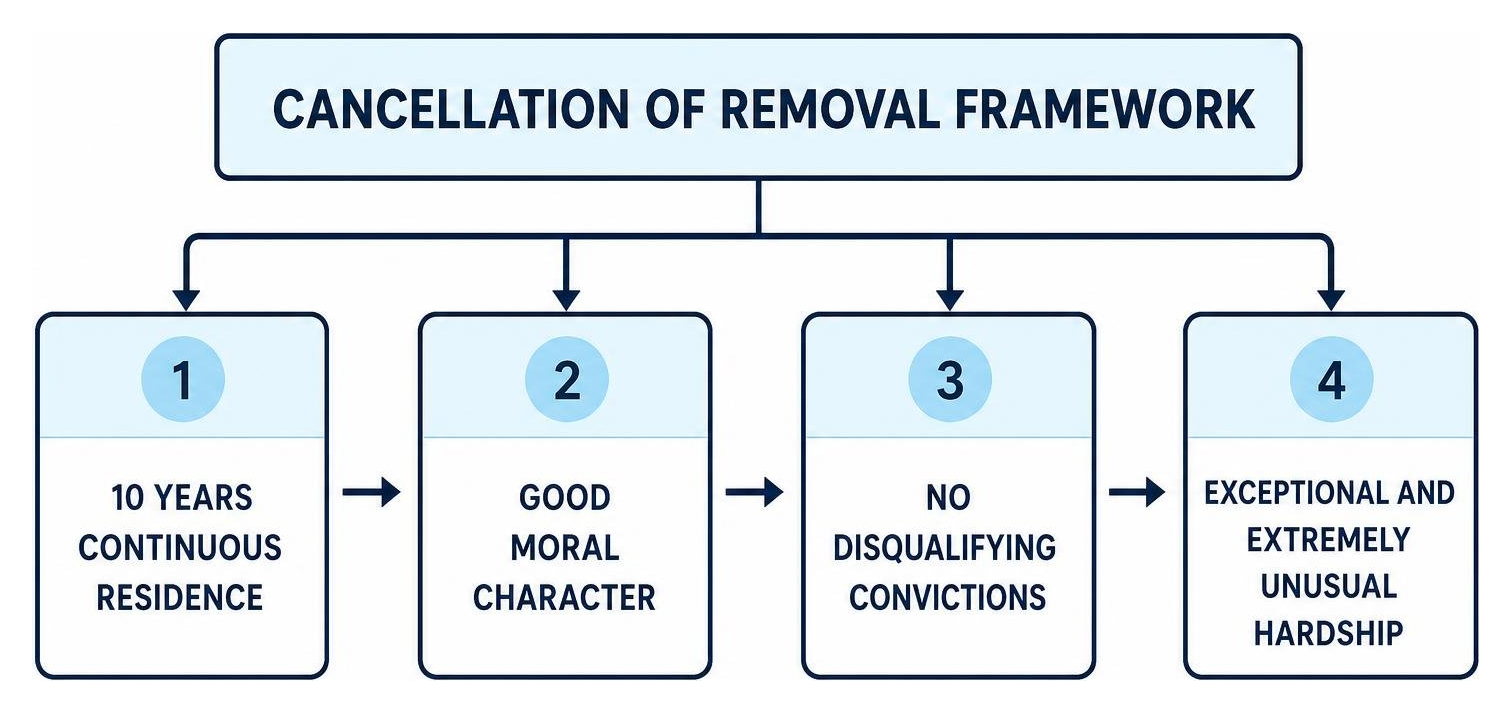
- Continuous Physical Presence: Proving continuous physical residence in the U.S. for at least 10 years prior to the issuance of a Notice to Appear (NTA).
- Good Moral Character: Demonstrating clean moral conduct and state/federal tax compliance during the 10-year period.
- Absence of Disqualifying Criminal Offenses: Showing no convictions for aggravated felonies or crimes involving moral turpitude.
- Exceptional and Extremely Unusual Hardship: Establishing that deportation would cause severe, extraordinary hardship to a U.S. citizen or lawful permanent resident spouse, parent, or child.
Proving "exceptional and extremely unusual hardship" requires overwhelming objective evidence. At Forensic Mental Health Evaluators and District Counseling, we specialize in conducting thorough psychological evaluations across Texas (including Houston, Katy, Cypress, and Sugarland), Florida, California, New York, Utah, Virginia, and Idaho.
Our evaluations document severe trauma, anxiety, clinical depression, and developmental risks that family members face if a primary caregiver is deported. Detailed clinical reports translate psychological trauma into actionable court evidence. To understand how court proceedings work, read our Cancellation of Removal Complete Guide, and learn how mental health assessments strengthen cases through our Immigration Psychological Evaluations Guide 2026.
Cutting Supplies and Local Cooperation: Supply Chain and 287(g) Resistance
Federal enforcement agencies rely heavily on municipal police partnerships, private corporate flight charters, and technology vendors to carry out mass deportations. Cutting these operational dependencies directly restricts agency capacity.
The expansion of the 287(g) program—which deputizes state and local police officers to perform federal civil immigration enforcement—has grown significantly, expanding from 135 local agreements in late 2024 to more than 2,100 agreements across 39 states by mid-2026. Resisting local police deputization is essential to preserving public safety and municipal trust.
| Operational Area | 287(g) Local Cooperation Policies | Sanctuary & Non-Cooperation Municipal Policies |
|---|---|---|
| Local Police Role | Deputizes local officers to query databases and hold detainees for ICE | Restricts police from asking about status or honoring civil detainer warrants |
| Municipal Funding | Local tax dollars offset federal administrative costs | City funds are prohibited from being used for federal civil immigration enforcement |
| Community Trust | Decreases crime reporting among immigrant residents due to fear of arrest | Increases community safety and cooperation with local police departments |
| Data Sharing | Share municipal mugshots and booking data directly with federal databases | Limits non-essential data sharing and restricts local database access |
Civic activists and advocates can submit targeted public records requests (using tools like MuckRock FOIA templates) to expose municipal contracts with federal agencies or surveillance contractors like Palantir and FLOCK camera systems.
Direct consumer pressure has also proven effective against corporate vendors. For example, in January 2026, Avelo Airlines dropped its ICE deportation flight contracts and shuttered its Arizona operational base following sustained public pressure and boycotts. For additional remote advocacy tools, consult Seven Ways to Push Back.
Legislative Pressure and Congressional Oversight to Rein In ICE
Long-term systemic changes require strict congressional oversight, federal budget conditions, and legislative guardrails. Public sentiment surrounding immigration enforcement has shifted dramatically: public support for abolishing or completely restructuring ICE rose to 46% (up from 27%), while the agency's net approval rating plummeted to -13 percentage points, with 62% of respondents expressing disapproval.
Congress holds direct oversight through annual appropriations bills for the Department of Homeland Security (DHS). Federal lawmakers possess key legislative levers to curb enforcement overreach:
- Spending Bill Conditions: Senate members can utilize the 60-vote cloture threshold (requiring at least 41 Senate votes to block non-conforming funding bills) to withhold budget allocations unless strict policy restrictions are attached.
- Warrant & Identification Mandates: Passing federal legislation requiring agents to obtain judicial warrants prior to making civil arrests and banning agents from wearing facial masks during public operations.
- Protecting Immigrant Youth: Passing the DREAM Act to provide permanent legal pathways for hundreds of thousands of young residents living under constant threat of removal.
- Ending Administrative Arrest Quotas: Defunding mandated daily detention bed quotas and closing unregulated large-scale warehouse detention facilities.
To read further analyses on political and legislative strategies to limit enforcement expansion, explore How to Stop ICE and examine legislative policy solutions in Rein In Trump's Deportation Force.
Frequently Asked Questions about ICE Deportation Defense
What is the difference between an administrative warrant and a judicial warrant?
An administrative warrant (Forms I-200 or I-205) is issued and signed by an administrative immigration official, not a judge. It does not grant law enforcement officers constitutional authority under the Fourth Amendment to enter private residences or non-public commercial spaces without explicit voluntary consent. In contrast, a judicial warrant is issued and signed by a judge or magistrate upon a finding of probable cause. A judicial warrant explicitly authorizes officers to enter the named location to execute an arrest or search.
How can U.S. citizens legally intervene during an ICE raid?
U.S. citizens have a protected First Amendment right to observe, photograph, and video record law enforcement officers conducting duties in public spaces. Allies can intervene legally by remaining at a safe distance, filming the encounter clearly, narrating details (time, date, address, agent badge/plate numbers), uploading footage directly to cloud storage, demanding officers show valid judicial warrants, and utilizing de-escalation techniques to prevent tensions from escalating. Allies should never physically block officers or assault agents, as doing so can lead to criminal charges.
How do I locate a family member who was detained by ICE?
To locate an individual detained by immigration authorities:
- Obtain their 9-digit Alien Registration Number (A-Number) or their full legal name, date of birth, and country of birth.
- Visit the ICE Online Detainee Locator System at
locator.ice.gov. - If the individual is not listed immediately, contact the Executive Office for Immigration Review (EOIR) automated hotline at 1-800-898-7180 to check court date filings.
- Contact an immigration attorney immediately to evaluate relief options and file emergency motions to stay removal before the individual is transferred to a distant facility.
Conclusion
Understanding how to stop ICE deportation requires a comprehensive defense strategy combining individual constitutional rights awareness, rapid community response networks, legislative advocacy, and expert legal representation in immigration court.
When a loved one faces removal, securing professional legal counsel and gathering strong objective evidence is paramount. At Forensic Mental Health Evaluators and District Counseling, we provide specialized, culturally sensitive immigration psychological evaluations across Houston, Katy, Cypress, Sugarland, and throughout Texas, Florida, California, New York, Utah, Virginia, and Idaho.
Our Spanish-language evaluations are fully translated into English, designed for client comfort, and include 6 complimentary therapy sessions post-report to support families through stressful legal proceedings. If your family is building a court defense for cancellation of removal or a hardship waiver, explore our specialized clinical support for evaluacion psicologica para caso de una cancelacion de deportacion today.