
Hardship Legal Definition: What Courts Really Look For
What the Hardship Legal Definition Means in Court

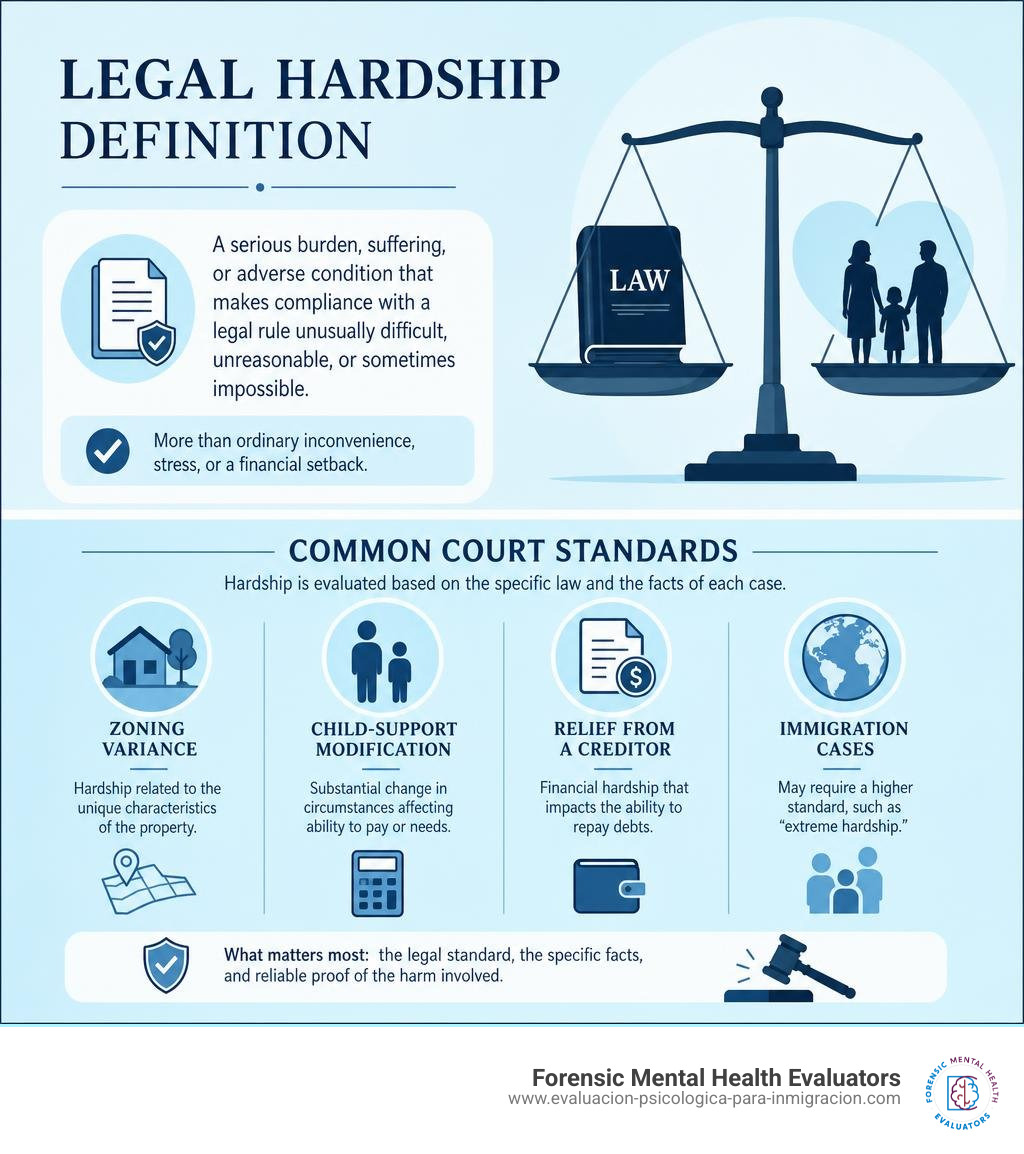
The hardship legal definition is a serious burden, suffering, or adverse condition that makes compliance with a legal rule unusually difficult, unreasonable, or sometimes impossible. It is more than ordinary inconvenience, stress, or a financial setback.
Courts and government agencies apply hardship differently depending on the law involved. For example, hardship may support a zoning variance, a child-support modification, or a request for relief from a creditor. In immigration cases, the standard may be much higher, such as extreme hardship to a qualifying U.S. citizen or lawful permanent resident family member.
What matters is not simply that life is difficult. Decision-makers usually look at the specific legal standard, the facts of the case, and reliable proof of the harm involved.
I am Francisco Ortiz, a Certified Forensic Mental Health Evaluator who conducts evidence-based psychological evaluations in immigration matters, including hardship waivers and immigration-court cases. My work focuses on explaining the real human impact behind the hardship legal definition, including family separation, trauma, emotional health, and the effect on U.S. citizen children and spouses.
Deciphering the Hardship Legal Definition Across Key Practice Areas
Understanding how the hardship legal definition functions requires looking beyond everyday language. In daily conversation, we might describe sitting in bumper-to-bumper traffic or taking a pay cut as a hardship. In a courtroom, however, judges evaluate hardship through specific legal filters.
General Hardship Legal Definition vs. Everyday Meaning
In standard English, dictionaries like Cambridge or Oxford define hardship simply as severe suffering or difficult living conditions. In contrast, the Black's Law Dictionary definition and broader legal scholarship frame hardship as an objective legal threshold. As noted in the LSD Law legal hardship overview, hardship in legal contexts describes a severe burden created by applying a rule, statute, or obligation to a specific individual or entity in a way that creates unreasonable adversity.
Courts distinguish sharply between subjective adversity—how uncomfortable a situation feels to someone—and objective legal hardship, which requires measurable proof of severe financial, physical, or psychological disruption.
Statutory Interpretation and Avoiding Absurd Outcomes
Judges frequently rely on hardship principles when interpreting ambiguous statutes. Under the long-standing legal doctrine of argument ab inconvenienti, courts evaluate the practical consequences of competing statutory interpretations.
If applying a law strictly according to its literal text would lead to an absurd, impossible, or severely unjust outcome, judicial discretion allows courts to adopt a more flexible reading. For example:
- A historic urban landmark building might face structural collapse if forced to install standard industrial fire suppression pipes. Courts can allow alternative safety compliance based on severe physical hardship.
- A downtown bakery might receive a narrow ordinance exemption for loading zone access if strict adherence prevents the delivery of essential goods.
Unnecessary Hardship in Zoning Law
In municipal and property law, property owners often petition local zoning boards for a variance based on "unnecessary hardship." To meet this legal standard, the hardship must arise directly from the unique physical characteristics of the land itself—such as steep topography, rock formations, or irregular lot shapes—rather than personal choices made by the owner.
If strict enforcement of setback lines makes it impossible to build a viable structure on a uniquely triangular lot, the property owner demonstrates unnecessary hardship justifying a zoning exception.
Financial Hardship in Family Law and Debtor Relations
In family courts, demonstrating financial hardship is essential when petitioning for child support modifications. Judges typically require proof of a substantial, unexpected change in financial circumstances, such as:
- Involuntary job loss or severe wage reduction due to economic layoffs.
- Catastrophic medical debt resulting from sudden hospitalization or chronic disability.
Similarly, in debtor-creditor relations, individuals facing severe economic disruption can negotiate payment deferrals, reduced interest rates, or fee waivers. Effective creditor outreach often starts with a formal hardship letter detailing the onset date, cause, expected duration, and requested financial relief, followed by formal written documentation.
Hardship vs. Undue Hardship: Key Differences and Legal Thresholds
Not all hardship standards are created equal. When analyzing employment, administrative, or civil rights matters, courts draw a firm distinction between general hardship and "undue hardship."
Defining Undue Hardship in Employment and Disability Law
Under federal statutes such as the Americans with Disabilities Act (ADA), employers are required to provide reasonable accommodations to qualified individuals with disabilities unless doing so creates an "undue hardship."
According to the Legal Information Institute undue hardship guidance, undue hardship means an action requiring significant difficulty or expense when evaluated against specific operational and financial factors:
- The overall financial resources, size, and facility count of the covered entity.
- The impact of the accommodation on facility operations, staff structure, and workplace safety.
- The geographic location and administrative relationship between the local site and any parent organization.
If a requested accommodation poses an undue financial hardship, employers are expected to explore alternative accommodations or allow the employee the option to cover the cost portion that exceeds the hardship threshold.

Hardship vs Undue Hardship Comparison
To better understand how these thresholds differ across legal settings, consider the comparison table below:
| Legal Context | Hardship Standard | Required Burden of Proof | Primary Application / Outcome |
|---|---|---|---|
| General Legal Standard | Standard Hardship | Objective proof of severe difficulty, loss, or adversity beyond ordinary stress. | Statutory interpretation relief, contract renegotiations. |
| Zoning Law | Unnecessary Hardship | Demonstration that unique land topography prevents reasonable property use. | Granting of zoning variances or setback modifications. |
| Family Law | Material Financial Hardship | Substantial, involuntary financial change (job loss, medical emergency). | Modification of court-ordered child support payments. |
| Disability & Employment Law | Undue Hardship | Accommodation causes significant financial expense or operational disruption. | Excuses employer from mandatory ADA workplace modifications. |
Commercial Contracts: Hardship, Frustration, and Force Majeure
In commercial transactions, unexpected global economic shifts can render contract performance significantly more expensive than originally anticipated. How courts treat these disruptions depends heavily on the jurisdiction and contract language.
English Contract Law and Economic Hardship
Under English common law, courts interpret contracts strictly. Unlike some civil law systems, English common law does not recognize an inherent, automatic doctrine of economic hardship. Courts enforce contracts even when market shifts make performance dramatically unprofitable for one party.
To seek relief under English law without an express contractual provision, a party must satisfy narrow legal standards:
- Doctrine of Frustration: Applies only when a supervening event makes performance physically impossible or fundamentally changes the nature of the obligation. Extreme price increases alone do not qualify as frustration.
- Force Majeure: Requires explicit contract provisions detailing qualifying events (such as war, natural disasters, or government action) and proving a direct causal link preventing performance.
Drafting Enforceable Economic Hardship Clauses
Because common law doctrines provide limited relief for commercial price volatility, businesses frequently include express economic hardship clauses in long-term supply and purchase agreements.

To ensure an economic hardship clause is legally enforceable in court, contract drafters should include:
- Specific Trigger Events: Clear metrics defining market imbalance, such as percentage cost increases in raw materials.
- Objective Price Adjustment Criteria: Guidelines for rebalancing contract terms rather than vague promises to negotiate.
- Dispute Resolution Mechanisms: Mandatory referral to independent arbitrators or third-party experts if parties cannot agree on revised pricing, preventing the clause from being struck down as void for uncertainty.
How Immigration Courts Apply the Hardship Legal Definition
In immigration law, demonstrating hardship is often the central requirement for noncitizens seeking relief from removal or requesting waivers of inadmissibility. However, standard hardship is insufficient; the law demands higher legal thresholds.
Extreme Hardship and Exceptional Circumstances
When petitioning for immigration relief—such as an I-601 or I-601A waiver—the applicant must prove that refusing their admission would cause extreme hardship to a qualifying relative who is a U.S. citizen or lawful permanent resident spouse or parent.
To navigate these complex standards effectively, applicants rely on comprehensive resources such as our Extreme Hardship Waiver Guide 2026 and specialized overviews of Extreme Hardship.
In cancellation of removal cases before an immigration judge, the statutory bar is even higher: the applicant must demonstrate Extreme and Exceptionally Unusual Hardship to qualifying relatives. This standard requires proving that the harm suffered by qualifying family members if the applicant is deported would be substantially beyond the ordinary hardship expected when a relative is removed from the United States. You can review detailed criteria in our guide on Extreme and Exceptionally Unusual Hardship.
Proving Hardship: Evidentiary Standards and Psychological Evaluations
Immigration courts and U.S. Citizenship and Immigration Services (USCIS) evaluate hardship using a cumulative approach. No single factor is viewed in isolation; instead, adjudicators consider the aggregate weight of multiple personal factors:
- Medical Conditions and Healthcare Access: Chronic health conditions requiring specialized care unavailable in the home country.
- Financial and Economic Disruption: Loss of primary family income, career disruption, or economic instability abroad.
- Psychological and Emotional Impact: Severe anxiety, clinical depression, PTSD, or severe psychological regression in U.S. citizen children or spouses.

Documenting psychological impact requires rigorous professional evidence. A detailed forensic evaluation translates human distress into concrete clinical diagnostic data that courts respect. For step-by-step guidance on gathering evidence, explore our articles on How to Show Extreme Hardship for a Waiver, securing an Immigration Extreme Hardship Waiver, and understanding what occurs during a comprehensive Hardship Evaluation.
Frequently Asked Questions About Legal Hardship
What is the primary difference between hardship and undue hardship?
Standard hardship refers to significant difficulty, financial loss, or personal adversity experienced by an individual or entity. Undue hardship is a specific legal standard—most notably under disability and employment law—where an accommodation or legal requirement creates an excessive operational burden or severe financial expense relative to an organization's size and resources.
What evidence is required to prove legal hardship in court?
Courts require objective evidence rather than unsupported personal statements. Key evidence includes:
- Comprehensive medical records, clinical diagnoses, and physician letters.
- Professional psychological evaluations from certified forensic evaluators detailing emotional and mental health impacts.
- Financial documentation including tax returns, wage statements, bank records, and debt notices.
- Detailed sworn affidavits and expert testimonies outlining country conditions or operational burdens.
Can economic changes automatically trigger legal hardship in contracts?
No. Under common law principles, financial changes or reduced contract profitability do not automatically excuse performance or trigger legal hardship. Relief is only available if the contract contains an express economic hardship clause, a valid force majeure provision, or if performance meets the strict criteria for legal frustration.
Conclusion
Whether navigating commercial agreements, employment compliance, family law modifications, or complex immigration proceedings, understanding the hardship legal definition is critical. Courts evaluate hardship not through subjective complaints of stress, but through rigorous objective evidence, legal standards, and professional assessments.
At District Counseling, our team of forensic mental health evaluators provides clinical evaluations tailored for immigration proceedings across Texas (including Houston, Katy, Cypress, and Sugarland), Florida, California, New York, Utah, Virginia, and Idaho. We offer Spanish-language evaluations translated into English, client-centered comfort, and post-report therapy sessions to support families through stressful legal processes.
If you or your client need evidence-based evaluation support to establish extreme hardship for a waiver or court proceeding, visit our specialized page on Evaluación psicológica para caso de un perdón to schedule a consultation.