
Navigating the Multi-Year Cancellation of Removal Backlog
Why the Cancellation of Removal Backlog Could Define Your Family's Future
The cancellation of removal backlog is one of the most urgent crises facing undocumented immigrants in the United States right now. Here is what you need to know at a glance:
- Over 250,000 applications for non-LPR cancellation of removal are currently pending in immigration courts
- Only 4,000 grants are allowed per year by federal law — creating a wait of 2 to 3 years even after a judge approves your case
- The total immigration court backlog stands at 3,195,137 active cases as of June 2026
- Only 21.5% of immigrants had an attorney when a removal order was issued in June 2026
- Nationals from Mexico, Honduras, and Guatemala make up the top three groups ordered deported in FY 2026
If you are a non-permanent resident facing deportation in Texas, this backlog is not just a number — it is years of legal limbo while your U.S. citizen children grow up without certainty about whether their parent will be here tomorrow.
The stakes are real. The wait is long. And the decisions you make right now — about evidence, representation, and documentation — will shape your outcome.
I am Francisco Ortiz, Lead Forensic Mental Health Evaluator at District Counseling PLLC, and I specialize in providing the clinical psychological evaluations that immigration attorneys rely on to prove extreme hardship in exactly these kinds of cases, including those stuck in the cancellation of removal backlog. In this guide, I will walk you through what the backlog means for your case and what you can do to protect your family.
Understanding the Cancellation of Removal Backlog in 2026
To understand why your case is taking so long, we have to look at the sheer scale of the U.S. immigration court system. As of June 2026, there are 3,195,137 active cases pending before the Immigration Court. This is an astronomical jump from previous years, driven by increased enforcement, policy shifts, and systemic bottlenecks.
Out of this massive mountain of cases, over 250,000 are applications for non-LPR (Non-Lawful Permanent Resident) cancellation of removal. While 250,000 might seem like a small slice of the pie—representing fewer than 7 percent of the overall court backlog—the bottleneck here is uniquely severe.
Why? Because Congress has placed a strict statutory limit of only 4,000 cancellation of removal grants per year.
Imagine a stadium with 250,000 people waiting to exit, but the security team is only letting 4,000 people through the gate every twelve months. This artificial limit is the primary driver of the cancellation of removal backlog. Even if an immigration judge hears your case today and believes you meet every single requirement for relief, they cannot technically "grant" your application if the 4,000-cap for the fiscal year has already been reached. Instead, your case gets placed on a waiting list, creating a secondary visa backlog that currently lasts between two to three years just for approved cases to receive their actual green cards.
This administrative logjam is further complicated by severe staffing shortages within the Executive Office for Immigration Review (EOIR). It currently takes more than two years for the Department of Justice to hire and onboard a single new immigration judge. With average individual judge caseloads hovering around 4,500 cases, the system is simply buckled under its own weight.
Furthermore, the backlog is not distributed evenly across the country. If you live in major metropolitan hubs like Miami-Dade County, Florida (which has the nation’s highest volume of pending cases at over 137,000) or right here in Texas, you are facing some of the most congested dockets in the United States. This reality leaves millions in a state of legal suspension, a phenomenon detailed in reports like the Logjam of U.S. immigration applications puts millions at greater risk of deportation | TPR .
To help you visualize this disparity, let's look at how the cancellation backlog compares to the broader court system:
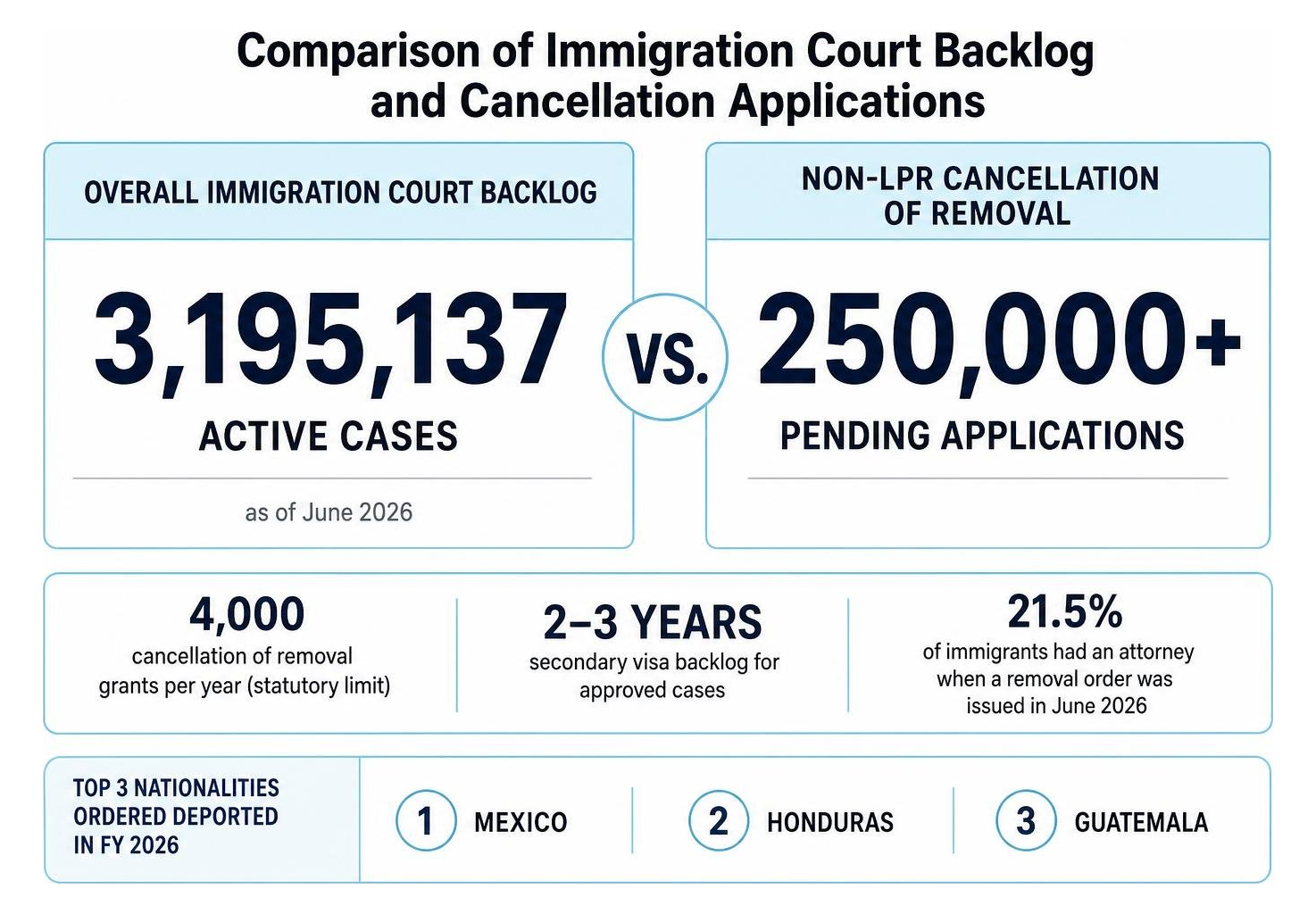
Court Backlog vs. Cancellation Applications
| Metric | Overall Immigration Court Backlog | Non-LPR Cancellation of Removal |
|---|---|---|
| Total Pending Cases | 3,195,137 active cases (as of June 2026) | Over 250,000 pending applications |
| Annual Statutory Limit | No limit on court completions | Strict limit of 4,000 grants per fiscal year |
| Current Wait Times | Average of 5 years to adjudicate a claim | 2 to 3 year visa backlog after judicial approval |
| Primary Nationalities | Global (Top: Mexico, Honduras, Guatemala) | Primarily long-term residents from Latin America |
Navigating this complex web requires a deep understanding of the procedural rules. For a comprehensive breakdown of the entire process, you can refer to our Cancellation Of Removal Complete Guide.
Eligibility and the High Bar of Exceptional Hardship
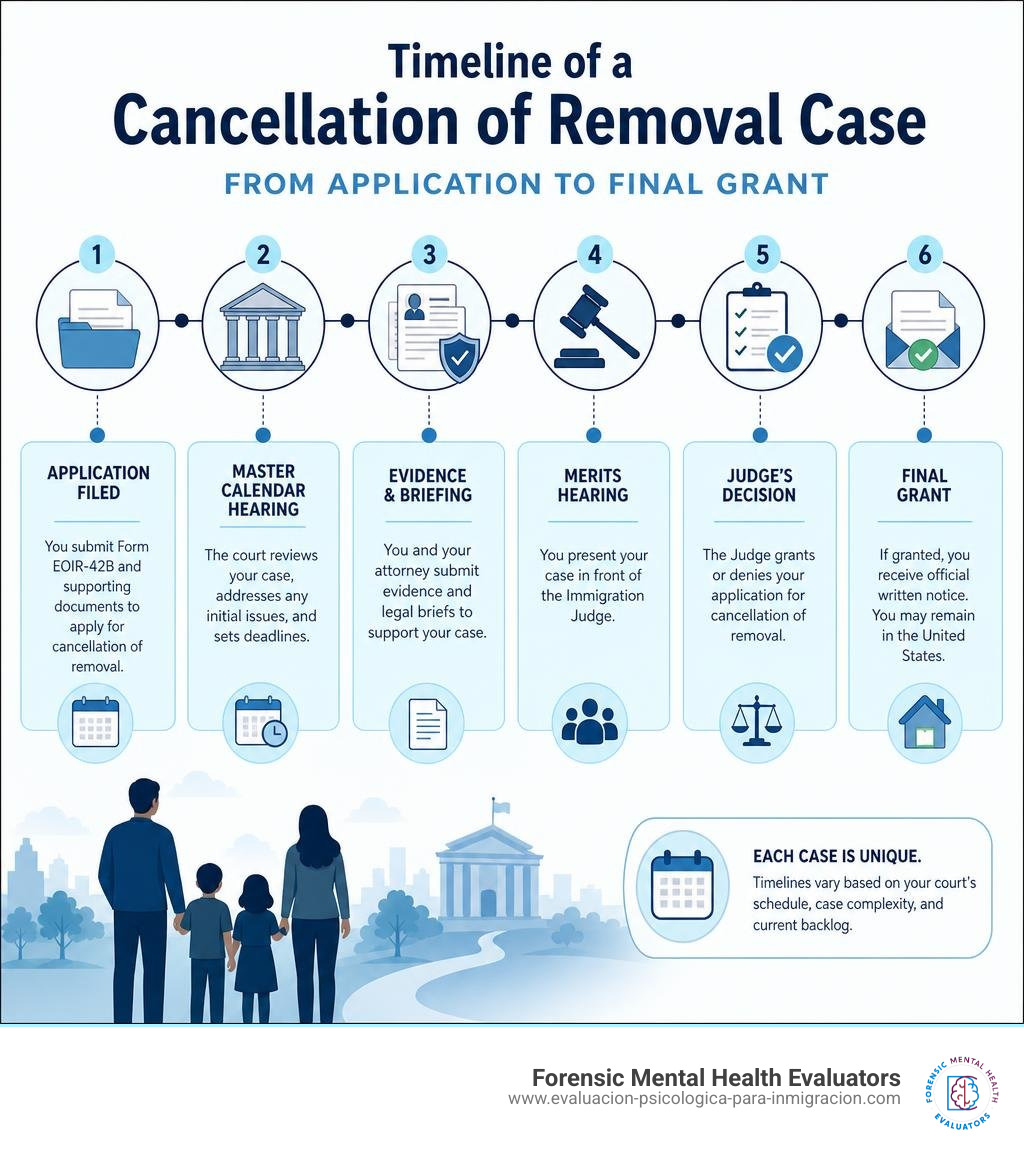
If you are a non-LPR applying for cancellation of removal (using the EOIR-42B form), you must meet four very strict statutory requirements:
- 10 Years of Continuous Physical Presence: You must prove you have lived in the United States continuously for at least 10 years before the date your Notice to Appear (NTA) was issued.
- Good Moral Character: You must demonstrate that you have been a person of good moral character during those 10 years, meaning no disqualifying criminal convictions or serious legal infractions.
- No Disqualifying Criminal Convictions: Certain crimes automatically disqualify you from seeking this relief.
- Exceptional and Extremely Unusual Hardship: You must prove that your deportation would result in "exceptional and extremely unusual hardship" to a qualifying relative who is a U.S. citizen or Lawful Permanent Resident (LPR). Qualifying relatives include your spouse, parent, or child.
Of these four, the hardship standard is by far the most difficult hurdle to clear. Under the landmark Board of Immigration Appeals (BIA) precedent Matter of Monreal, the hardship to your qualifying relative must be "substantially beyond" what would ordinarily be expected from the deportation of a loved one.
In other words, the court already assumes that deportation will cause sadness, financial strain, and family separation. To win, you must prove that the impact on your spouse, parent, or child will be truly devastating. You can read more about this rigorous legal standard in our detailed guide on Extreme And Exceptionally Unusual Hardship.
Proving Hardship Amid the Cancellation of Removal Backlog
Because the legal standard is so high, successful cases require creative, highly detailed legal arguments. Attorneys cannot simply rely on the argument that "the family will miss each other." Instead, they must look at the aggregate of multiple hardship factors, including medical conditions, caregiving responsibilities, and systemic differences in the country of origin.
For example, we have seen successful cases built around:
- Severe Medical Conditions: A U.S. citizen child with a severe medical condition, such as a life-threatening peanut allergy, where the family's home country lacks public awareness, emergency medical response times, and reliable access to auto-injectable epinephrine (EpiPens).
- Interconnected Caregiving: A case where the deportation of a mother would force her healthy, teenage U.S. citizen daughter to drop out of school to become the primary caregiver for an adult disabled brother (who, as an adult sibling, is not technically a qualifying relative, but whose care directly impacts the qualifying teenage daughter's life).
These arguments must be backed by objective, professional documentation. This is where a clinical Hardship Evaluation becomes an indispensable tool for your legal team.

The Role of Psychological Evaluations in Overcoming Court Delays
When you are stuck in the cancellation of removal backlog, time is both your enemy and your ally. While you wait, you have the opportunity to build an airtight case. A professional clinical psychological evaluation is one of the most powerful pieces of evidence you can submit to an immigration judge.
These evaluations go far beyond a simple letter. They are comprehensive clinical assessments that document the psychological impact of family separation on your qualifying relatives. At District Counseling, we evaluate qualifying relatives for:
- Severe Anxiety and Depression: Documenting how the chronic stress of the pending deportation affects a child’s school performance, emotional development, and daily functioning.
- Post-Traumatic Stress Disorder (PTSD): Highlighting how a spouse or parent who has already survived trauma would be psychologically shattered by the deportation of their primary support system.
- Developmental and Cognitive Needs: Assessing how a child with special educational or behavioral needs would regress without the stability of both parents in the household.
If you are navigating the immigration courts in Texas—whether in Houston, Austin, Dallas, or San Antonio—having a local, culturally competent evaluator who understands the specific dynamics of Texas courts is critical. Our team specializes in conducting these sensitive evaluations in Spanish and translating them into precise, legally rigorous English reports. To learn more about how this process works, read our guide on Cancellation Of Removal Psych Eval.
Key Hurdles: Aging Out, Enforcement, and Administrative Closure
The landscape of immigration defense is constantly shifting, and recent policy changes have made navigating the cancellation of removal backlog even more treacherous. Under the current administration, interior enforcement has scaled up significantly, meaning more individuals are being placed into active removal proceedings.
Historically, immigration judges used a tool called "administrative closure" to temporarily pause cases, removing them from the active court docket while applicants waited for external visas or petitions to process. This kept the active backlog manageable. However, the Board of Immigration Appeals issued a major precedent in Matter of Ibarra-Vega, which severely restricted the use of administrative closure.
The ruling declared that immigration judges do not have the authority to use administrative closure as a de facto form of relief, meaning that over 340,000 previously closed cases are now at risk of being recalendared back onto active court dockets. This massive influx of old cases is flooding an already drowning court system. To make matters worse, new BIA appellate procedures have shortened the appeal window from 30 days to just 10 days for certain decisions, giving families very little time to react to a negative ruling. You can read a detailed analysis of this shift in the article BIA Ends Administrative Closure: 340,000 Cases at Risk | Chris Hammond Law Firm .
How the Cancellation of Removal Backlog Exacerbates the Age-Out Risk
One of the most heartbreaking consequences of the multi-year cancellation of removal backlog is the "age-out" risk for qualifying children.
To use a child as a qualifying relative for your cancellation application, that child must be under the age of 21 at the time the final grant of cancellation is issued by the judge. Because the backlog is so long, a child who was 17 or 18 when you first filed the Eoir 42B Form may turn 21 before your final court hearing or before a visa becomes available.
If your only qualifying relative turns 21 while your case is pending, they "age out," and you instantly lose your eligibility for cancellation of removal.
To prevent this tragedy, experienced immigration attorneys must proactively monitor their clients' files. If a qualifying child is approaching their 21st birthday, your lawyer can file a motion to expedite your case, asking the immigration judge to issue a final decision before the child ages out. However, given the crowded court calendars, these motions are difficult to get approved without compelling, documented evidence of extreme hardship.
Step-by-Step Guide to Navigating Your Deportation Case
If you or a loved one is currently facing deportation and navigating the cancellation of removal backlog, you cannot afford to take a passive approach. You must be proactive. Here is a step-by-step guide to protecting your case:

- Secure Legal Representation Immediately: Only 21.5% of immigrants had an attorney to assist them when a removal order was issued in June 2026. Having an experienced immigration lawyer dramatically increases your chances of success. Do not face this system alone.
- File a FOIA Request: Ask your attorney to submit a Freedom of Information Act (FOIA) request to obtain your complete immigration file. This allows your team to review your entire history and identify any potential legal issues or avenues for relief.
- Keep Your Contact Information Updated: Because these cases take years, many families move. You must update your address with the court within five days of moving using Form EOIR-33. If the court sends a hearing notice to your old address and you miss your court date, the judge can issue a deportation order in your absence. Updating your address with USCIS does not automatically update it with the immigration court (EOIR)—they are separate systems!
- Gather Evidence of Good Moral Character: Start collecting tax returns, letters from employers, church recommendations, and proof of community involvement. You must show a consistent track record of positive contributions to your community over the last 10 years.
- Obtain a Professional Hardship Evaluation: Do not wait until the last minute. Schedule a clinical psychological evaluation to document the mental health impact of your potential deportation on your qualifying relatives. This clinical report will serve as a cornerstone of your defense.
Frequently Asked Questions about the Cancellation of Removal Backlog
What is the current wait time for a cancellation of removal decision?
Because of the massive court backlog, it typically takes three to five years just to have your individual merits hearing before an immigration judge. If the judge approves your application, you must then wait in a secondary queue for an available visa cap number, which currently adds another two to three years of waiting before your permanent residency (green card) is finalized.
What happens if my qualifying child turns 21 while my case is pending?
If your child turns 21 before the judge issues the final grant of cancellation, they are no longer considered a "qualifying child" under the law. Unless you have another qualifying relative (such as a spouse or parent), you will lose your eligibility for this form of relief. Your attorney must monitor this closely and, if necessary, file a motion to expedite your proceedings.
How does the 4,000 annual statutory cap affect my approved case?
Once the 4,000 annual limit is reached nationwide, immigration judges cannot issue final approvals. Instead, they will grant "tentative approvals" and place your case on a waiting list. While you are in this holding pattern, you are generally eligible to apply for and renew your work authorization, but you will not receive your actual green card until a visa number becomes available in a future fiscal year.
Conclusion
The cancellation of removal backlog presents an incredibly challenging road for families seeking to build a secure life in the United States. Between strict annual caps, rising interior enforcement, and the devastating risk of children aging out of eligibility, you need every piece of leverage you can find to protect your future.
At District Counseling (Forensic Mental Health Evaluators), we are committed to standing with the immigrant community across Texas, including Houston, Austin, Dallas, and San Antonio. We specialize in providing highly detailed, compassionate, and culturally sensitive psychological evaluations in Spanish, translating them into the professional English reports that immigration judges respect.
To help your family heal from the intense stress of this legal journey, we also offer 6 free therapy sessions to our clients following the completion of their evaluation report.
Do not let the backlog dictate your family's fate. Take control of your case today by visiting our page on Evaluacion Psicologica Para Caso De Una Cancelacion De Deportacion and scheduling a consultation with our compassionate clinical team. We are here to help you turn the tide.