
How to Understand Forgiveness Evaluation 601 in 5 Simple Steps
Step 1: What is the Form I-601 Waiver and Grounds of Inadmissibility

Understanding an I-601 waiver evaluation (commonly sought as an evaluacion perdon 601) in five steps begins by recognizing that Form I-601, Application for Waiver of Grounds of Inadmissibility, is a critical legal remedy before U.S. Citizenship and Immigration Services (USCIS). When an individual applies for an immigrant visa, adjustment of status, or certain other immigration benefits, the U.S. government may find them inadmissible due to prior immigration violations, criminal records, or medical grounds. To navigate this process, you must first identify the ground of inadmissibility, confirm a qualifying relative, gather robust extreme hardship evidence, file the form with the $930 USD government fee, and respond promptly to any requests for evidence or decisions from USCIS.
A waiver does not automatically erase past history; instead, it requests that USCIS exercise favorable discretion to waive a specific ground of inadmissibility. For formal filing requirements and official guidance, applicants should review the instrucciones oficiales del Formulario I-601. The current filing fee for Form I-601 is $930 USD.
| Criteria | Form I-601 | Form I-601A |
|---|---|---|
| Primary Objective | Waives multiple grounds (fraud, crimes, unlawful presence, health). | Waives only unlawful presence accrual (INA § 212(a)(9)(B)). |
| Filing Location | Outside the U.S. (consular process) or inside (adjustment of status). | Exclusively inside the U.S., prior to departing for the consular interview. |
| Qualifying Relative | U.S. citizen or LPR spouse or parent; qualifying children in select cases. | U.S. citizen or lawful permanent resident spouse or parent only. |
| Procedural Timing | Filed after consular interview refusal or during adjustment adjudication. | Filed before leaving the country for the scheduled consular appointment. |
| Separation Risk | Longer wait times abroad if processed through consular channels. | Drastically minimizes prolonged family separation abroad. |
Legal Grounds and Inadmissibility Waived by USCIS
Under Section 212 of the Immigration and Nationality Act (INA), federal law defines which grounds prevent a foreign national from legally entering or remaining in the United States. Common grounds eligible for an I-601 waiver include:
- Unlawful Presence: Individuals who have accrued over 180 days or one year or more of unauthorized stay and are subject to the 3-year or 10-year bars.
- Fraud or Misrepresentation: Inadmissibility under INA § 212(a)(6)(C)(i) for false statements or material misrepresentation made to secure a visa or entry.
- Certain Criminal Offenses: Crimes involving moral turpitude (CIMT), simple possession of 30 grams or less of marijuana, or multiple criminal convictions under INA § 212(h).
- Health-Related Grounds: Communicable diseases of public health significance or missing required vaccinations under INA § 212(g).
Non-waivable grounds through standard I-601 procedures include false claims to U.S. citizenship made after September 30, 1996, unexempt drug trafficking offenses, and the permanent bar triggered by unlawful re-entries following prior deportations or unlawful presence accruals.
Key Differences Between Form I-601 and Form I-601A
Understanding the procedural distinction between these two waivers prevents unnecessary delays. Form I-601A is a provisional waiver designed to shorten family separation by allowing eligible applicants to seek relief for unlawful presence while still residing inside the United States. For additional regulatory details, review the normativa de la exención provisional I-601A.
In contrast, Form I-601 covers a much wider range of inadmissibility grounds and is typically filed either after a consular officer issues a formal refusal during an overseas interview or domestically when the applicant is eligible for direct adjustment of status.
Step 2: Identify the Qualifying Relative and Extreme Hardship Criteria
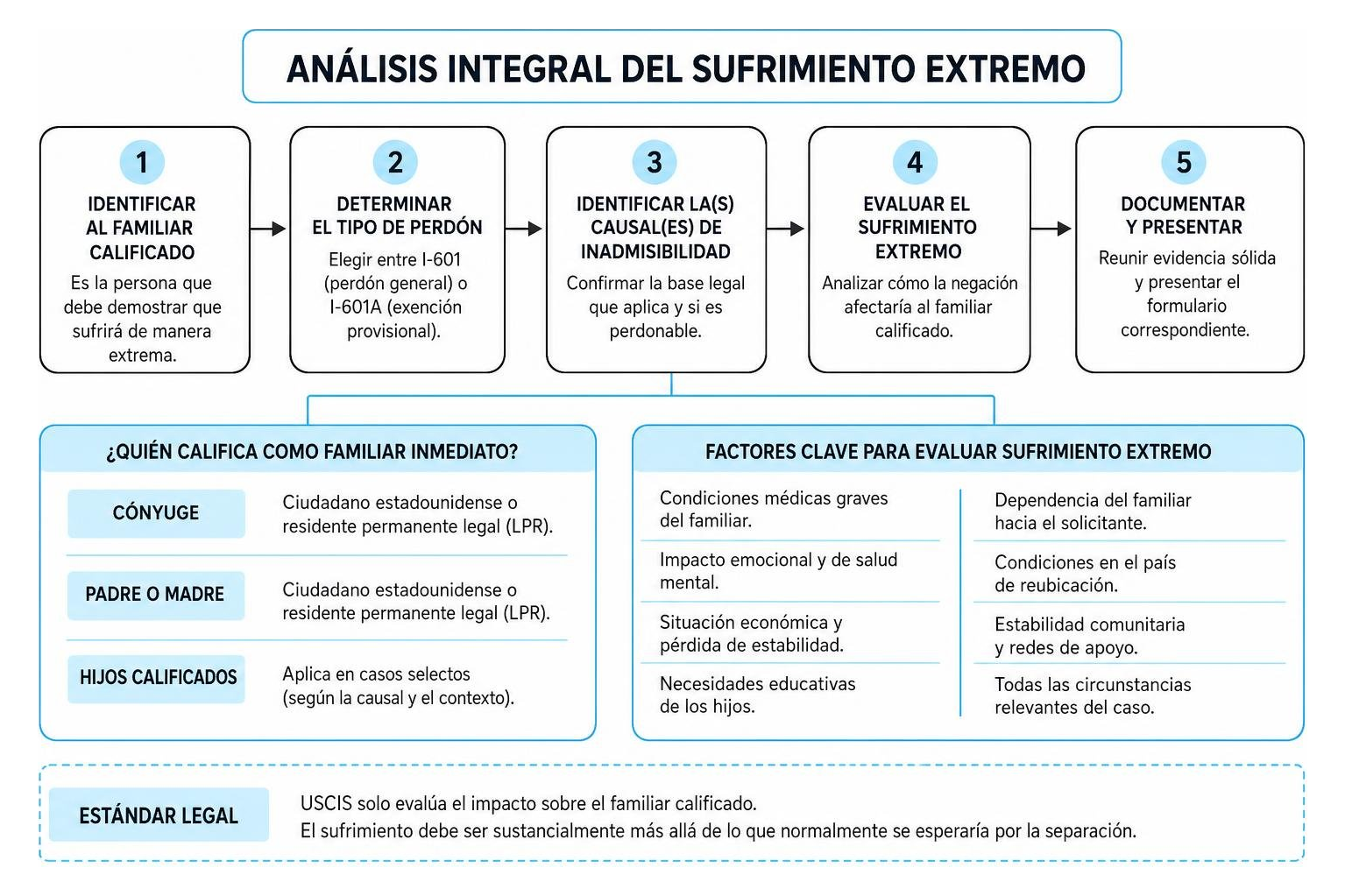
A successful waiver petition hinges on proving that a legally qualifying family member will suffer disproportionately if the applicant is denied entry or forced to depart. USCIS does not measure the hardship experienced by the foreign applicant; the statute strictly requires demonstrating severe impact on the qualifying relative. Understanding the legal standard of extreme hardship is the foundational step in assembling a persuasive case.
Who Qualifies as an Immediate Relative Before USCIS
For most inadmissibility grounds under Form I-601, a qualifying relative must be:
- Spouse: A U.S. citizen or lawful permanent resident (LPR).
- Parent: A U.S. citizen or lawful permanent resident father or mother.
For unlawful presence waivers, U.S. citizen or permanent resident children do not qualify as direct qualifying relatives. However, hardship suffered by children can be considered indirectly to the extent that it inflicts substantial emotional, medical, or financial distress on the qualifying spouse or parent. In specific fraud or misrepresentation provisions, certain statutory exceptions allow children to qualify, making legal case review essential.
Medical, Financial, and Psychological Hardship Factors
Extreme hardship must go far beyond the typical sadness and disruption naturally expected during family separation. USCIS adjudicators evaluate hardship holistically across two mandatory scenarios:
- If the qualifying relative remains in the U.S. while the applicant resides abroad (separation).
- If the qualifying relative relocates abroad with the applicant to maintain family unity (relocation).
When assessing how to show extreme hardship for a waiver, evaluators look at multiple core areas of impact:
- Physical Health: Chronic medical conditions, severe disabilities, specialized ongoing treatments unavailable in the home country, or physical reliance on the applicant for daily care.
- Mental and Emotional Health: Major depressive disorder, post-traumatic stress disorder (PTSD), severe generalized anxiety, and acute psychological decompensation resulting from forced separation.
- Financial Strain: Loss of the household's primary wage earner, risk of home foreclosure, accumulation of medical debt, and the financial impossibility of supporting two separate households in different countries.
- Country Conditions: High rates of violence, political instability, lack of access to basic medical care, and targeted discrimination in the applicant's country of origin.
Step 3: How to Prepare the Waiver Psychological Evaluation and Document Dossier
Compiling the documentation for a waiver requires meticulous consistency and clinical rigor. Submitting Form I-601 with the $930 USD fee requires a complete supporting dossier. Within this evidentiary packet, a specialized clinical assessment provides objective evidence that links the family's lived experience to established diagnostic criteria.
Undergoing a thorough evaluación psicológica para caso de un perdón evaluates the individual vulnerabilities of the qualifying relative, using psychometric tools to document the potential psychological harm.
The Role of Forensic Psychological Evaluations
A forensic clinical report is far more than a character reference; it is an objective diagnostic evaluation. Through structured clinical interviews and standardized psychological inventories (such as the BDI-II, BAI, and PCL-5), clinicians assess for clinical disorders, psychosocial impairments, and functional capacity.
A specialized informe psicológico forense para inmigración translates family hardship into the structured technical standards required by immigration adjudicators, detailing how separation or relocation would undermine the mental stability of the U.S. citizen or resident relative. For clients based in Texas, scheduling a evaluación psicológica bilingüe en Texas is available in person across Houston, Katy, Cypress, Sugar Land, Dallas, Austin, and San Antonio, as well as via telehealth in Florida, California, New York, Utah, Virginia, and Idaho.
Supporting Records, Sworn Affidavits, and Letters of Support
Testimonial and clinical evidence must be corroborated by tangible documentation. A strong submission should incorporate the key elements outlined in our guía completa de evaluación de inmigración:
- Sworn Affidavits: Detailed statements from the qualifying relative and applicant outlining their personal history, community roots, and specific hardships.
- Medical Records: Certified medical histories, prescription lists, physician letters, and specialized care estimates.
- Financial Proof: Tax returns (Form 1040/W-2), recent pay stubs, bank statements, mortgage or lease agreements, and outstanding debt records.
- Family and Community Ties: Marriage certificates, birth certificates of children, employer reference letters, and documentation of religious or civic involvement.
Step 4: 2026 USCIS Processing Timelines and Handling RFEs
In the 2026 processing landscape, Form I-601 adjudication times vary significantly. On average, resolving an immigration waiver application takes between 12 months and over 2 years, depending on the assigned service center, overall USCIS caseloads, and the legal complexity of the inadmissibility grounds.
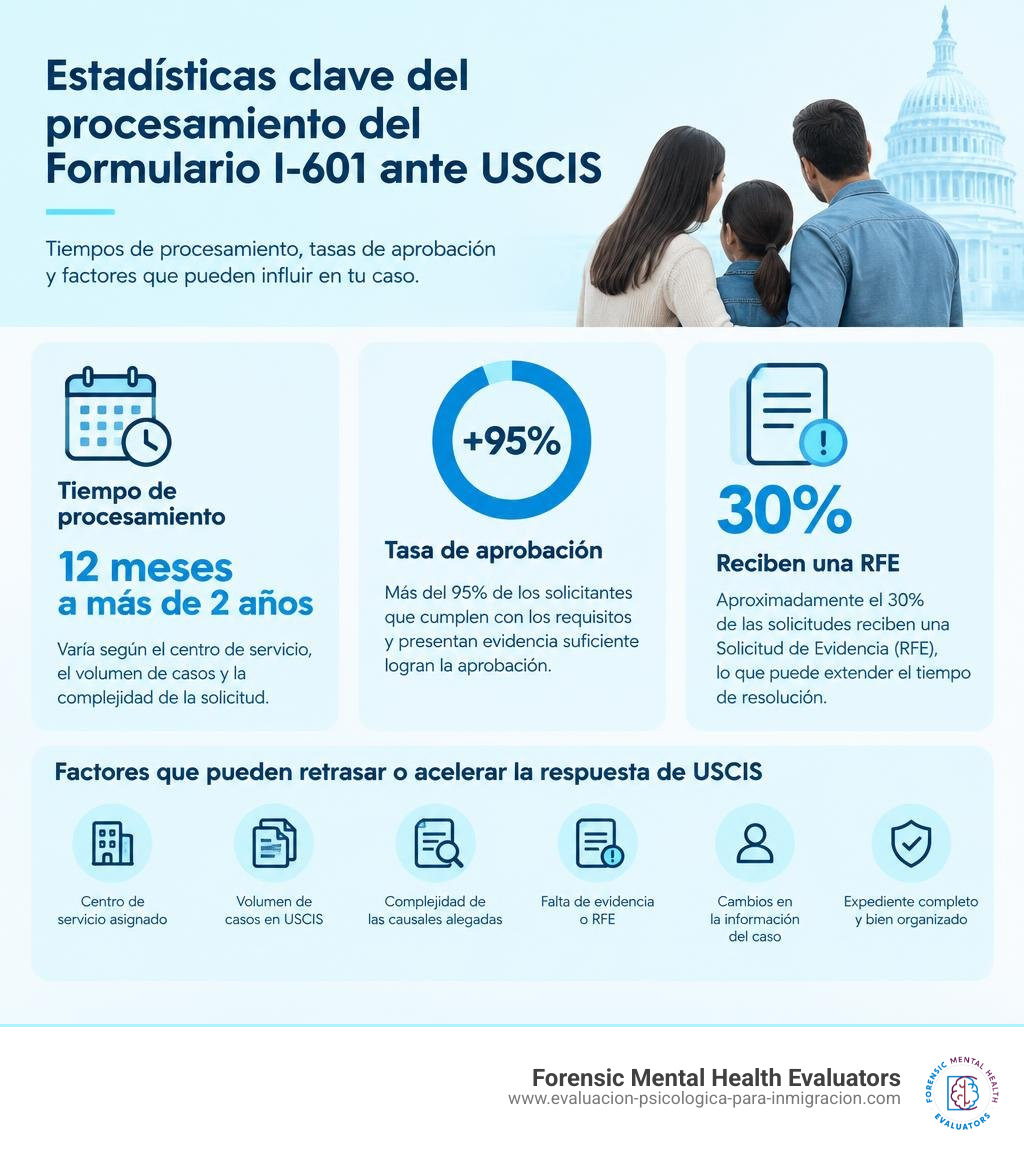
Despite extended processing times, data indicates that over 95% of applicants who satisfy statutory criteria and present robust evidence receive an approval. However, roughly 30% of petitions receive a Request for Evidence (RFE), adding weeks or months to the total adjudication timeline.
Factors That Delay or Expedite USCIS Processing
Several factors directly influence adjudication timelines:
- Delay Factors: Incomplete forms, vague or unquantified hardship evidence, missing certified translations, unresolved criminal records, or slow responses to official agency correspondence.
- Expedited Processing: USCIS grants expedited processing only under strict criteria, such as severe medical emergencies threatening the life of the qualifying relative, catastrophic financial loss to a company or individual, or critical humanitarian reasons.
How to Respond Effectively to a Request for Evidence (RFE)
Receiving an RFE does not mean your waiver is denied; it indicates that the adjudicating officer needs supplemental documentation to determine statutory eligibility.
- Monitor Deadlines: USCIS enforces strict, non-extendable response windows (typically between 30 and 87 days). Missing the deadline triggers an automatic denial.
- Address Every Point: If USCIS questions financial dependency or psychological distress, submit targeted supplemental evidence, such as updated clinical reports, recent medical assessments, or bank records.
- Ensure Consistency: All supplemental documentation must align seamlessly with the facts and narratives presented in the initial filing.
Step 5: Post-Decision Steps and Appeal Options
Receiving an official decision notice from USCIS represents a pivotal milestone in the applicant's immigration journey.
Consular Processing After Waiver Approval
When USCIS approves Form I-601, the specified ground of inadmissibility is officially waived. However, approval does not automatically grant a green card. Next steps depend on the procedural route:
- Consular Processing: USCIS notifies the National Visa Center (NVC) or the respective U.S. embassy or consulate. The consular post reopens the immigrant visa application, requests updated medical exam results if expired, collects valid passports, and issues the immigrant visa. Once admitted to the U.S. by CBP, the applicant pays the USCIS Immigrant Fee to receive their permanent resident card.
- Adjustment of Status: For applicants filing within the United States, USCIS moves forward with final adjudication of Form I-485 to grant lawful permanent residence and mail the physical green card.
Legal Remedies and Appeals Following a Denial
If USCIS denies the I-601 waiver application, timely legal remedies are available:
- Form I-290B: Applicants can appeal the unfavorable decision to the Administrative Appeals Office (AAO) or file a Motion to Reopen or Reconsider within 30 days of the decision date (33 days if served by mail).
- Refiling the Waiver: When family circumstances have changed substantially (such as the onset of a new severe health condition), refiling a fresh Form I-601 with a newly restructured clinical and documentary package is often more effective than an administrative appeal.
Frequently Asked Questions About I-601 Waivers
Can a U.S. citizen child qualify a parent for an I-601 waiver?
Under immigration law, U.S. citizen or permanent resident children do not serve as direct qualifying relatives for unlawful presence waivers. Only a spouse or parent with legal status qualifies. However, hardship to children can be evaluated indirectly if their suffering causes severe emotional, physical, or financial hardship to the qualifying parent or spouse. Certain fraud waiver exceptions permit child qualification, making an individualized legal consultation vital.
Can I work or travel while waiting for a USCIS decision?
Filing Form I-601 does not grant temporary lawful immigration status or automatic employment authorization. If an applicant is inside the United States undergoing adjustment of status, employment eligibility depends on an approved Form I-765 associated with Form I-485. Traveling internationally without advance parole can lead to case abandonment and trigger severe inadmissibility bars.
Is it mandatory to hire an immigration attorney for an I-601 waiver?
While not legally mandated, working with an experienced immigration attorney is strongly advised. Form I-601 involves high discretionary thresholds and complex legal standards. Mistakes in framing inadmissibility grounds or presenting weak extreme hardship documentation can result in years of delays or irreversible denials.
Conclusion
Securing approval for an immigration waiver requires transforming a complex personal journey into a clear, legally sound, and clinically supported petition. Waiver success depends on objectively demonstrating extreme hardship to USCIS adjudicators.
At District Counseling, we specialize in comprehensive forensic psychological evaluations for immigration cases throughout Texas (including Houston, Katy, Cypress, Sugar Land, Dallas, Austin, and San Antonio), as well as through secure telehealth services in Florida, California, New York, Utah, Virginia, and Idaho. Our commitment extends beyond the written report: we provide evaluations in Spanish translated into English, prioritize client comfort, and offer 6 free therapy sessions post-report to support your family's ongoing emotional health.
If you or your legal representative need to schedule an evidence-based clinical evaluation, explore our servicios profesionales de evaluación psicológica para inmigración and take the next step toward securing stability and legal protection for your loved ones.