
All About Immigration Evaluation Services in Houston
Why an Immigration Evaluation in Houston Could Determine Your Family's Future

If you are facing deportation or applying for a visa waiver, getting an immigration evaluation in Houston from a licensed mental health professional could be one of the most important steps you take.
Here is a quick summary of what you need to know:
- What it is: A clinical psychological assessment that documents trauma, hardship, or mental health impact for your immigration case
- Who needs it: People applying for hardship waivers, VAWA, U-Visa, T-Visa, asylum, or cancellation of removal
- Who conducts it: Licensed psychologists, LPCs, or LCSWs with specialized forensic immigration training
- How long it takes: Clinical interview of 1.5–3 hours; written report typically ready within 5–7 business days
- Cost range: Approximately $650 for a standard English evaluation, up to $1,500–$3,000 for complex cases
- Available via telehealth: Yes, for clients physically located anywhere in Texas
The stakes are high. Research shows that asylum seekers who received professional clinical evaluations won their cases at a rate of 89%, compared to just 37.5% for those who did not — according to data from Physicians for Human Rights. A well-prepared evaluation does not just document symptoms. It tells your story in a way that immigration courts and USCIS can act on.
I'm Francisco Ortiz, Lead Forensic Mental Health Evaluator at District Counseling PLLC, a Certified Forensic Mental Health Evaluator (CFMHE) licensed in Texas and five other states, with specialized training in hardship waiver, asylum, and U-Visa/T-Visa evaluations — the exact case types most Houston families need when facing removal. I have worked directly with Spanish-speaking immigrant communities and understand both the cultural and legal dimensions of an immigration evaluation in Houston from the inside out.
What is an Immigration Psychological Evaluation and Why is it Crucial?
An immigration psychological evaluation is a highly specialized forensic mental health assessment designed specifically for use in legal immigration proceedings. Unlike traditional clinical therapy, which focuses primarily on ongoing treatment and healing, a forensic evaluation is an objective, evidence-based investigation. It connects a client’s mental health status, trauma history, and emotional vulnerability directly to the legal criteria required by United States Citizenship and Immigration Services (USCIS) and the Executive Office for Immigration Review (EOIR).
In our work across Texas cities like Houston, Katy, Cypress, and Sugar Land, we often see how the immigration system can feel like an impersonal machine of forms and deadlines. A comprehensive Texas Immigration Psych Evaluation serves to bridge this gap. It humanizes your legal case, translating your deeply personal experiences into a structured, professional clinical report that judges and immigration officers can easily interpret.
When an individual applies for legal status, they are frequently asked to prove subjective experiences—such as "extreme hardship" or "credible fear." A licensed mental health clinician uses standardized diagnostic tools, clinical interviews, and psychosocial history to provide objective evidence of these experiences. This includes documenting:
- The psychological impact of past physical or emotional trauma.
- The potential cognitive and emotional regression of children if a parent is deported.
- The presence of clinical conditions like Post-Traumatic Stress Disorder (PTSD), Major Depressive Disorder, or generalized anxiety.
These evaluations address credibility challenges. In complex immigration proceedings, an official clinical report provides a standardized framework that supports the applicant’s testimony, making it significantly harder for adjudicators to dismiss their claims.
The Impact of Forensic Evidence on Case Outcomes
The presence of a forensic mental health evaluation can be the deciding factor between a approved petition and a devastating denial. The legal system relies heavily on documented, expert proof. While an applicant’s personal testimony is vital, it can sometimes be perceived as self-serving or fragmented due to the very nature of trauma, which frequently impairs memory and narrative consistency.
Consider the compelling data compiled by Physicians for Human Rights (PHR). Between 2000 and 2004, 89% of asylum seekers who received professional medical and psychological evaluations won their cases. In stark contrast, the national average win rate for asylum seekers who did not receive these clinical evaluations was only 37.5%. This dramatic statistical difference highlights how clinical documentation directly influences legal outcomes.
A thorough report from a Texas Asylum Psychological Services provider translates silent suffering into legally recognized clinical findings. It explains why an applicant might struggle to remember dates or why they exhibit hypervigilance during a hearing. By establishing these clinical connections, forensic evaluators give immigration attorneys the robust scientific backing they need to build an unassailable legal strategy.
Key Case Types That Benefit from an Immigration Evaluation
Every immigration journey is unique, and the legal pathways reflect this diversity. Forensic mental health evaluations are tailored to meet the specific legal standards of several different petition types. Whether you are trying to keep your family together or seeking refuge from violence, a detailed assessment is crucial. For a broader look at how these assessments support various pathways, you can consult our Immigration Evaluations Complete Guide 2026.
Below, we break down the primary case types that benefit most from a clinical evaluation.
Hardship Waivers and VAWA Petitions
Extreme Hardship Waivers (such as Form I-601 and Form I-601A) require applicants to demonstrate that the deportation of a non-citizen family member would result in "extreme and unusual" hardship to a qualifying U.S. citizen or lawful permanent resident relative (such as a spouse, parent, or child). This is not just about the financial strain of separation; it focuses heavily on the psychological devastation.
During an evaluation conducted by a Texas Immigration Psychological Expert, we assess how the qualifying relative would cope. We look at:
- Separation Hardship: The severe depression, anxiety, and trauma a spouse or child would suffer if forced to live apart from their loved one.
- Relocation Hardship: The psychological, medical, and educational challenges the U.S. citizen relative would face if they were forced to relocate to the applicant’s home country—a country they may not know, where they might face safety risks or lack access to necessary medical care.
For survivors of domestic violence, the Violence Against Women Act (VAWA) (Form I-360) allows abused spouses, children, or parents of U.S. citizens or permanent residents to petition for legal status independently. A VAWA evaluation focuses heavily on documenting the psychological abuse, coercive control, and physical trauma suffered by the petitioner. It is common for survivors to feel immense guilt or shame, which can make explaining their situation to a legal authority incredibly difficult. A compassionate, clinical setting allows them to share their story safely, resulting in a detailed report that clearly outlines the presence of abuse-related trauma and PTSD.
Asylum, U-Visa, and T-Visa Cases
Asylum cases (Form I-589) are designed for individuals who have fled persecution in their home countries based on race, religion, nationality, political opinion, or membership in a particular social group. An asylum evaluation is critical because it documents the deep psychological scars left by persecution. The evaluator carefully assesses symptoms of trauma, fear of returning, and the long-term mental health consequences of the abuse the applicant survived.
Similarly, humanitarian visas exist to protect victims of crimes and human trafficking within the United States:
- U-Visas (Form I-918): Designed for victims of mental or physical abuse who have suffered substantial harm due to criminal activity (such as domestic violence, sexual assault, or felonious assault) and are helpful to law enforcement. A Dallas U Visa Mental Evaluation Clinical Consultation or a Houston-based consultation focuses on documenting the severe physical and emotional toll the crime took on the victim.
- T-Visas (Form I-914): Created specifically for survivors of severe forms of human trafficking. The evaluation details the extreme trauma, coercion, and psychological manipulation used by traffickers, establishing the profound impact of the exploitation.
What to Expect During Your Immigration Evaluation Houston Process
We understand that undergoing a psychological evaluation can feel intimidating, especially when your future in the United States hangs in the balance. Our goal is to make the process of getting an immigration evaluation in Houston as transparent, comfortable, and stress-free as possible.
To help you prepare, we recommend reviewing our Immigration Evaluation Guide 2026, which outlines the clinical expectations in detail.
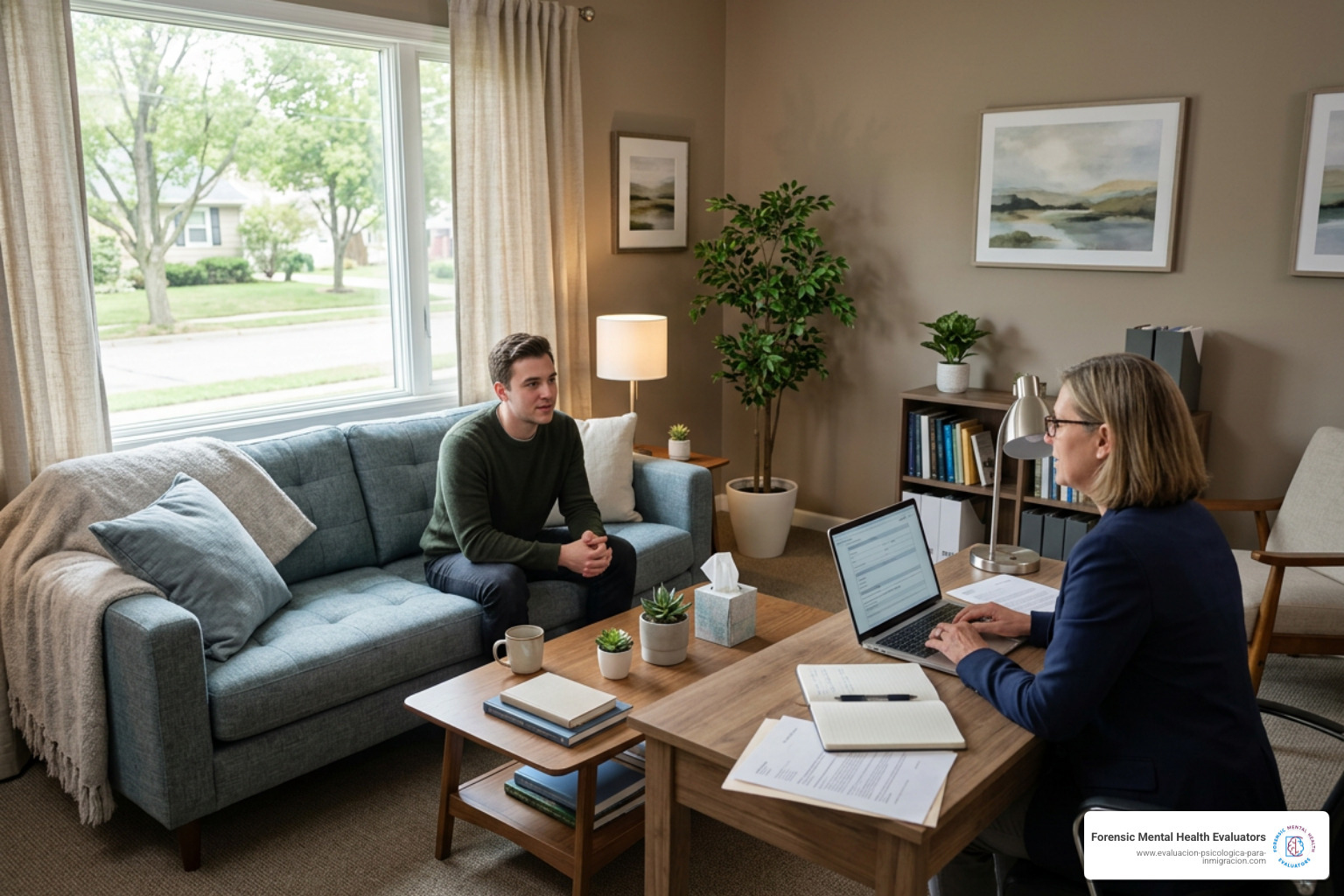
During the assessment, you will participate in a structured clinical interview. This is not an interrogation; it is a warm, supportive conversation where we discuss your personal history, family background, current living situation, and any symptoms of distress you may be experiencing. We also utilize standardized, evidence-based psychological questionnaires to screen for clinical conditions like depression, anxiety, and PTSD. These tools ensure your report is grounded in objective, scientific DSM-5 diagnostic criteria.
Step-by-Step Timeline and Turnaround Times
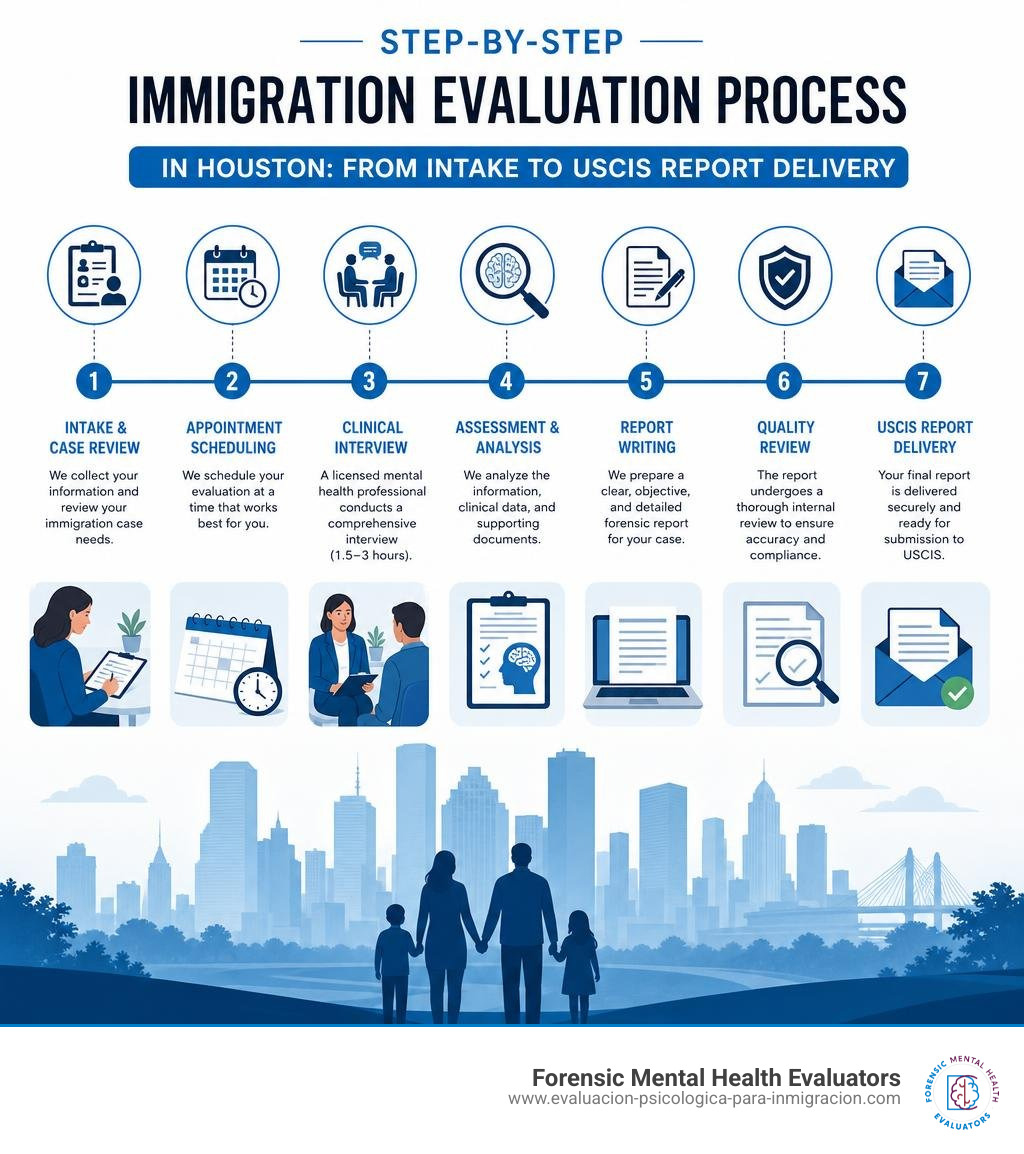
To help you visualize how your case progresses from the initial call to the final document, here is the typical timeline:

- Initial Consultation: We discuss your specific legal case and coordinate with your attorney to understand the exact referral questions.
- Clinical Assessment: You will complete one or two clinical interview sessions (typically lasting 1.5 to 3 hours total) and any necessary clinical questionnaires.
- Drafting & Review: We write a comprehensive, 12-to-20-page clinical report detailing your psychosocial history, diagnostic impressions, and treatment recommendations.
- Final Delivery: You and your attorney receive the finalized, USCIS-ready report. This standard process usually takes 5 to 7 business days after your final interview. If you have an urgent court date or a tight USCIS deadline, we also offer expedited turnaround options (including 24-to-48-hour rush reports). You can view what a completed report looks like by checking out an Immigration Psychological Evaluation Sample.
Cost and Telehealth Options for Texas Residents
We believe that high-quality, professional forensic evaluations should be both accessible and affordable. A standard clinical evaluation in English typically starts around $650, while more complex cases requiring multi-session assessments or detailed translation services can range from $1,500 to $3,000.
For individuals living in Houston, Katy, Cypress, Sugar Land, or anywhere else in the state of Texas, we offer both in-person appointments and secure, HIPAA-compliant telehealth sessions. Telehealth allows you to complete your evaluation from the comfort and privacy of your own home, removing the stress of traveling to an office, taking extensive time off work, or arranging childcare.
If you are looking specifically for bilingual services, our Austin Spanish Immigration Evaluation page highlights our ability to serve Spanish-speaking clients seamlessly across the entire state of Texas.
Finding a Qualified Clinician for Your Case
Choosing the right professional to conduct your evaluation is a critical decision. Not all therapists or counselors are qualified to write reports for legal proceedings. A poorly written, brief, or generic report can easily be dismissed by USCIS or an immigration judge, wasting your time and money.
It is also important to distinguish a psychological evaluation from a medical exam. If you require a physical health screening, vaccination verification, or disease screening for your green card adjustment of status, you will need to visit a USCIS-designated civil surgeon for an Immigration Physicals Houston Heights. However, if your attorney has advised you to document your mental health, trauma, or the emotional impact of family separation, you need a licensed mental health professional.
Finding a Qualified Clinician for Your Immigration Evaluation Houston
When searching for a clinician to handle your immigration evaluation in Houston, you must ensure they hold the proper state licenses and specialized training. Qualified professionals include:
- Licensed Psychologists (PhD/PsyD)
- Licensed Professional Counselors (LPCs)
- Licensed Clinical Social Workers (LCSWs)
To see how we structure our clinical assessments to meet these rigorous standards, you can read more about a Dallas Psychological Immigration Assessment.
Always verify that your evaluator has experience in forensic mental health and a deep understanding of USCIS legal standards. A strong evaluator knows how to collaborate closely with your immigration attorney, ensuring the clinical report directly addresses the legal questions central to your waiver or petition.
For families in Fort Bend County, Houston, and surrounding areas, finding a local evaluator who understands the specific needs of your community is essential. Whether you are located in Richmond, Katy, or Sugar Land, our team is equipped to provide the comprehensive, legally rigorous assessments required for your case. We also offer telehealth services to ensure that no matter where you are in Texas, you have access to expert forensic mental health evaluations.
Cultural Sensitivity and Language Accessibility
A successful forensic evaluation requires a deep level of trust and emotional safety. Many applicants have survived severe trauma, domestic abuse, or political persecution, making it incredibly difficult to open up to a stranger.
We pride ourselves on providing a highly compassionate, trauma-informed environment. For our Spanish-speaking clients, we offer evaluations conducted directly in Spanish and professionally translated to English. This ensures that none of the clinical nuances, emotional expressions, or details of your story are lost in translation.
Furthermore, we recognize that reliving your trauma during a clinical interview can be emotionally exhausting. To support your ongoing healing, we provide 6 free therapy sessions post-report to help you process your experiences and find a path forward in a safe, supportive space.
Frequently Asked Questions about Houston Evaluations
What is the Typical Cost of an Immigration Evaluation Houston?
A standard clinical evaluation in English is typically around $650. For highly complex cases, multi-session family hardship assessments, or evaluations requiring professional translation and certified forensic formatting, the cost can range between $1,500 and $3,000. We believe in transparent pricing with no hidden fees, and we work to provide flexible payment options to accommodate our clients' budgets.
Can my immigration evaluation be conducted online via telehealth?
Yes! Under Texas regulations, licensed mental health professionals can legally conduct clinical evaluations via secure, HIPAA-compliant video telehealth platforms. As long as you are physically located within the state of Texas (such as in Houston, Katy, Cypress, or Sugar Land) at the time of your appointment, you can complete your entire evaluation from the comfort of your home.
How long does it take to receive the final clinical report?
Our standard turnaround time to deliver a completed, USCIS-ready clinical report is 5 to 7 business days after your final interview session. For urgent legal situations, immigration court deadlines, or rapid response requests, we offer expedited rush services to ensure your attorney receives the document exactly when they need it.
Conclusion
Navigating the immigration system is one of the most stressful journeys a family can undertake. A professional, legally rigorous psychological evaluation is often the missing piece that humanizes your legal petition, provides objective clinical proof of your hardships, and gives you the best possible chance of a favorable outcome.
At District Counseling, we are proud to stand alongside immigrant communities in Houston, Katy, Cypress, Sugar Land, and throughout Texas. We combine clinical expertise with deep compassion, offering native Spanish evaluations translated to English, a warm and welcoming environment, and 6 free therapy sessions post-report to ensure your mental well-being is cared for long after your legal documents are filed.
Don't leave your family's future to chance. Schedule your immigration evaluation today and let us help you tell your story with the dignity, clarity, and legal strength it deserves.