
Grab the Current Form I-589 PDF to Protect Your Asylum Claim
How to Download and Prepare the Current I-589 Form PDF

Filing for asylum requires precision right from the start. Securing the official document is the bedrock of your petition. Submitting an expired edition can result in immediate rejection by immigration authorities, which costs valuable time against strict filing deadlines.
You should always obtain the direct Form I-589, Application for Asylum and for Withholding of Removal directly from official sources to ensure you have the edition dated 07/28/26 with the active OMB control number. Although digital tools make it tempting to look for an online submission button, USCIS mandates physical paper filings for Form I-589.
If you reside in Texas—whether in Houston, Dallas, Austin, or San Antonio—or other covered jurisdictions like Florida, California, New York, Utah, Virginia, or Idaho, you must send your completed paper packet to the designated USCIS lockbox. For example, Texas residents sending standard mail typically submit to the USCIS Dallas Lockbox (P.O. Box 653080, Dallas, TX 75265-3080), while courier deliveries (FedEx, UPS, DHL) route to 2501 S. State Highway 121 Business, Suite 400, Lewisville, TX 75067-8000. Always verify your specific state's lockbox destination using the USCIS tool prior to mailing.
Where to Obtain the Official I-589 Form PDF and Instructions
When preparing your submission, you also need to download the official instructions for Form I-589. USCIS provides reference copies of the form instructions in 12 languages—including Spanish, Arabic, French, Haitian Creole, Russian, and Vietnamese. However, these translations serve only as comprehension guides; your final submitted application must be completed entirely in English.
You can use standard PDF reader software to type your responses directly into the form fields, which minimizes legibility errors. If completing the document by hand, you must write clearly using black ink. Make sure to save local copies of your completed PDF to avoid losing detailed statements.
Eligibility Criteria and One-Year Filing Deadline Rules
To apply for asylum, you must satisfy fundamental legal thresholds established under immigration law:
- Physical Presence: You must be physically present in the United States and not be a U.S. citizen.
- Protected Grounds: You must demonstrate that you have suffered persecution or possess a well-founded fear of future persecution based on race, religion, nationality, membership in a particular social group, or political opinion.
- The One-Year Deadline: Under section 208(a)(2)(B) of the Immigration and Nationality Act (INA), you must submit Form I-589 within one year of your most recent arrival in the United States.
Failing to meet the one-year arrival deadline presents a major barrier, but two statutory exceptions exist under INA § 208(a)(2)(D):
- Changed Circumstances: Material changes in conditions within your country of origin, or changes in your personal circumstances that create a new basis for fear.
- Extraordinary Circumstances: Severe events directly related to the delay in filing, such as serious physical illness, severe mental health conditions, incapacitation, or legal disability.
Documenting severe psychological trauma, such as Post-Traumatic Stress Disorder (PTSD) or severe depression stemming from past harm, can provide objective evidence of extraordinary circumstances when explaining why an application could not be submitted within the initial 12 months.
Determining Your Filing Track: USCIS vs. EOIR Immigration Court
Where you file your completed paperwork depends on whether you are seeking affirmative protection or defending against removal.
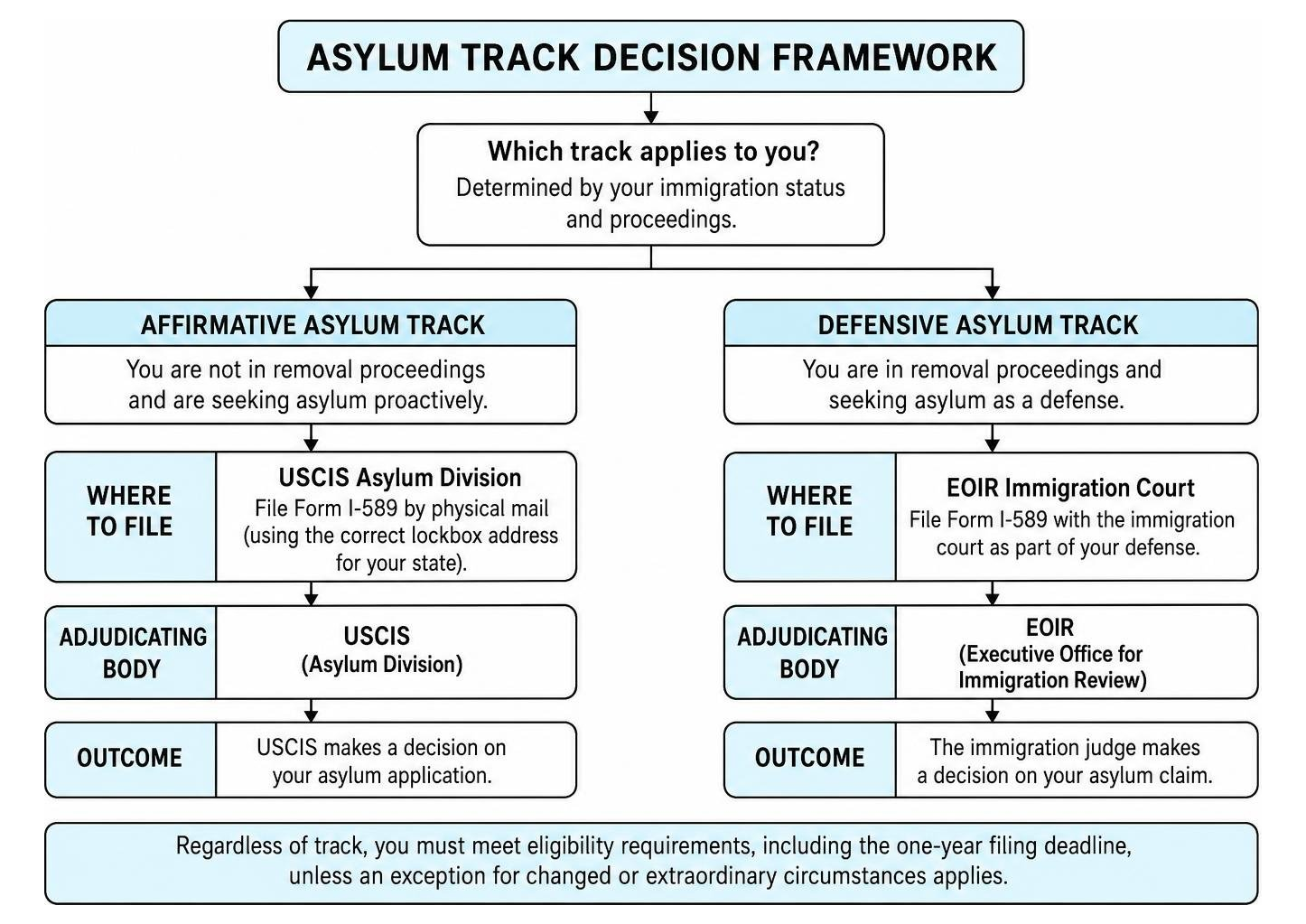
Here is how the two pathways compare:
| Feature | Affirmative Asylum Track | Defensive Asylum Track |
|---|---|---|
| Adjudicating Body | USCIS (Asylum Division) | EOIR (Executive Office for Immigration Review) |
| Applicant Status | Not in formal removal proceedings | Placed in removal proceedings (issued a Notice to Appear) |
| Submission Destination | Appropriate USCIS Lockbox | Assigned Immigration Court handling the case |
| Interview/Hearing Format | Non-adversarial interview with an Asylum Officer | Formal, adversarial evidentiary hearing before an Immigration Judge |
| Outcome if Denied | Referred to Immigration Court (if out of legal status) | Order of removal (subject to BIA appeal) |
If you are an Unaccompanied Alien Child (UAC), special statutory rules generally allow you to file affirmatively with the USCIS Asylum Intake Unit even if an immigration court proceeding is pending.
Step-by-Step Instructions: Completing the Application

Completing the paperwork requires accuracy, internal consistency, and transparent reporting. Blank fields where answers are expected can prompt USCIS lockbox staff to reject the petition outright.
Always write "N/A" (not applicable) or "None" if a question does not apply to your background rather than leaving the field empty. The primary applicant must verify that critical identification fields—such as Alien Registration Number (A-Number), Complete Last Name, Date of Birth, Country of Birth, and U.S. Residence Address—match all attached identity documentation.
Section-by-Section Guide to Completing the I-589 Form PDF
- Part A.I (Information About You): Collects your core biographical details, contact information, date of entry, current immigration status, passport details, and Native Language. Check the designated box on page 1 if you also wish to apply for withholding of removal under the Convention Against Torture (CAT).
- Part A.II (Information About Your Spouse and Children): Detailed reporting on your spouse and all biological, adopted, or stepchildren, regardless of age, marital status, or geographic location. Use Supplement A if you have more than four children.
- Part A.III (Your Background): Chronological, reverse-order listing of your past addresses, employment history, education, and details regarding parents and siblings.
- Part B (Information About Your Application): The heart of your substantive claim. This section asks whether you or your family experienced past harm, why you fear return, whether you were ever detained or arrested in your home country, and whether you participated in political or social organizations. Provide concise summaries here and reference detailed written affidavits.
- Part C (Additional Information): Inquiries covering prior asylum claims, transit through third countries, firm resettlement considerations, whether you ever caused harm to others, past criminal history in the U.S., and explanations for filings past the one-year deadline.
- Part D & Part E (Signatures & Preparer Declarations): You must physically sign Part D under penalty of perjury. If someone assisted you in filling out the form, that individual must complete and sign Part E.
- Part F & Part G: Do not sign these sections in advance; Part F is completed at your USCIS Asylum Interview, and Part G is signed during an EOIR court hearing.
Including Dependents and Adding Family Members
You may include your spouse and unmarried children under the age of 21 who are present in the United States as derivatives on your application. By checking the appropriate box in Part A.II ("Yes, include this person in my asylum application"), derivatives receive the same grant of asylum if your petition is approved.
For each included family member, attach:
- One copy of your marriage certificate (and proof of legal termination for prior marriages).
- One copy of each child's birth certificate showing parental relationships.
- Certified English translations for all non-English civil documents.
If you have additional children beyond the space provided in Part A.II, use Supplement A to list them. To add a dependent after your petition has already been mailed, you must submit an amended Form I-589 with updated civil records and an explanatory letter to the adjudicating USCIS Asylum Office or Immigration Court.
Mandatory Evidence, Fees, and Supporting Documentation
A strong asylum submission requires thorough corroborating documentation. When preparing your packet, include:
- Identity & Travel Records: Copies of passports, birth certificates, national identity cards, and Form I-94 arrival records.
- Country Condition Reports: Objective data from the U.S. Department of State Country Reports on Human Rights Practices, international human rights monitors, and recognized news outlets.
- Personal & Witness Affidavits: Detailed statements documenting specific dates, locations, and threats of persecution.
- Forensic Mental Health Evidence: When an applicant has endured persecution or fear of return, an asylum evaluation provides clinical corroboration. Detailed guides on this process, such as this asylum psychological assessment complete guide, illustrate how clinical evaluations assess trauma-related symptoms like PTSD, depression, and memory impairment. A formal psychological report can explain gaps in testimony caused by trauma and substantiate fear of return.
Fee Structure and Exemptions
There is no base filing fee to submit the core Form I-589 application. However, statutory updates introduce recurring obligations for applicants:
- Annual Asylum Fee (AAF): Under Public Law 119-21, an Annual Asylum Fee is assessed for each year an application remains pending adjudication.
- Fee Exemptions for Ms. L. Settlement Class Members: As of February 5, 2026, members of the Ms. L. v. ICE Settlement Class and Qualifying Adult Family Members (QAFMs) are exempt from paying the Asylum Application Fee (8 U.S.C. § 1802), the Annual Asylum Fee (8 U.S.C. § 1808), and related HR-1 fees. If you qualify under this settlement, write "Ms. L Settlement Class Member" prominently at the top of page 1 of your paper Form I-589.
What Happens After Submitting Form I-589?
Once you mail your complete packet to the appropriate lockbox, the procedural timeline unfolds across several milestones:
- Receipt Notice (Form I-797C): USCIS issues a formal Notice of Action confirming receipt and assigning your receipt number.
- Biometrics Appointment: You will receive an appointment notice to visit an Application Support Center (ASC) for digital fingerprinting, photography, and signature capture.
- The 180-Day Asylum Clock: Filing starts an employment authorization clock. Once your application has been pending for 150 days without applicant-caused delays, you become eligible to submit Form I-765 for an Employment Authorization Document (EAD), which can be granted once 180 days elapse.
- Interview or Court Hearing:
- Affirmative Track: You will be scheduled for a non-adversarial interview at a regional Asylum Office. You may bring an attorney, an accredited representative, and a qualified interpreter if needed.
- Defensive Track: You will attend a Master Calendar Hearing followed by an Individual Merits Hearing before an Immigration Judge, where evidence is presented and cross-examination occurs.
Consulting a structured immigration psychological evaluation guide helps ensure that any clinical documentation submitted to the adjudicator aligns with the legal requirements of your claim.
Frequently Asked Questions About Form I-589
Can I file Form I-589 online in 2026?
No. USCIS strictly mandates paper submissions for Form I-589. Attempting to upload or submit this form through an online portal will result in rejection. You must print, sign, and mail the physical document packet to the designated USCIS lockbox or file it directly with the appropriate Immigration Court.
What fees apply to Form I-589, and who is exempt?
While there is no initial submission fee for the form, the Annual Asylum Fee (AAF) established under Public Law 119-21 applies annually while the application is pending. Members of the Ms. L. v. ICE Settlement Class and QAFMs are legally exempt from both the initial and annual asylum fees. Eligible class members should mark their status on the top of the form.
What happens if I miss the one-year filing deadline?
If you file past the one-year window, you must establish an extraordinary circumstance or changed country condition in Part C (Question 5) of the form. If you cannot meet an exception, you may still remain eligible for Withholding of Removal under INA § 241(b)(3) or relief under the Convention Against Torture, both of which are requested through the same I-589 application.
Conclusion
Successfully filing an asylum claim requires strict adherence to procedural guidelines, the use of the latest form edition (07/28/26), and thorough corroborating evidence.
District Counseling provides forensic psychological evaluations for immigration matters across Texas—including Houston, Austin, Dallas, San Antonio, Katy, Cypress, and Sugar Land—as well as throughout Florida, California, New York, Utah, Virginia, and Idaho. We offer culturally sensitive Spanish-language evaluations translated into English and provide six free therapy sessions post-report to support client well-being.
To discuss clinical documentation or schedule an assessment to support an asylum petition, visit Forensic Mental Health Evaluators to connect with our evaluation team.